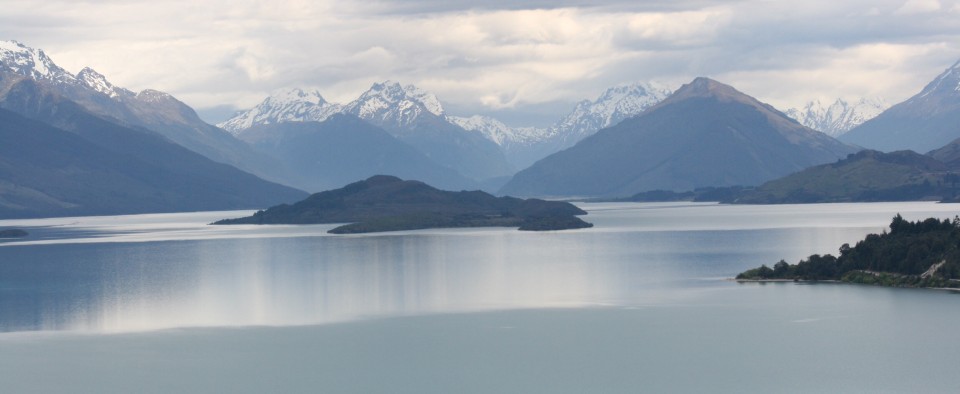
Family Trip to Iceland – September 2024

Tags

, , ,

We had so much fun traveling together in Ireland last year that George Jr decided to take us all to Iceland this year. He wanted to do it before mom and dad got too old! It was very generous of him to book our tickets, rent the car, establish a reasonable itinerary and act as chauffeur and guide.

We flew out of Hamilton via Play airlines. For some of us that was our first experience flying out of the small Hamilton airport. How nice to be able to unload easily on arrival, check in quickly and not experience any wait through security. The service on Play was fine and staff were quite friendly, other than one attendant who wore a very powerful perfume. For those of us who are scent-sensitive, it was an unpleasant experience each time she passed by.

We left Hamilton at 7 p.m. and arrived in Iceland at 4 a.m., a bit tired but ready to start our next adventure. It took about two hours at the airport since the car rental booth didn’t open until 5:30. We chose to have a small breakfast at one of the bakeries while waiting. It was cool and rainy when we left the terminal, and there was a bit of a walk to where our car was parked. Welcome to Iceland!
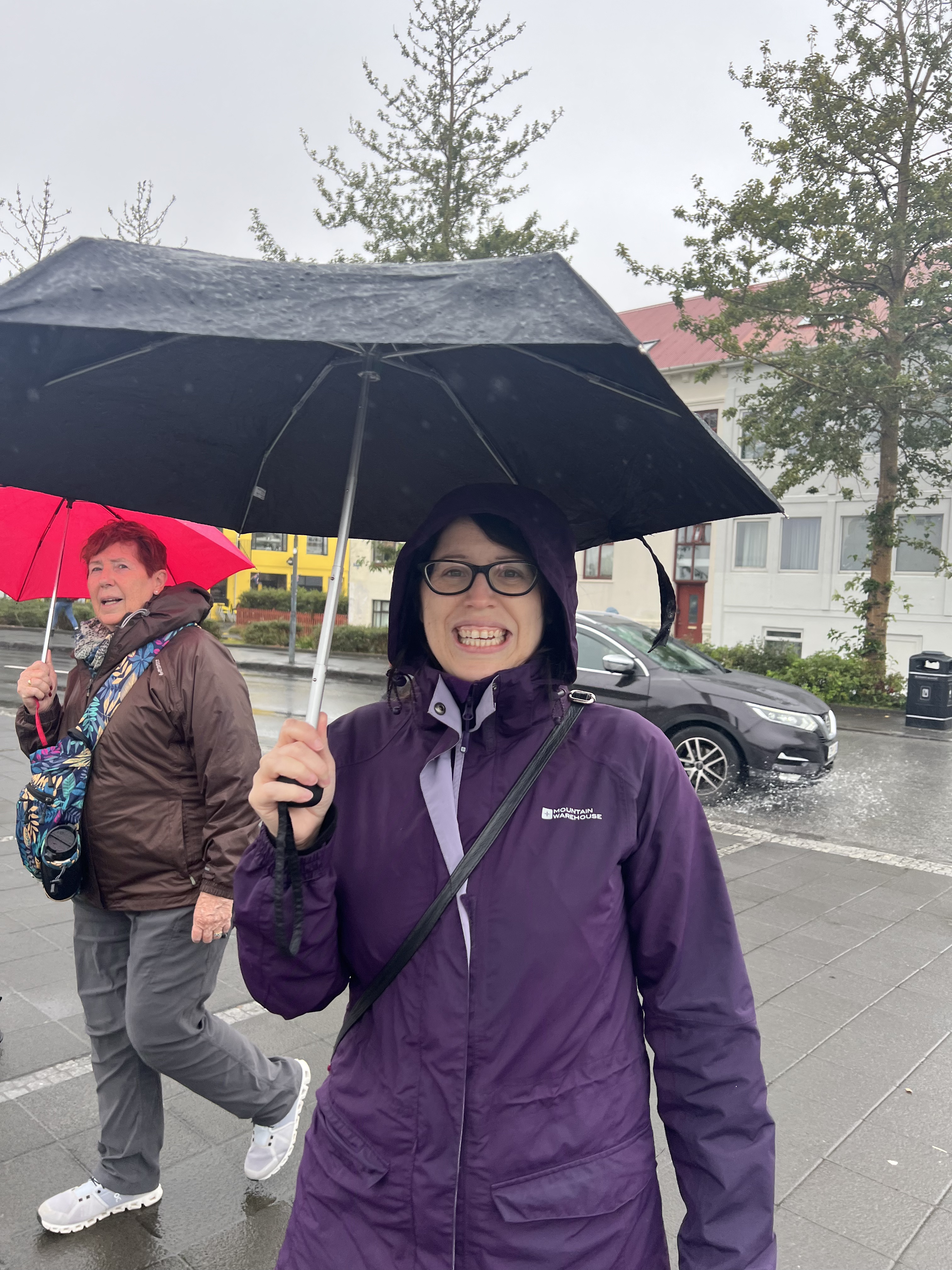
Welcome to Iceland

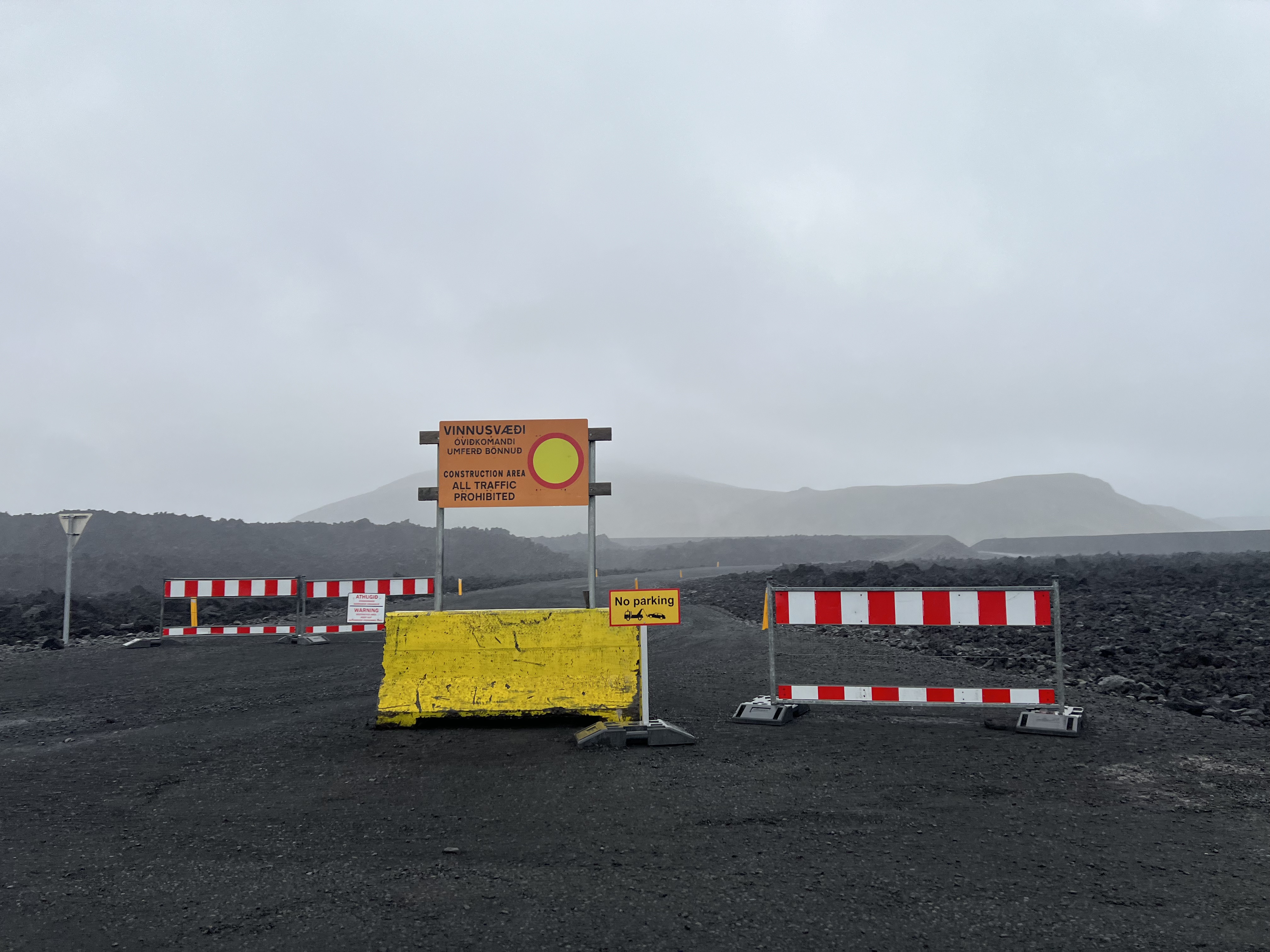
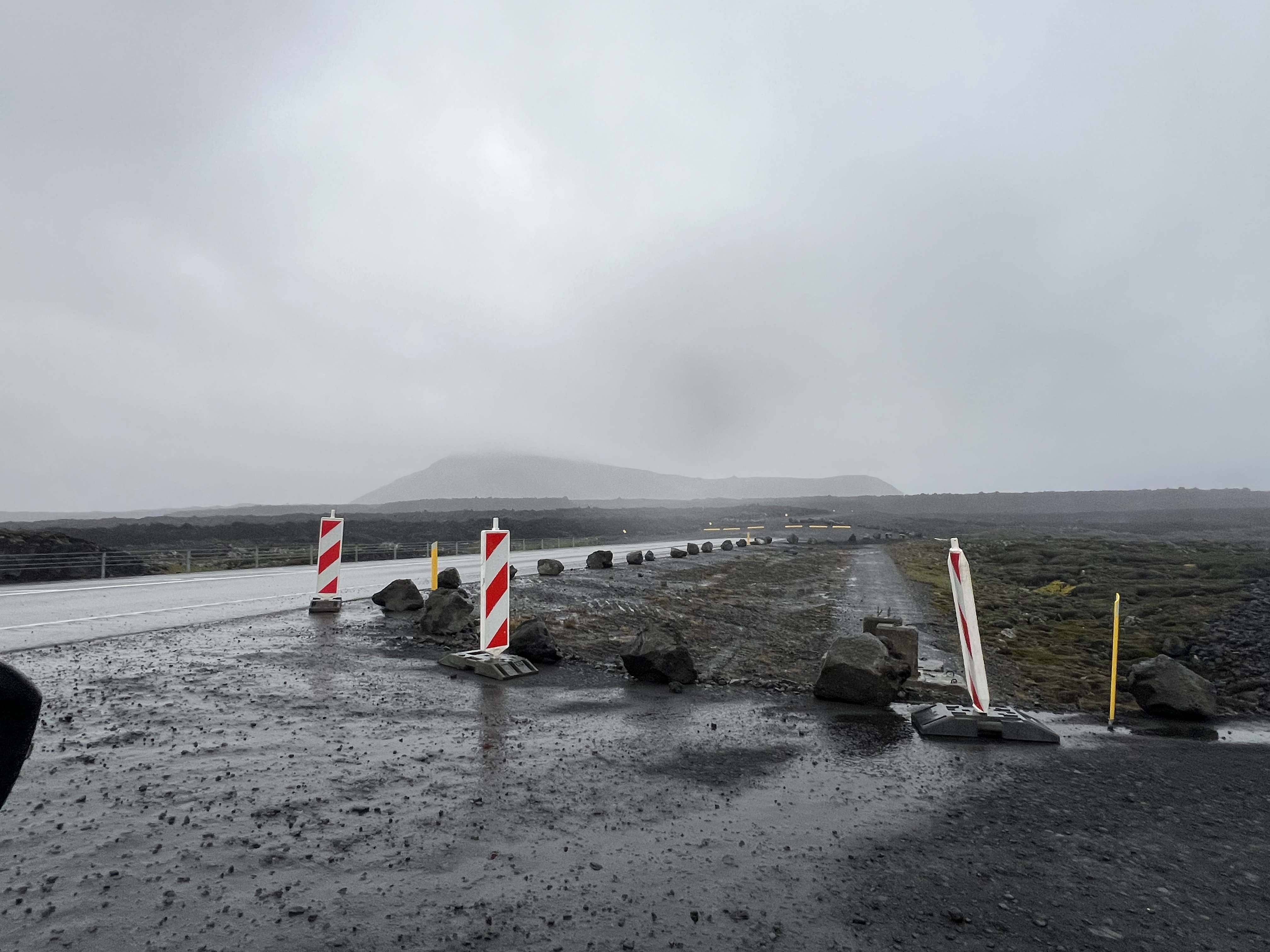
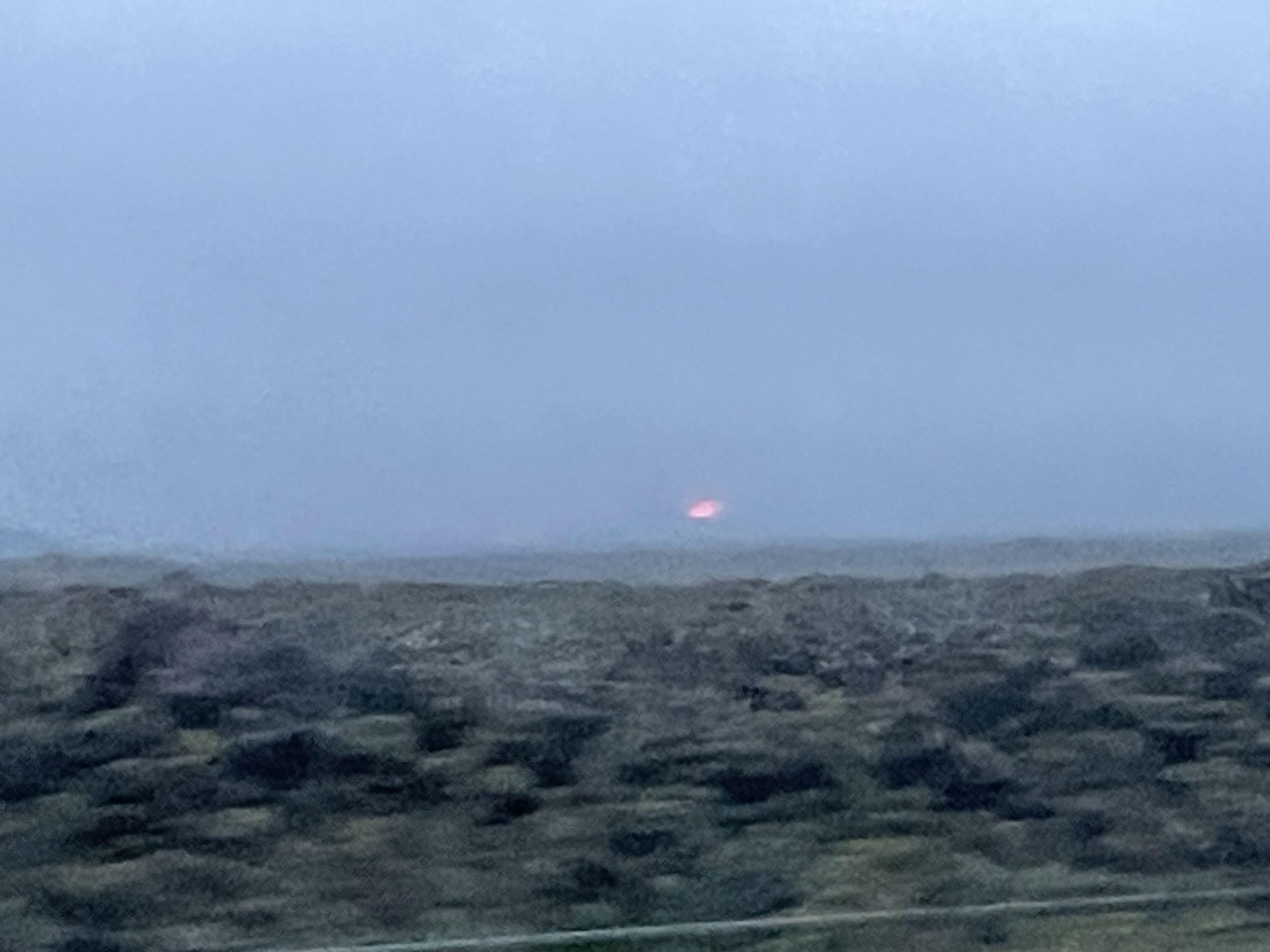
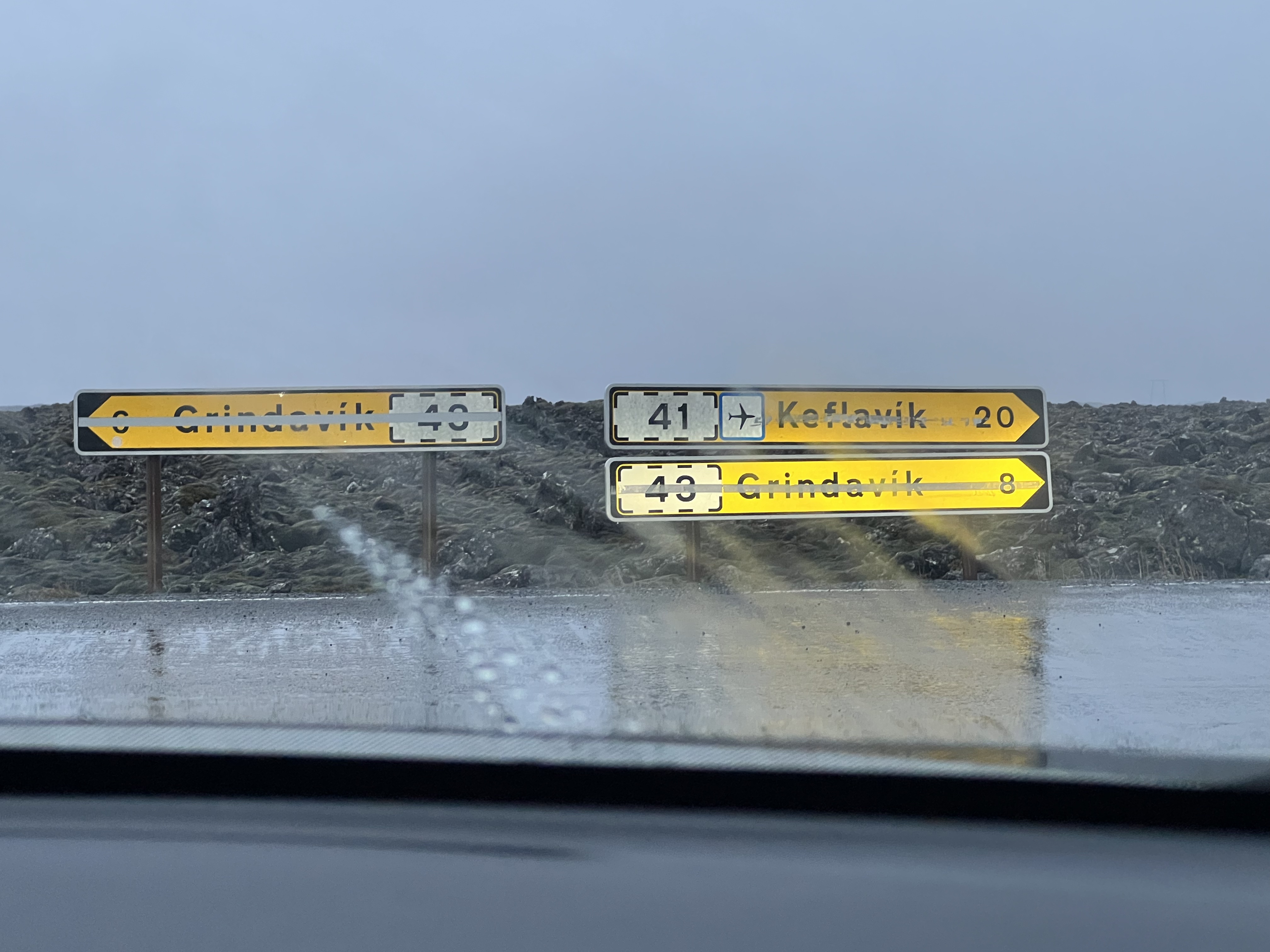
Day 1 – Given that we couldn’t check in to our hotel until after lunch and nothing was open yet, George took us on a little ride out by the Blue Lagoon. This is in the area where the Sundhnuksgigar eruption began on August 22nd, closing the town of Grindavik. We were able to see the volcano from a distance on the way out but it had disappeared completely by the time we returned from our drive. George was quite amazed at how the traffic pattern had changed since his last trip, because the lava had overflowed the road.
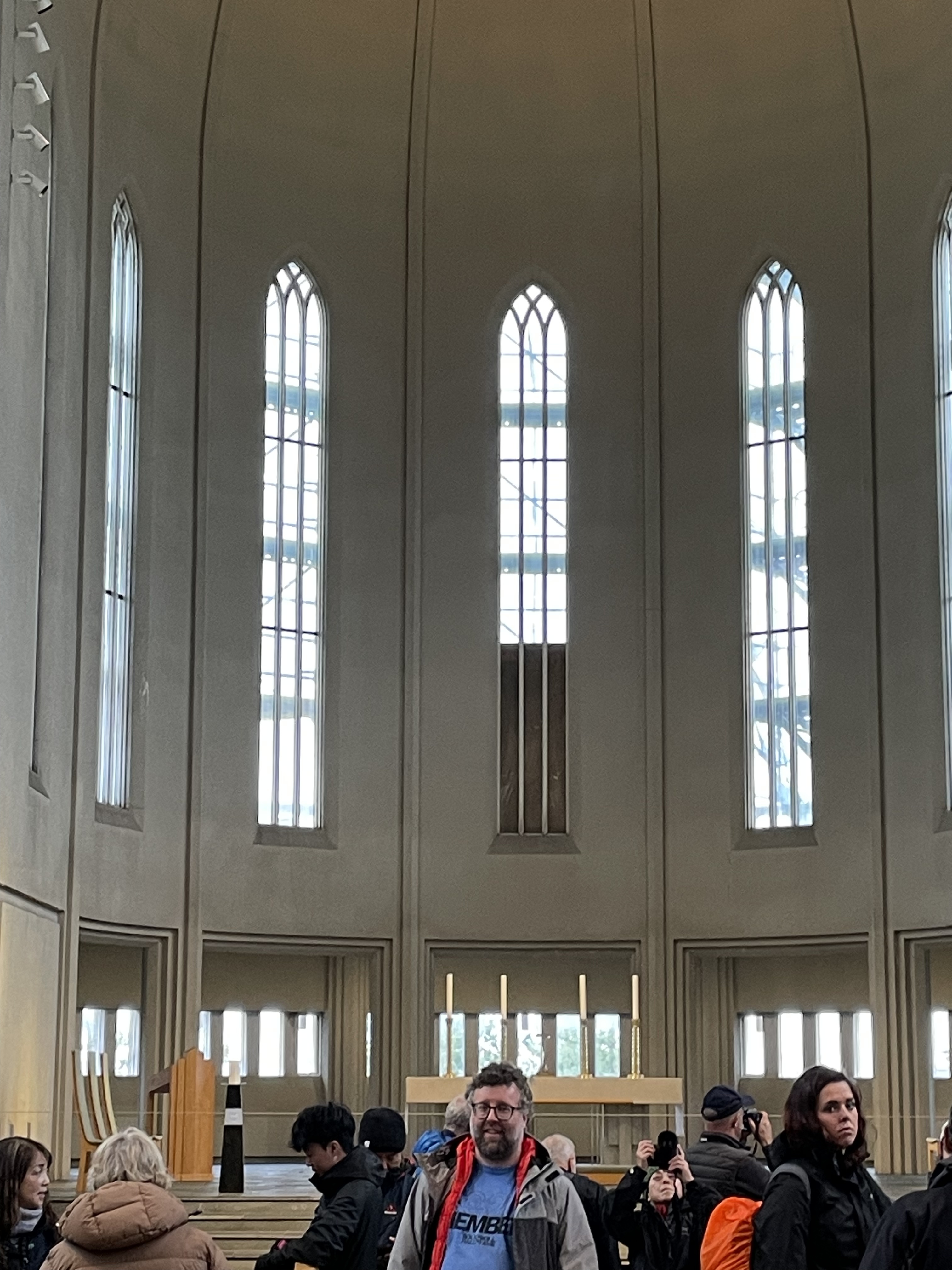
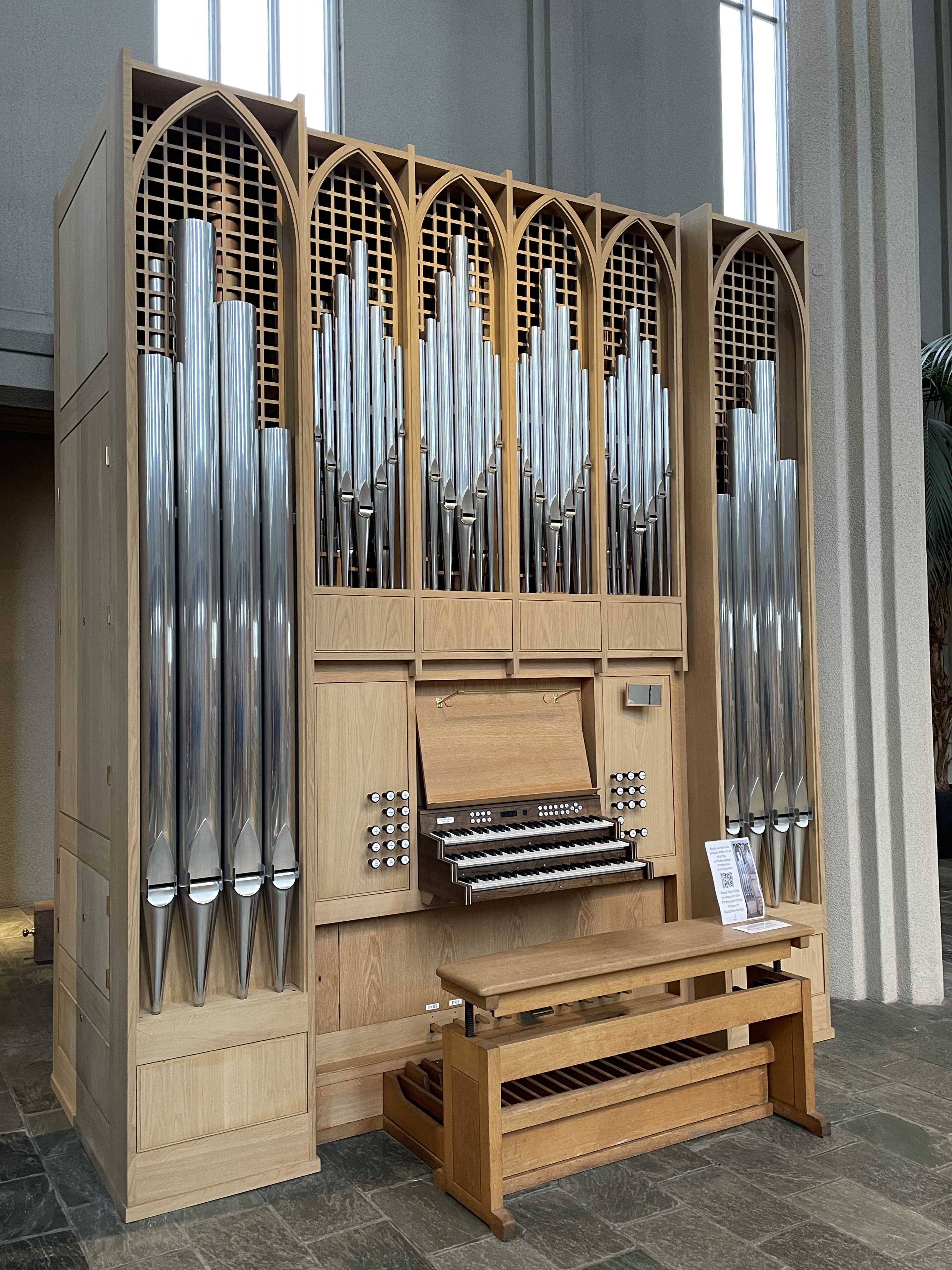
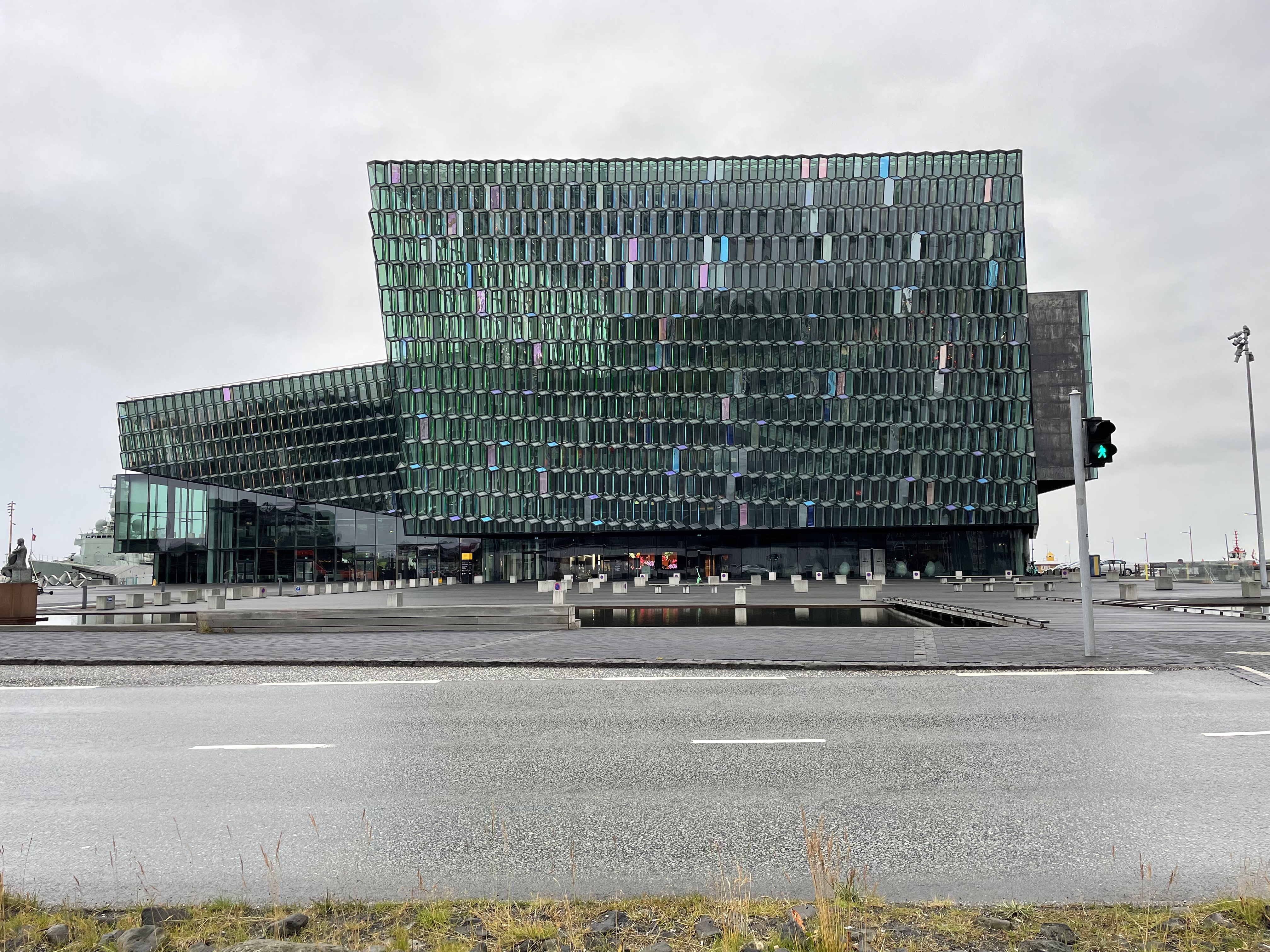
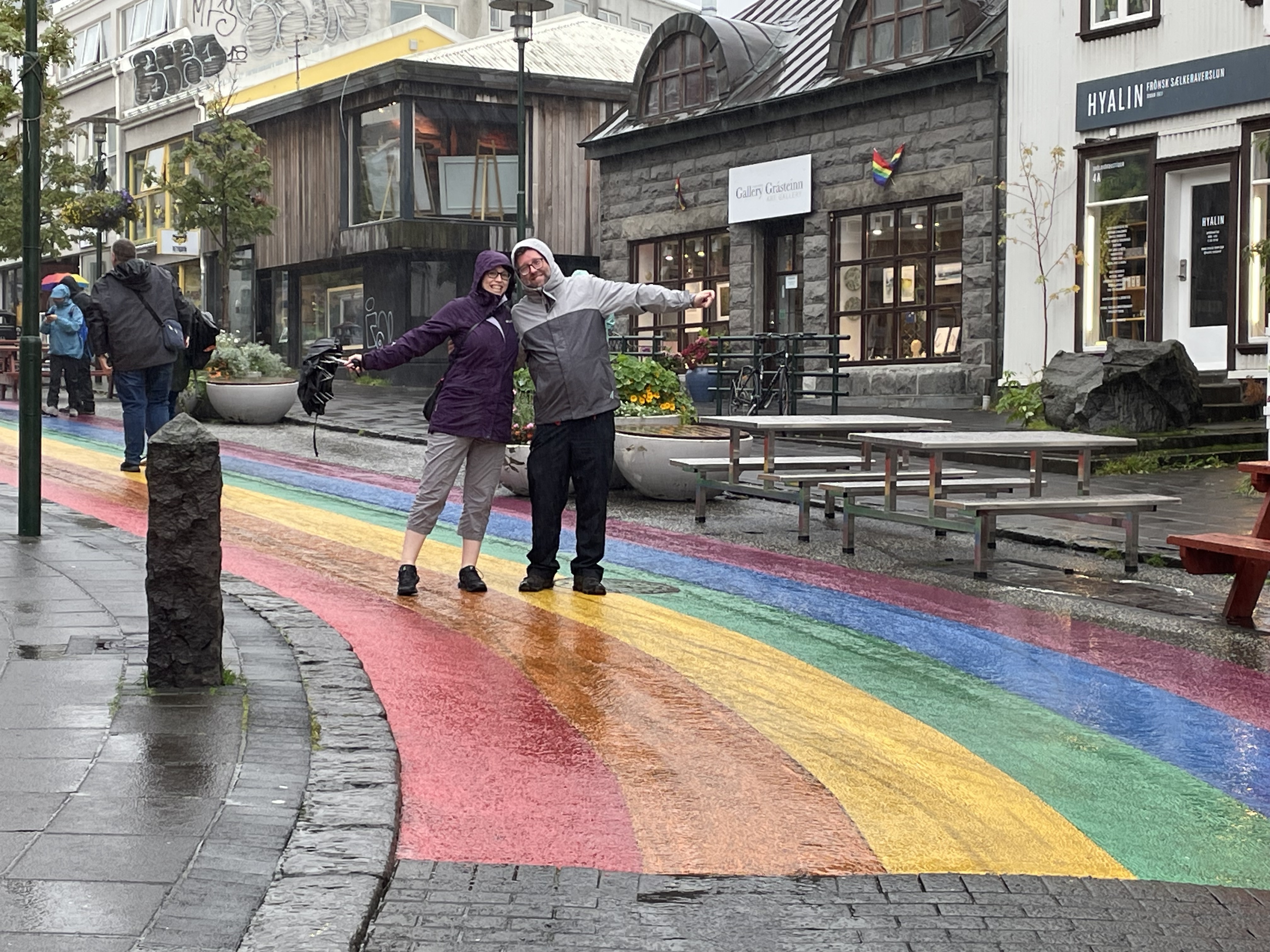
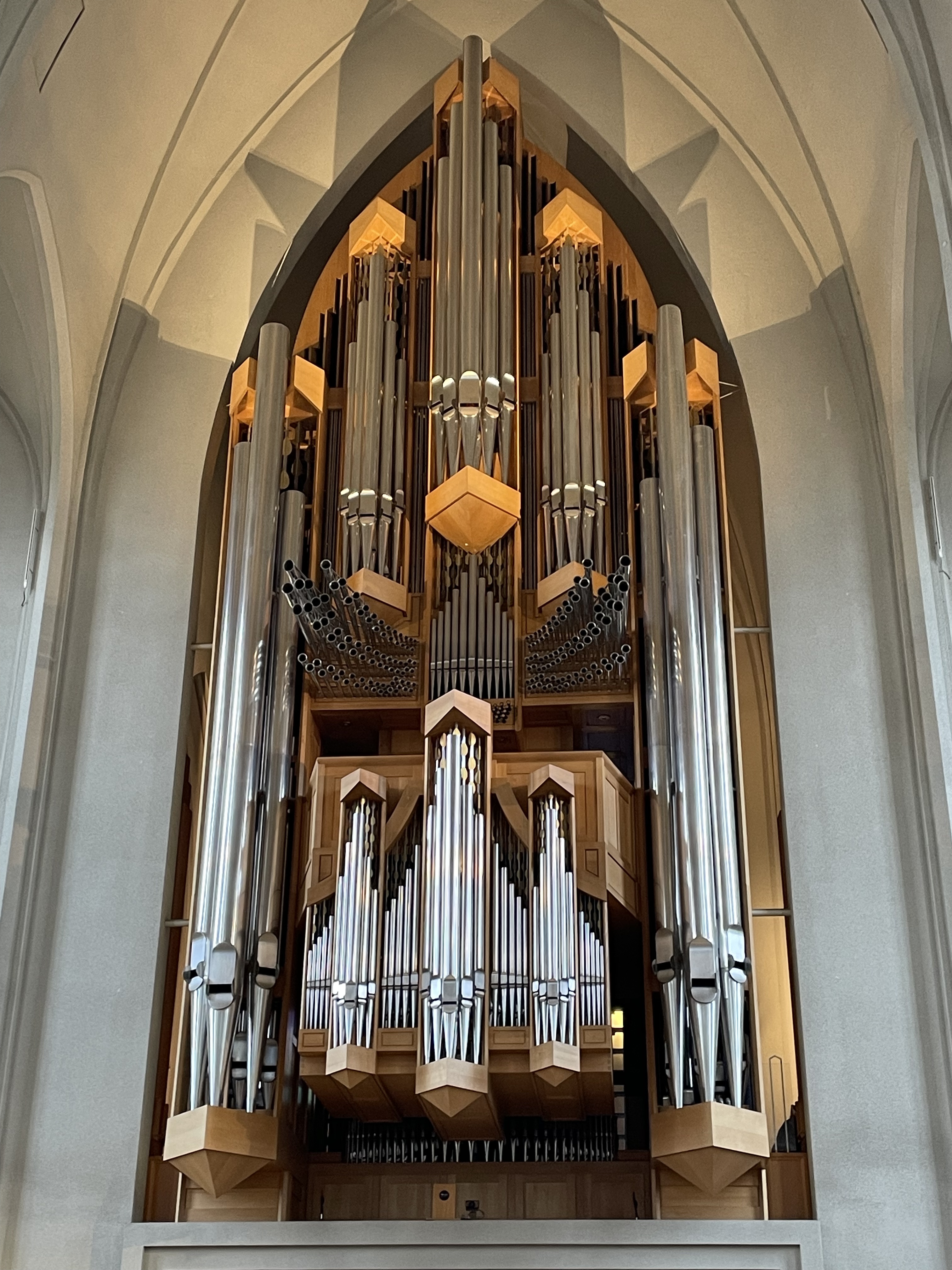
Driving on to Reykjavik, we continued our tour checking out the beautiful concert hall down near the harbour and the Hallgrimskirkja church, which is both a parish church and a national sanctuary. Built on top of a hill it is visible by two-thirds of the people in Reykjavik. Also well-known and oft photographed is the rainbow road which celebrates Reykjavik Pride which has taken place annually since 1999. While we were out walking, Jenn met a couple from her office who were walking back to their hotel to head to the airport. What are the chances? Better in Iceland since the population is only 400,000.

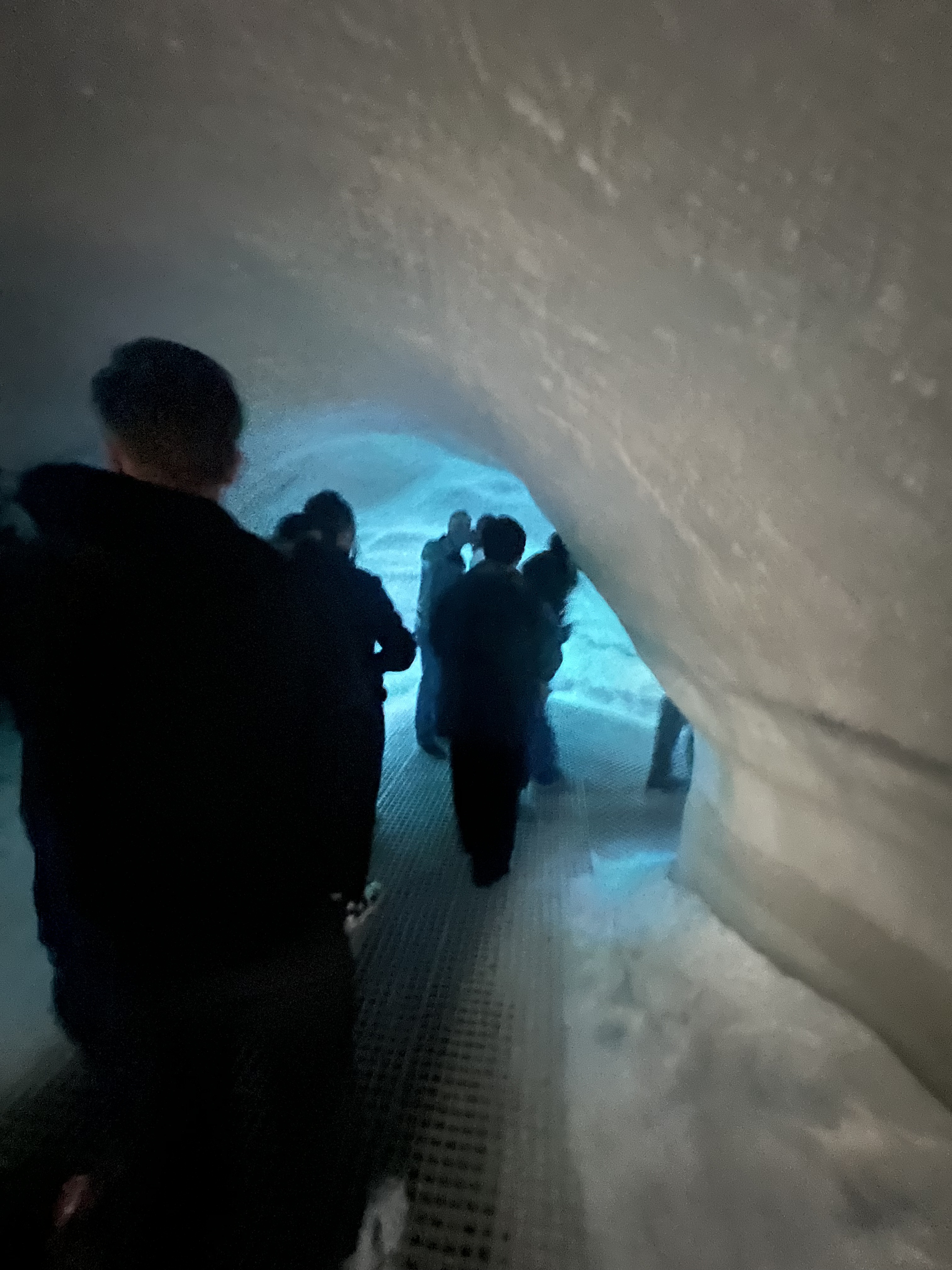
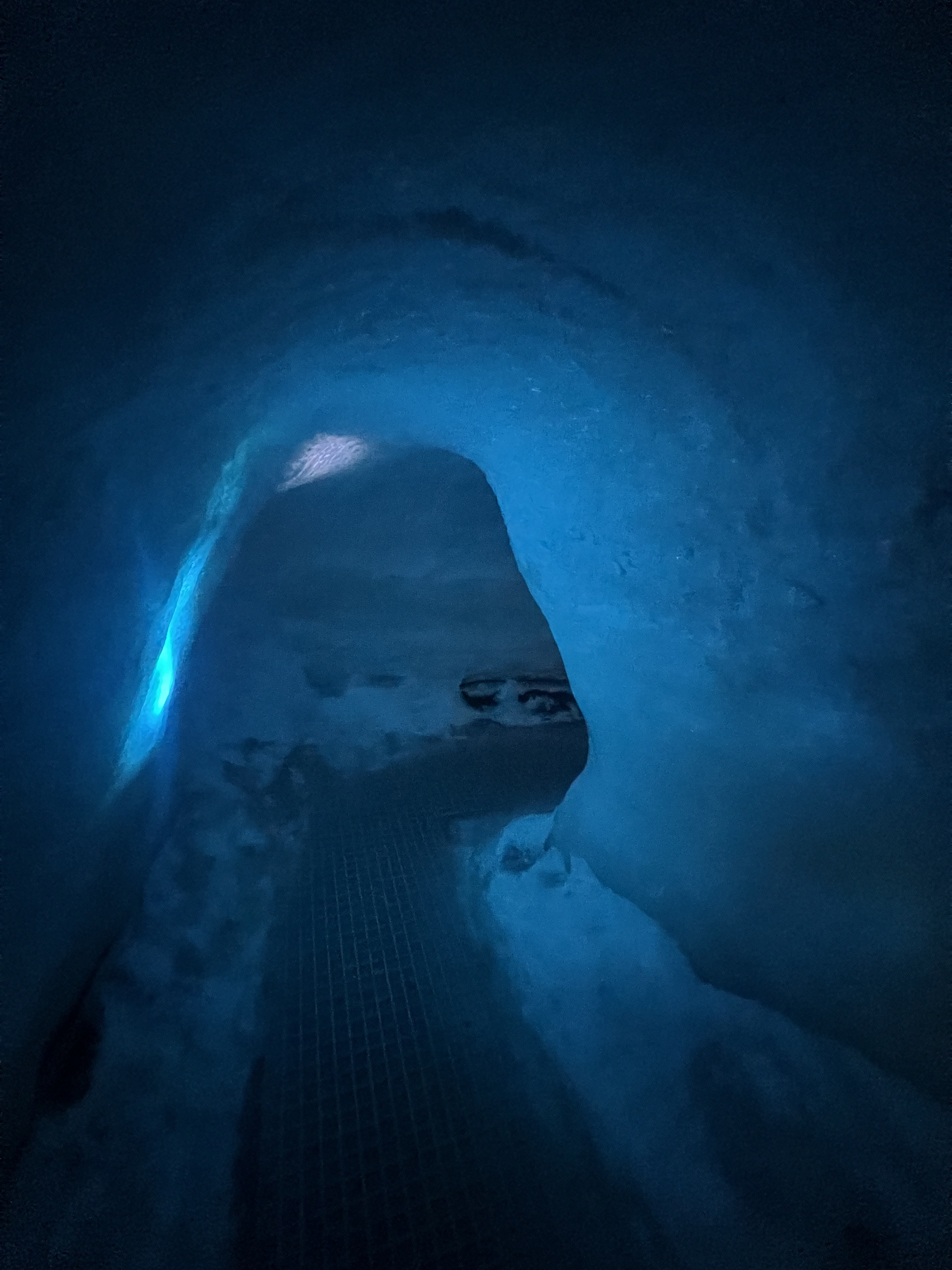
By then most things were open, and we headed over to Perlan, a museum like no other, to spend the next part of the day. Perlan is a nature exploratorium and science centre all rolled into one. Many of the exhibitions are interactive and educational. For those just arriving in Iceland it provides an excellent overview of what you will see on your travels. For those who can only spend a few short hours in Reykjavik, it is an excellent place to see what you’ll be missing. Our favourite part was the ice cave – a 100m glacier hike and a video of the most recent volcanic eruption. What power!
By lunch time we were all tired and ready for a nap. After checking in to the hotel, three of us went to sample Iceland’s famous hot dogs – a combination of lamb, beef and pork (organic, free-range, hormone free). It’s the cheapest meal you will buy in Iceland!

After our nap, we headed out to find dinner at one of the street food restaurants. Because the first one wasn’t what we expected, we all got up and headed out the door. We eventually found the one we were looking for – Icelandic lamb soup served in a bread bowl.
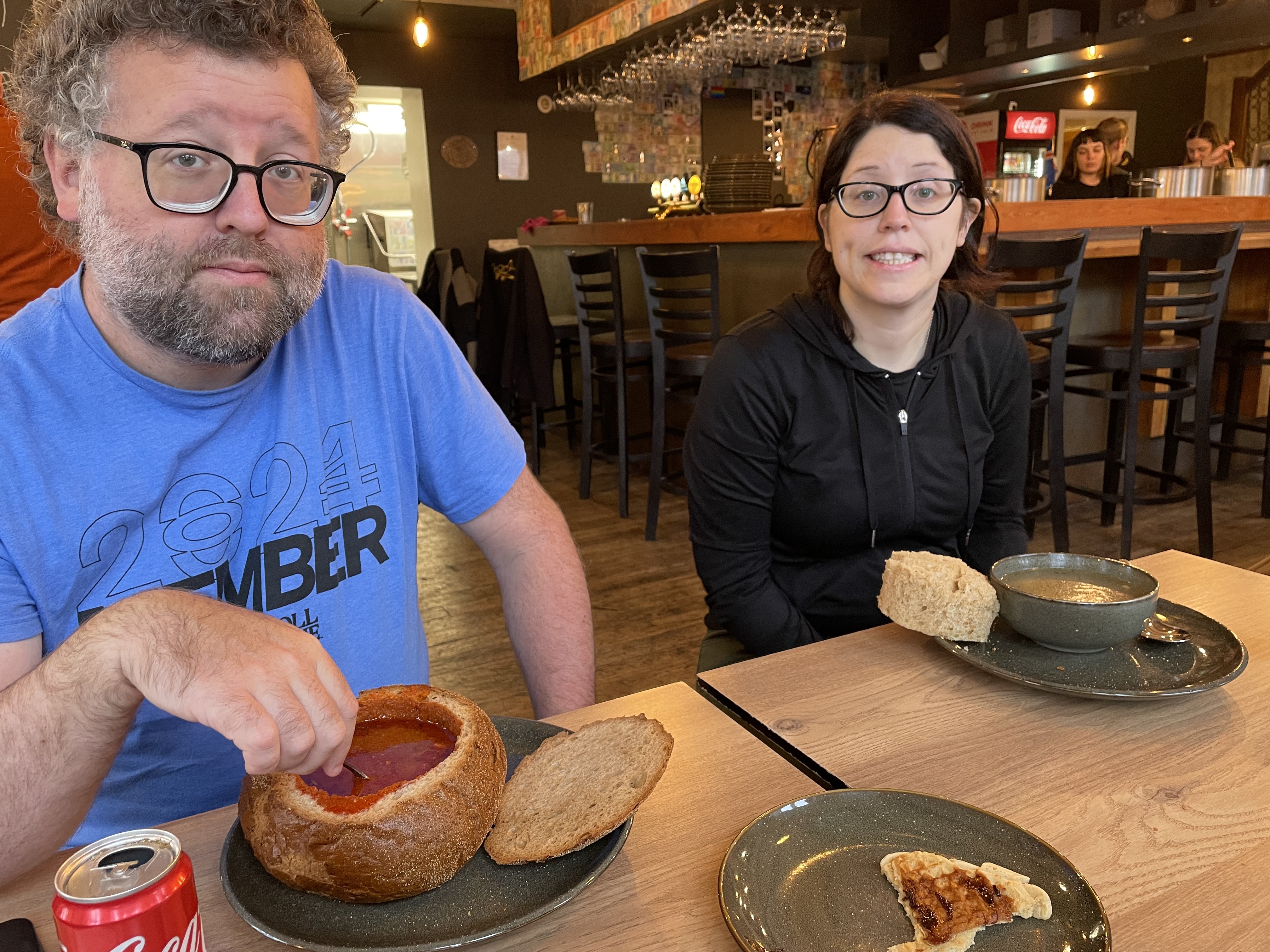
In the category of we knew it, we expected it but we still couldn’t quite believe it – food is very expensive in Iceland. Breakfast ranges from $32-40, a Subway sandwich is $15 and our bread bowls were $30 each. The good part was you were allowed refills.

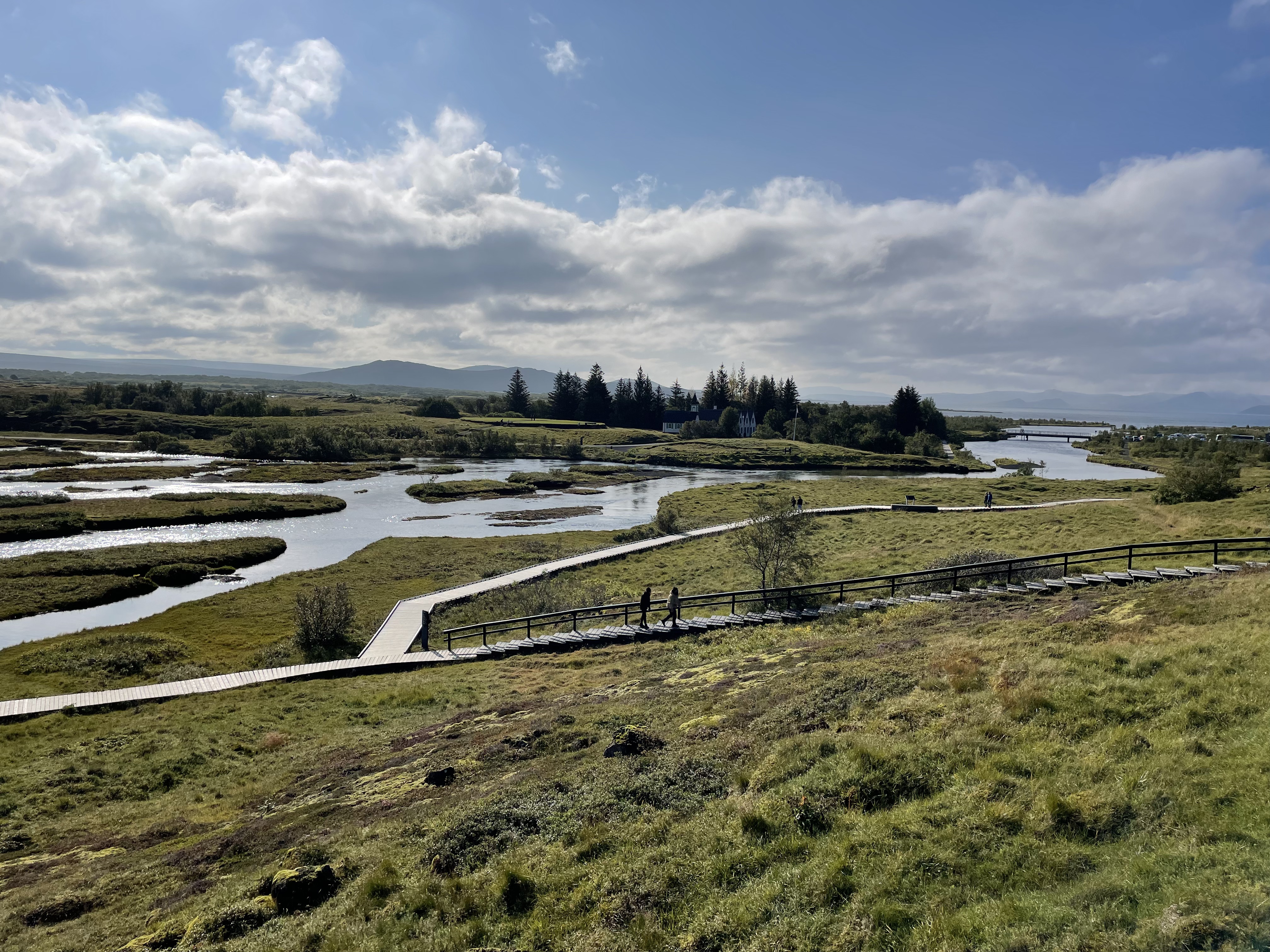
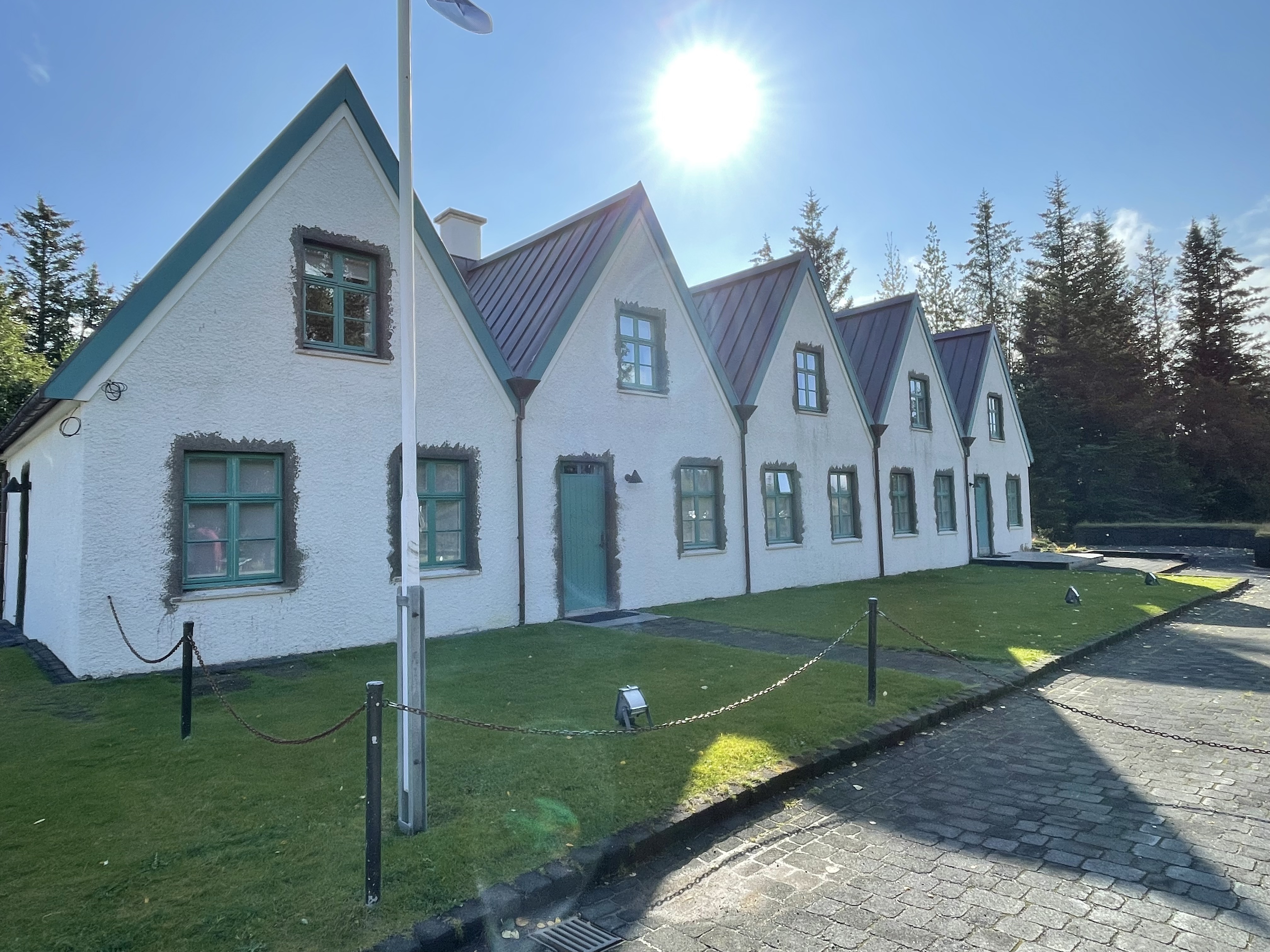
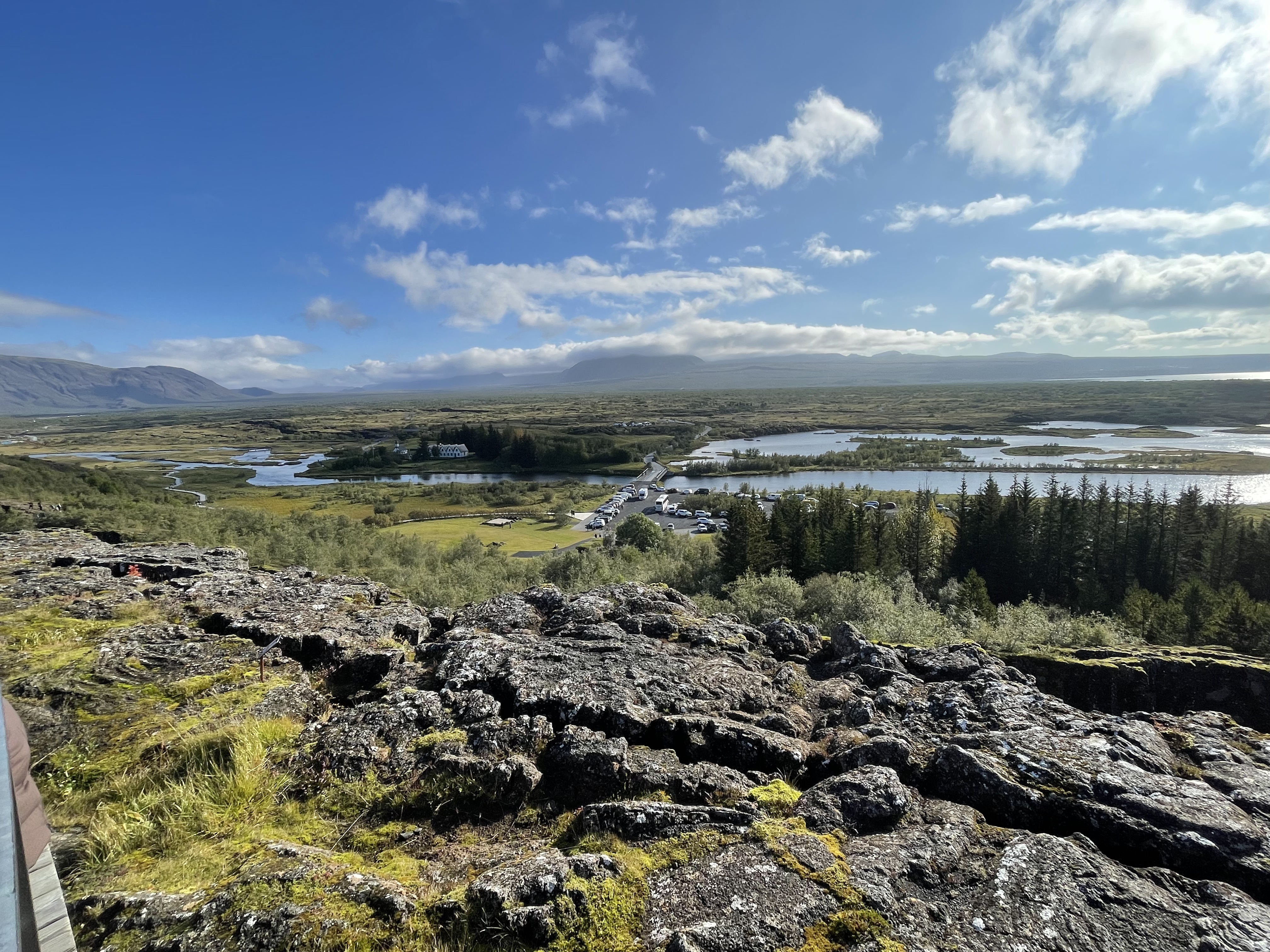
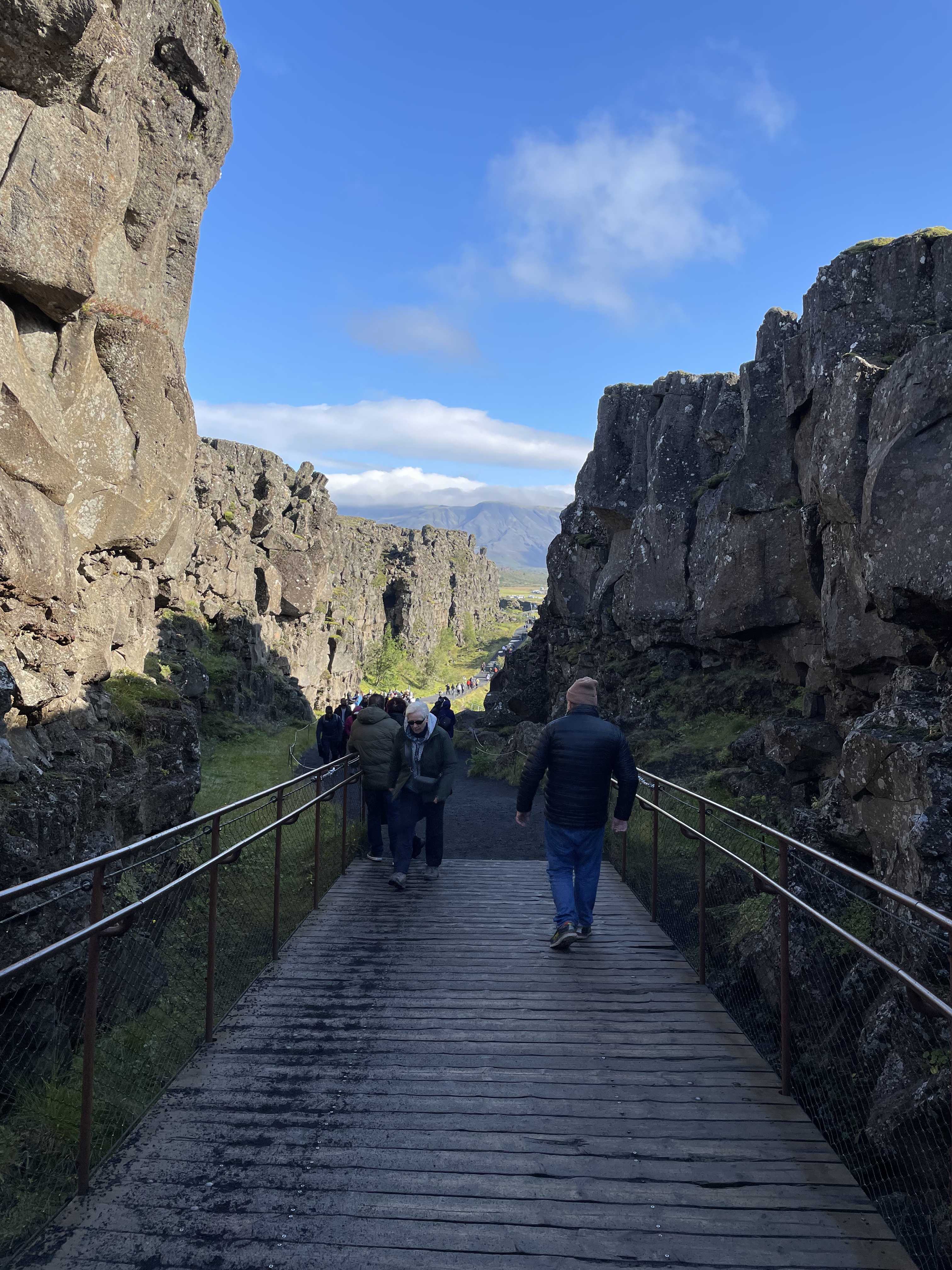
Day 2 – Hooray, the sun was shining when we left in the morning which made for great hiking/walking weather. Our first stop was Thingvellir National Park, a UNESCO World Heritage site. It holds deep historical, cultural and geological significance. From 930 until 1798, it was the site of the annual parliament of Iceland. In 1944, it was chosen as the site of the celebration of Iceland’s independence from Denmark. Given WW2, the King of Denmark could no longer provide protection for Iceland, and hence it was decided that Iceland should become an independent country.

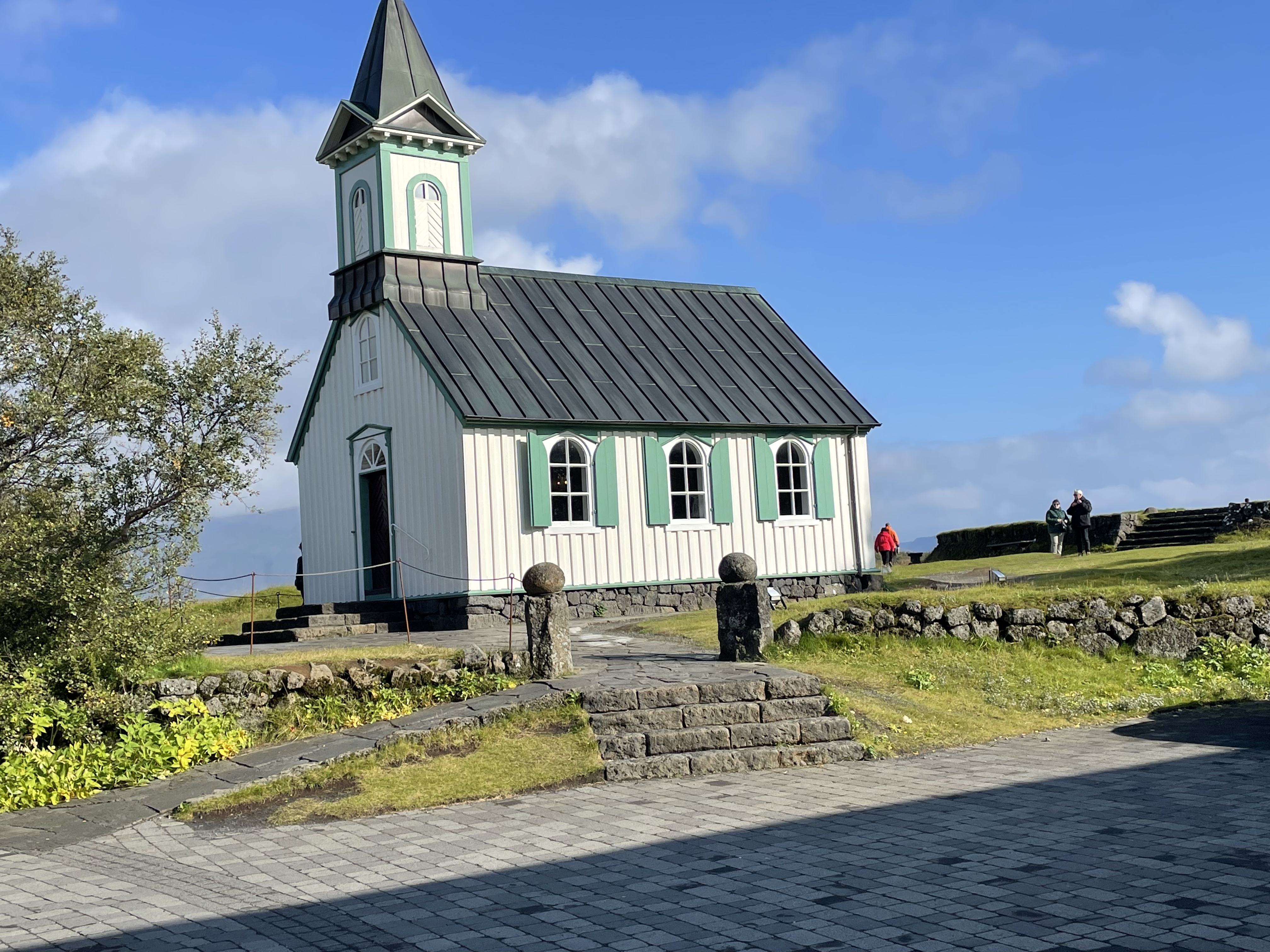
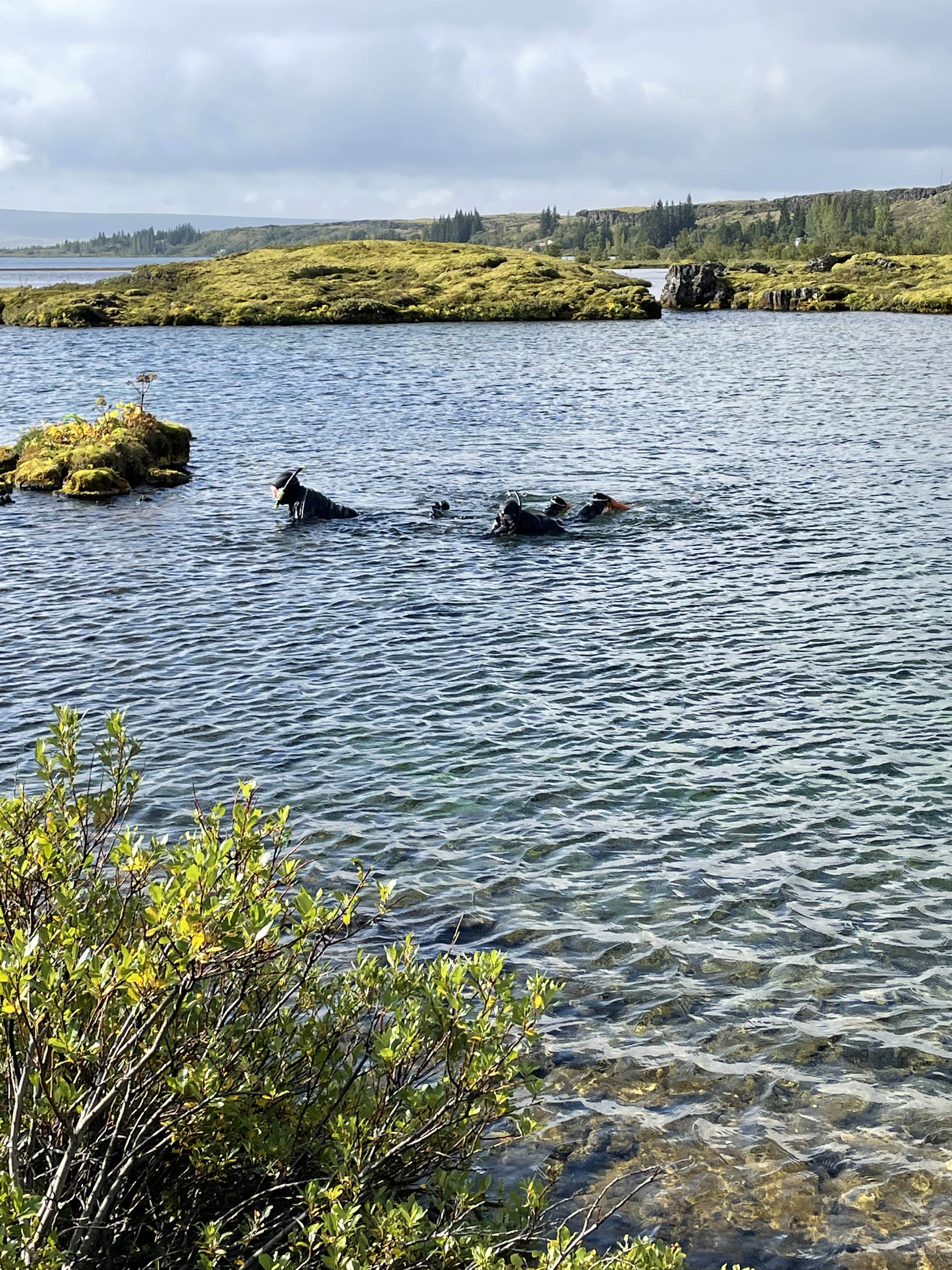
Located in a rift valley, it is the only place in the world where you can snorkel between two tectonic plates. Thingvallavatn Lake is Iceland’s largest and is fed by ground water from the Langajokull glacier. It evidently takes about 30 years to actually reach the lake. Within the park is also a church and the Prime Minister’s summer residence.
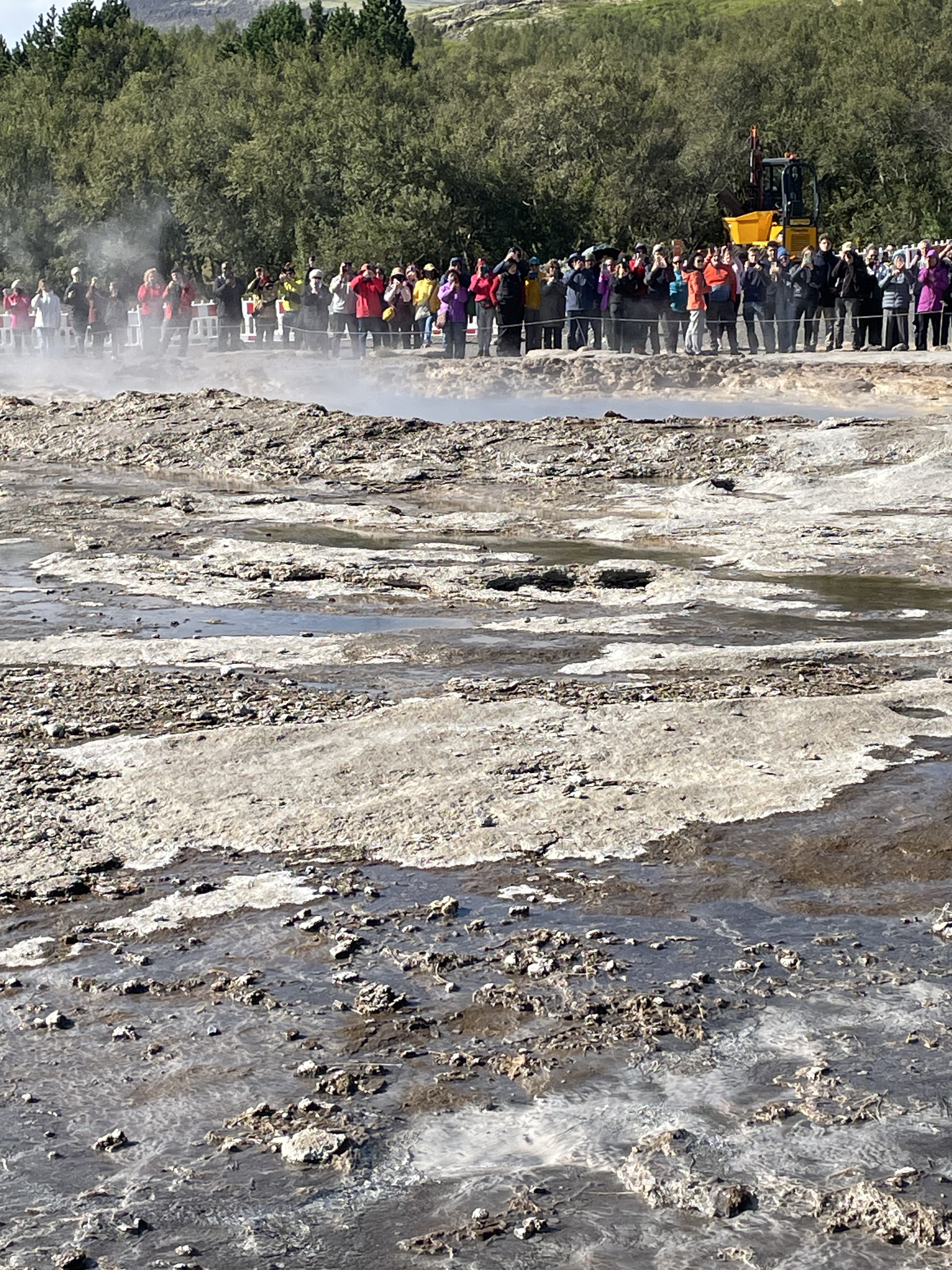
Then it was on to see the Strokkur Geyser, which erupts every few minutes to heights of up to 115′. We saw a couple of eruptions but none that high. The visitor’s centre was a welcome spot to stop for lunch.
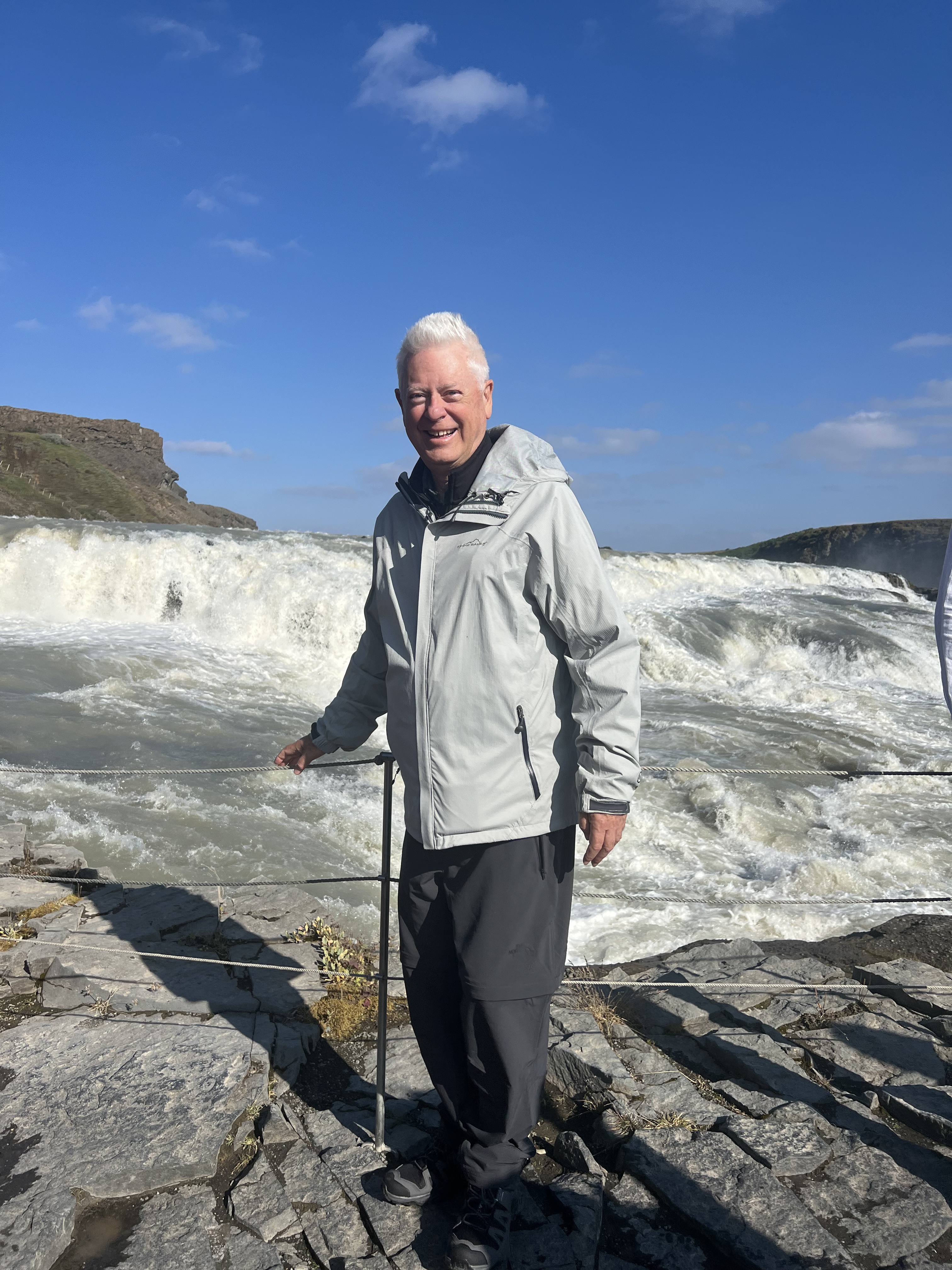
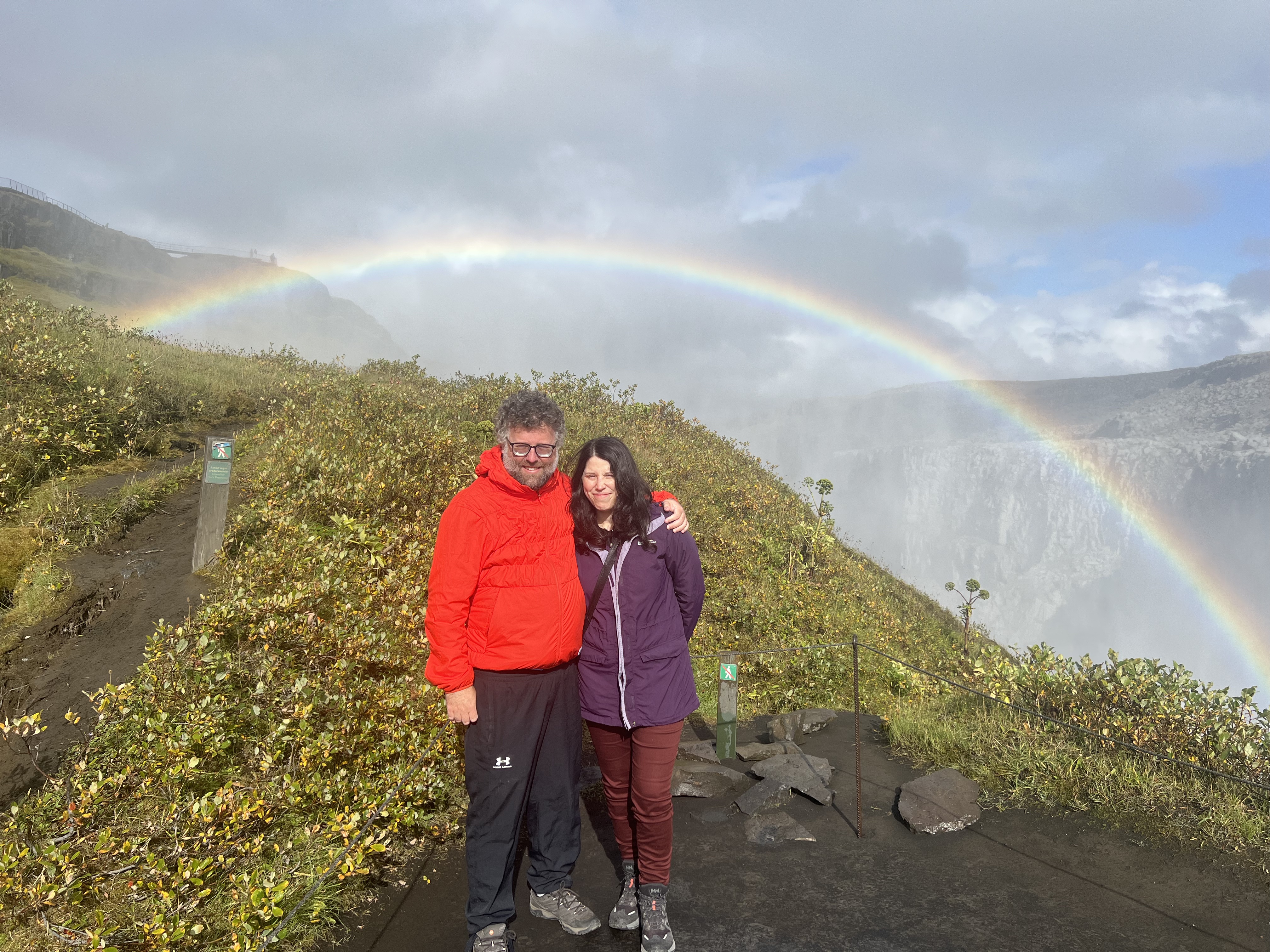
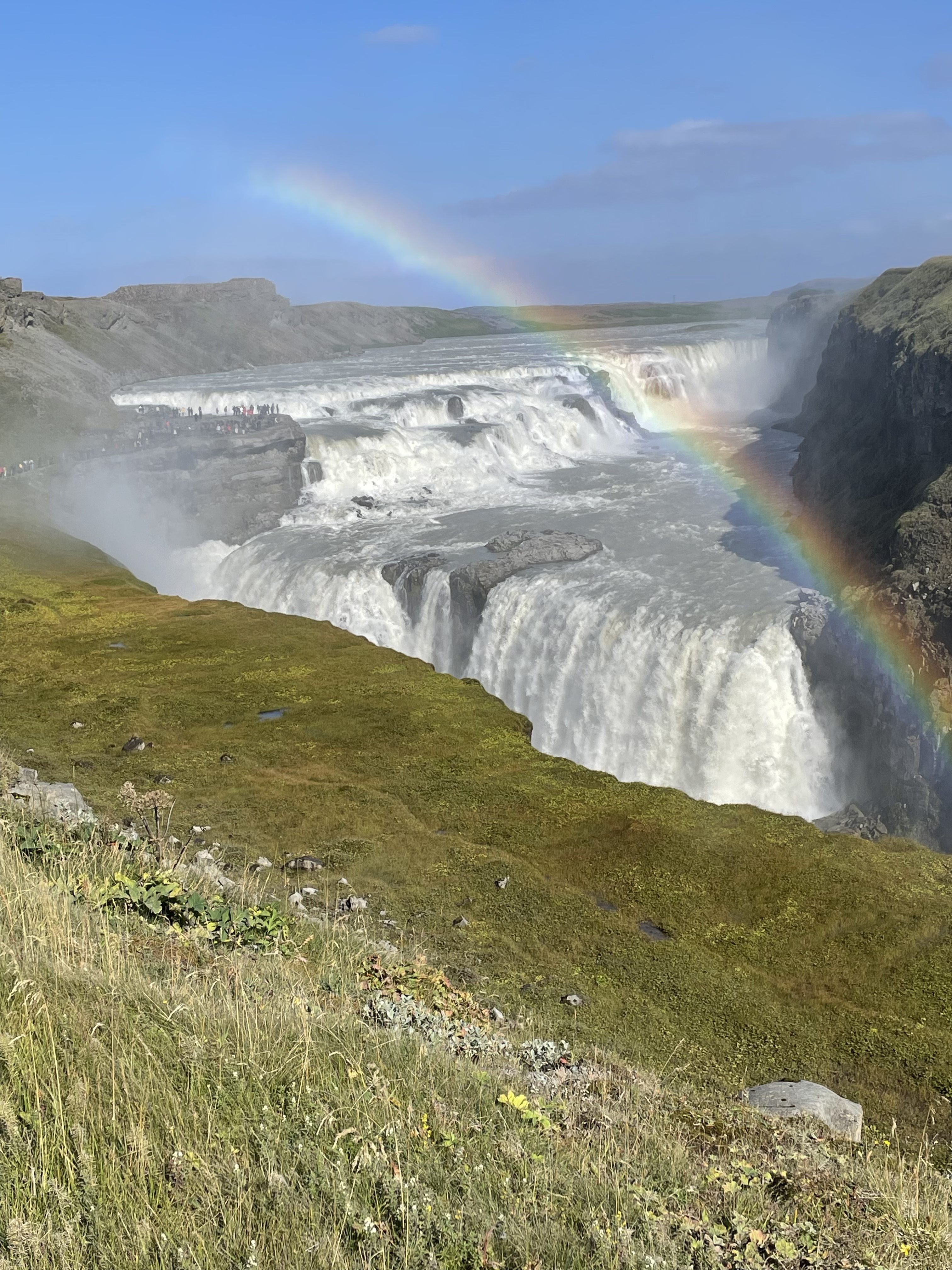
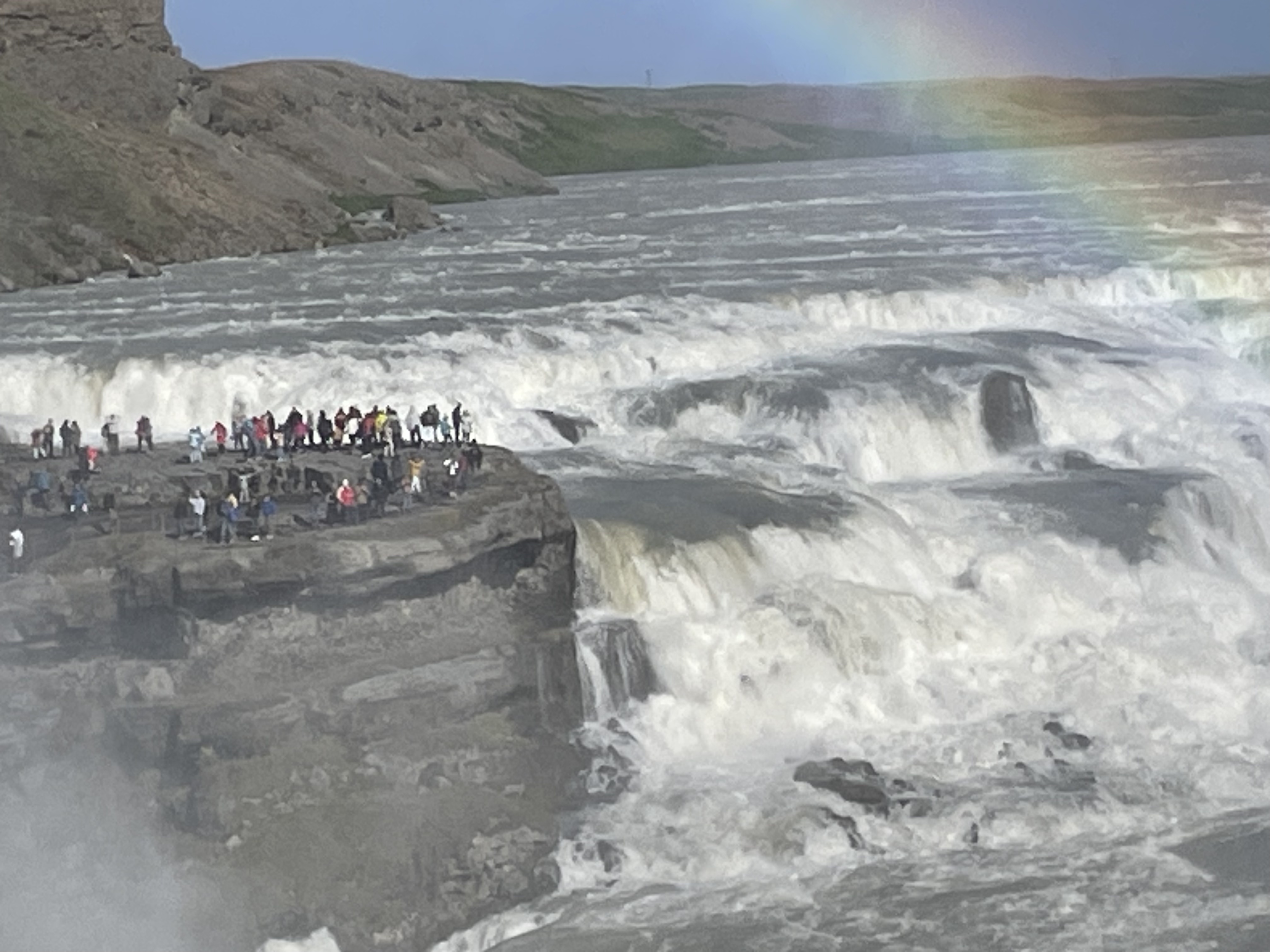
After lunch we travelled a short distance to the Gullfoss Falls, which means “the golden falls.” Our chauffeur dropped us off midway down the hill but it was still a bit of a wet descent to the bottom level. It doesn’t quite rival Niagara Falls but the rainbow was pretty. Dad was quite close to the end of the rainbow at the bottom, but he claims there was no pot of gold. I stayed at the midway point and chatted with a couple from the US who were doing a similar tour with their siblings.
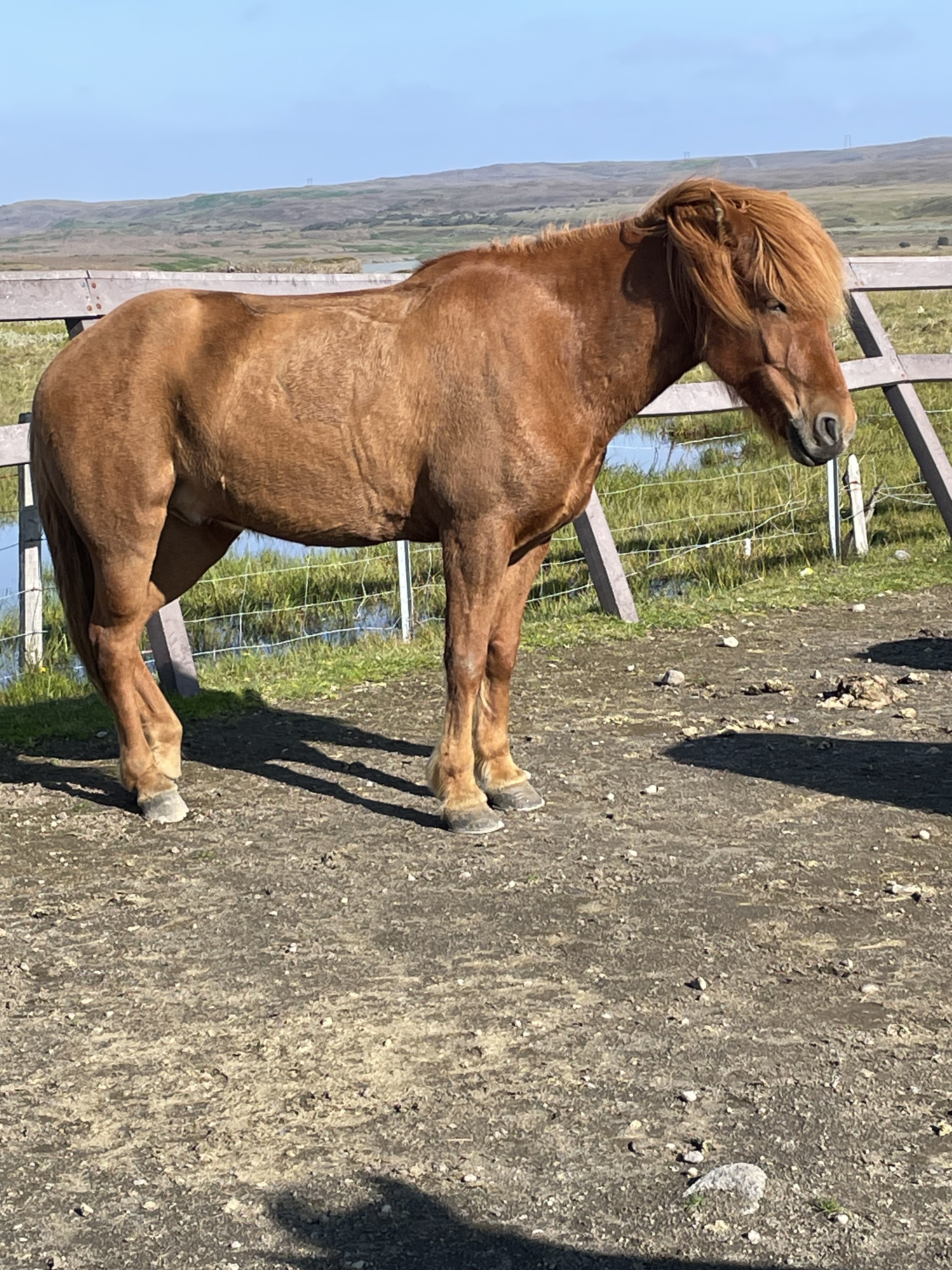
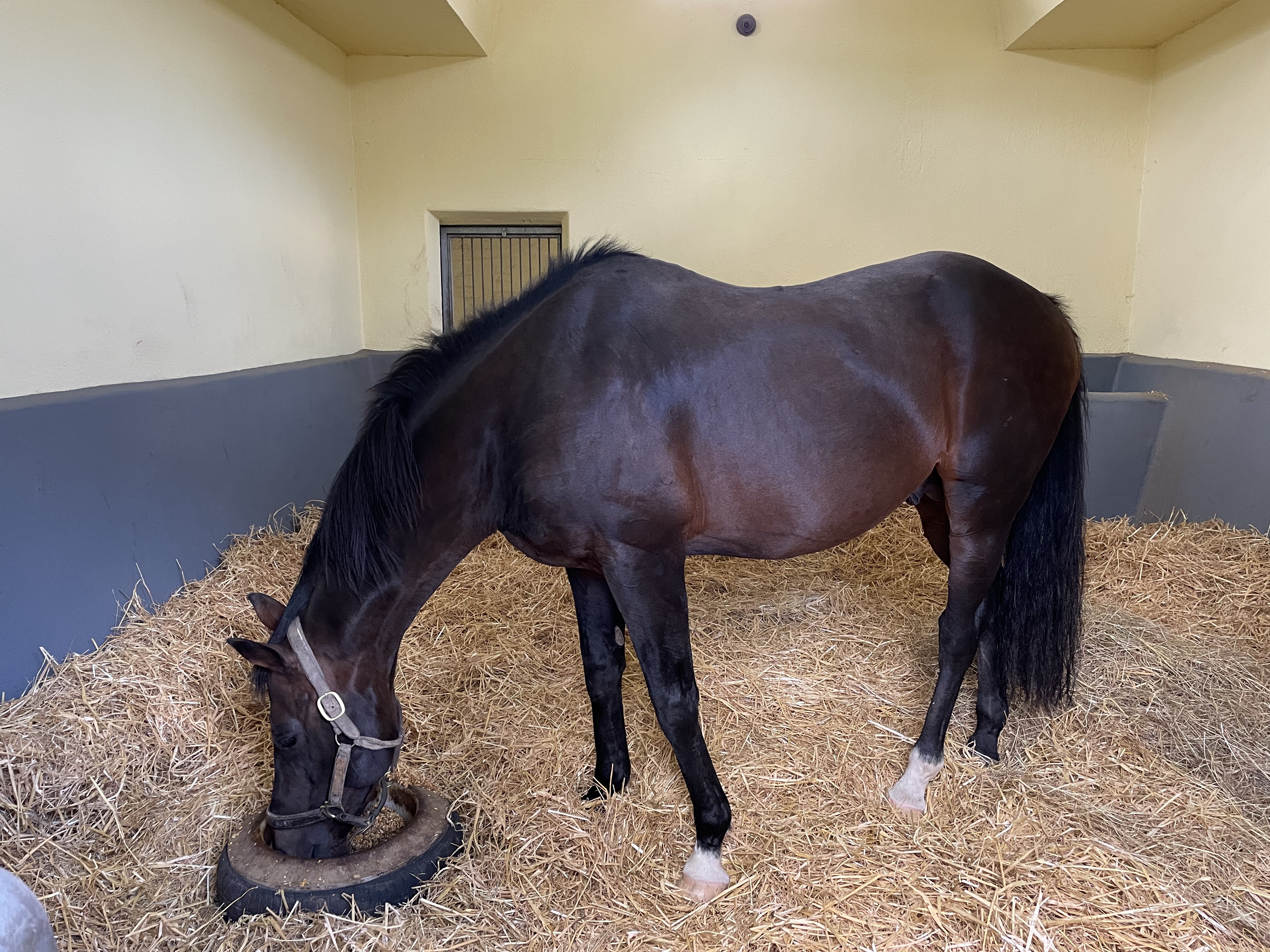
We saw a lot of horses in Iceland as well as farms with sheep and some cattle. We didn’t see any pigs. The horses are specially bred for hardiness owing to the ruggedness of the land. Laws in place prevent foreign-born horses from being imported and any horses exported are not allowed to return. This ensures that the native breed experiences few diseases. Typically they are used for sheep-herding, leisure, showing and racing.

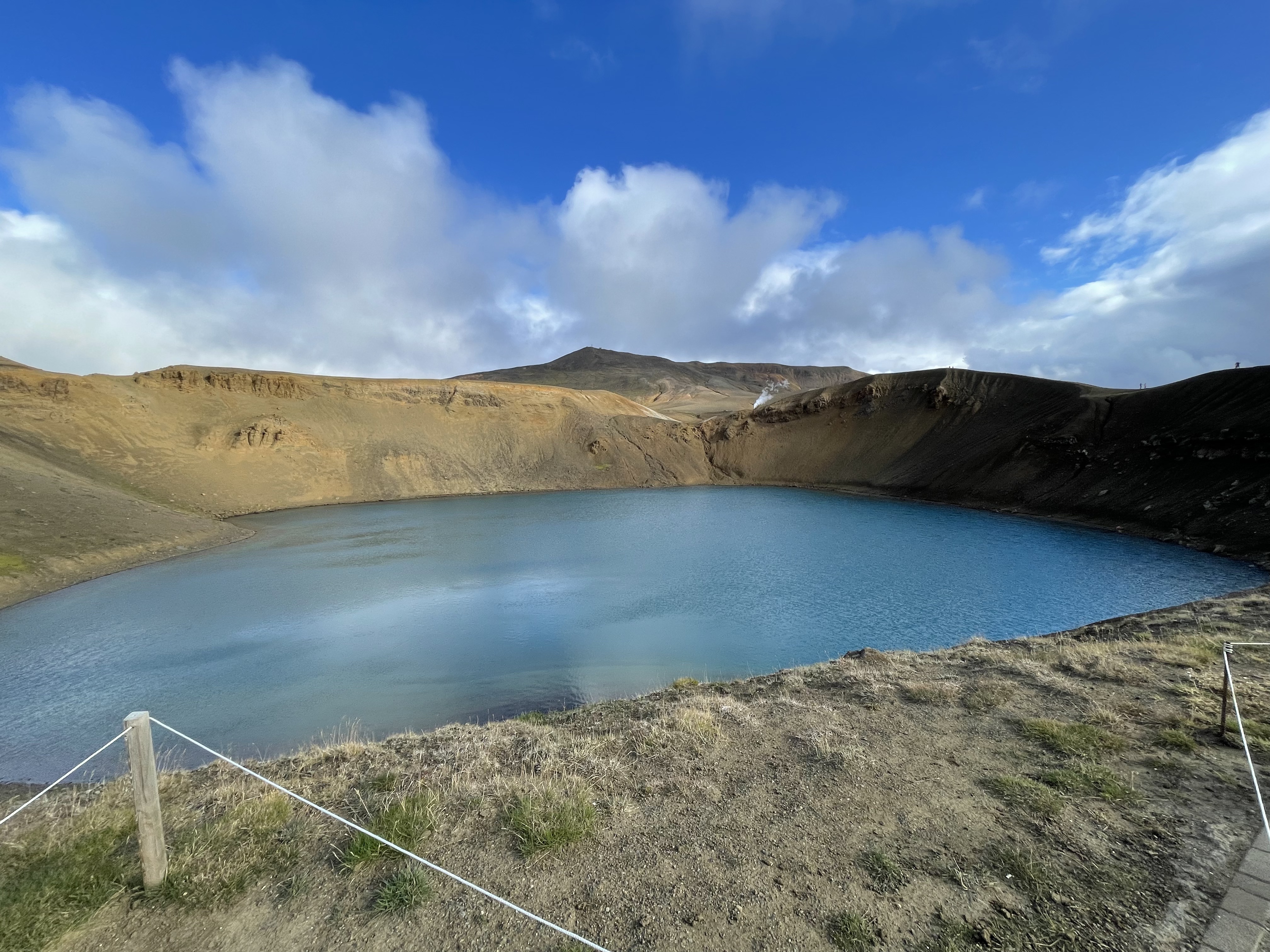
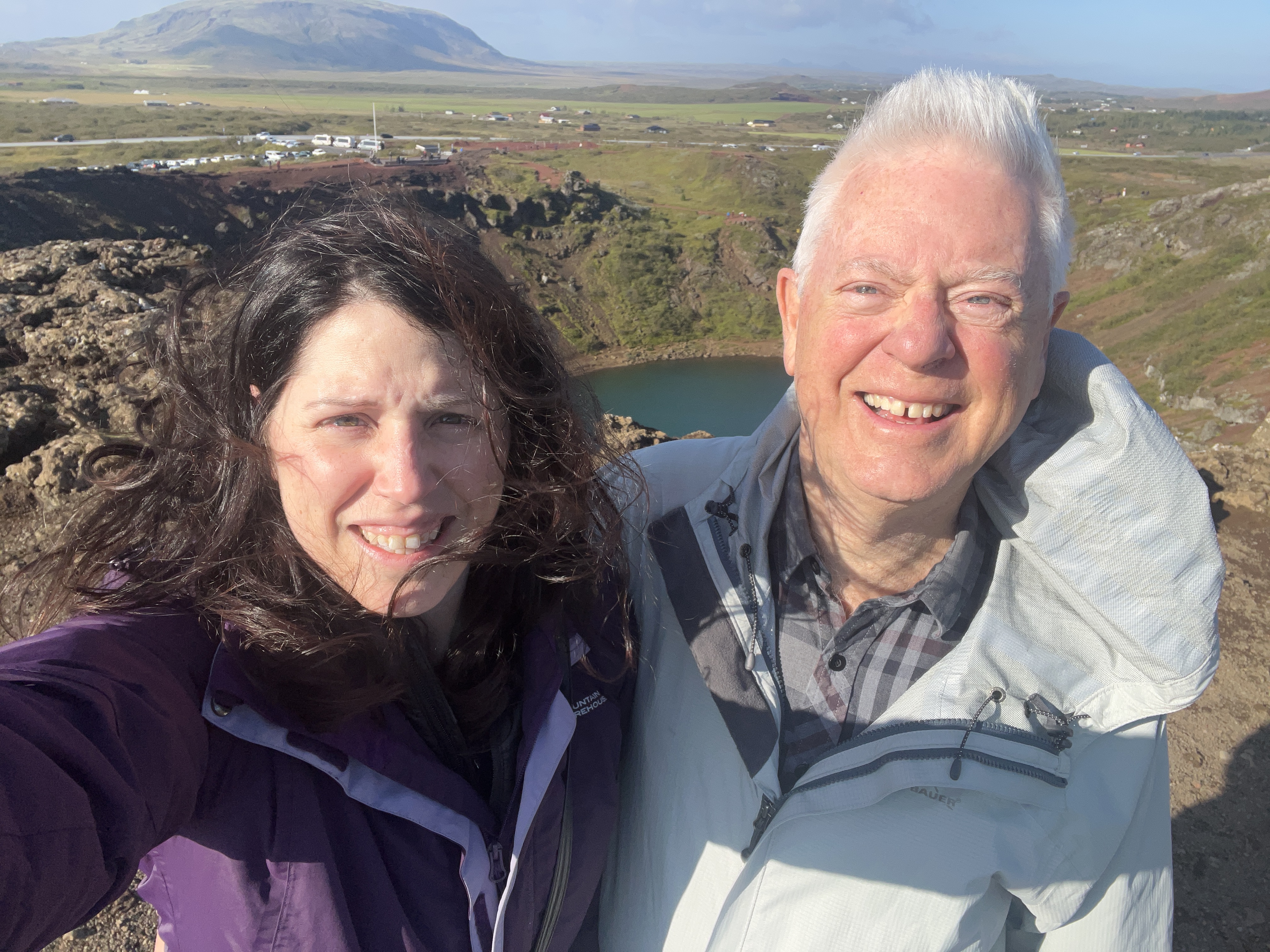
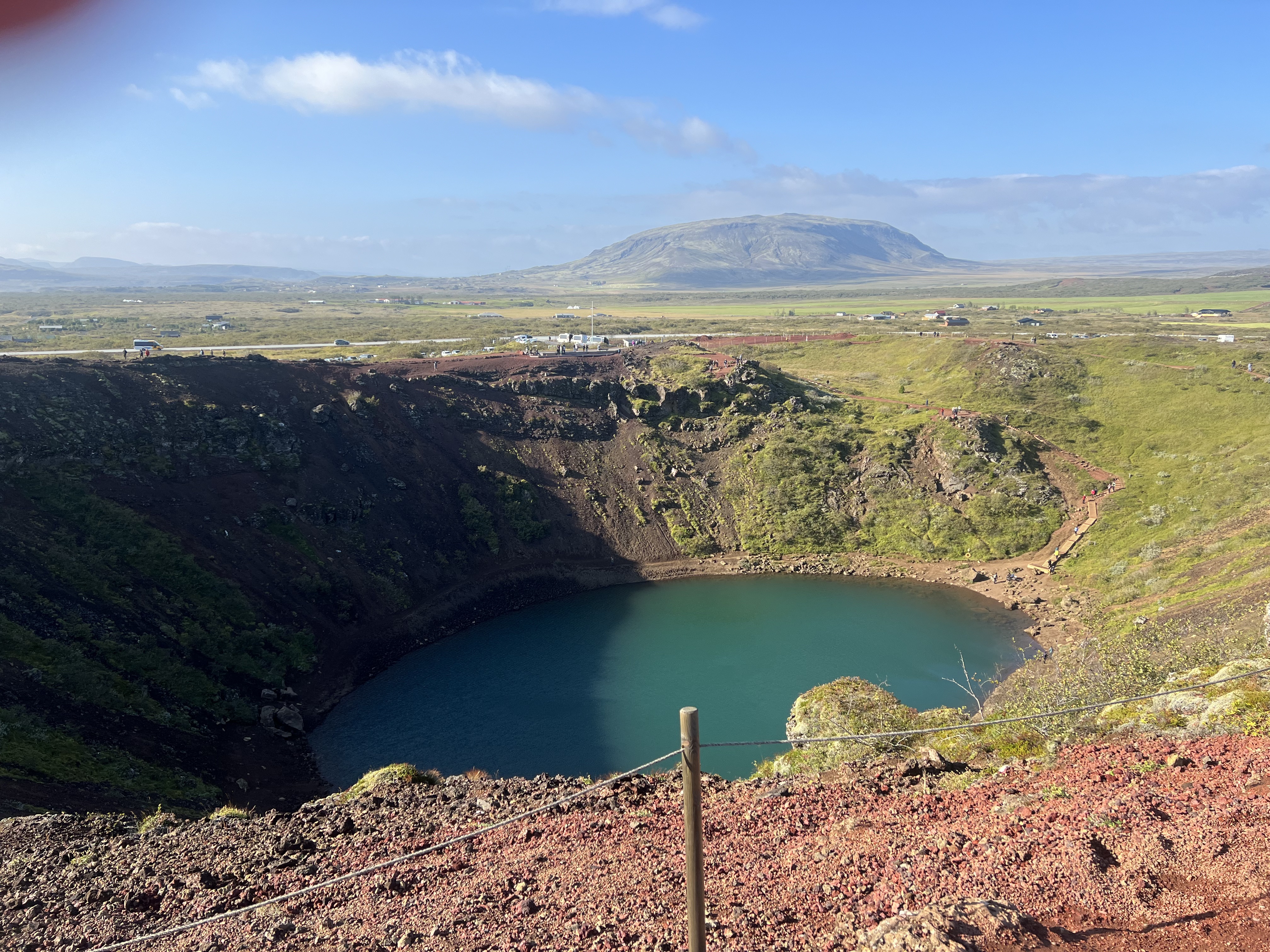
The last stop for the day was the Kerid Crater, which Jenn and dad hiked around on their own. A volcanic crater thought to be about 6500 years old, it was formed by a volcanic cone that erupted, the weight of which caused the cone to collapse creating the current crater. It is made up of a unique red volcanic rock. The water is fairly shallow and is at the same level as the surrounding water table.
It was just a short drive from there to Sellfoss, our stop for the night. Dinner was at the Old Dairy Food Hall, an historical house that was the first dairy factory built in 1929. It has eight different restaurants in a gourmet fair type setting so everyone’s taste buds could be satisfied. After a little walk to wear off dinner, we turned in early, because we had an early departure the next morning to catch the ferry to Westman Island.

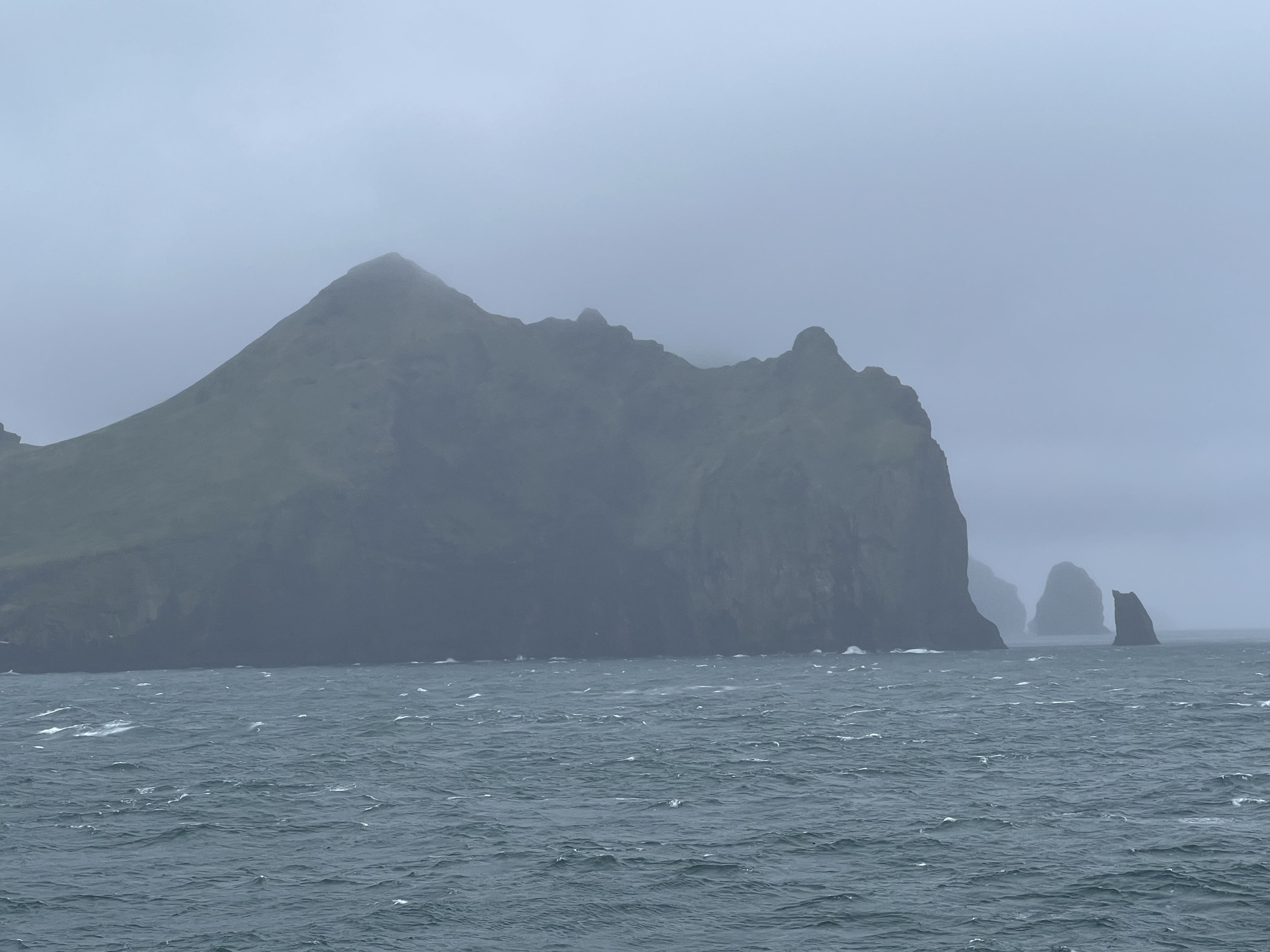
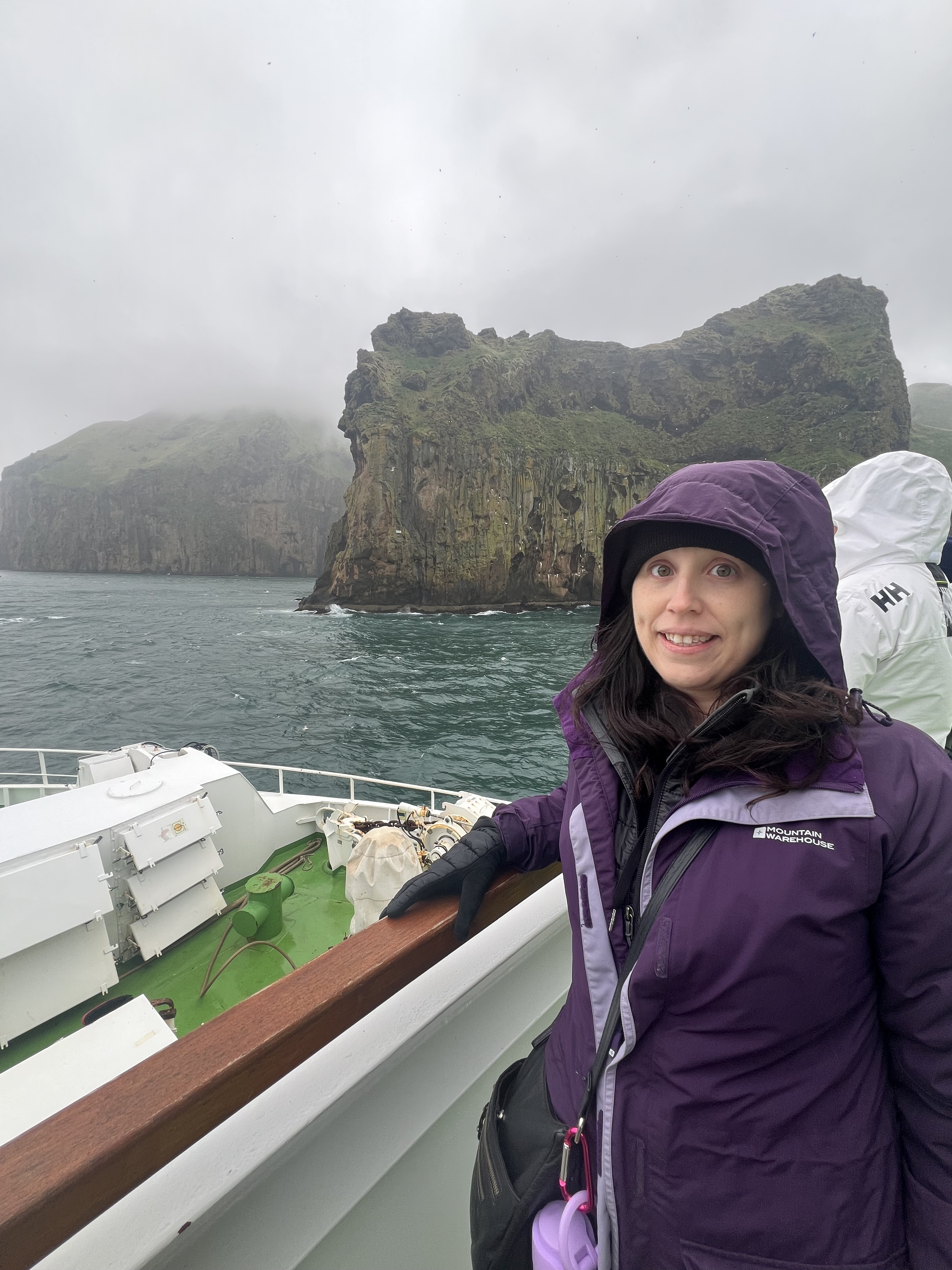
Day 3 – The weather was damp with a biting cold wind. We’re told Iceland has not had a good summer weather-wise and we are just experiencing the ups and downs of living in a maritime climate. Our route took us on a ferry over to Westman Island, scene of a large volcanic eruption in 1973. The entrance to the harbour is shielded by very high cliffs that dramatically rise out of the ocean. We certainly wondered how the captain pilots a ship through such a narrow opening. Practice makes perfect, I guess.
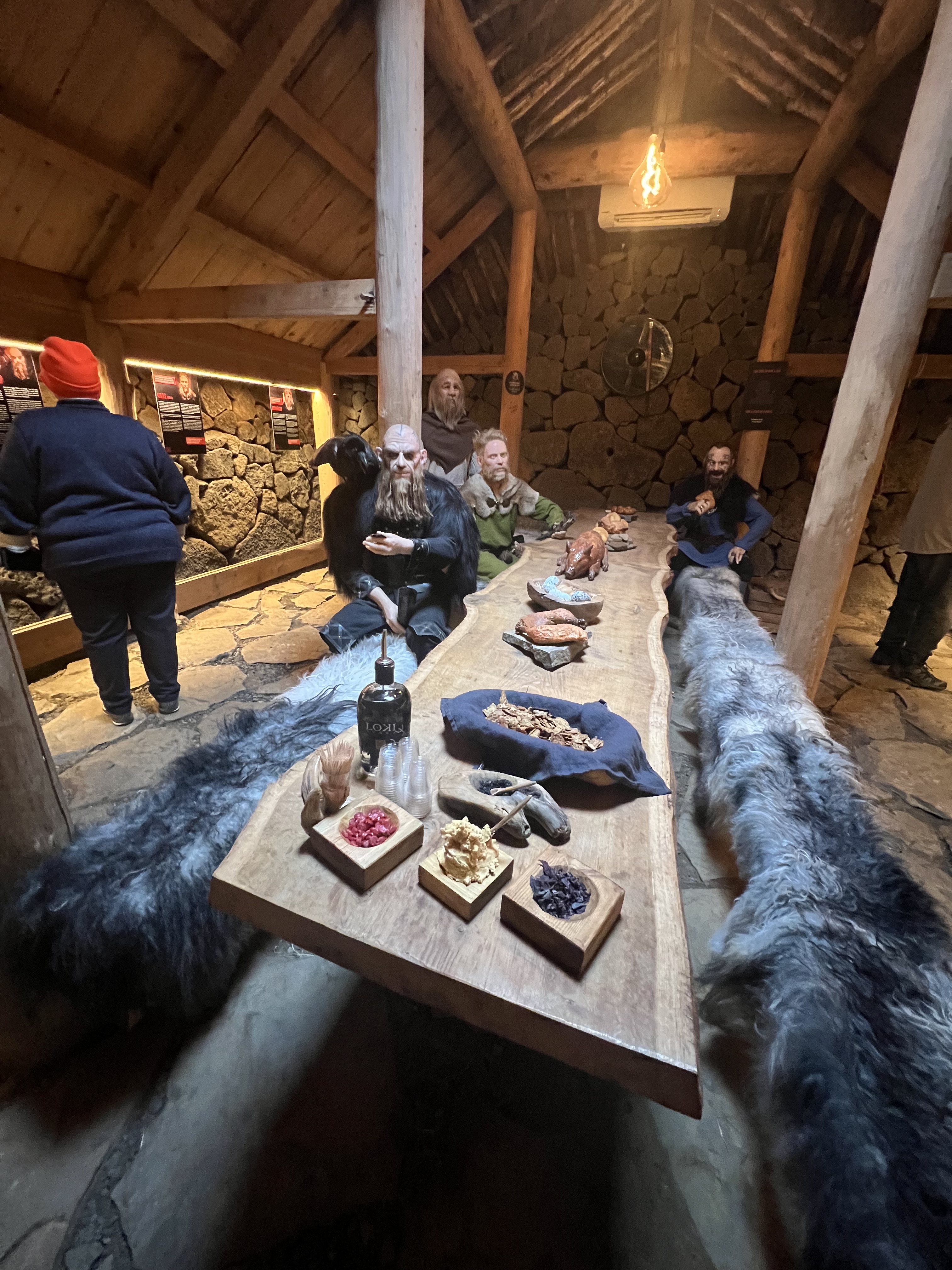
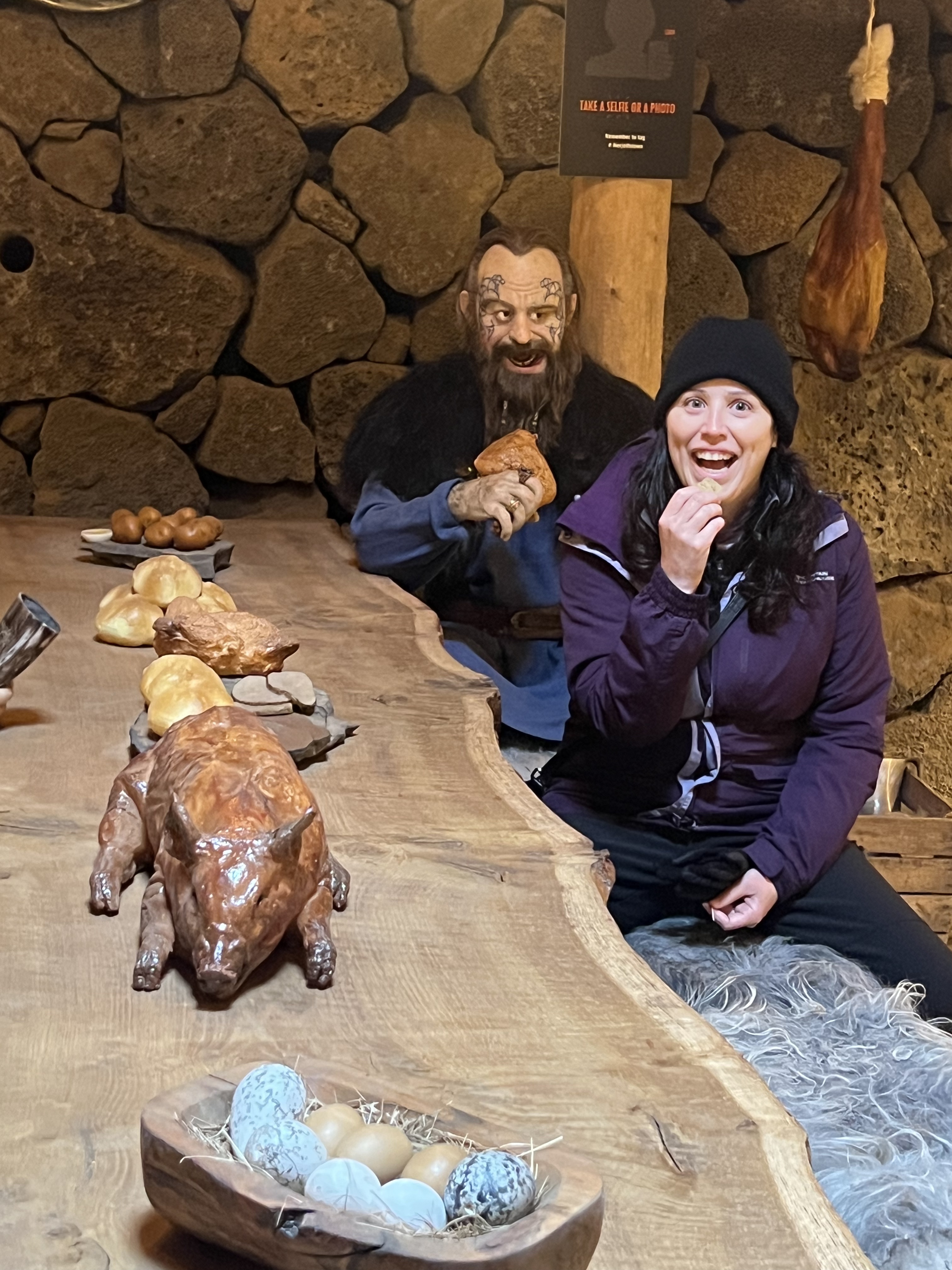
Our first stop was at a little Viking museum that told the story of Herjolfur, his wife Freyja, and their two children. The turf house has been recreated along with artifacts and samples of traditional Viking delicacies. We sampled dulce, dried sausage, dried fish that seemed like a cracker, whipped butter, black lava salt, and Viking vodka.

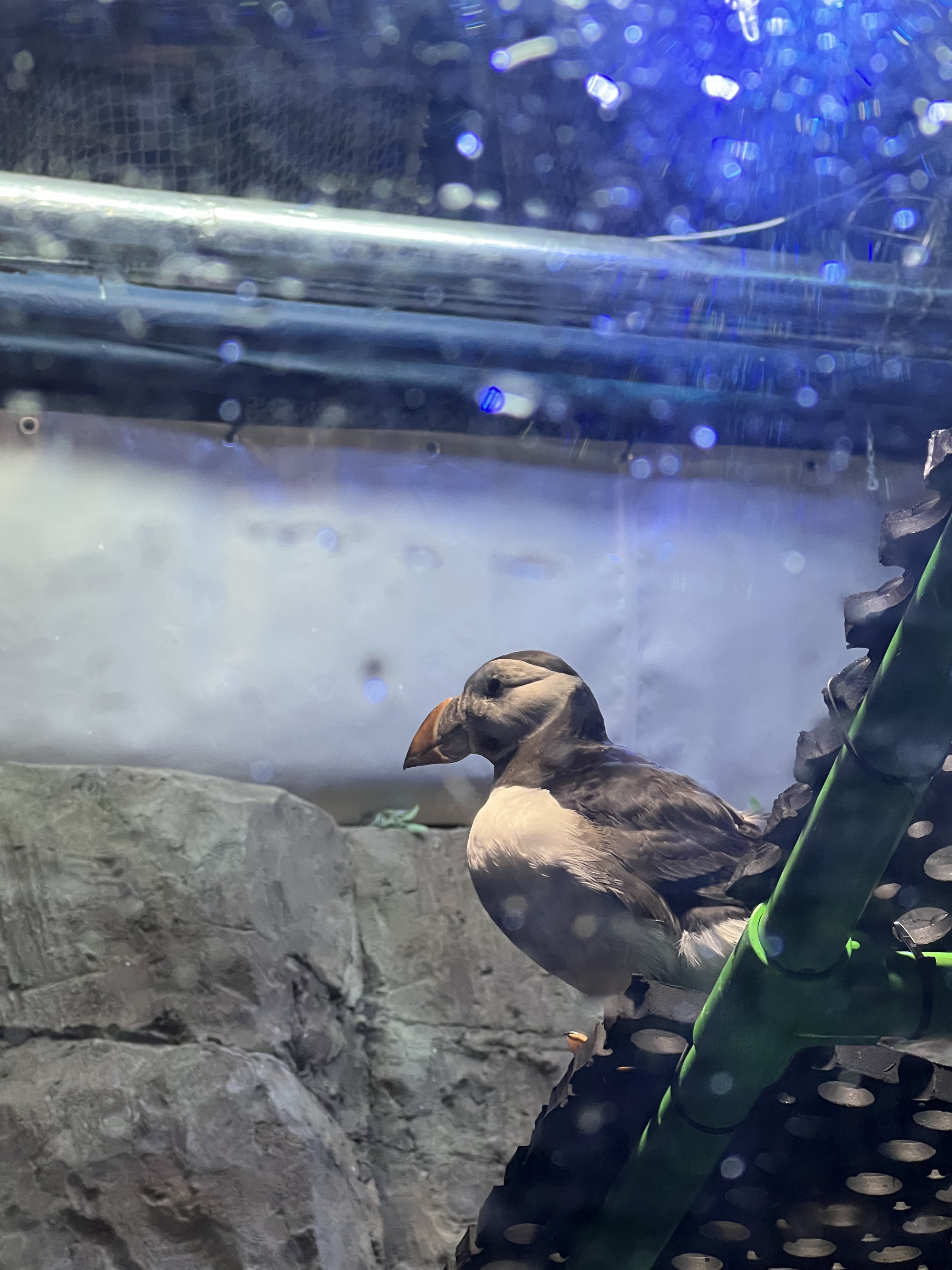
We had lunch at a little cafe down near the harbour and then visited the Puffin and Beluga Rescue Centre. The Centre provides a natural sanctuary in a protected sea inlet that allows for land-side care. Currently two belugas, Little White and Little Gray, who were rescued from a Chinese water park, call the sanctuary home. It is the hope that this more natural setting will provide opportunity for more belugas to be housed. The Centre also acts as the Puffin Rescue Mission, treating puffins and then releasing them. Locals, including schoolchildren, act as the Puffling Patrol, finding and bringing in puffins (usually babies) in need of assessment and care. It is always the intent to release them back into the wild but at least three make the Centre their permanent home because of permanent injuries.

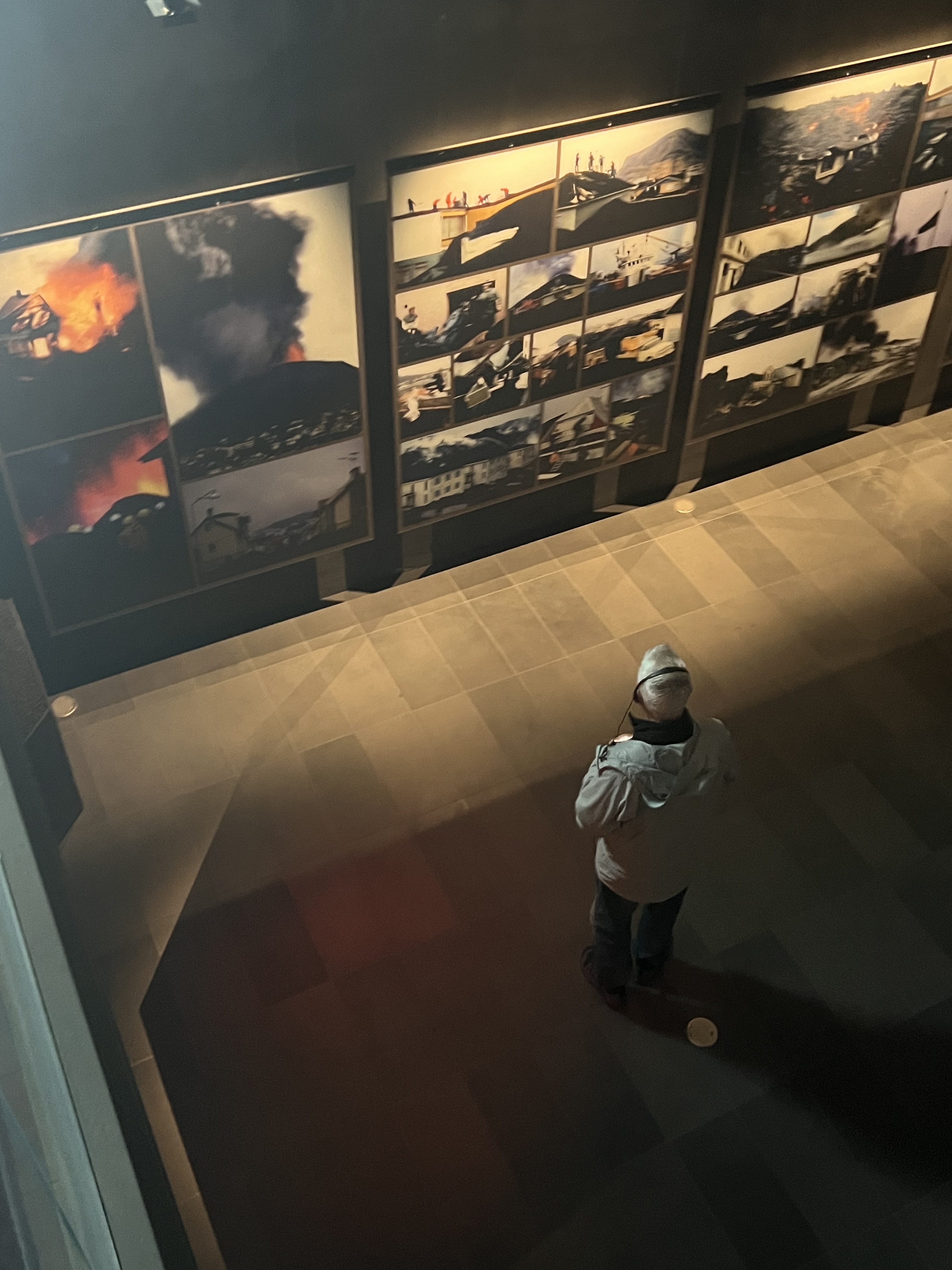
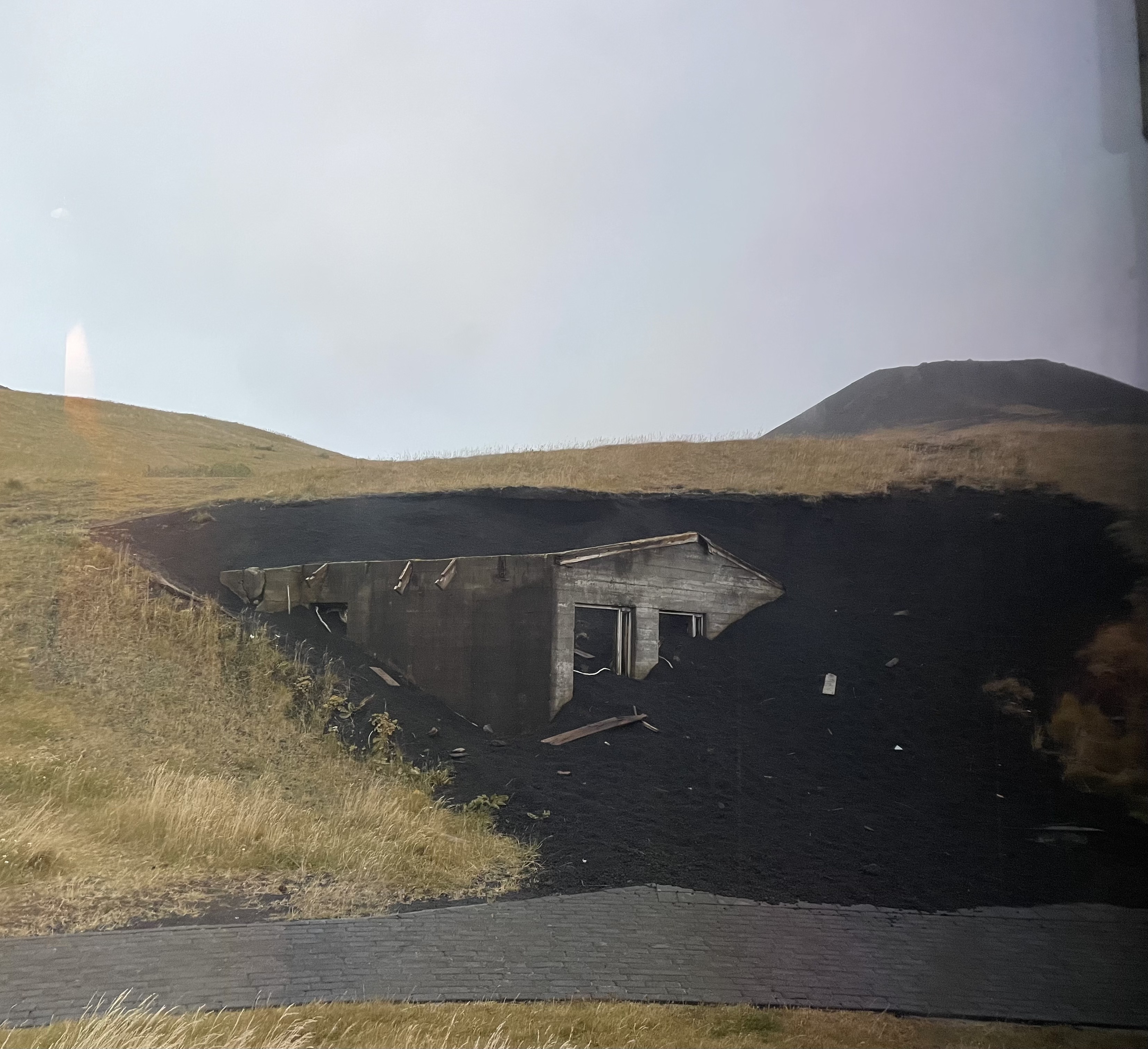
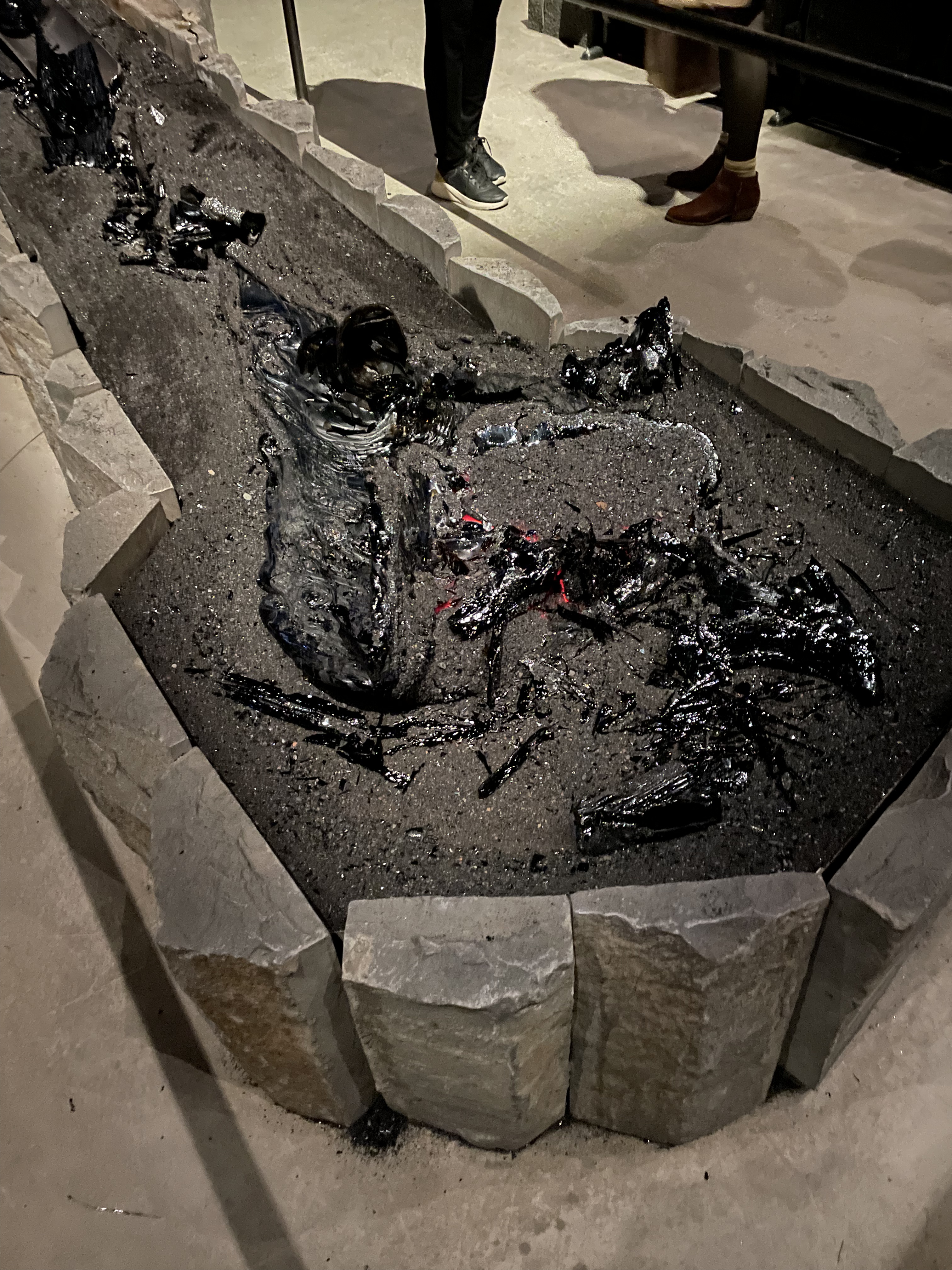
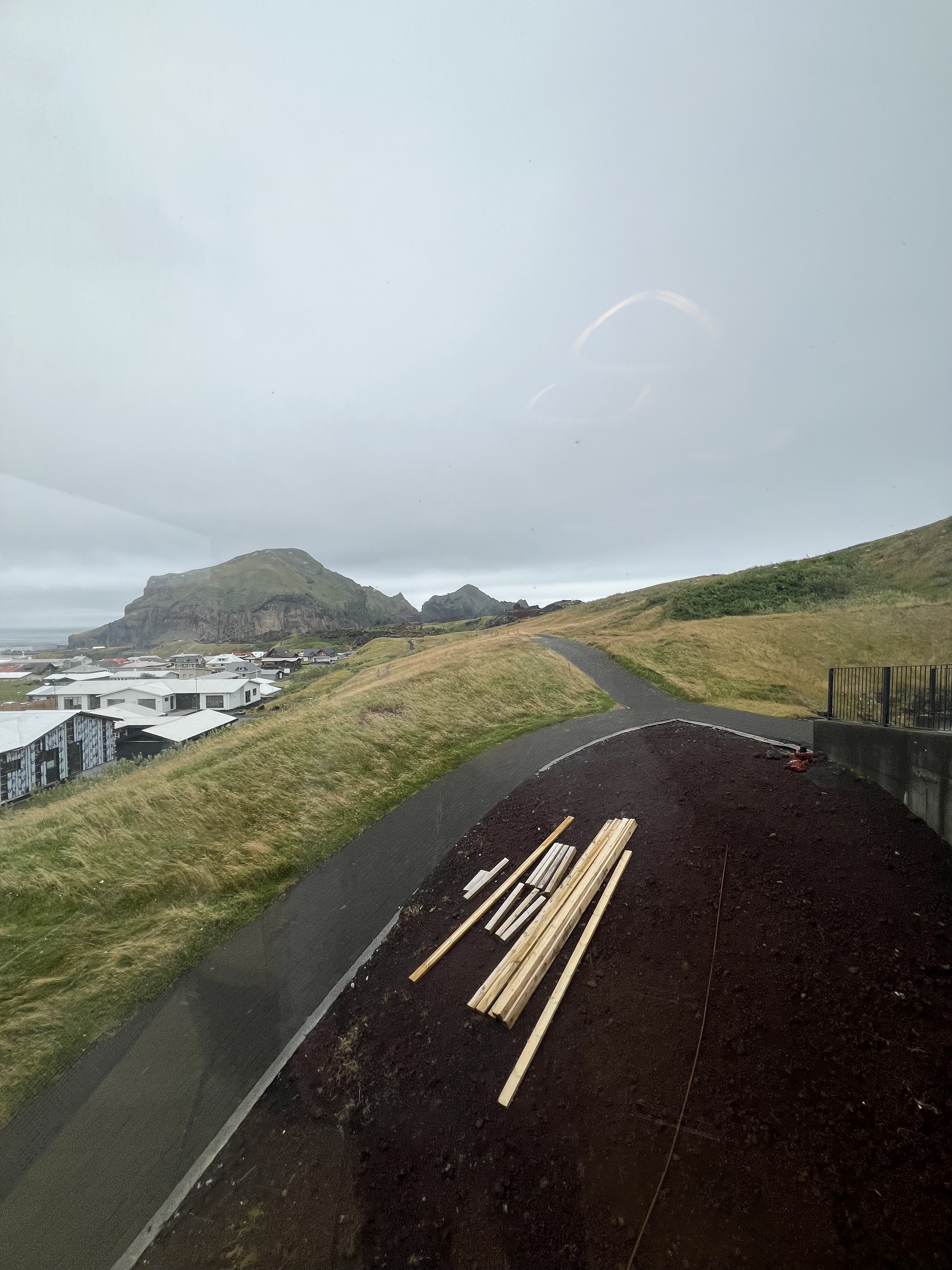
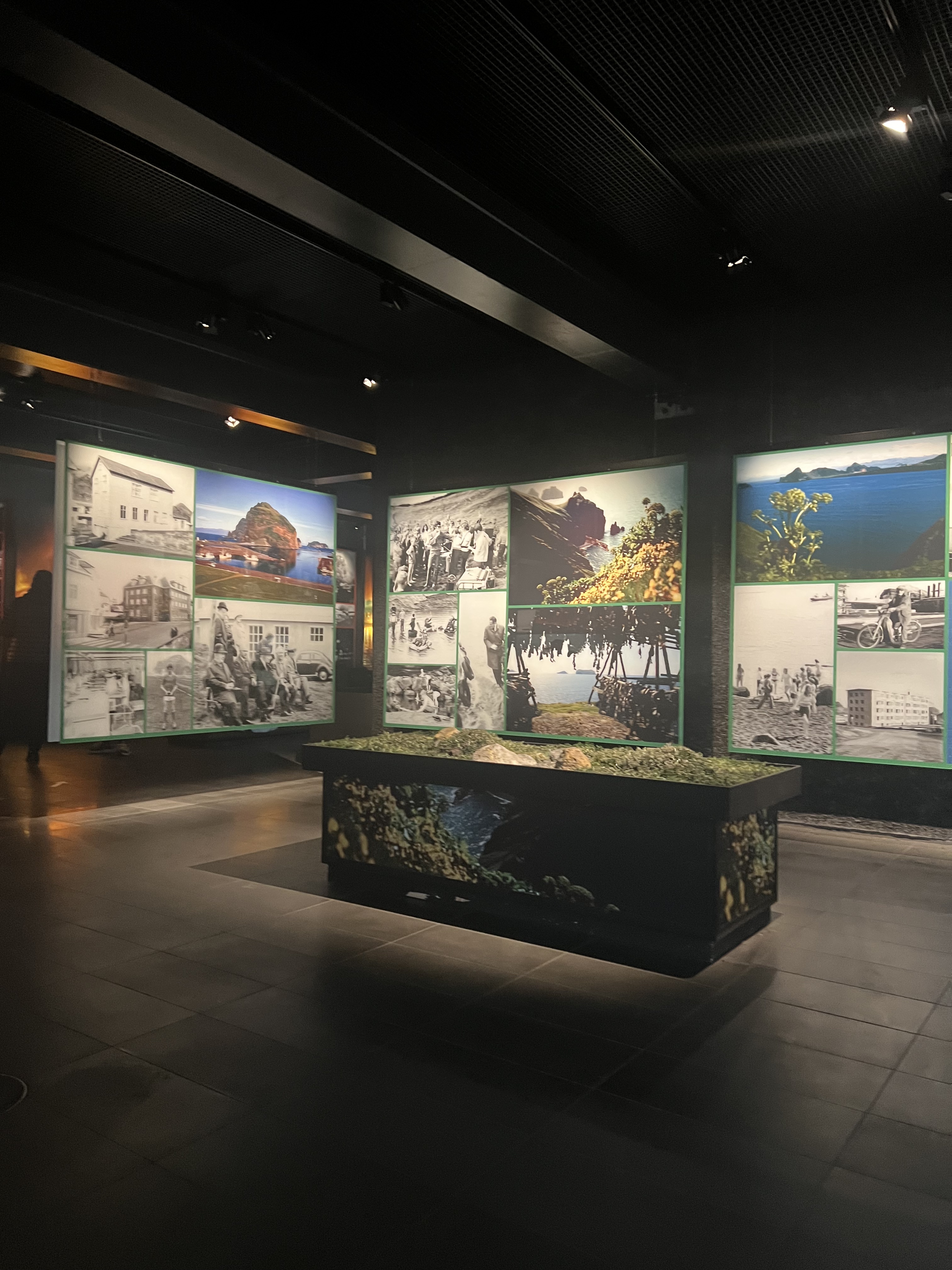
Our next stop was the site of the eruption of Eldfell on January 23, 1973 in the early morning hours. Lasting until July 3rd, nearly 1/3 of the homes and buildings were burned or buried under the lava and ash. A storm the previous day meant all the fishing boats were in port providing the means to evacuate 5000 people from the town quickly. As a result of the eruption the island grew by more than 2 square kilometres, the harbour entrance that was almost blocked by the lava ended with a better protected harbour, and the lava brought unlimited landfill material which had been scarce. It also brought new people to the island while others who lost their homes decided not to return.

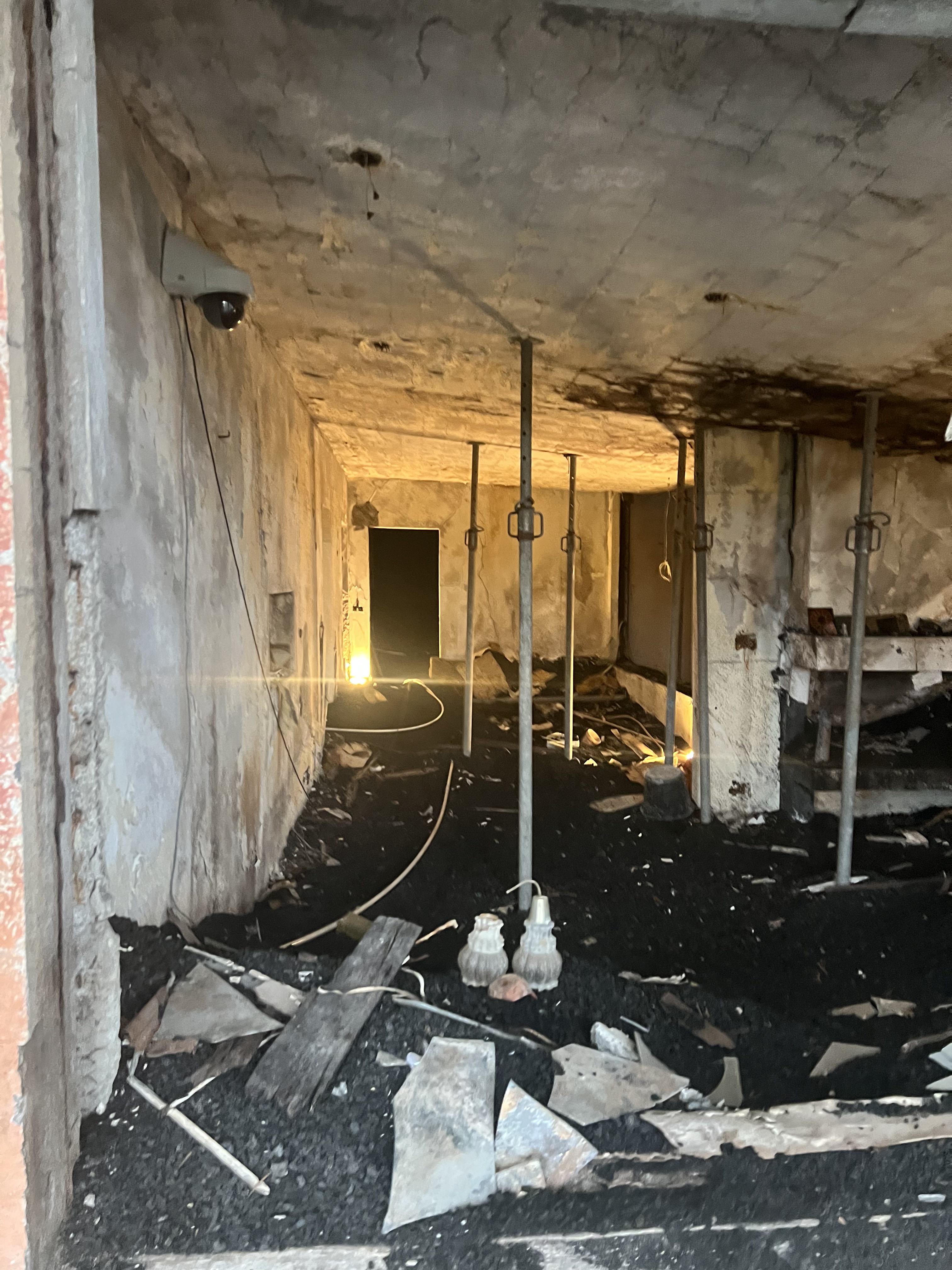
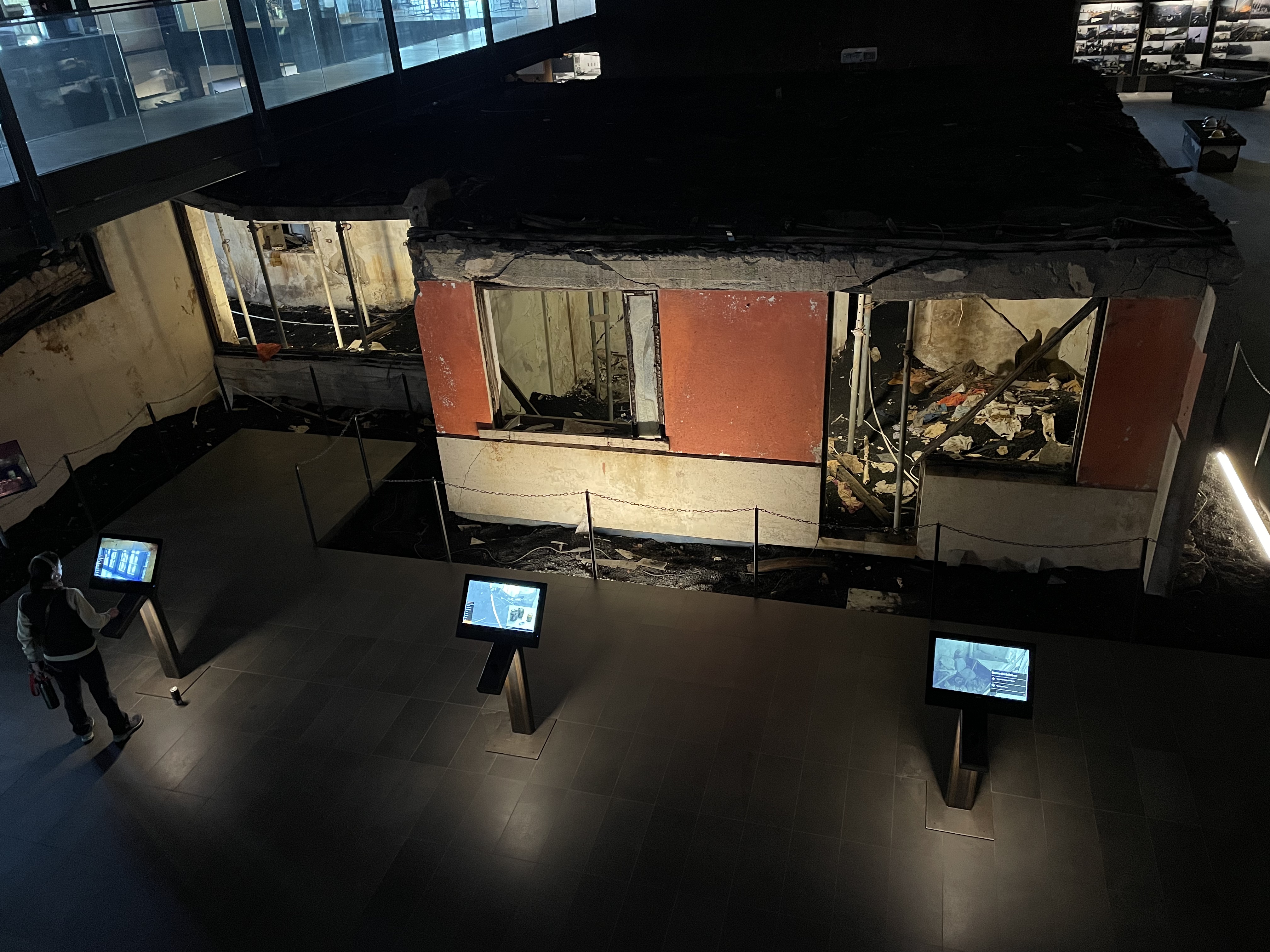
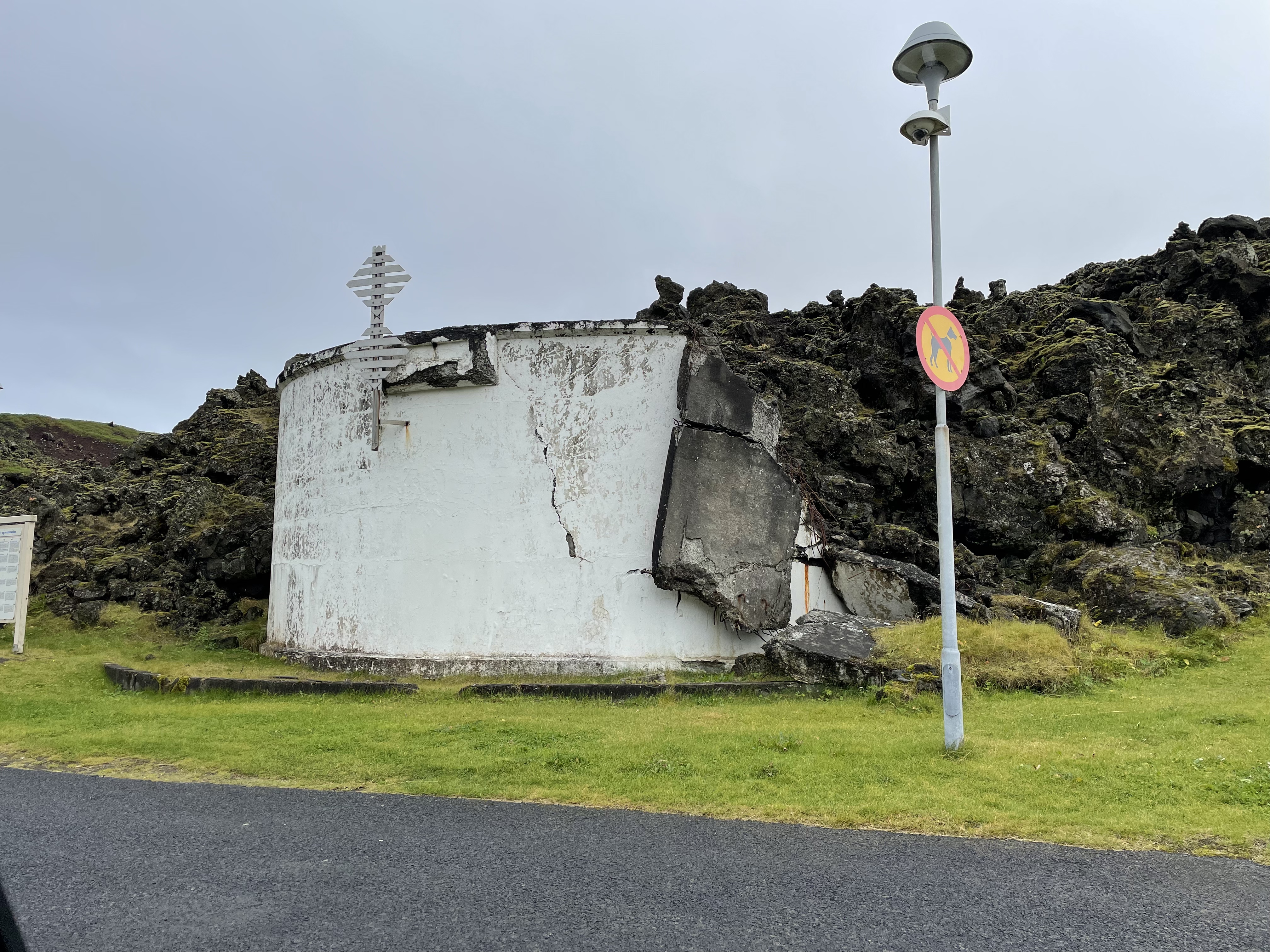
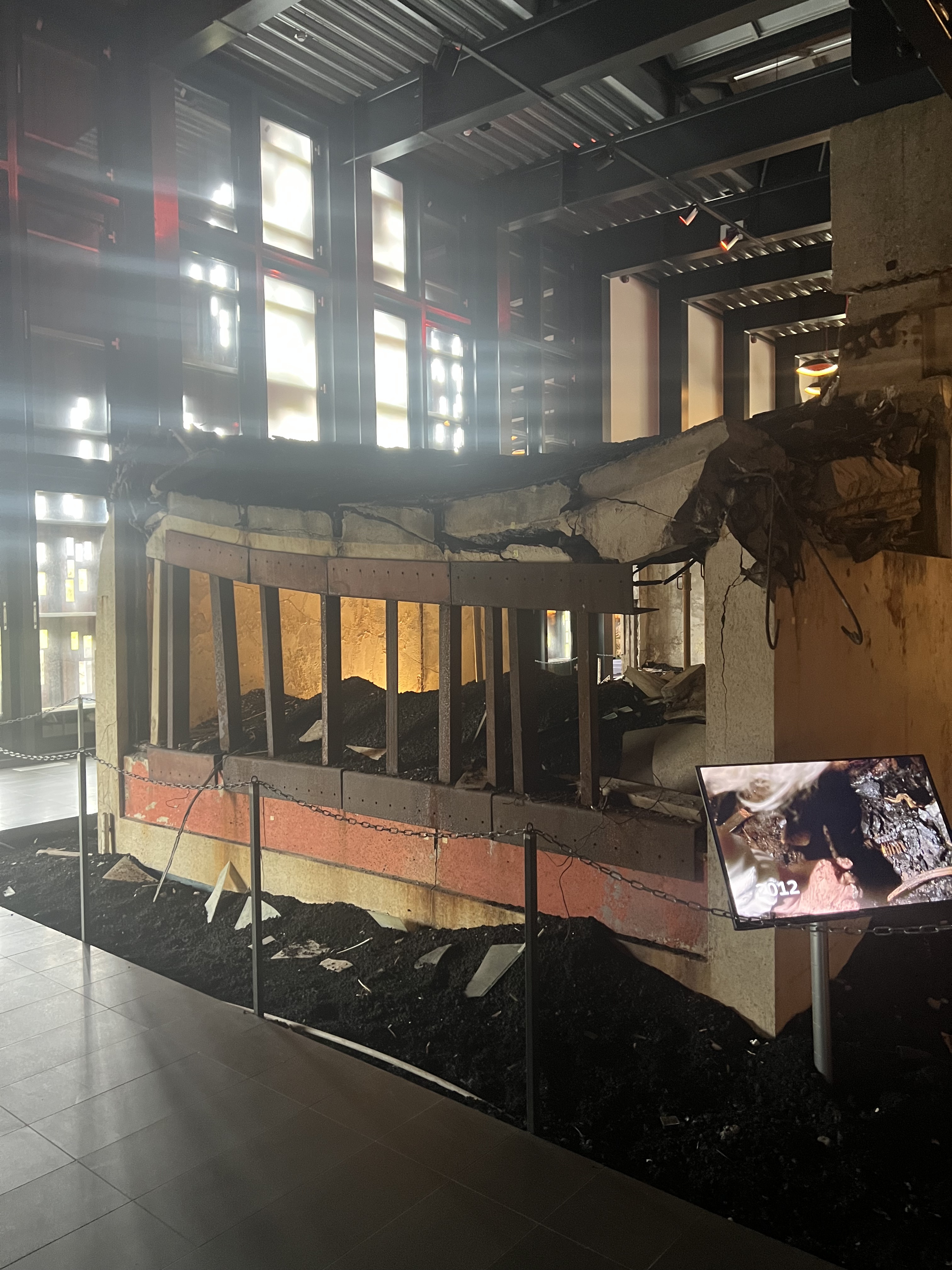
Most of the oldest part of the town was completely buried, but within months rebuilding and reconstruction of the town’s infrastructure was begun. In May 2014, a museum of remembrance was opened giving visitors a chance to go back in time and learn about the dramatic events that took place. The highlight is the house at Gerdisbraut 10, which has been excavated, and the museum built around it. It demonstrates the cruel treatment of nature. Interestingly, the cemetery gates were filled with lava and ash but survived. One of the pictures show the destruction of the island’s water tank, still filled with lava rocks.
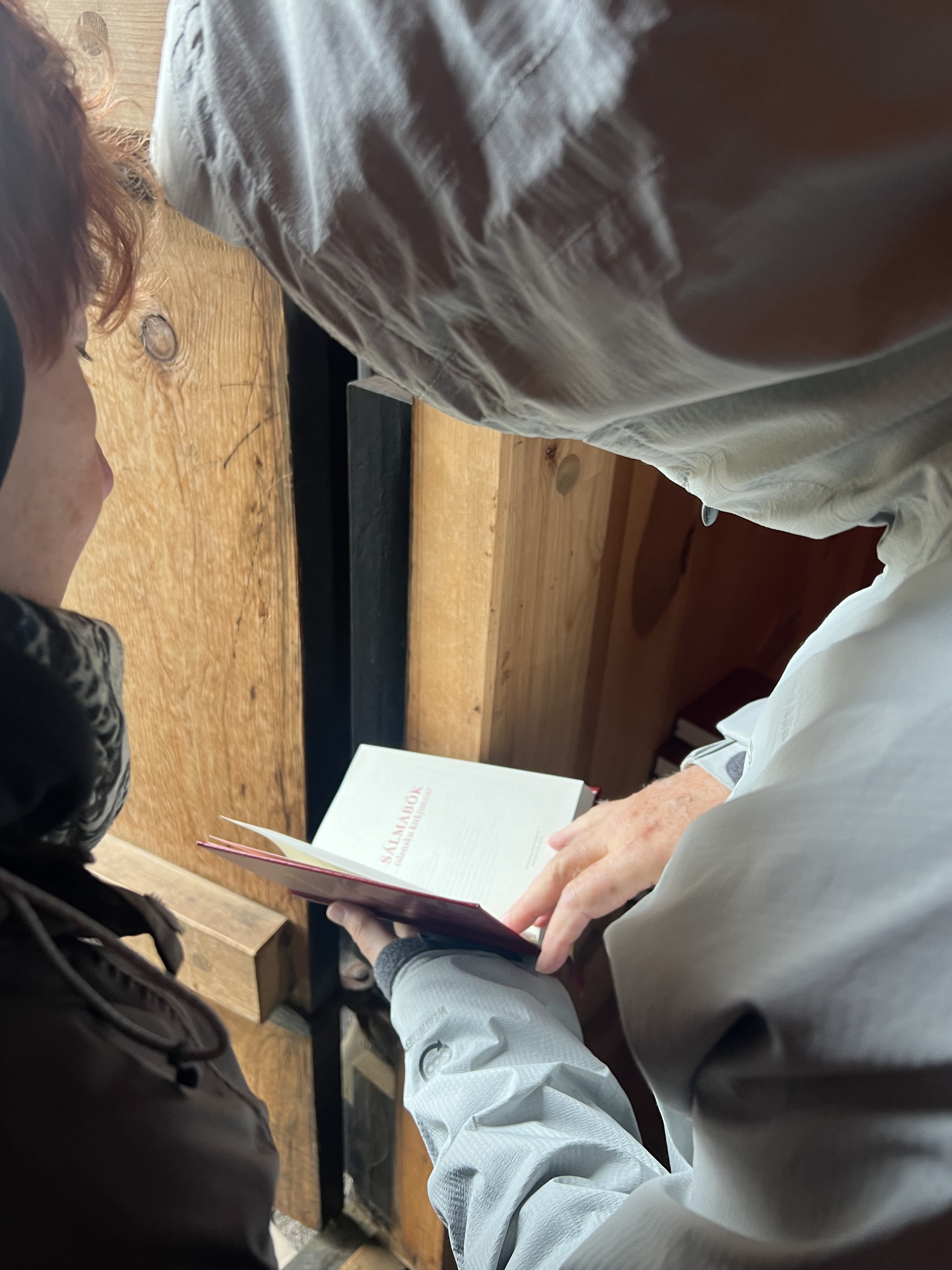
Lastly, we visited two reconstructed buildings down by the harbour. One was the home of Solveig Palsdottir, the first midwife on the island. The other was a replica church donated by Norway to celebrate the 1000th anniversary of Christianity on the island. Jennifer was taken by the children’s song The B-I-B-L-E in the Icelandic language.
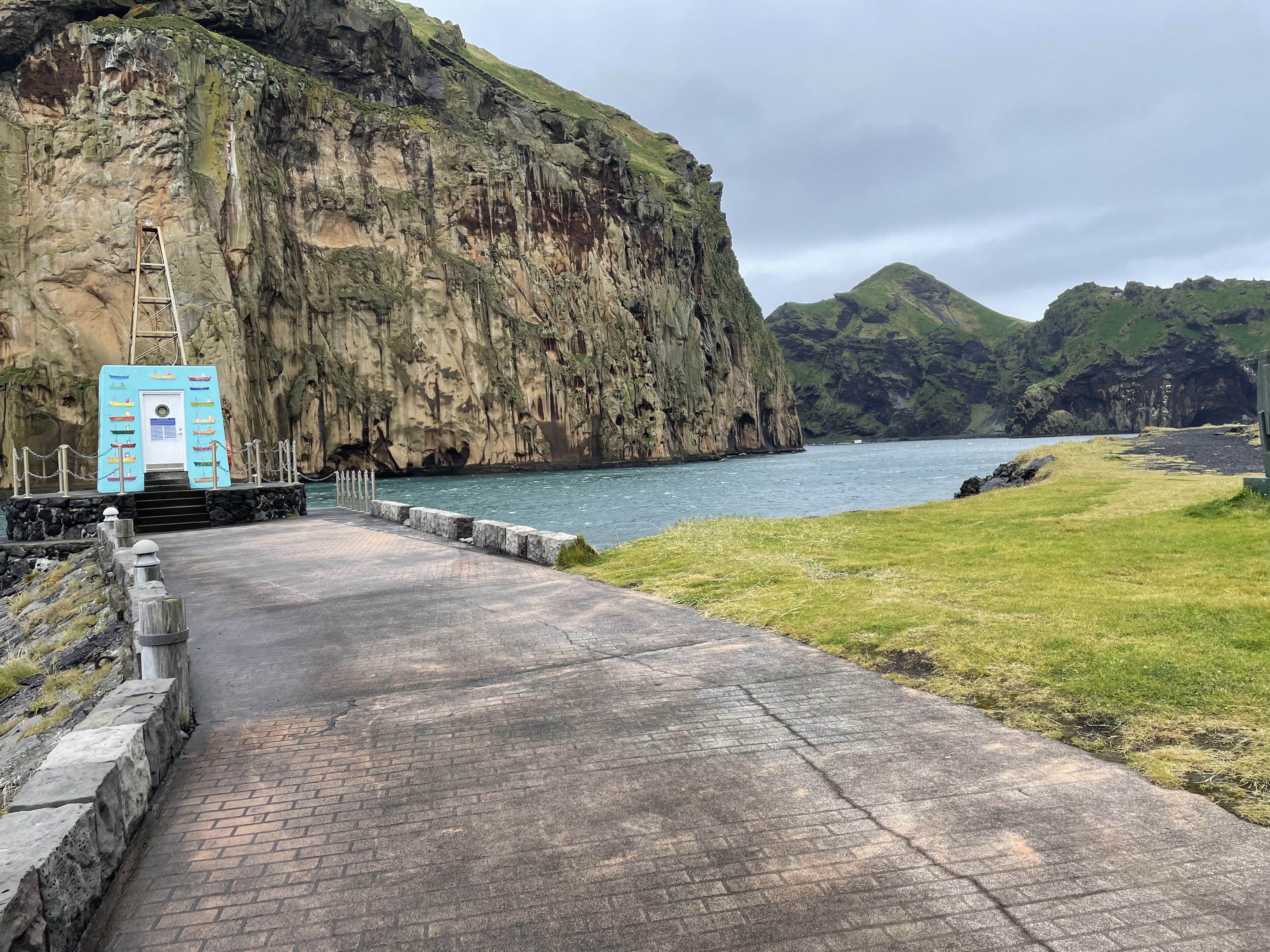
After all that, the day wasn’t quite over. We had a great meal at Gott’s restaurant in town and then dad and George visited the local swimming (thermal) pool for a quick dip. Unfortunately, the weather wasn’t really showing it off to its best.

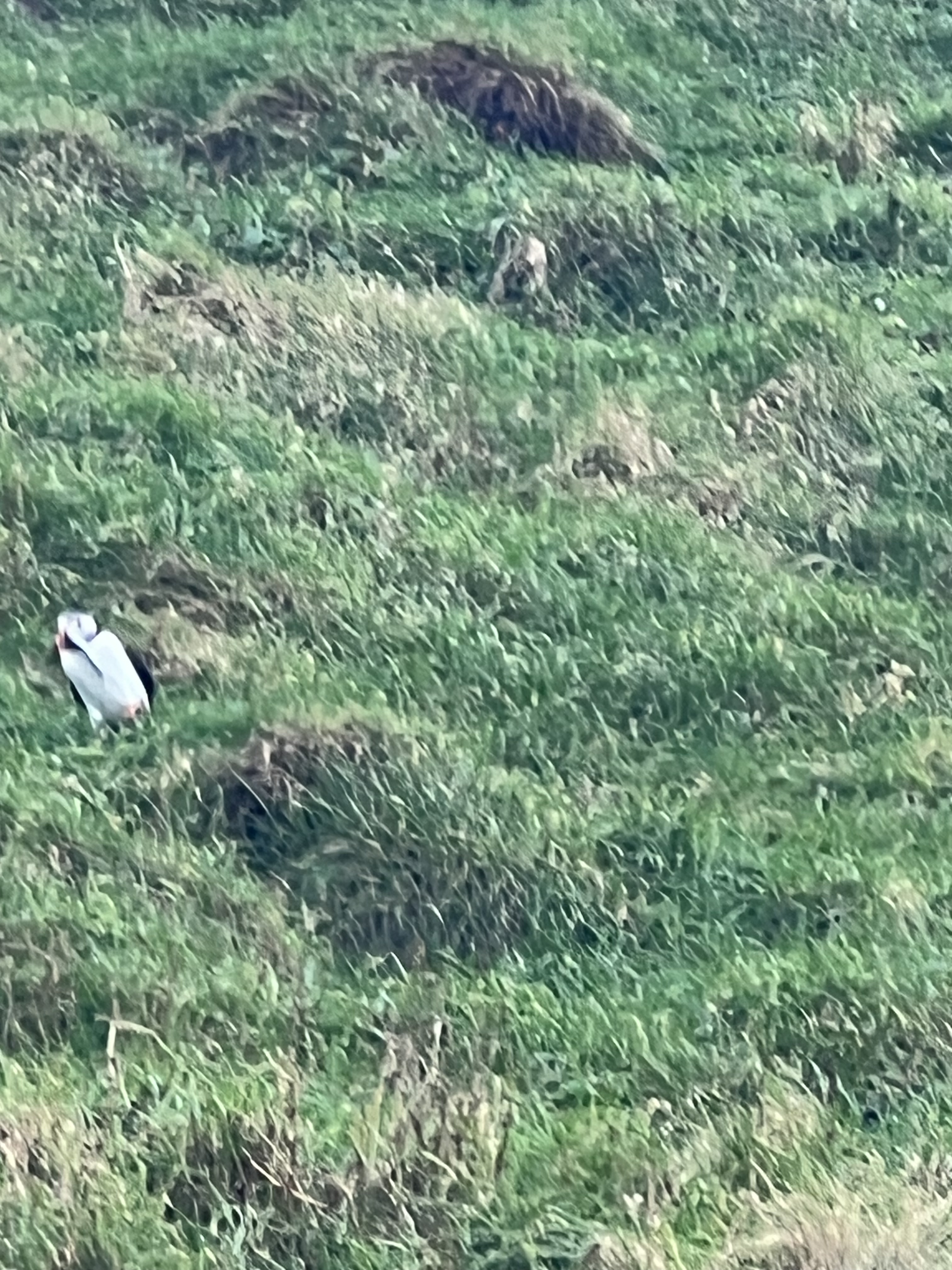
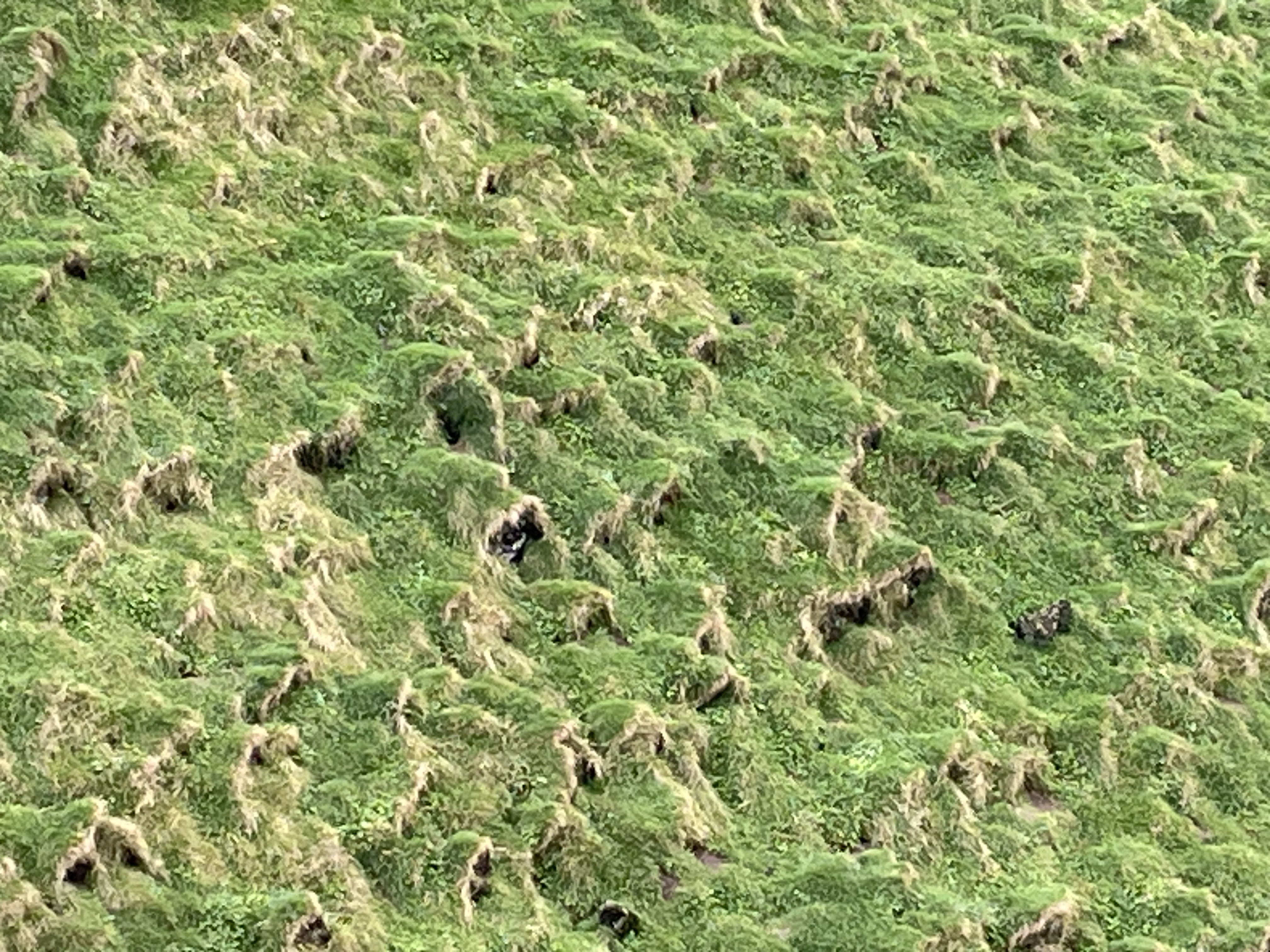
Day 4 – Today was all about the puffins and waterfalls. After a bit of a slower morning, we drove out to see where the puffins nest. The hillside is covered with their burrows and while most had already left their nests for the winter, there were still a few coming and going. They are very hard to capture on film!
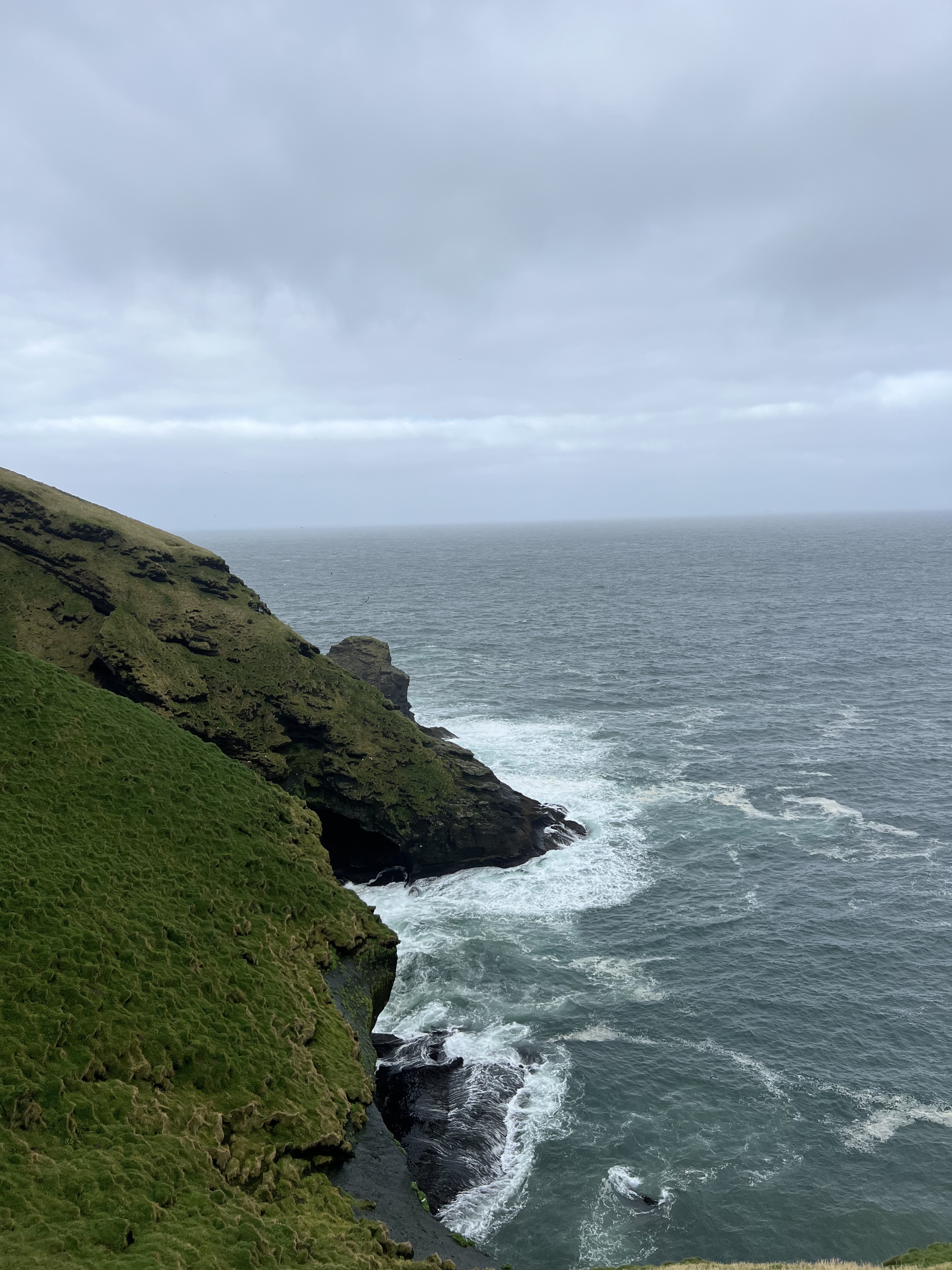
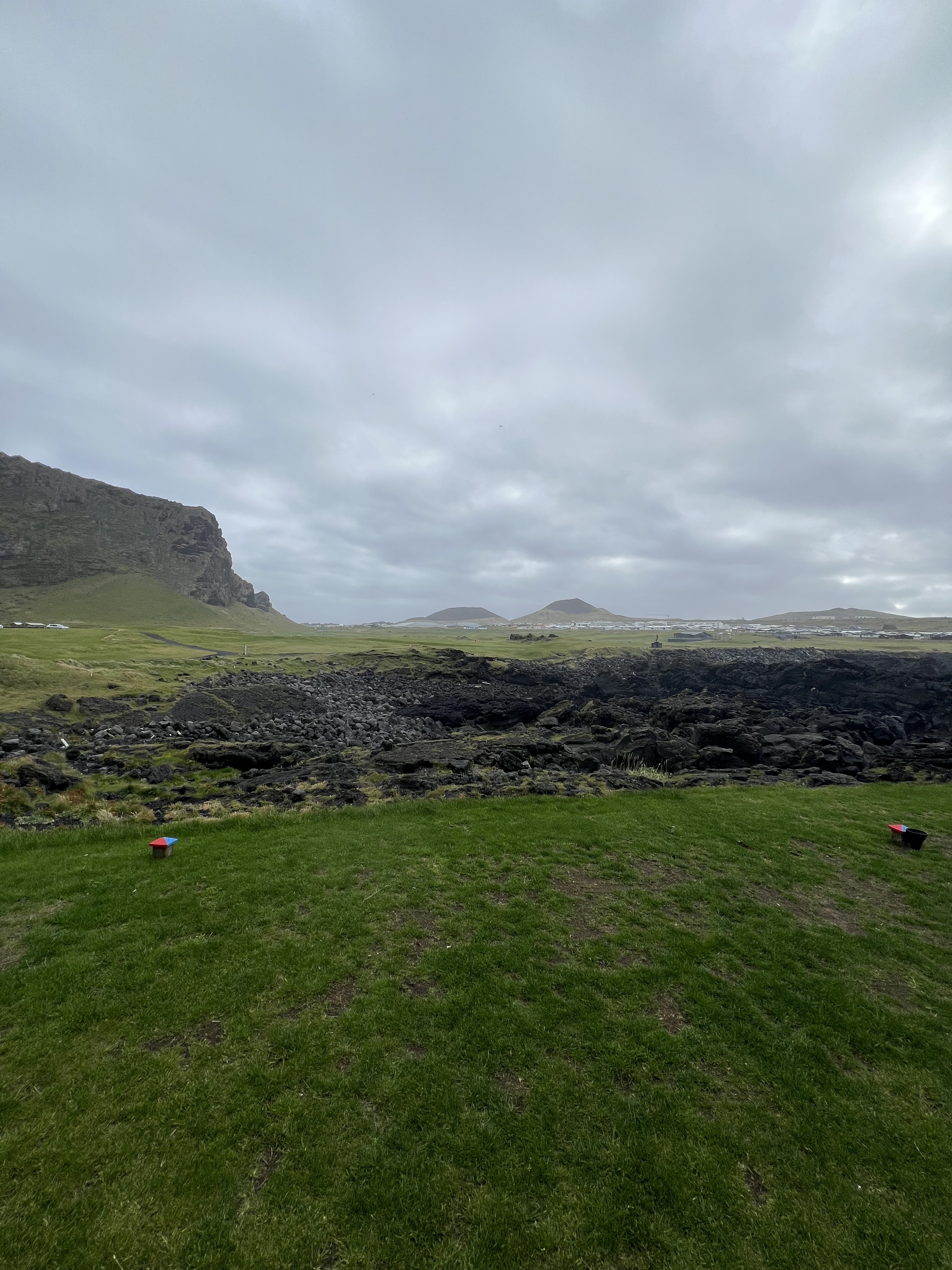
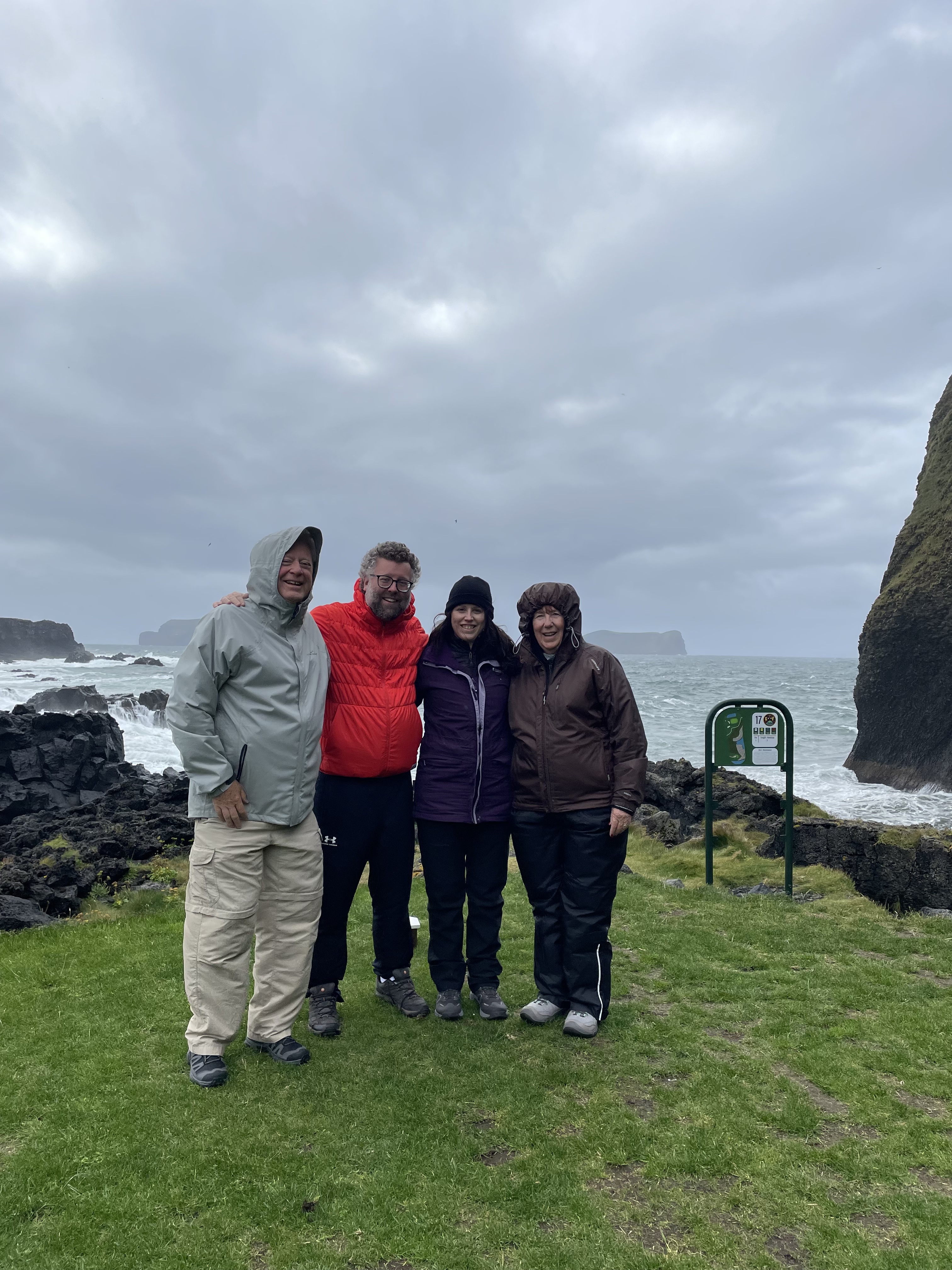
On the way back into town, we stopped to check out the golf course. Since it’s right on the coast it was a wee bit windy. In Iceland you don’t have gorse between the tee box and the fairway, you have large rocks and ocean. George figured he would lose lots of balls on this course with his hook swing. I wondered if you get a free drop if your ball landed in a lava-rock formation. There was actually a couple golfing as we returned to the car. It looked like a true slog in the wind!
We returned to town for lunch and an introduction to Icelandic yogurt called Skyr – delicious with fruit and toppings.

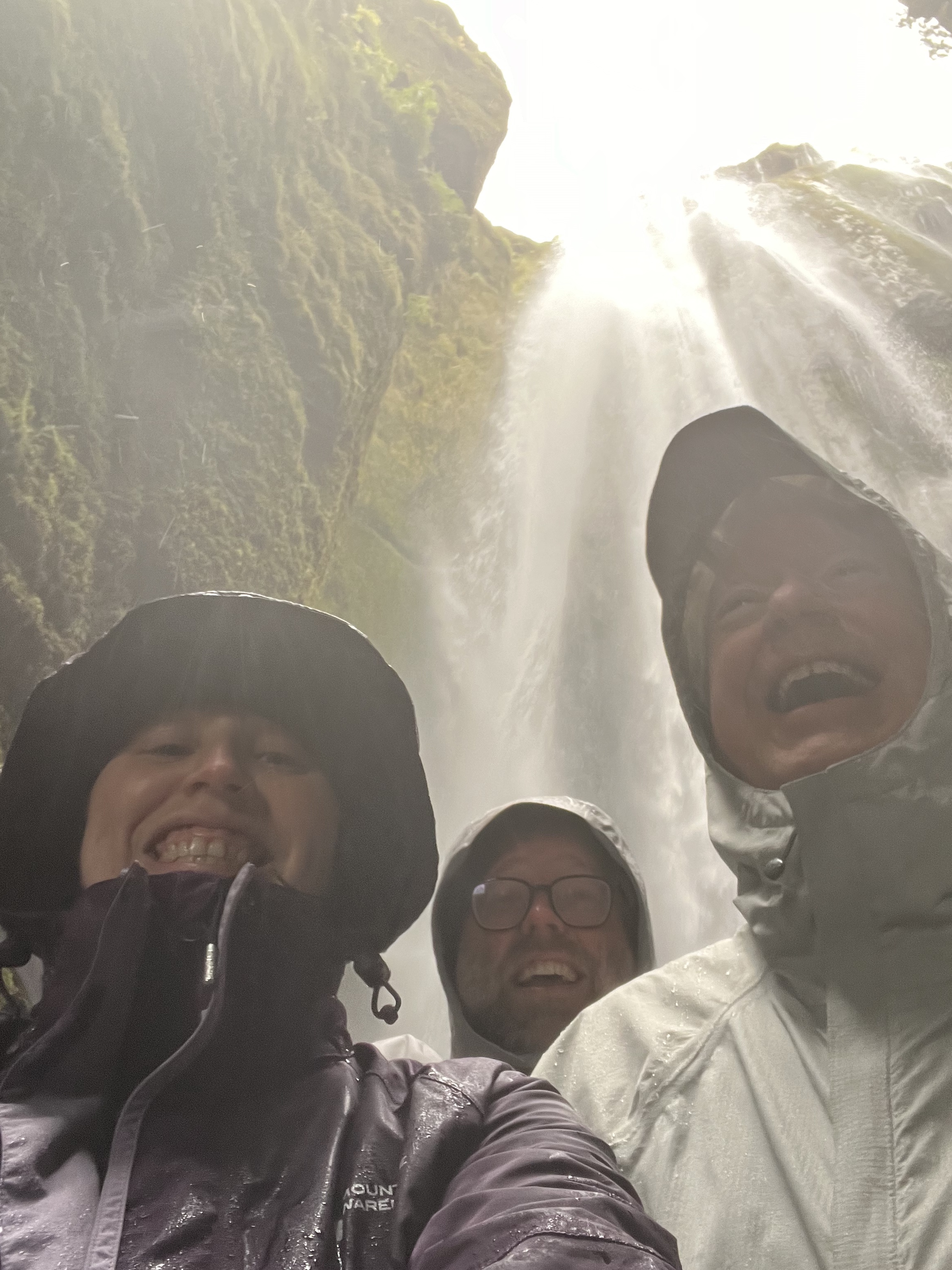
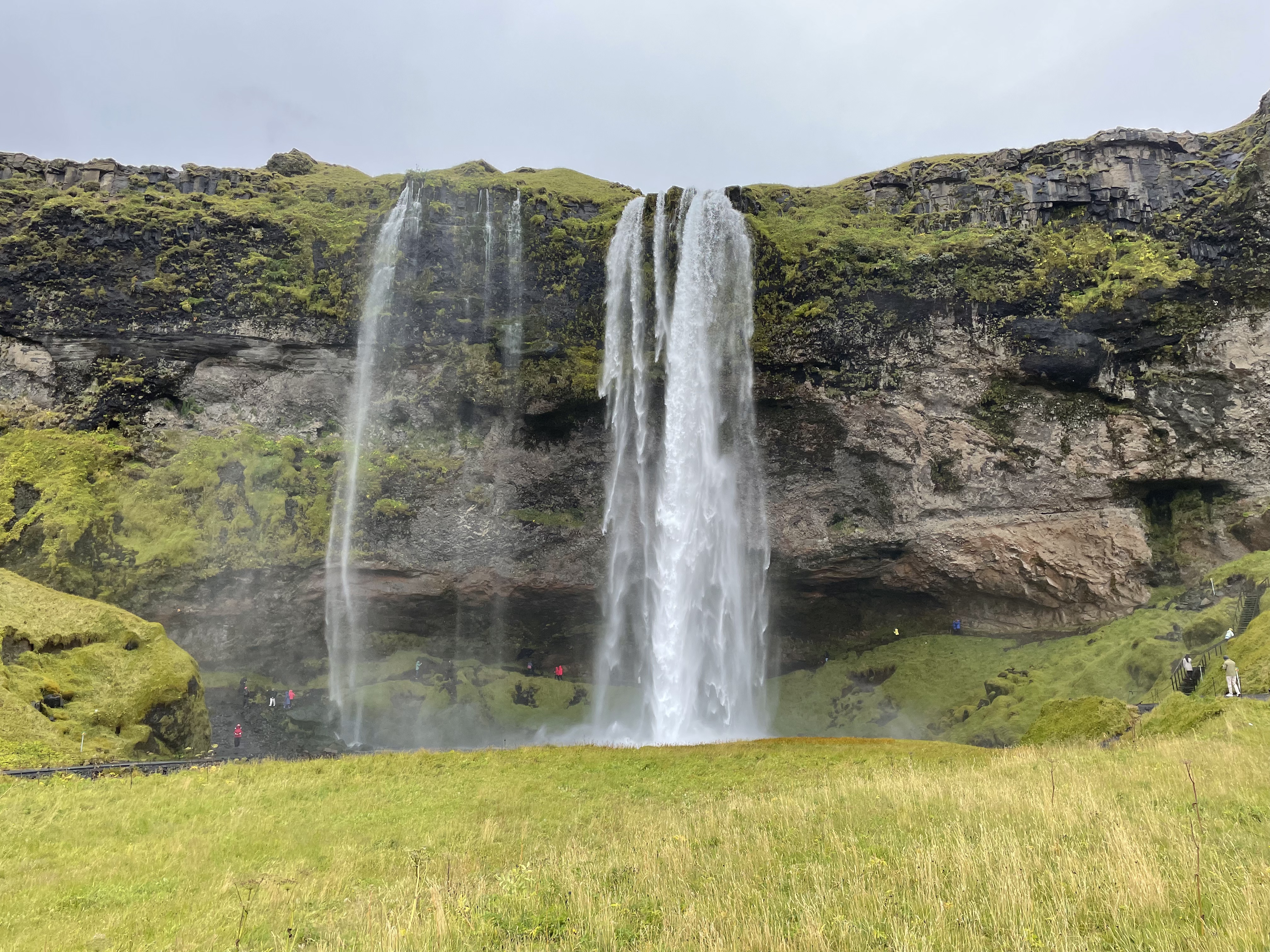
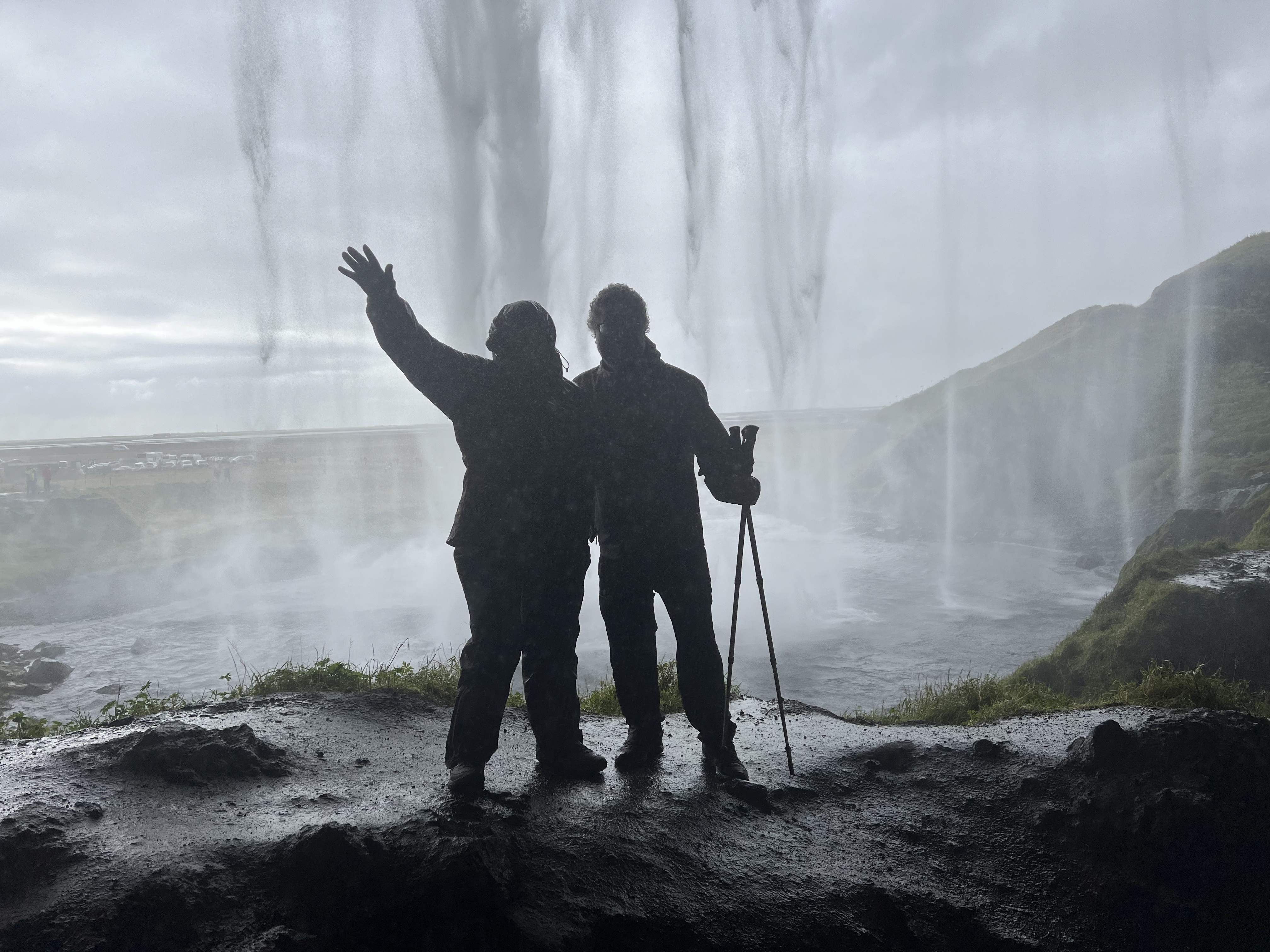
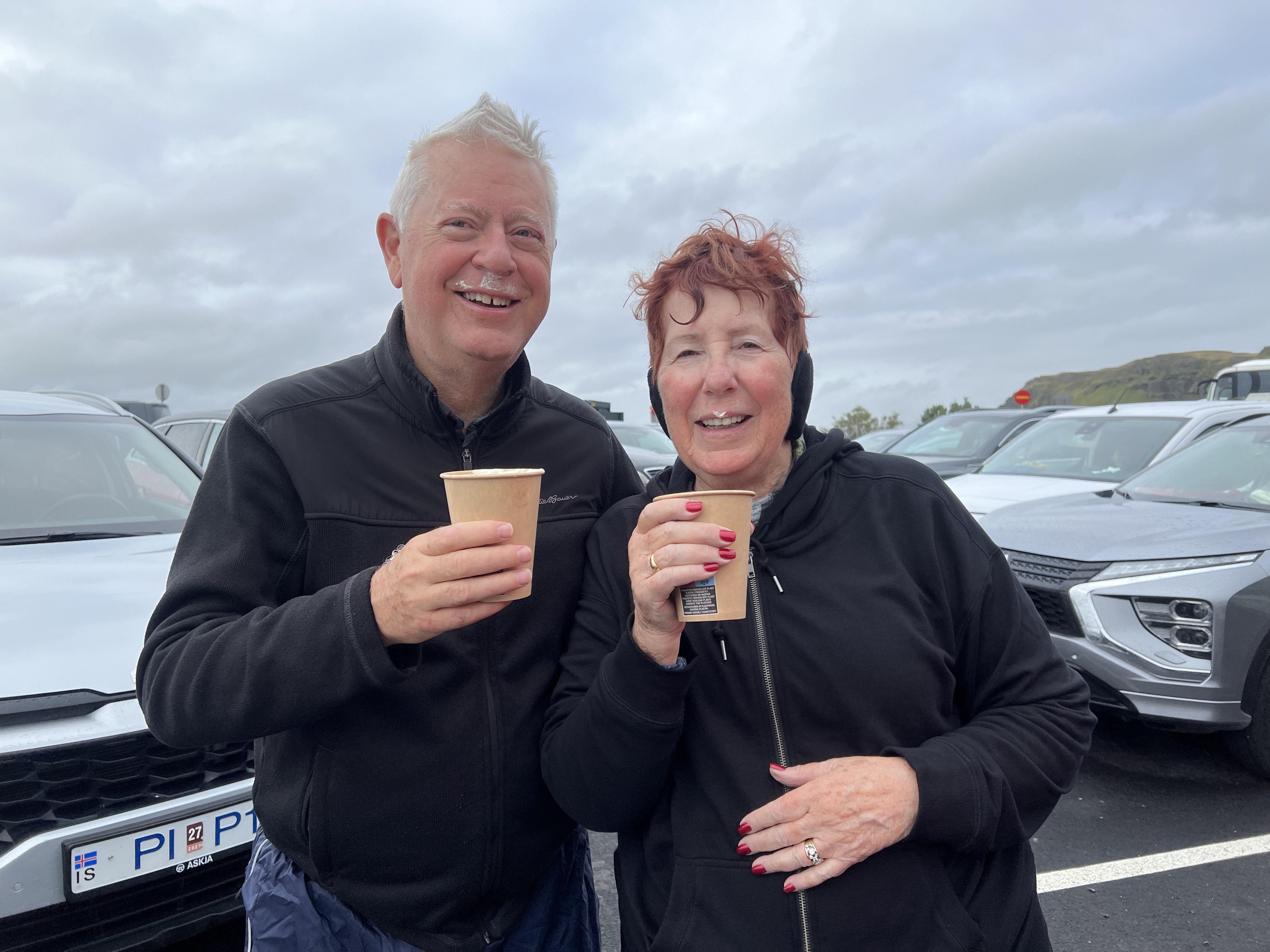
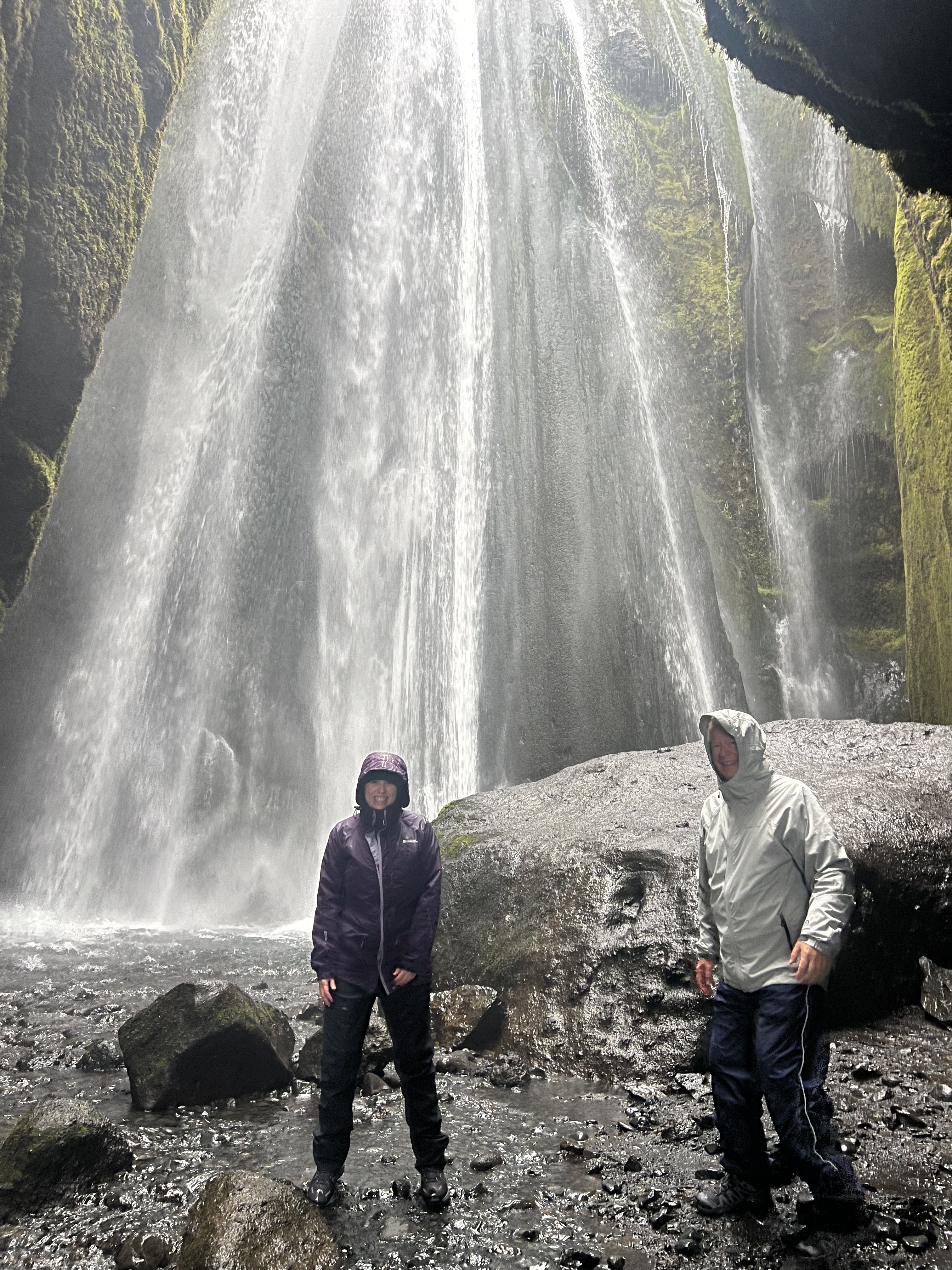
Then it was back on the ferry to head in the direction of Vik, stopping at no fewer than 4 different waterfalls. Our first stop was Gljufrafoss, a 131-foot waterfall hidden behind a cliff. Getting close requires getting wet and clambering over slippery rocks to arrive at a large flat rock where you can take pictures. Also at this stop was Seljalandsfoss, probably one of the more famous waterfalls. Standing about 197 feet tall, there is a path that allows you to walk behind the falls and experience another opportunity to get wet. I don’t think our son thought I would be able to do these two waterfalls but I persevered and had fun doing it. In between the two waterfalls is another small one with its own unique features. All of these waterfalls are accessible along a 1.2 km path from the parking lot. The hot chocolate was a welcome treat at the end of our hike.

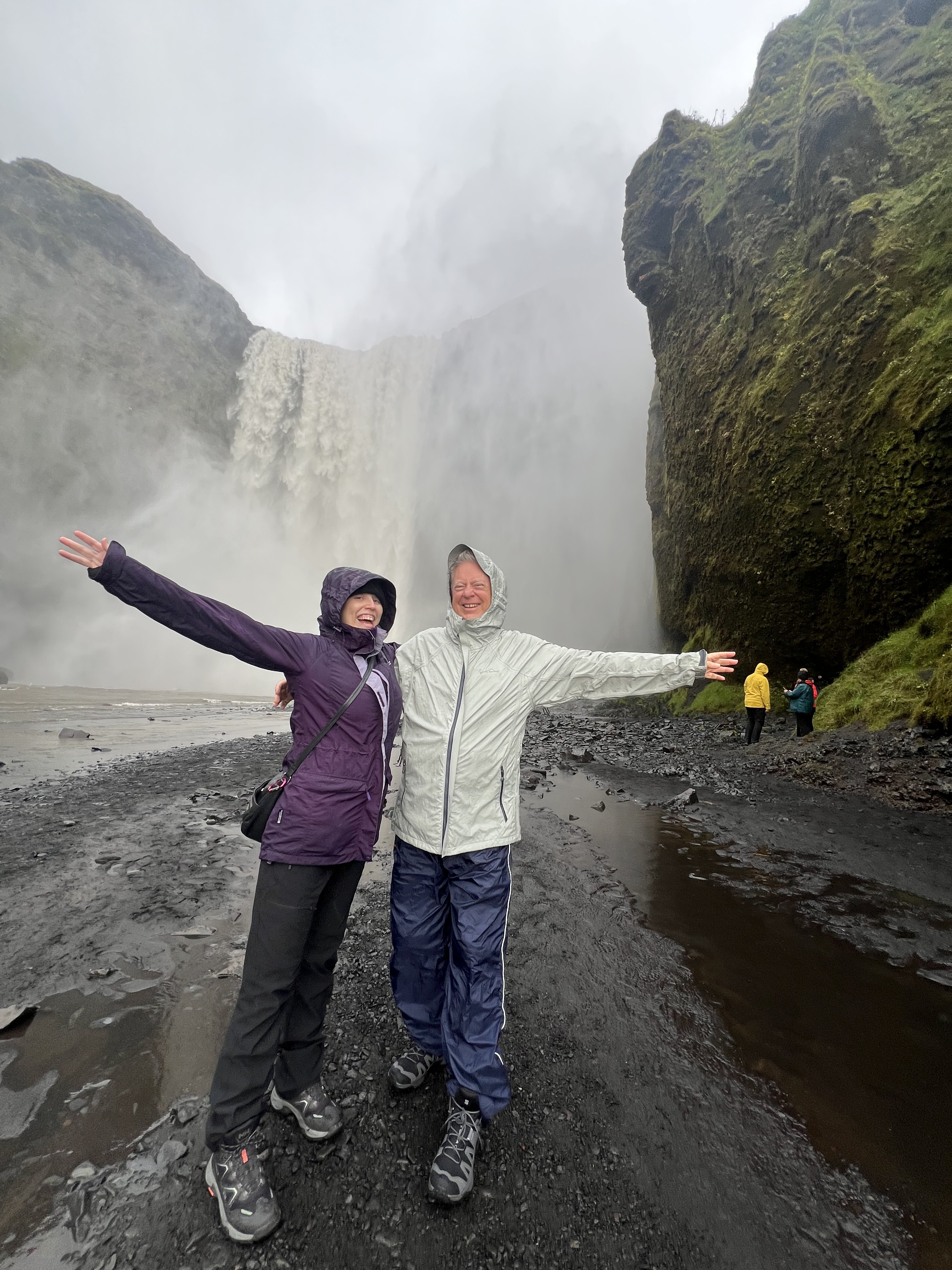
The last waterfall for the day was Skogafoss. At 82 feet wide and 200 feet tall, it is powerful and epic! It’s easily reached along a short path from the parking lot. We didn’t have time but evidently a hike up about 530 steps to the top provides you with incredible views of the waterfall and surrounding area.

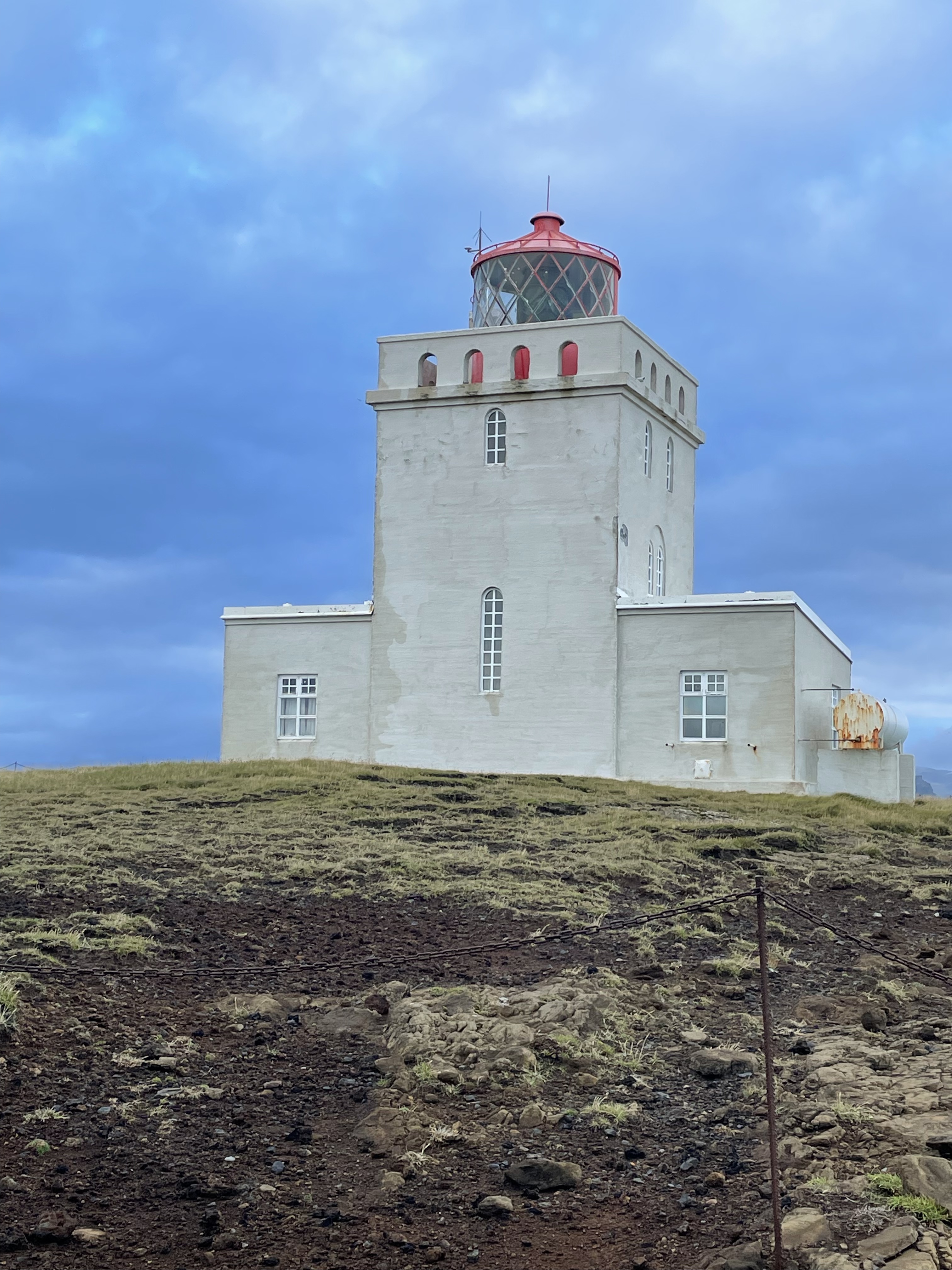
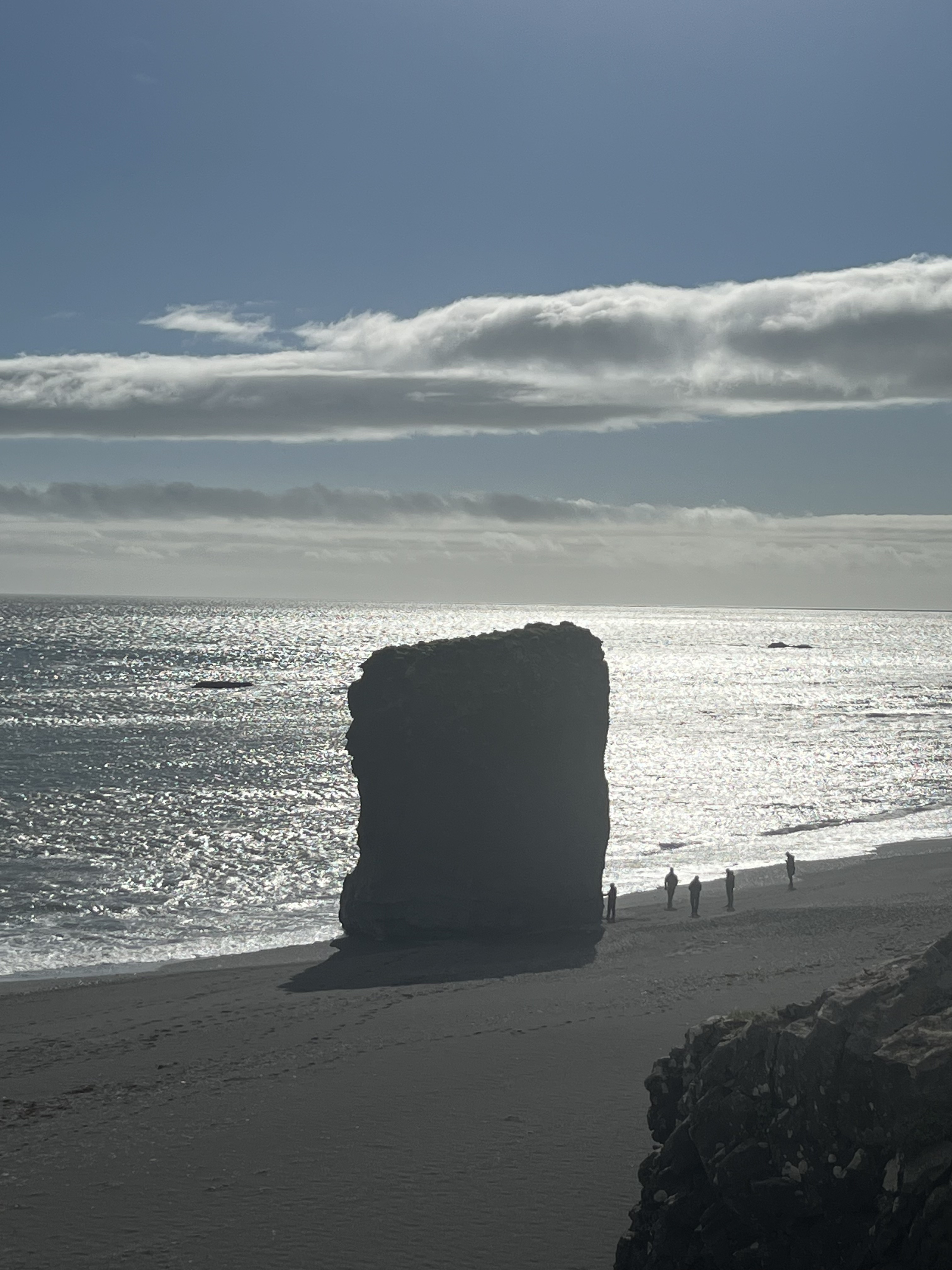
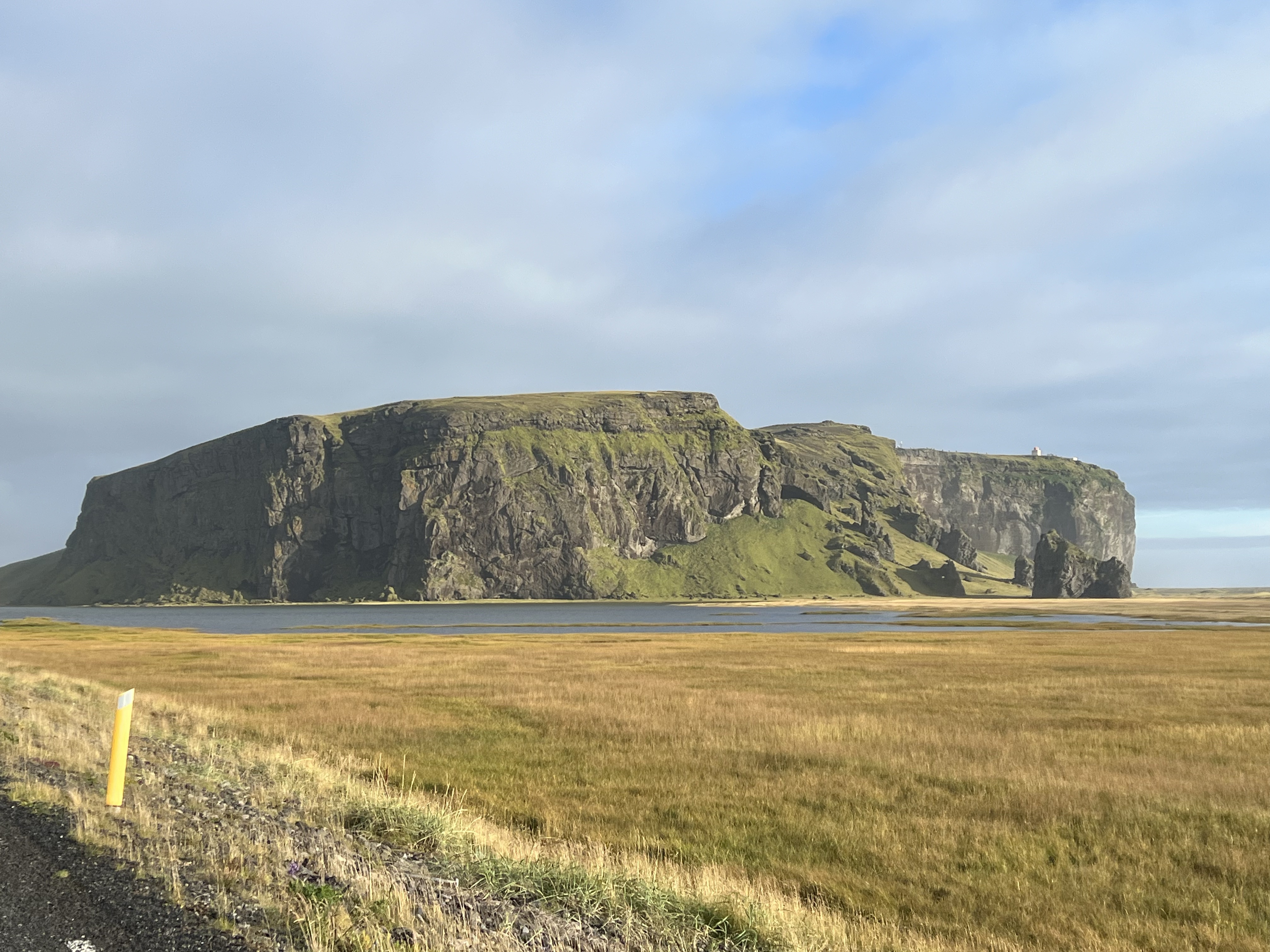
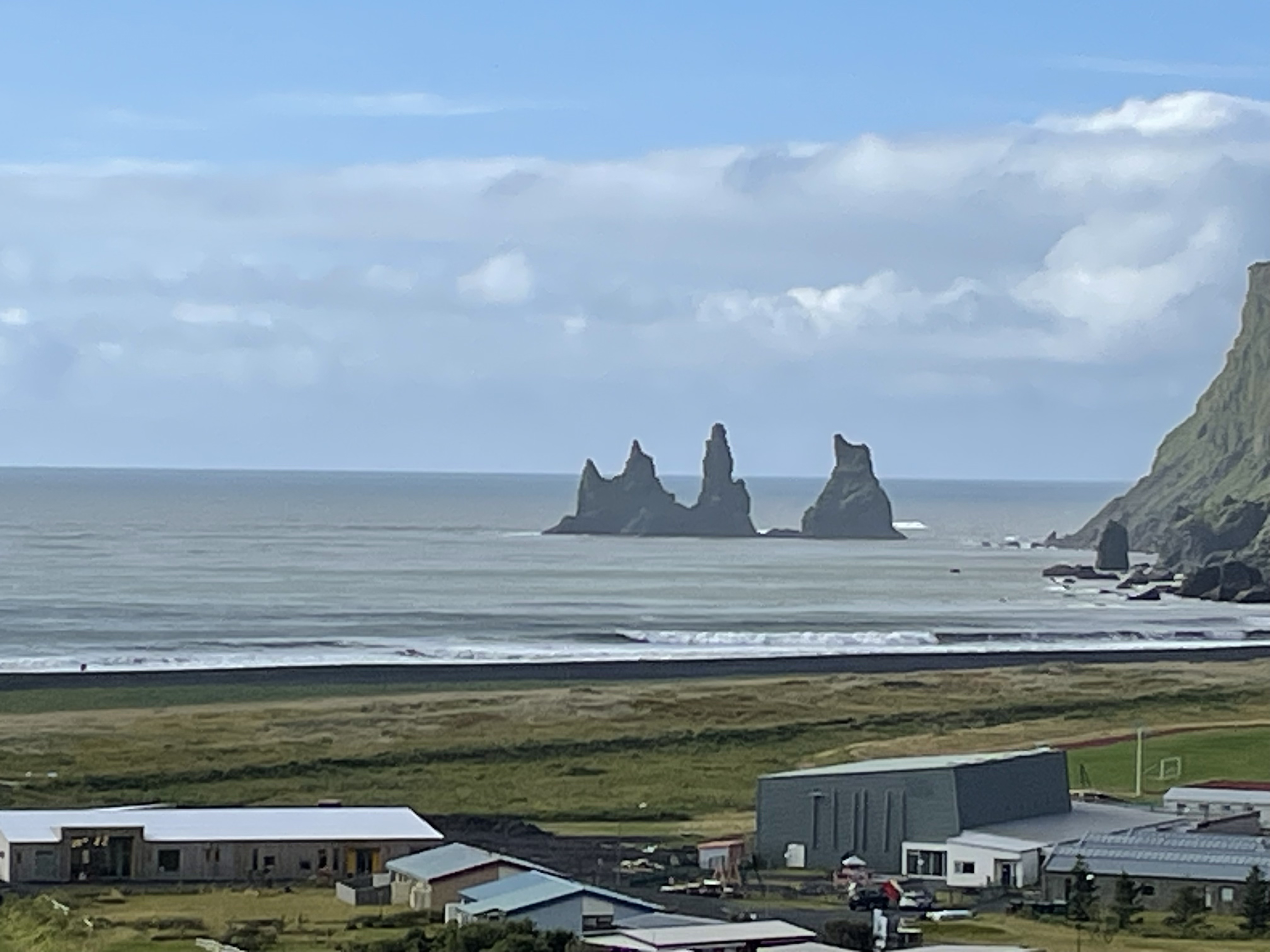
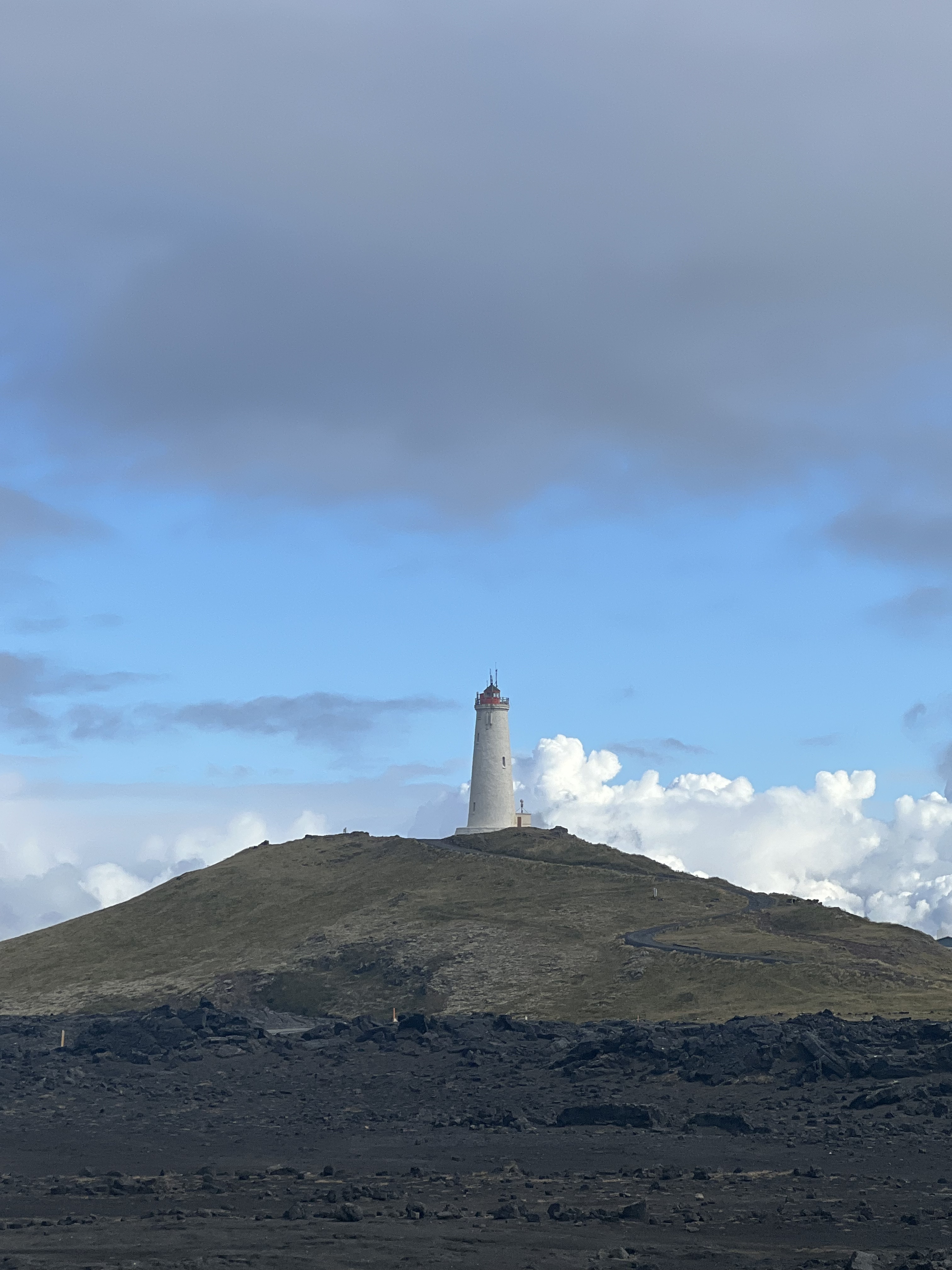
Our last stop was at Dyrholaey, a hill overlooking Black Sand Beach, with its interesting rock formations and old lighthouse. The black sand, of course, is formed from volcanic lava, creating a dramatic contrast against the powerful waves of the Atlantic Ocean. The basalt columns located along the cliffs of Reynisfall mountain are formed by cooling lava. According to local folklore, these large sea stacks were once trolls trying to pull ships from the ocean to the shore. However, the trolls went out too late one night and as dawn broke, with sunlight on the horizon, the trolls turned into stone. Dyrholaey means “the hill island with the door hole” and perfectly describes the enormous lava arch that dominates the coastline. The lighthouse, completed in 1927, isn’t open to visitors and still emits a white light every 10 seconds guiding ships around Iceland’s southernmost point.
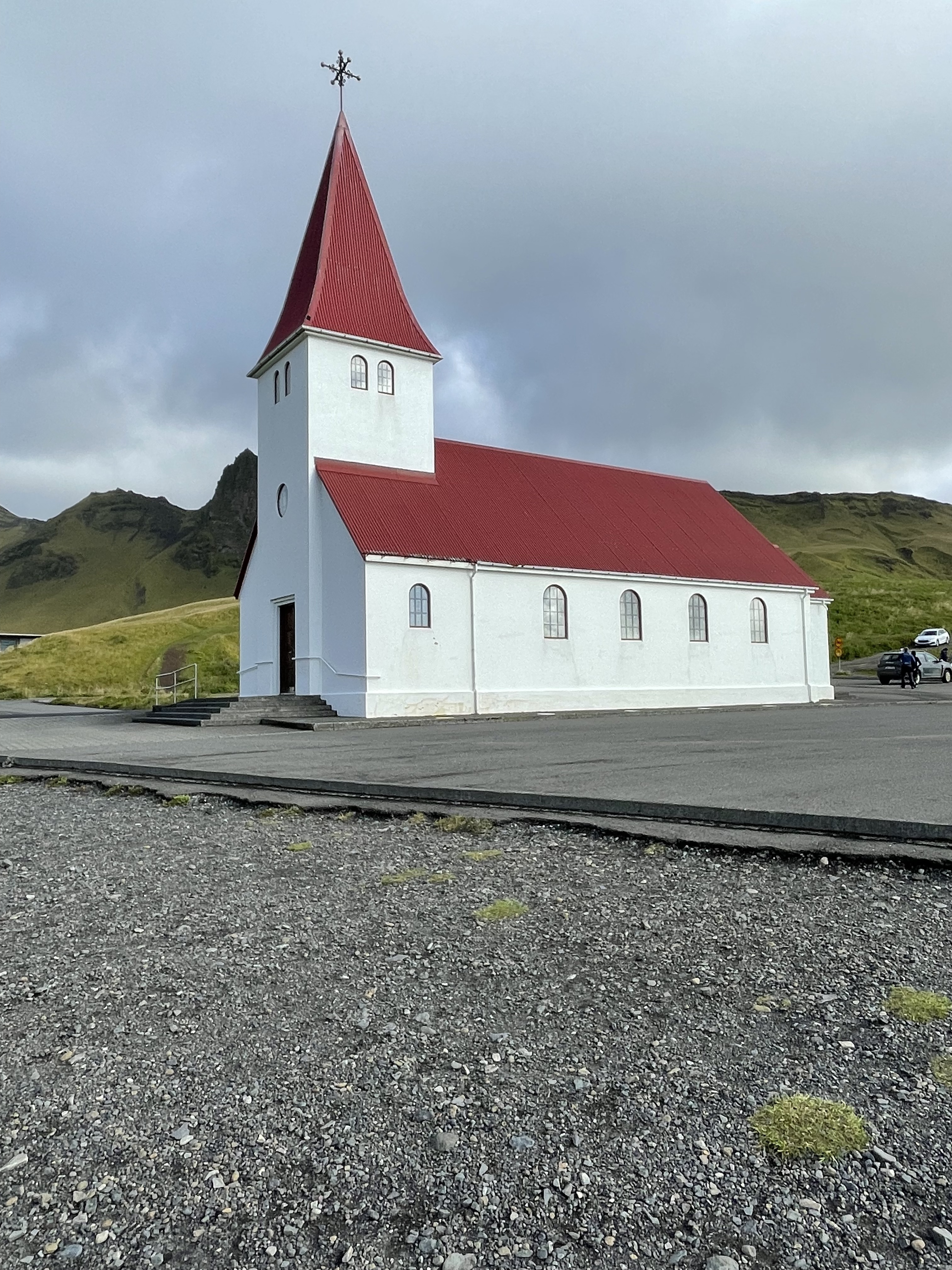
Then it was into Vik and our lovely home for the evening. We rented at Vik Apartments on the same property as the Vik Hotel. We had a big two-bedroom suite that included a full kitchen and laundry facilities. Time for showers, clean clothes and a nice dinner across the road at the Strodin Pub (great choice!). Since we didn’t want to buy breakfast supplies for just one morning, we were able to enjoy a full breakfast at the Vik Hotel next door.
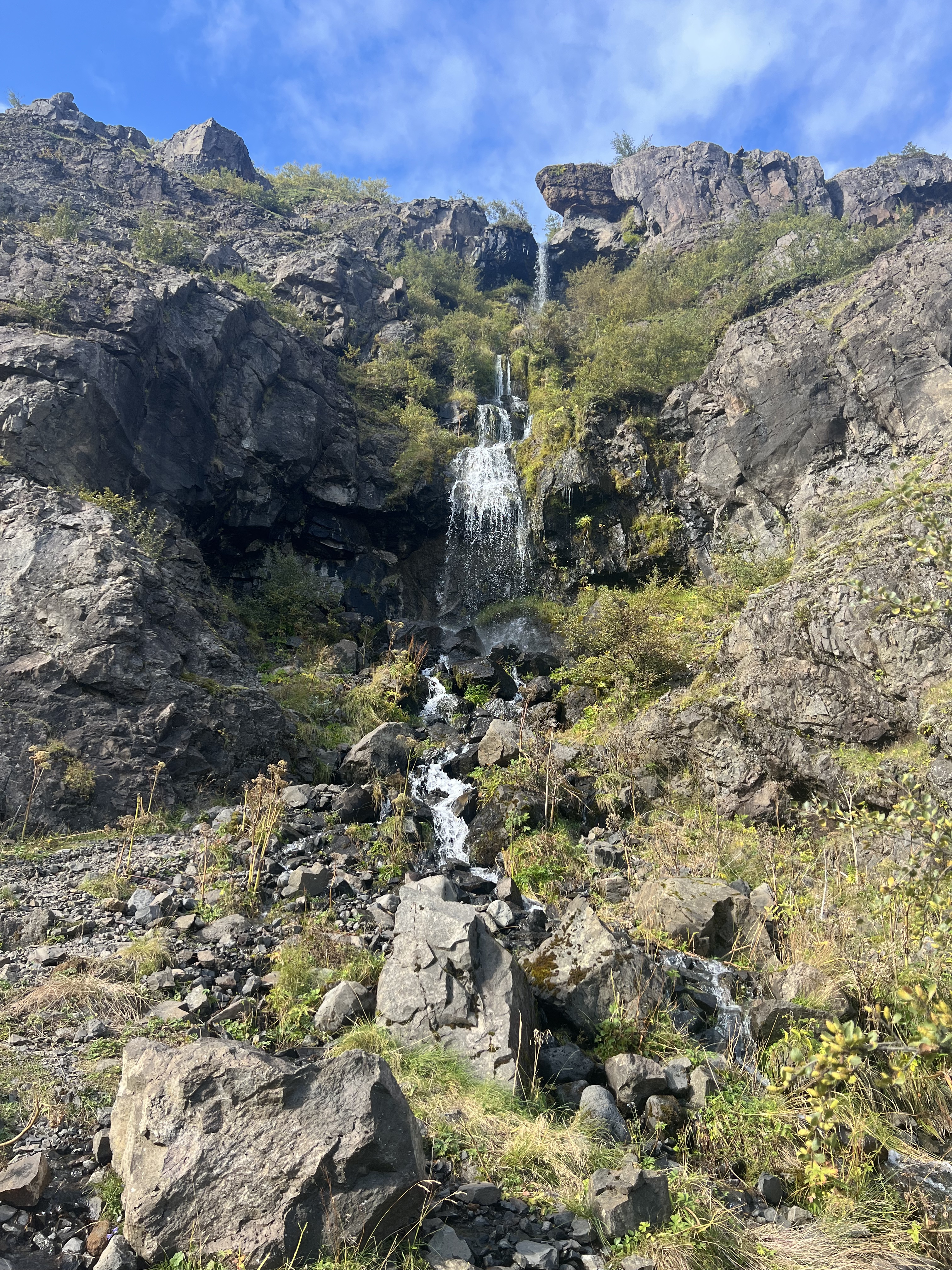
Day 5 – Today’s adventure was all about glaciers, which cover about 11% of the land area of Iceland. Our first stop was at the Fjadrargljufur gorge, made famous by Justin Bieber music video, I’ll Show You. The kids hiked part way up to the top while we just sat on a bench in the sun. Unfortunately, the gorge was closed after Justin’s escapade but has now reopened with more stringent rules to protect the fragile nature of the area. It’s a shame that so many areas have to be roped or fenced off because people just don’t understand that tromping all over the flora and fauna, rather than staying on the path, will eventually spoil things for everyone.
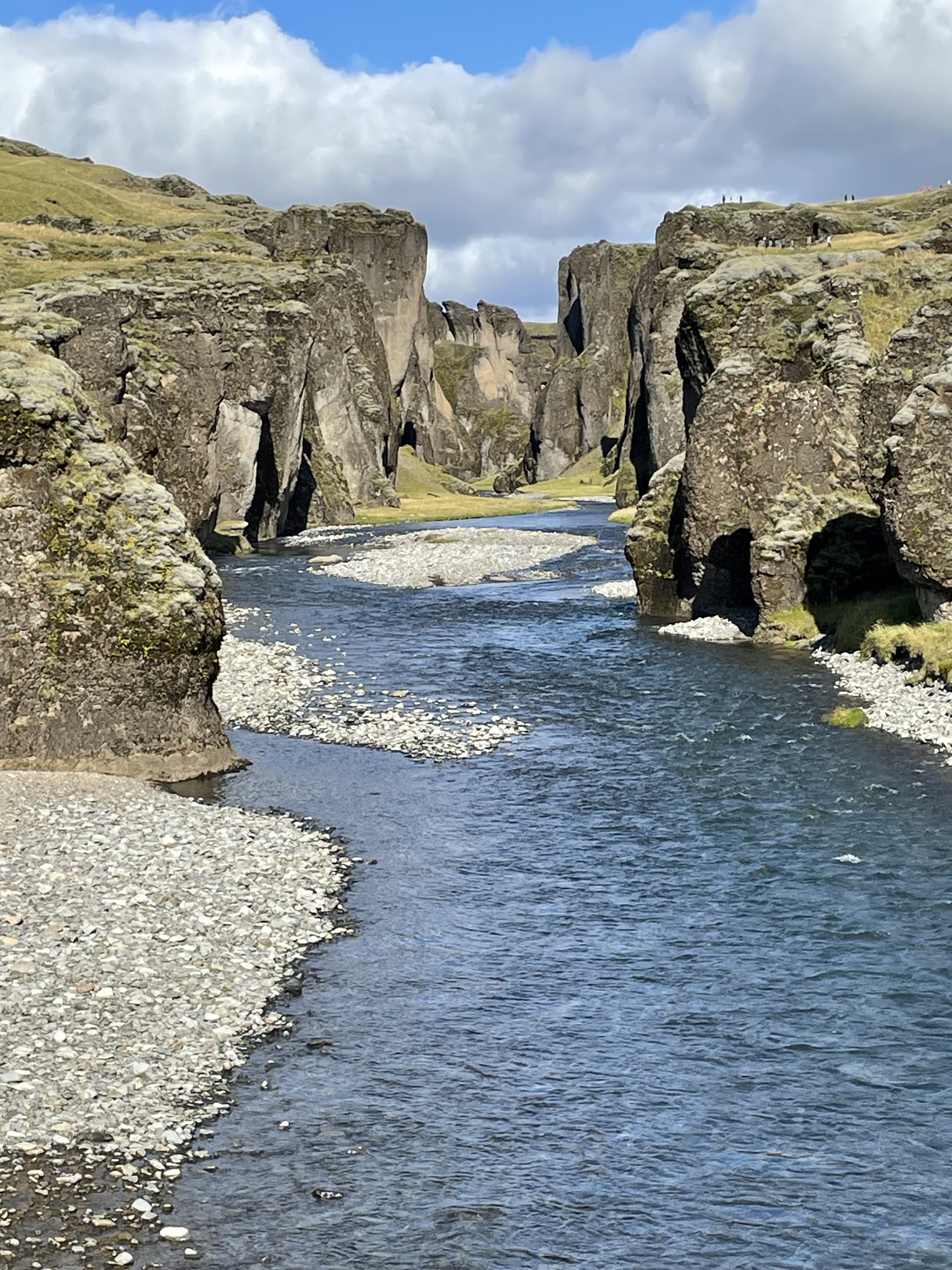
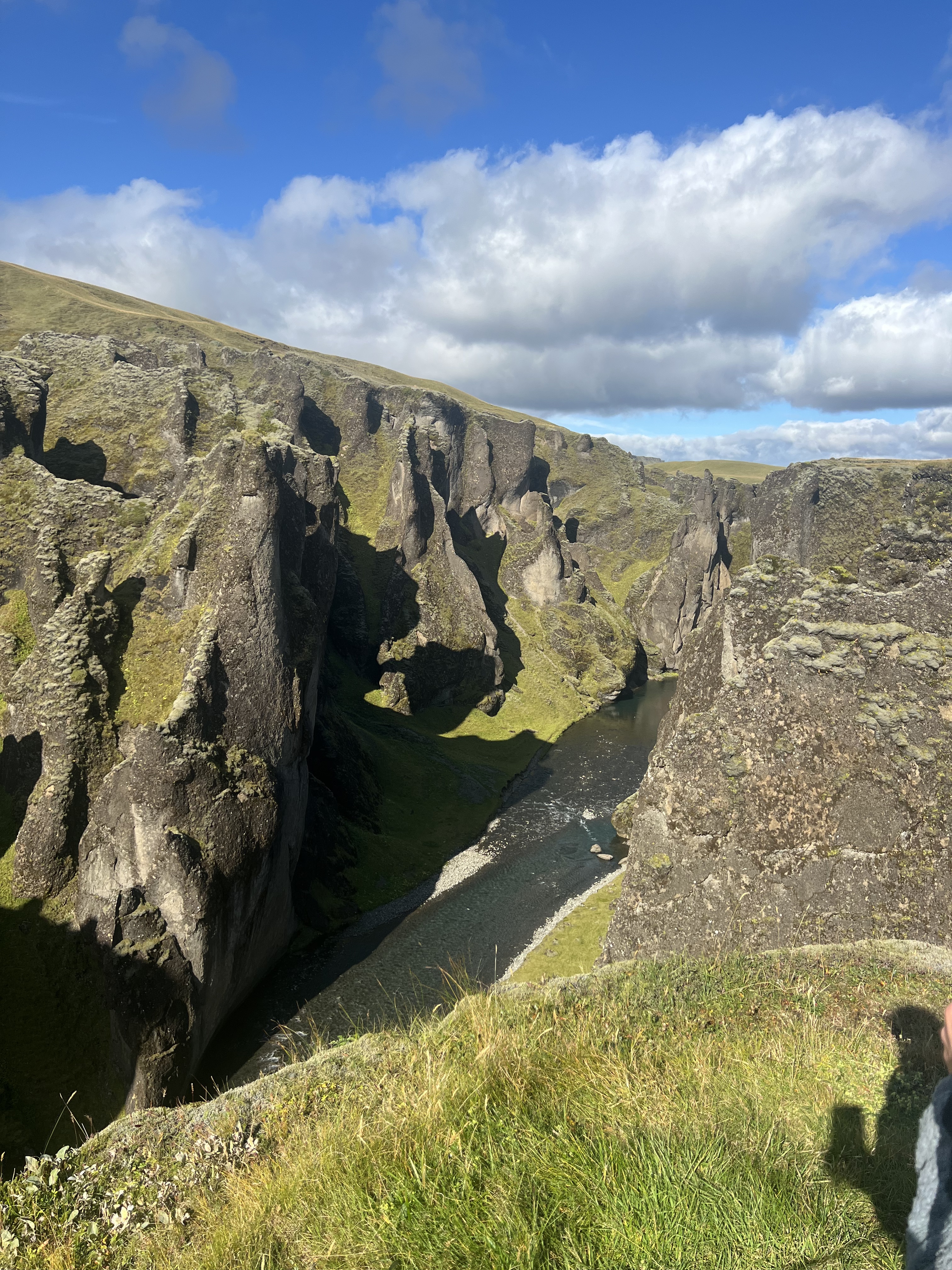
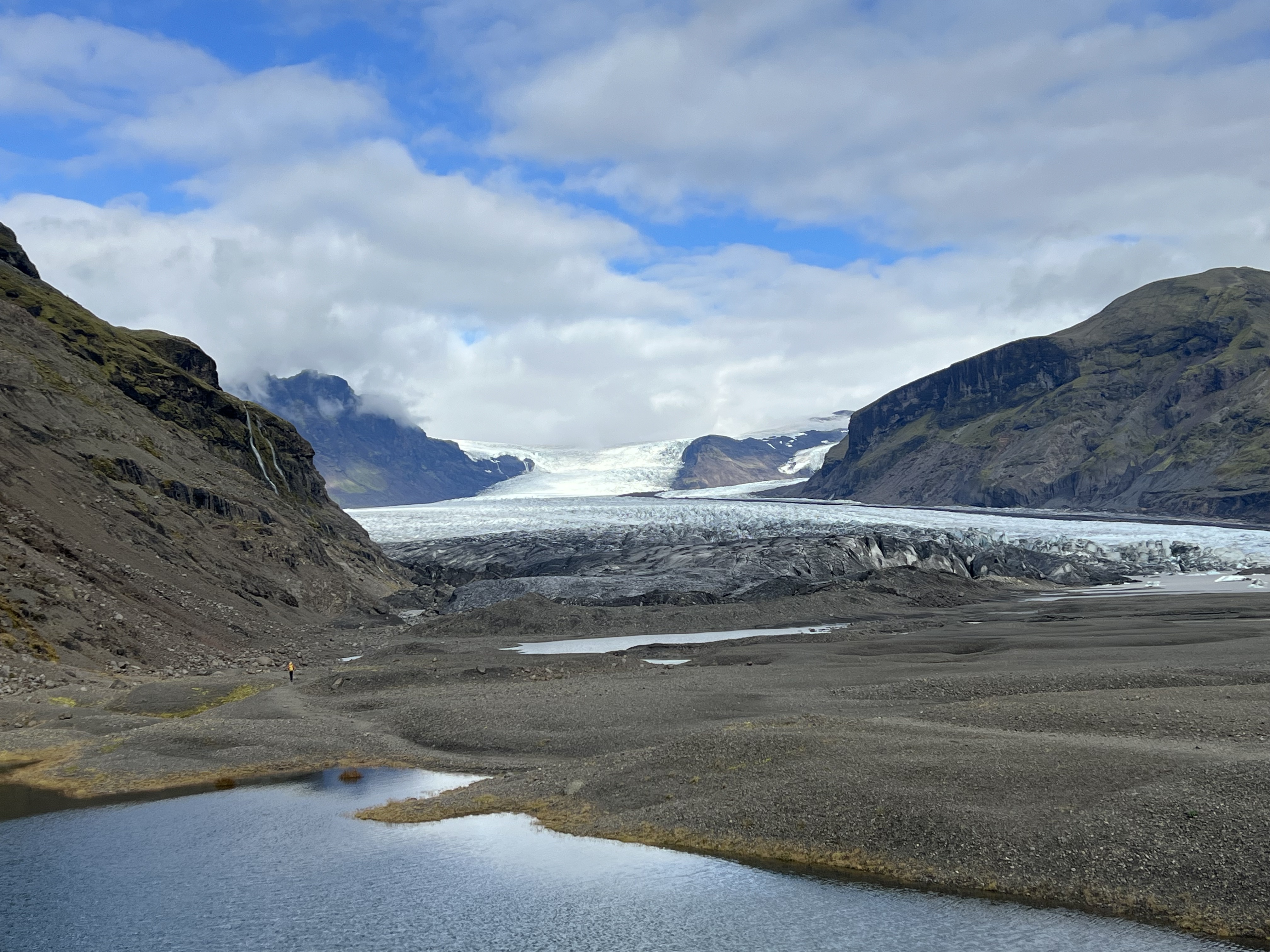
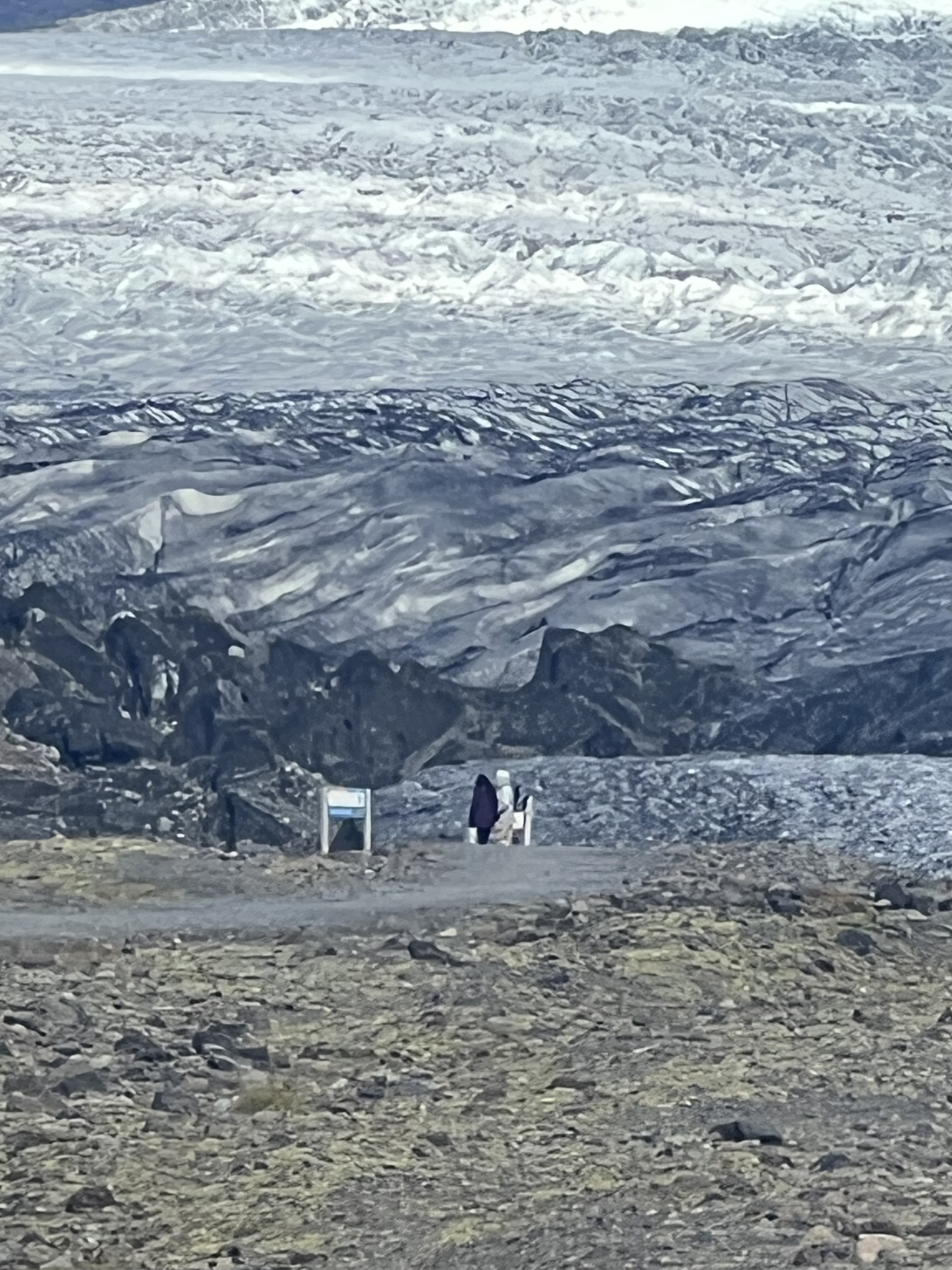
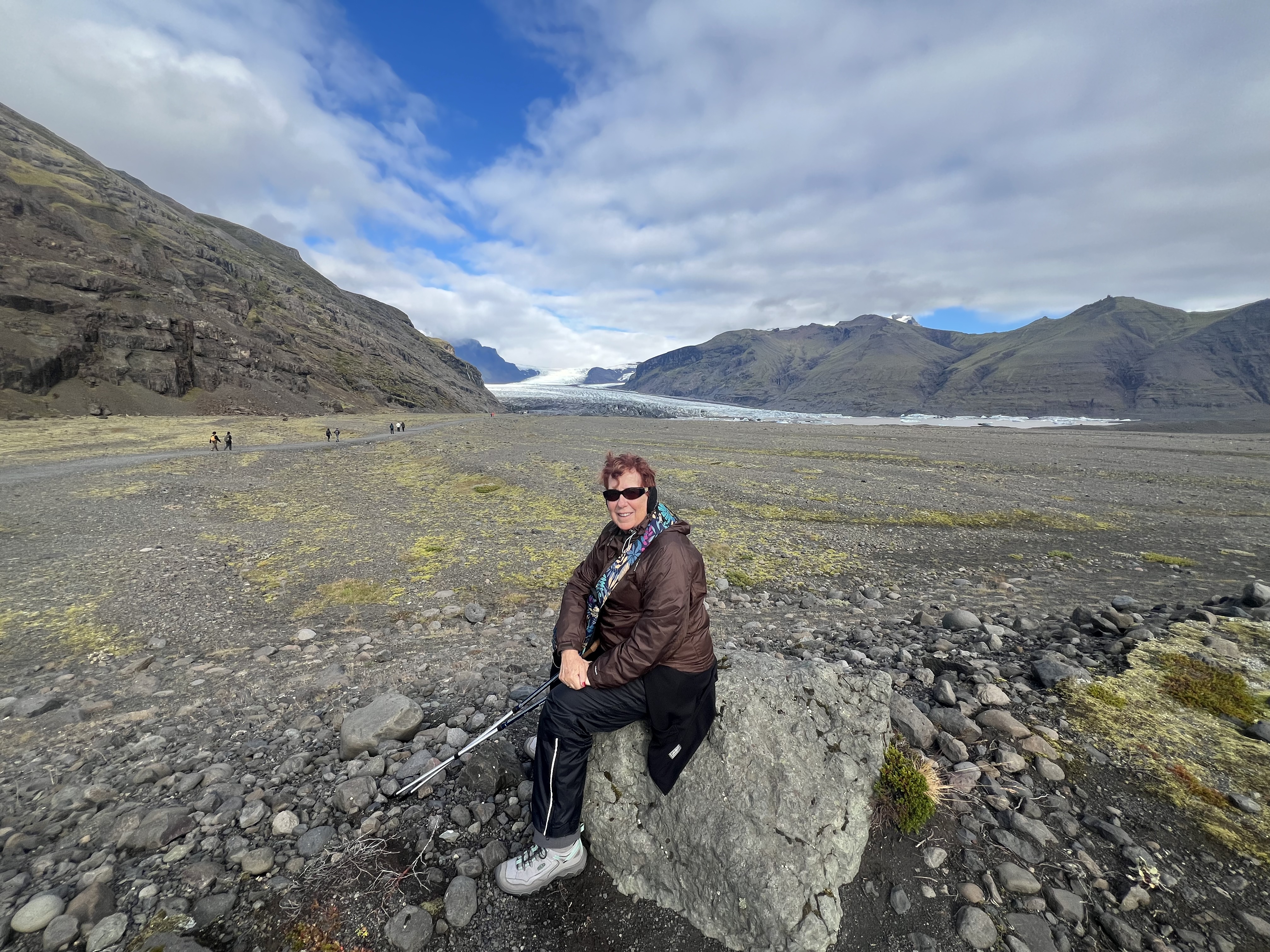
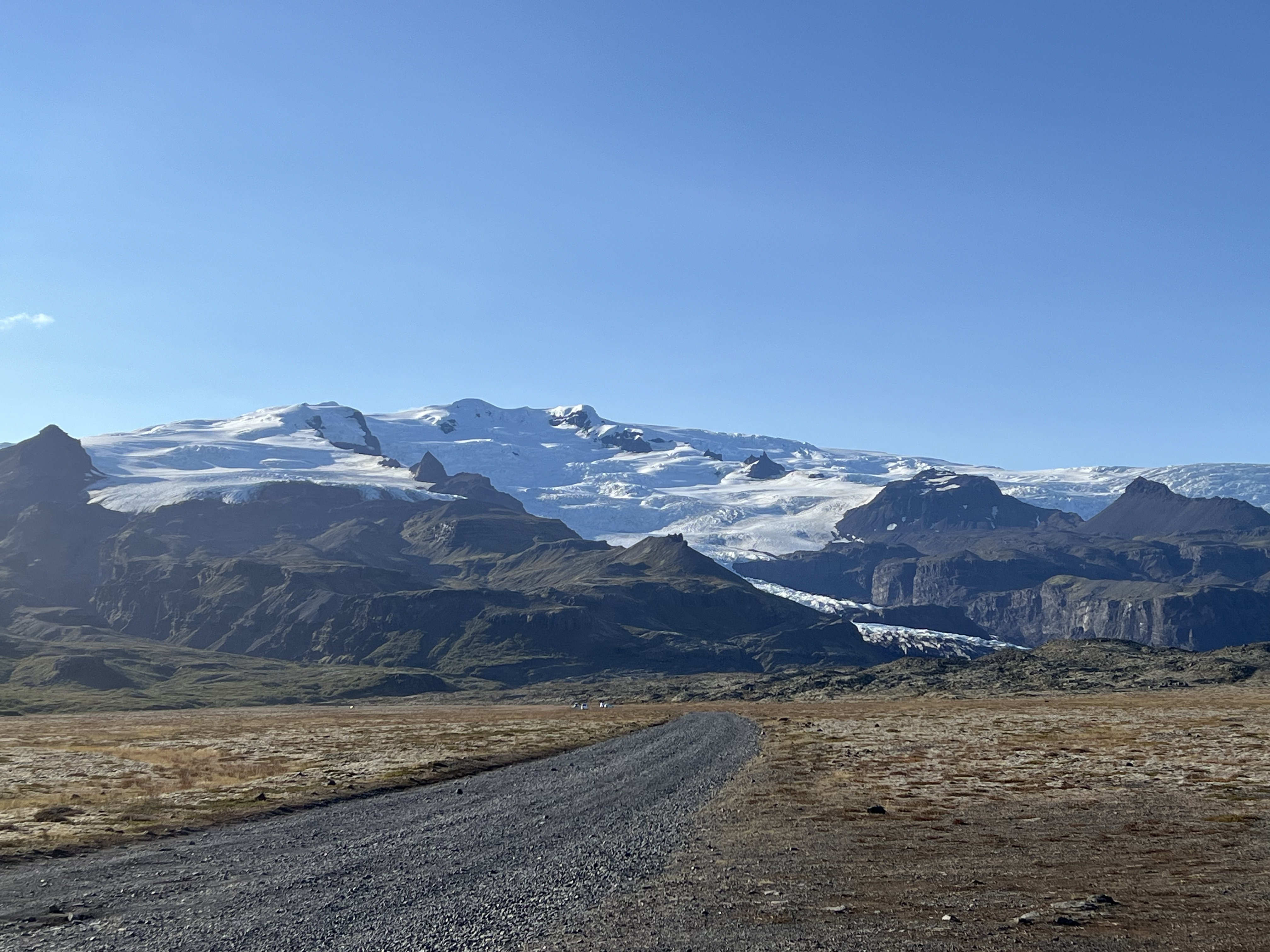
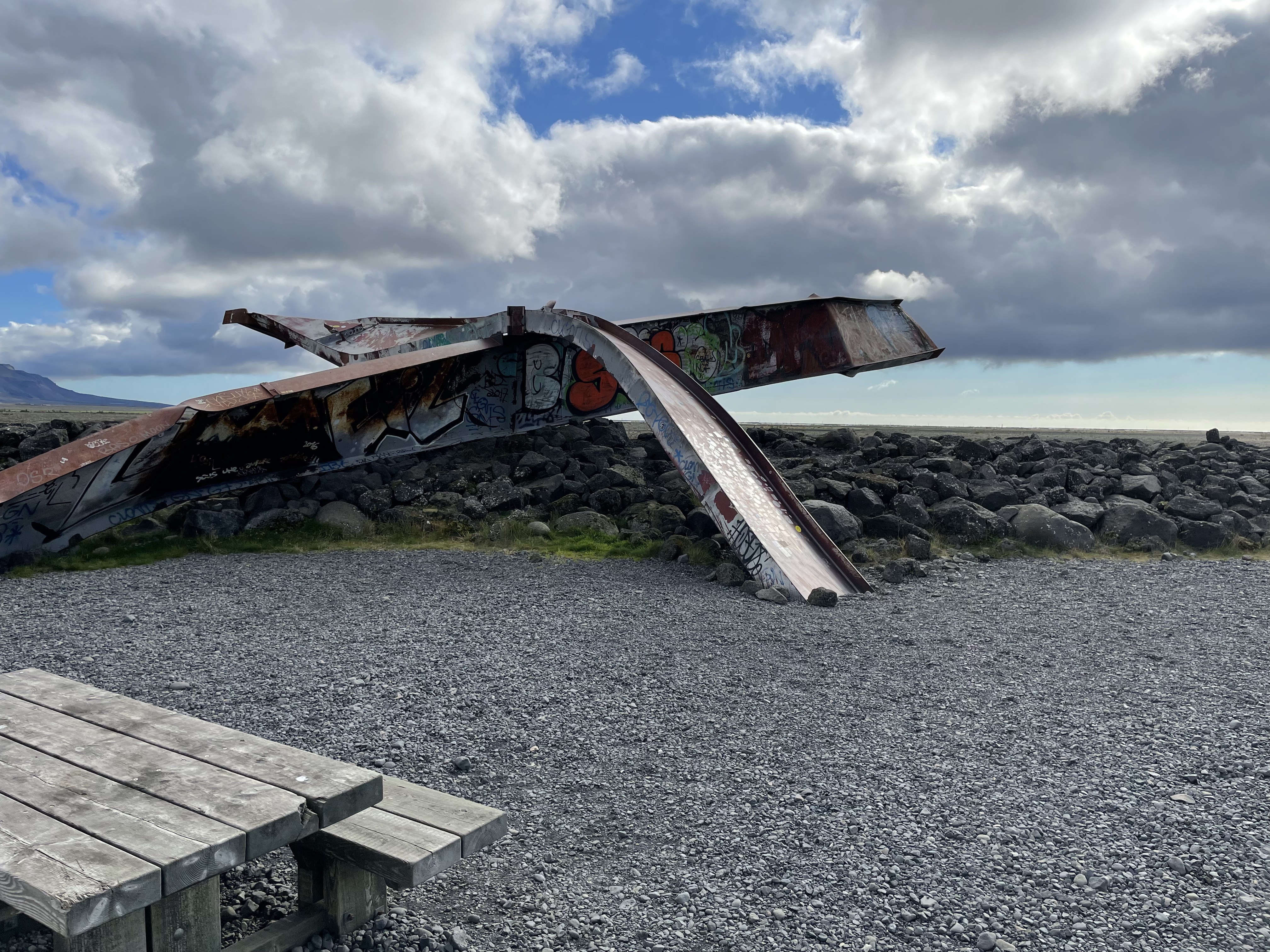
Then it was on to the Vatnajokull glacier, the largest in Iceland covering about 10% of the land area. Under the ice cap there are volcanoes, whose eruptions have caused the development of large pockets of water beneath the ice. Occasionally these break through and cause severe flooding carrying huge icebergs across the sand flats to the eastern side. The ‘artwork’ in one of the photos is the remnants of a bridge that was washed out during one of the last floods in 1996. After we had lunch at the visitors centre, we hiked down to the edge of the glacier. Jenn and dad made it all the way to the bottom while George and I stopped after 2 km. The sun was shining and it was very warm through part of the hike, but it definitely got colder as we got closer to the glacier.

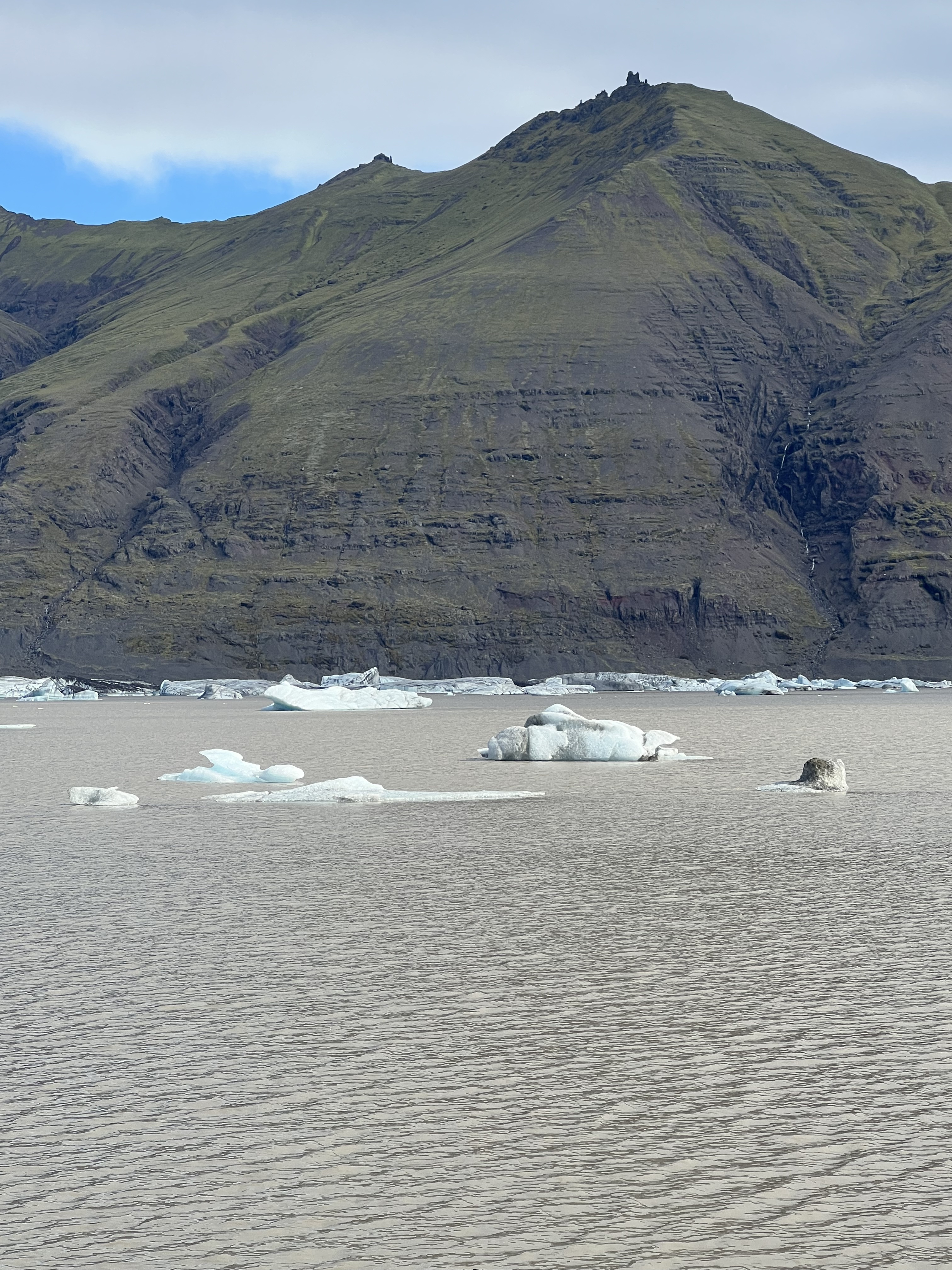
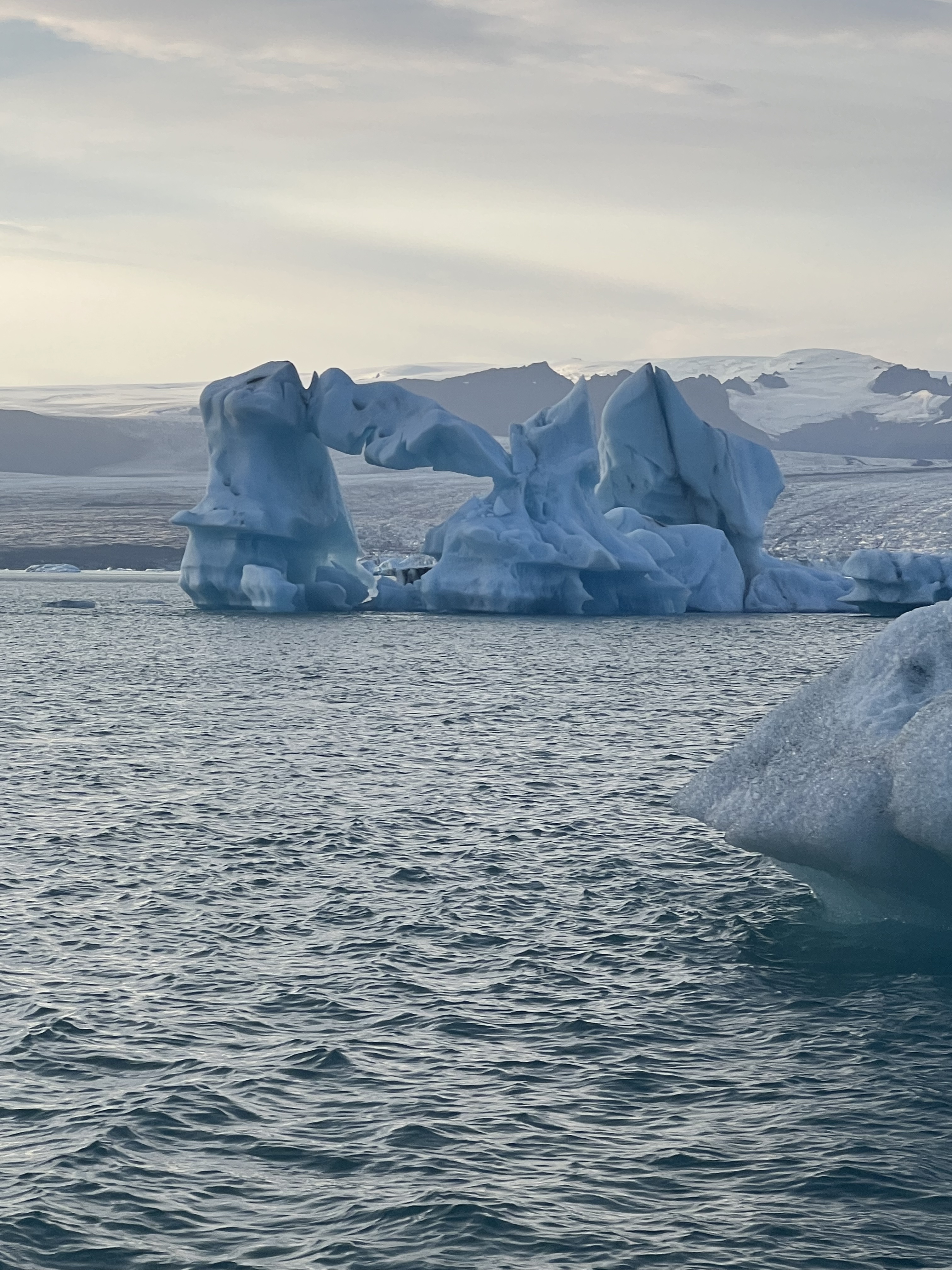
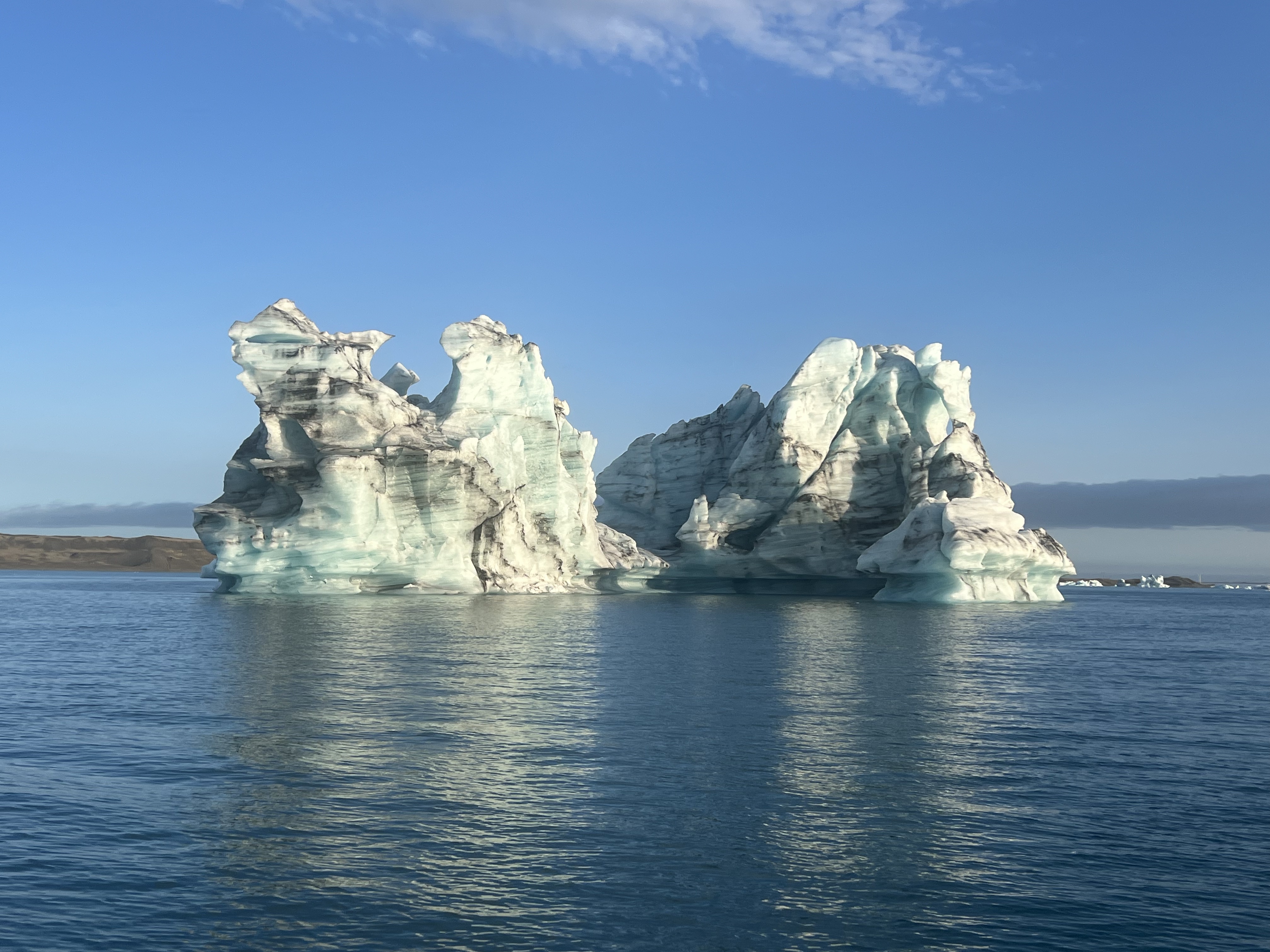
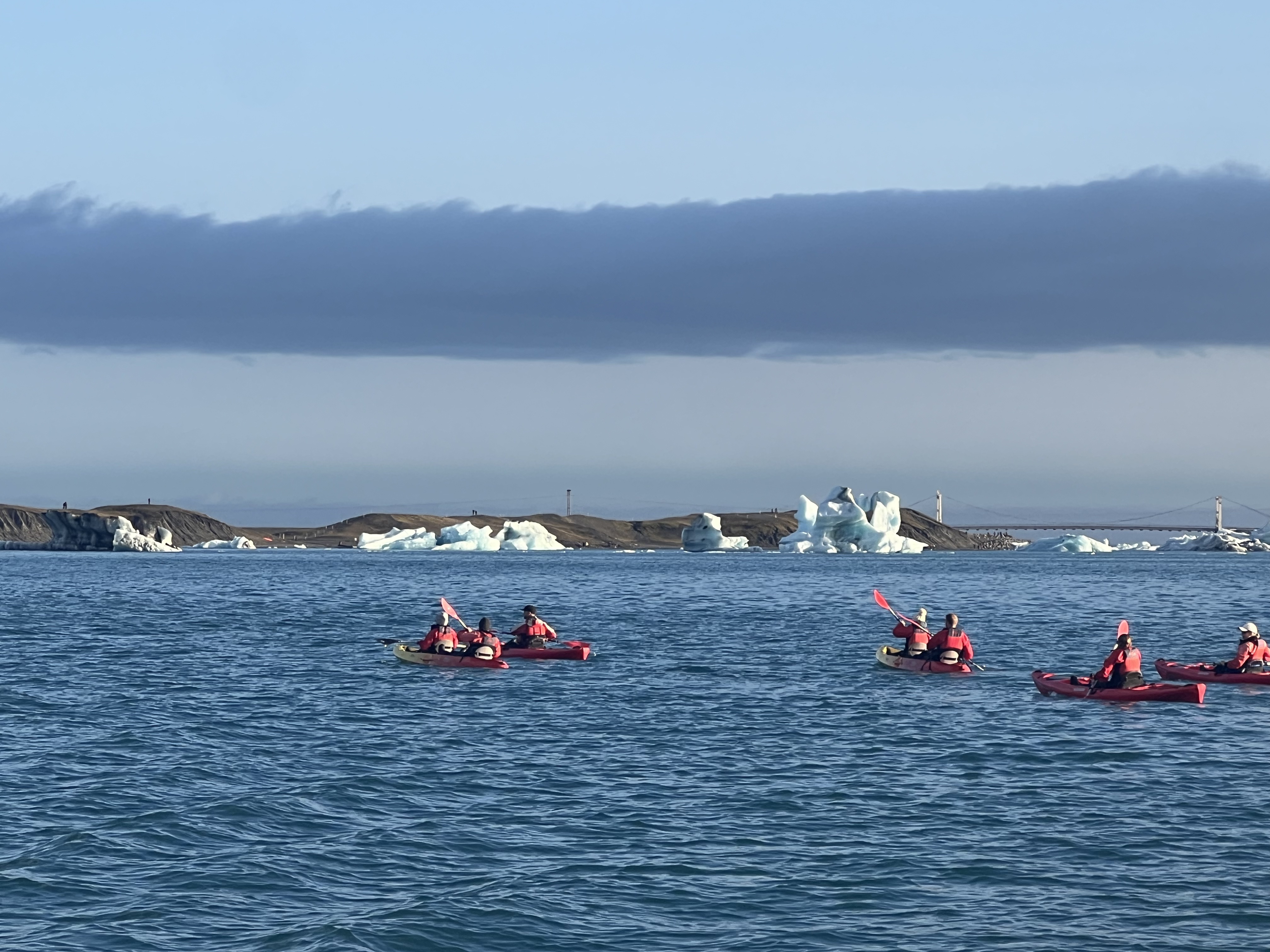
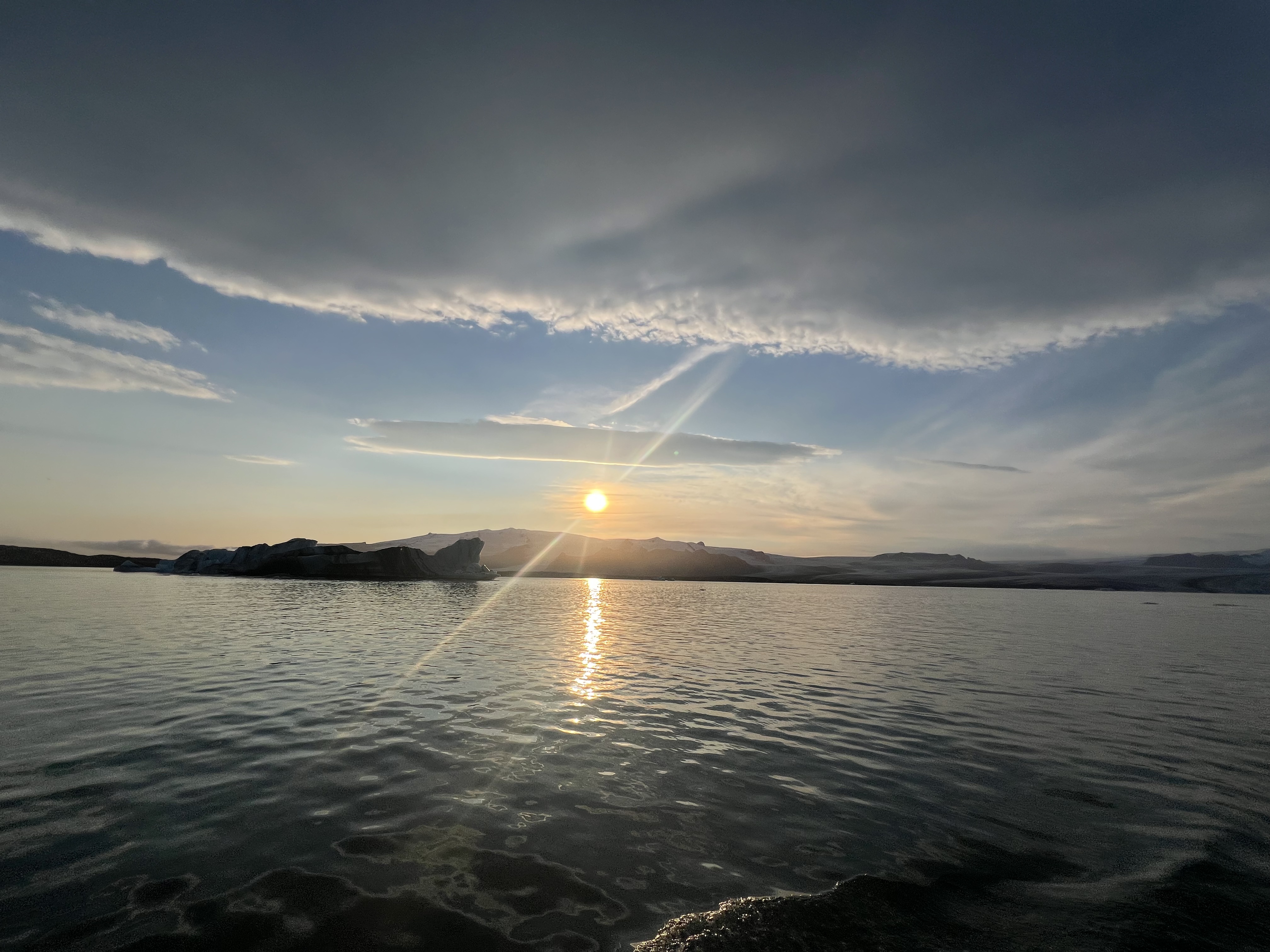
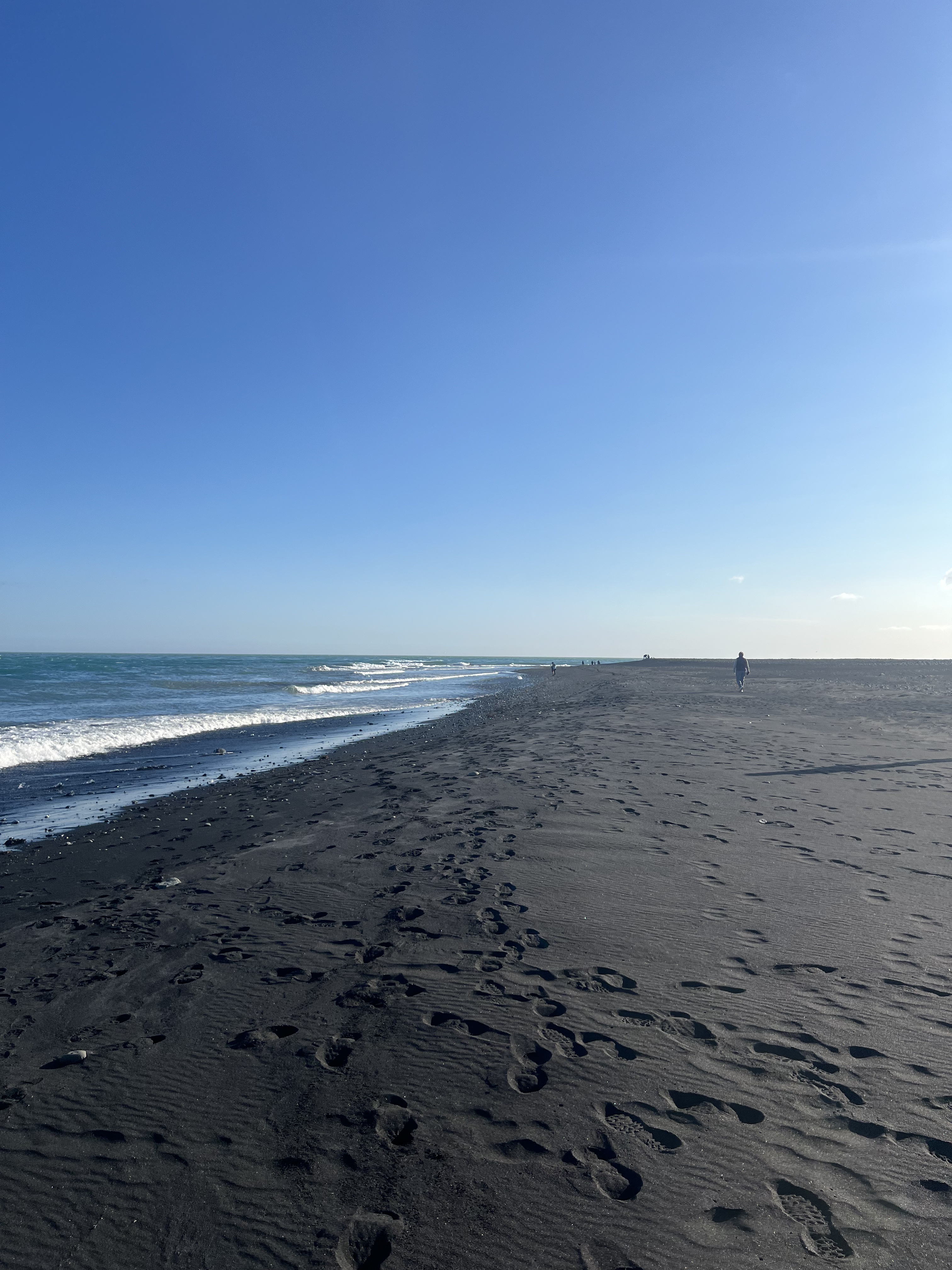
Our last stops for the day were Iceberg Lagoon and Diamond Beach. As the glacier recedes, large chunks break off and begin their voyage to the sea. Icebergs stay in the lagoon for up to three months but many only last about three weeks or less. When they get to the ocean they break up completely and small shards of ice wash up on the nearby beach and appear to be ‘diamonds’ on the sand.
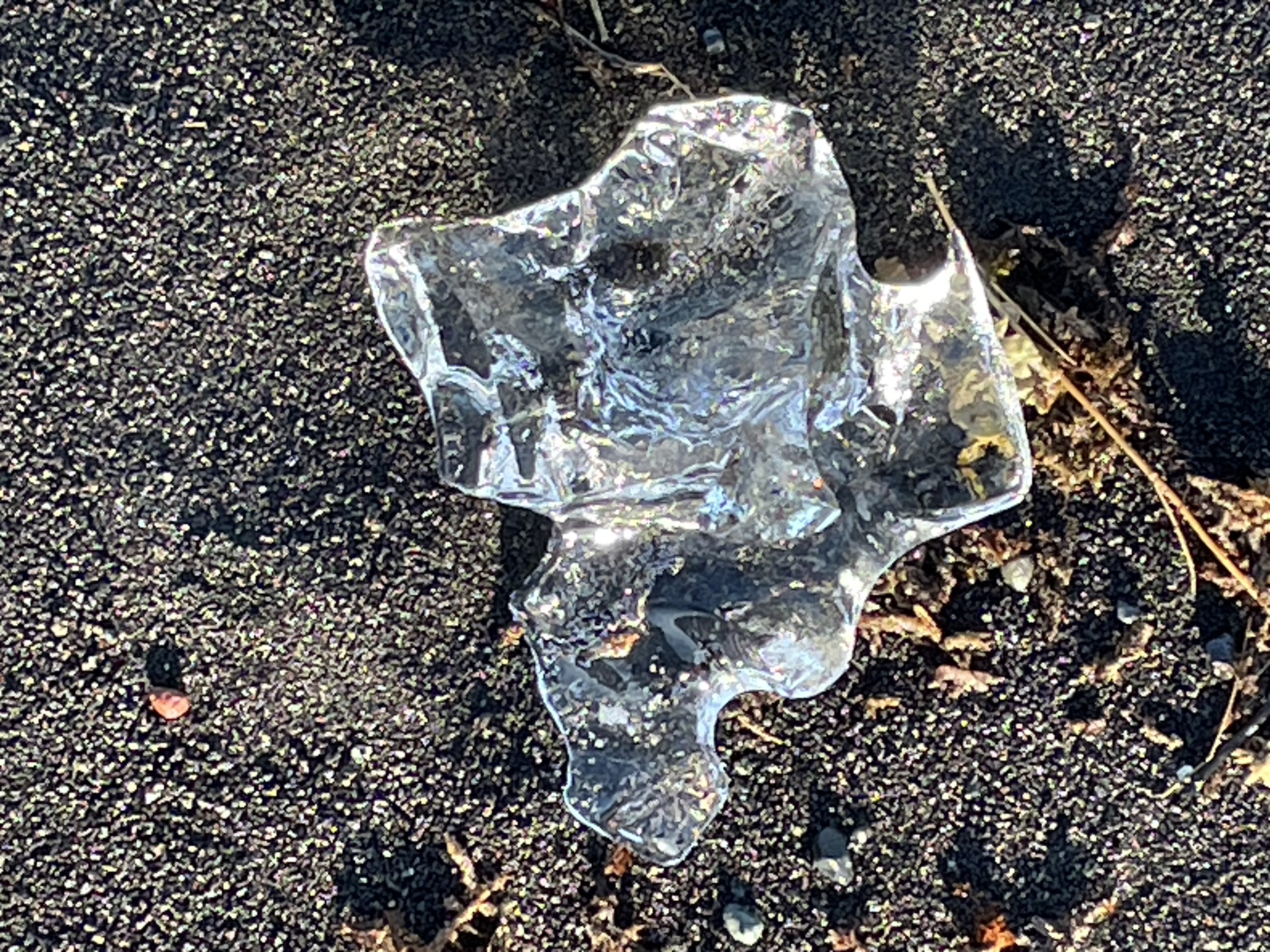
It was late when we arrived at the Foss Hotel so we quickly unloaded and headed into Hofn for a late night snack. The Traditional Icelandic Dessert at Kaffi Hornid was excellent!

Day 6 – Today’s adventure was big skies, mountains and fjords, with a little off-roading for good measure. We toured around Hofn briefly stopping at the harbour to check out the Hofn Universe Sculpture and the nature walk. The walk is about 3 km (we didn’t do it because of time) and to-scale displays the size and orbits of the planets in the solar system. The sculpture is a memorial but to whom we do not know.
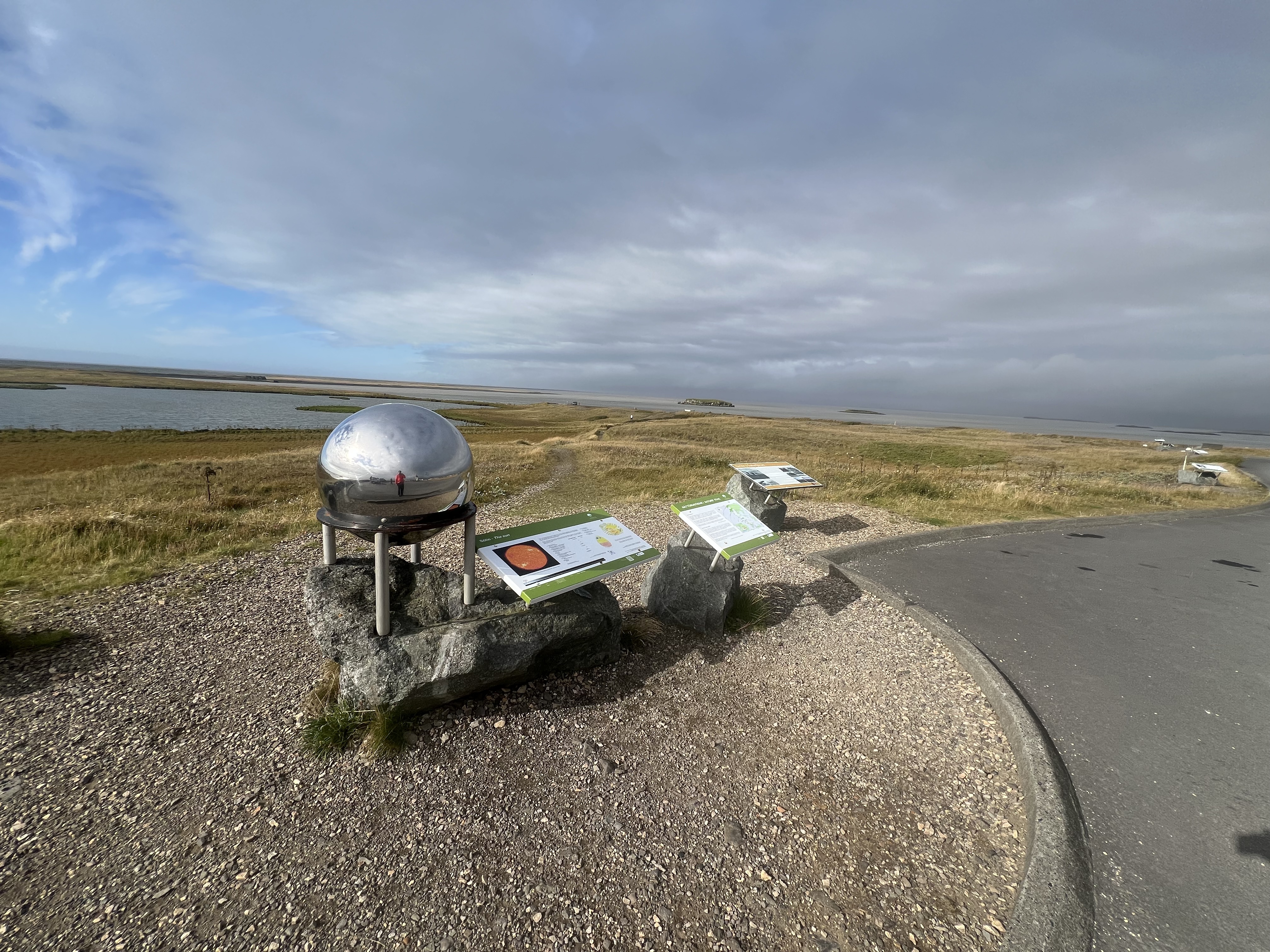
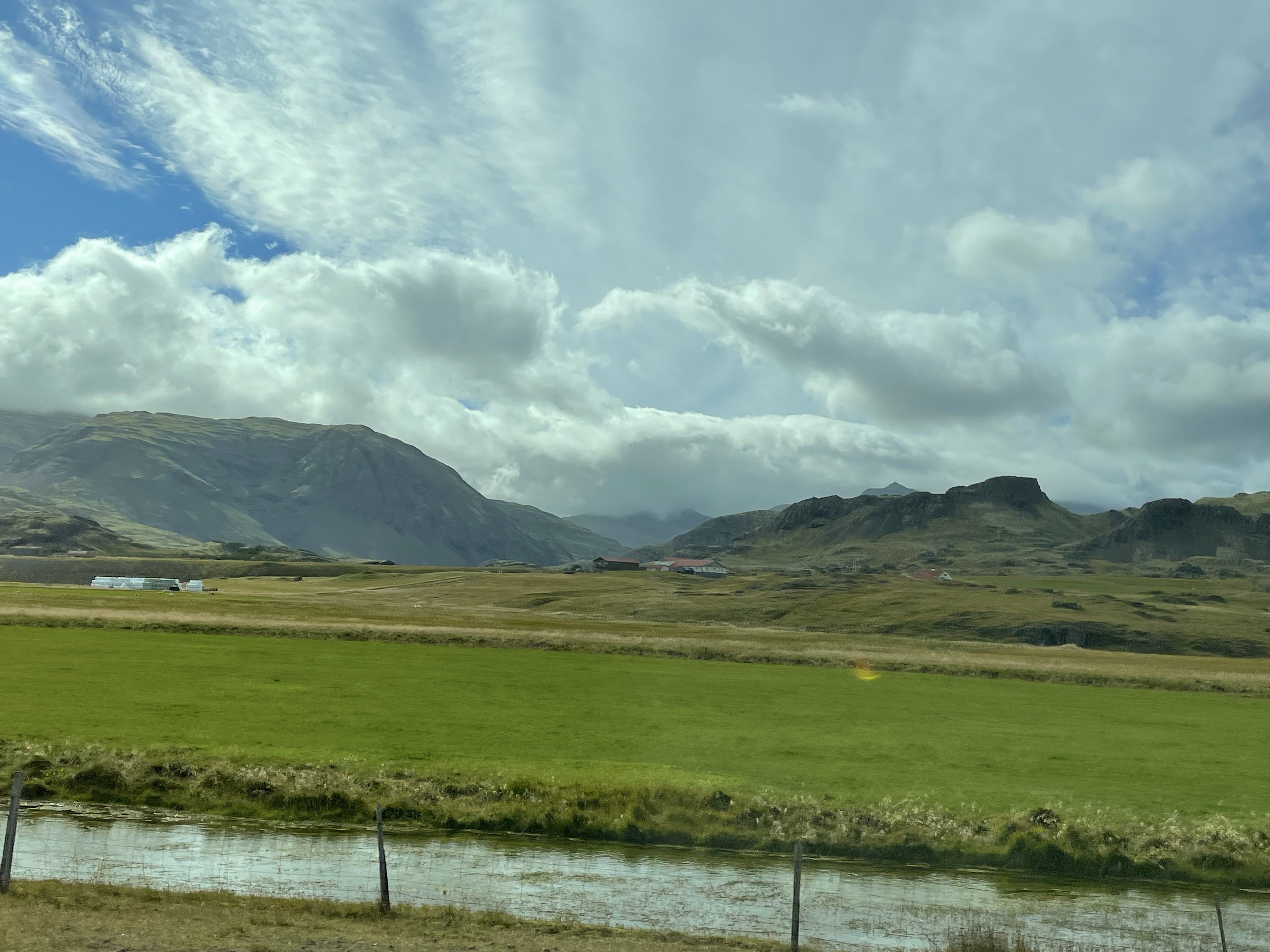
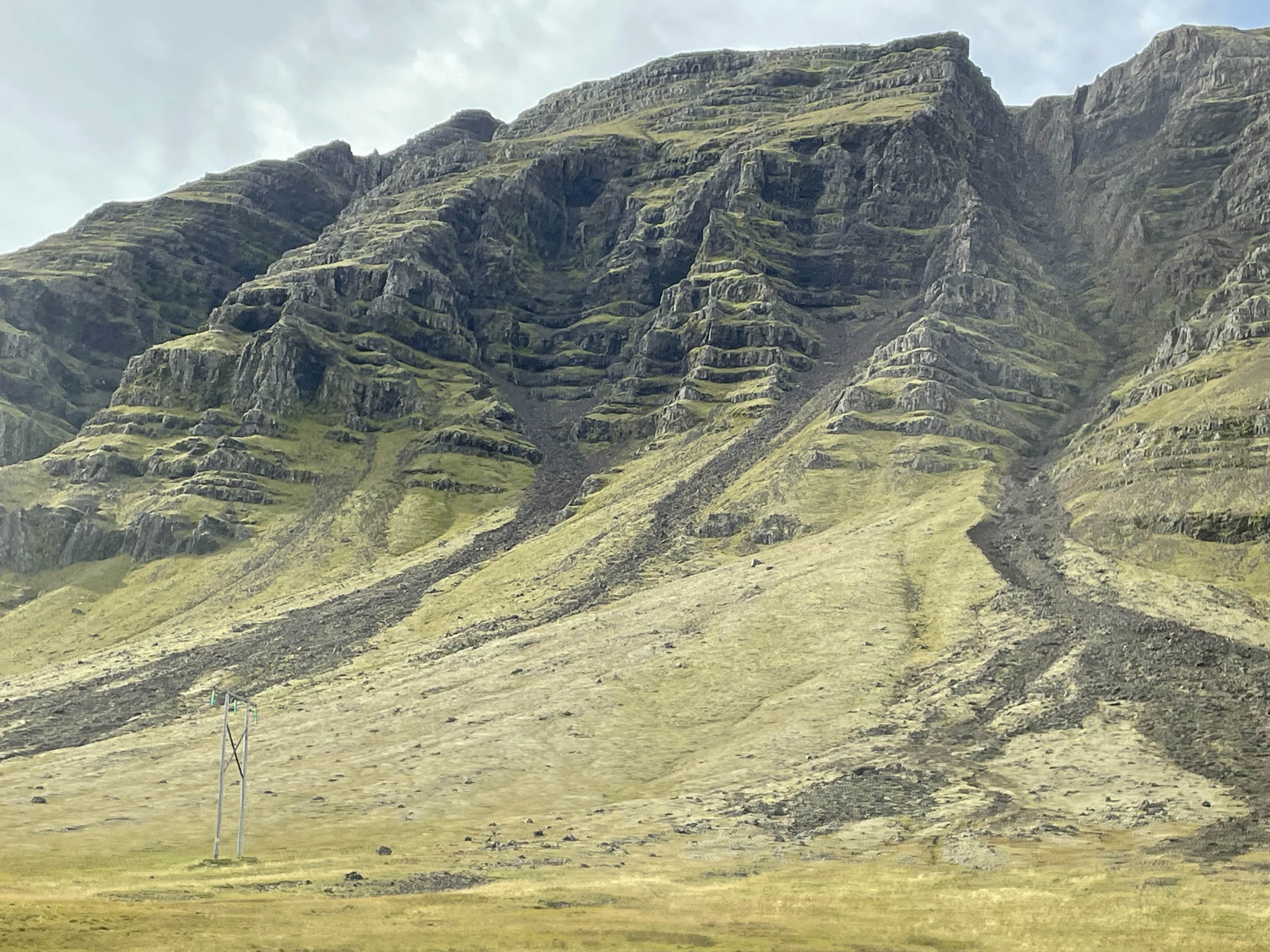
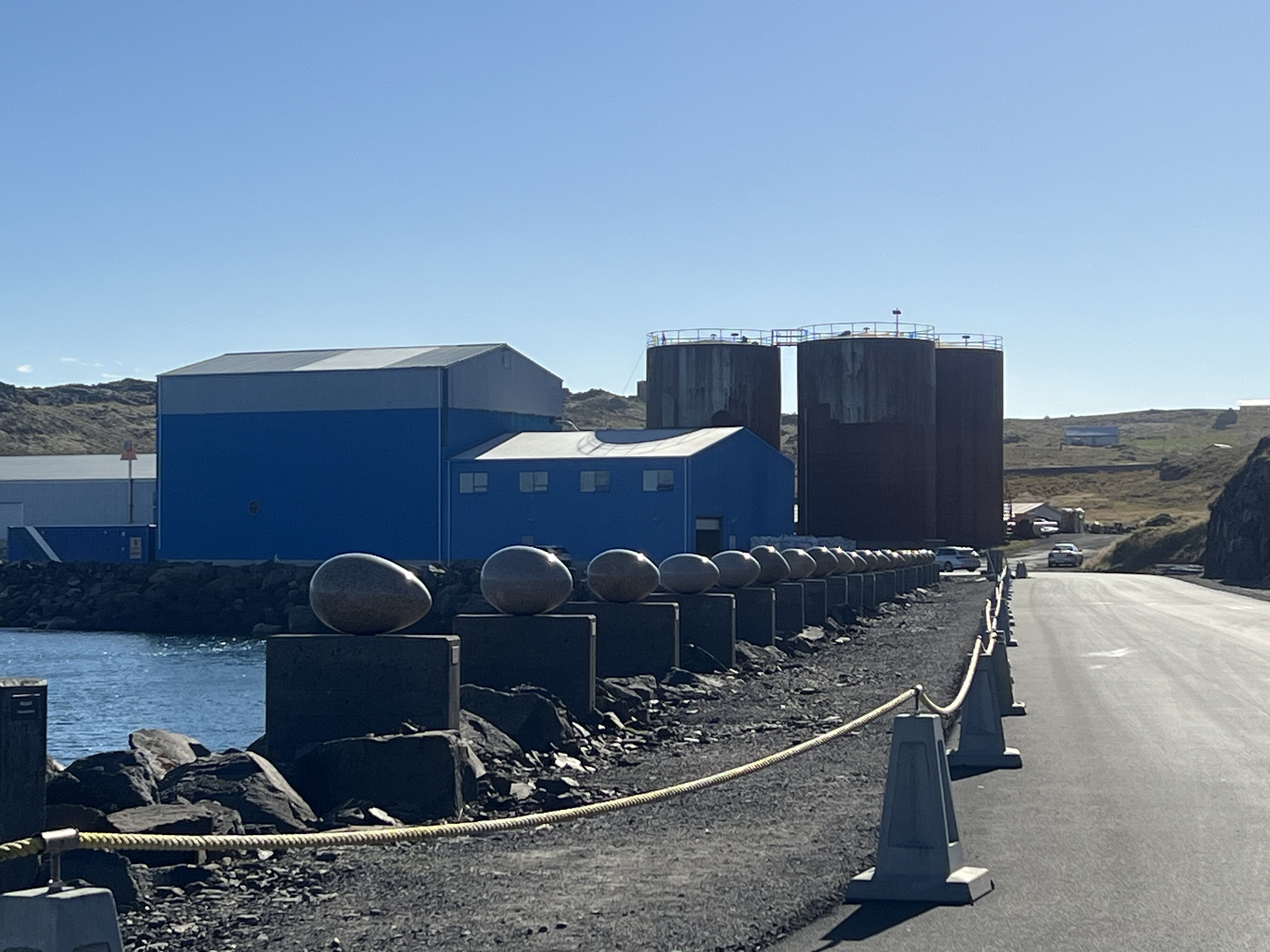
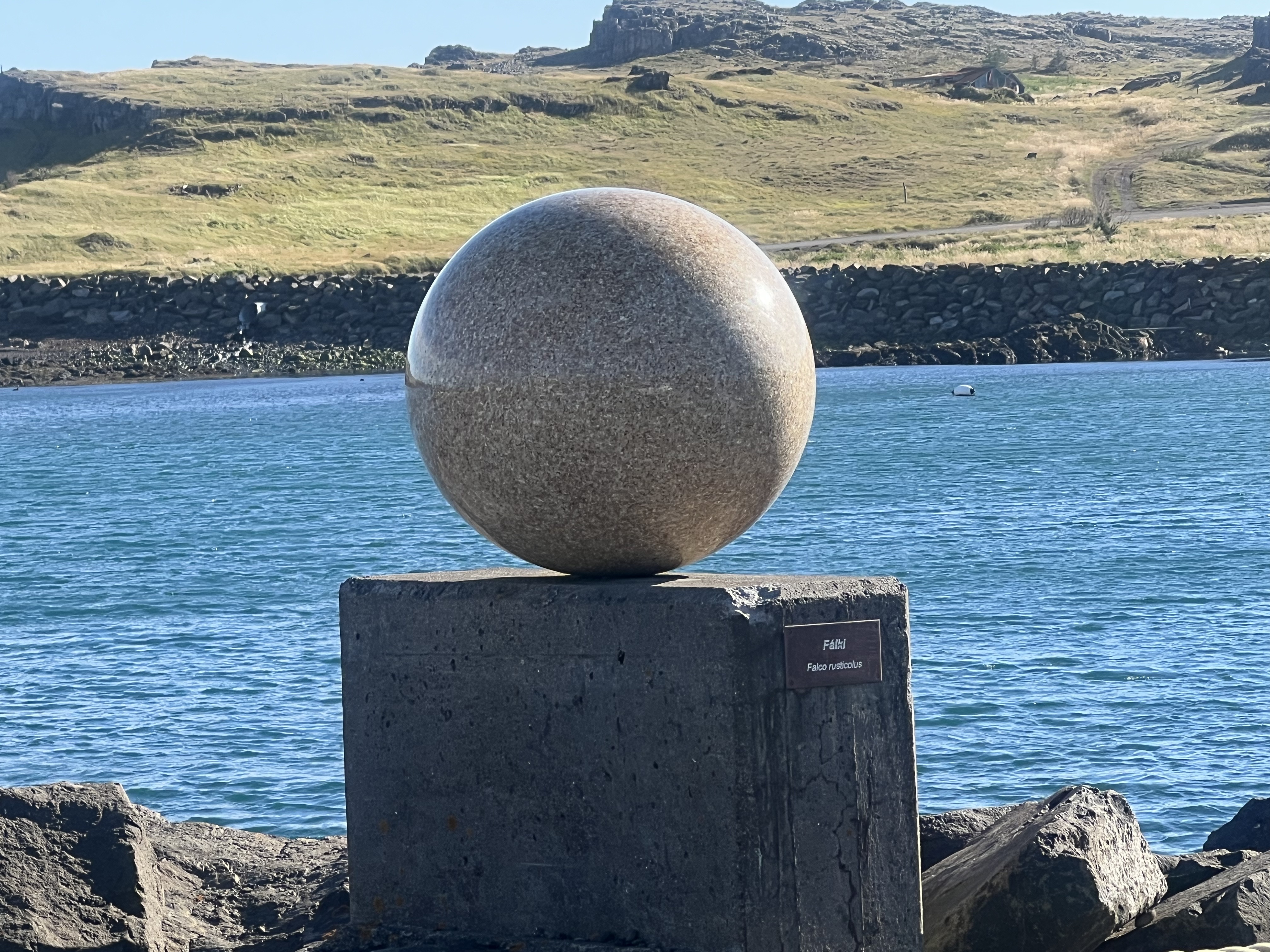
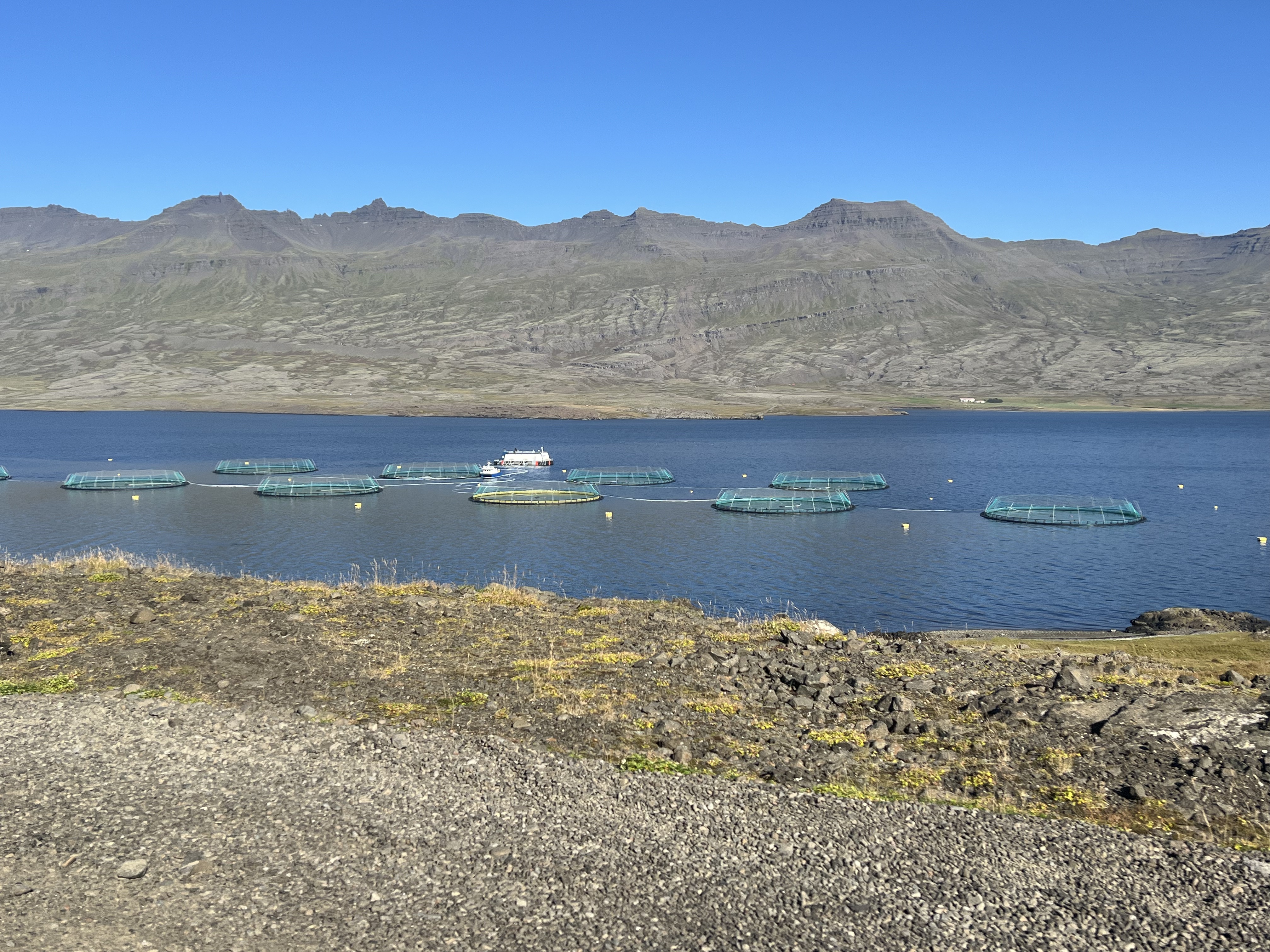
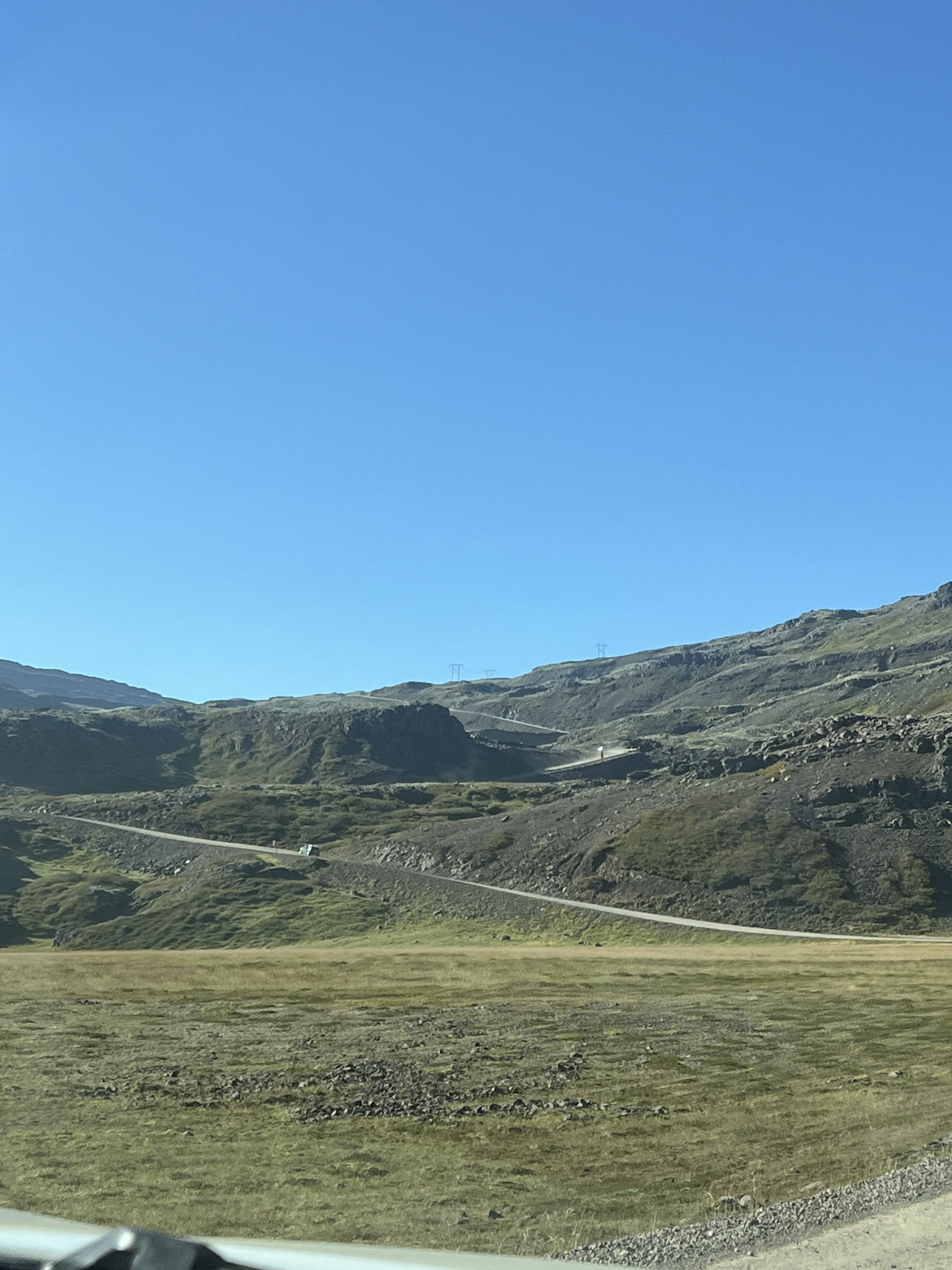
Pictures from day 6 are just a few of the scenes along the way – fjords, rocky mountain vistas, farms and a quaint fishing village, Djupivogur, where we stopped for lunch and visited the port and cultural centre. On the way out of town, we were fascinated by the sculpture, “The Eggs of Merry Bay”, representing the 34 eggs from species of birds that nest in the Djupivogur area.
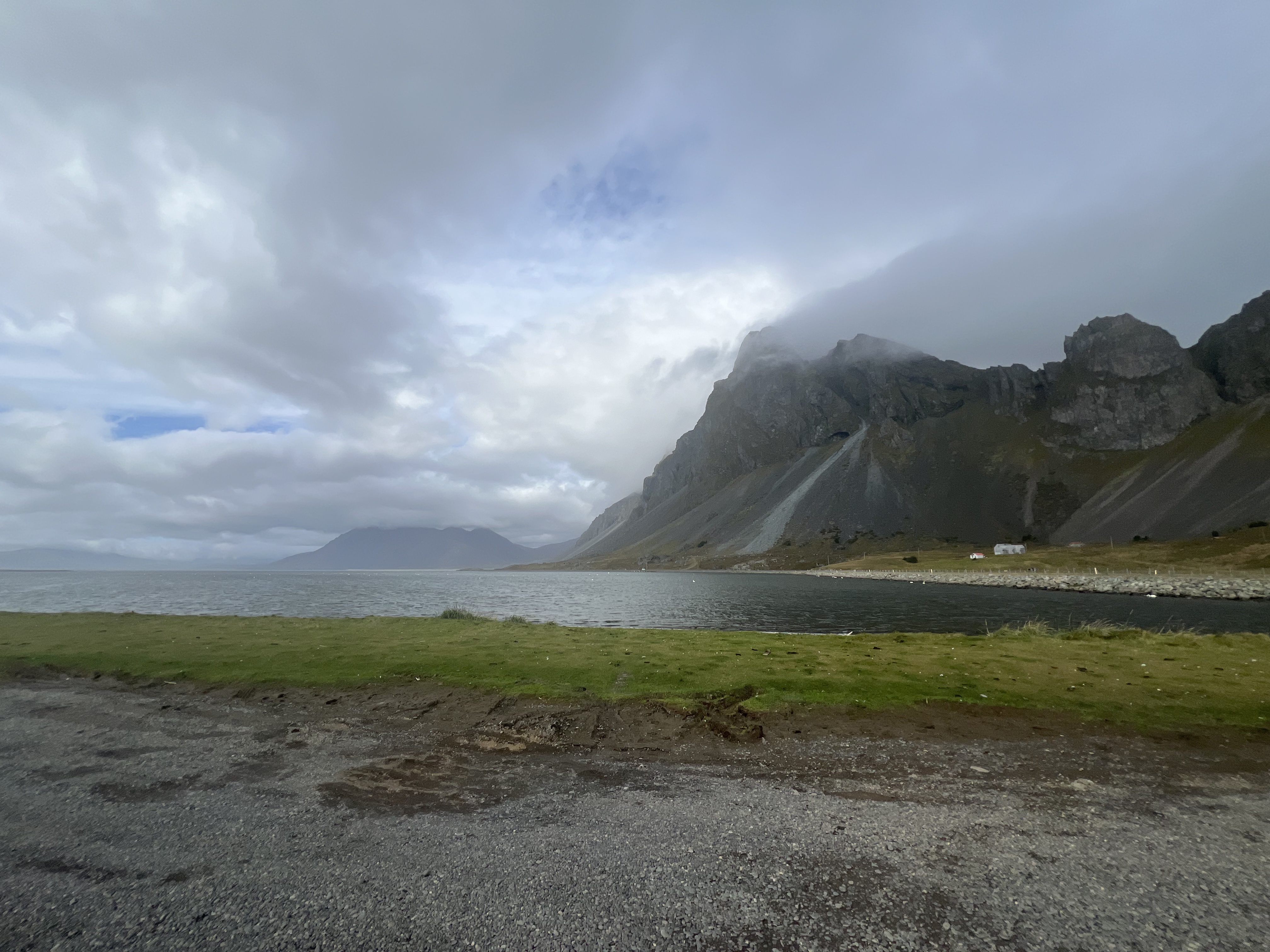
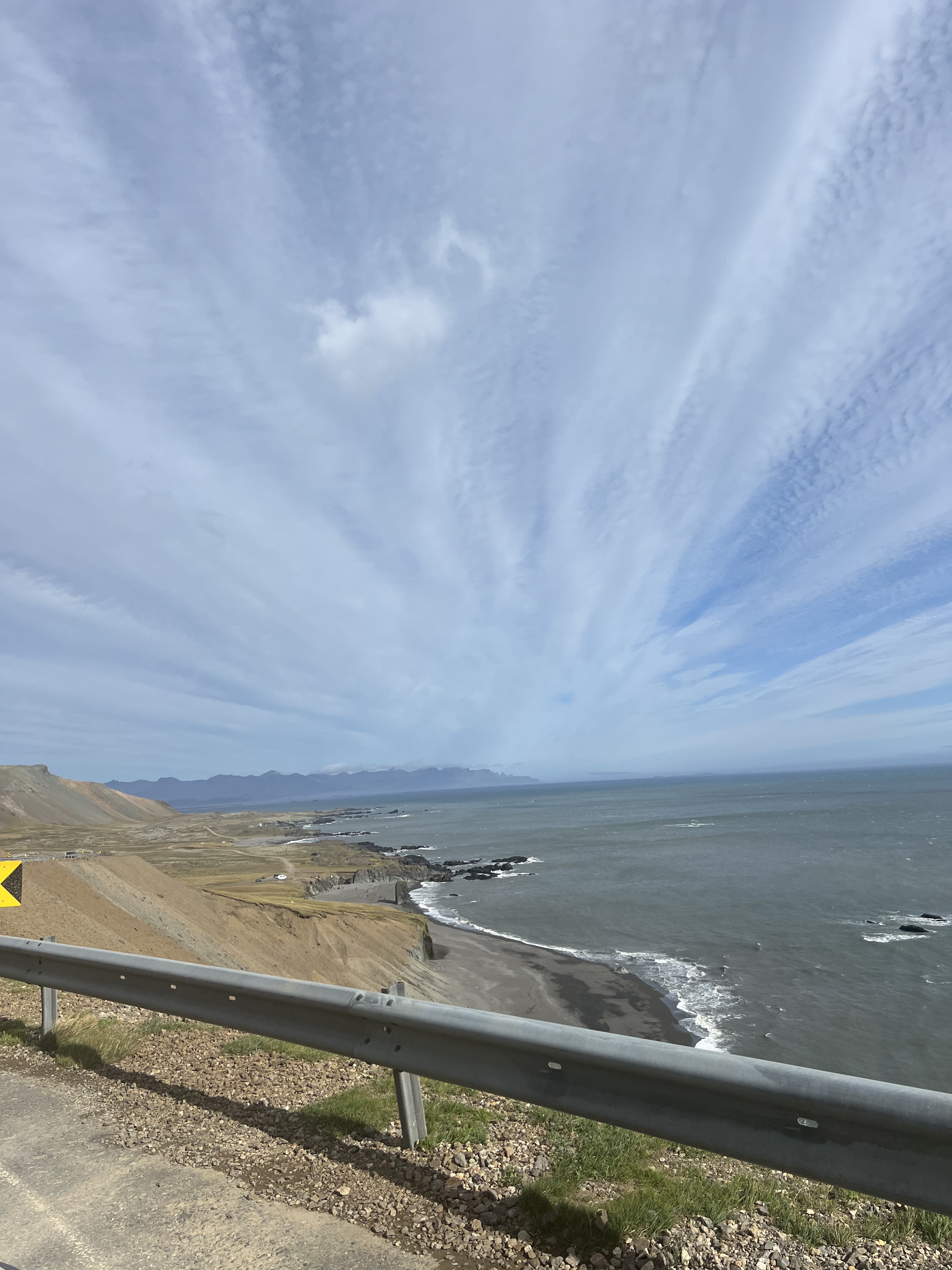
George travelled this route last year on his way to the ferry that took him from Seydisfjordur to the Faroe Islands. On that trip, he parked his bike about 15 km from Seydisfjordur, returned his rental car back to the airport in Egilsstadir (about 15 km back), hitchhiked back to his bike and coasted down a really scary road with multiple hairpin turns into town. This time, we drove from the mountains to the port, and enjoyed the beautiful vistas as we descended.
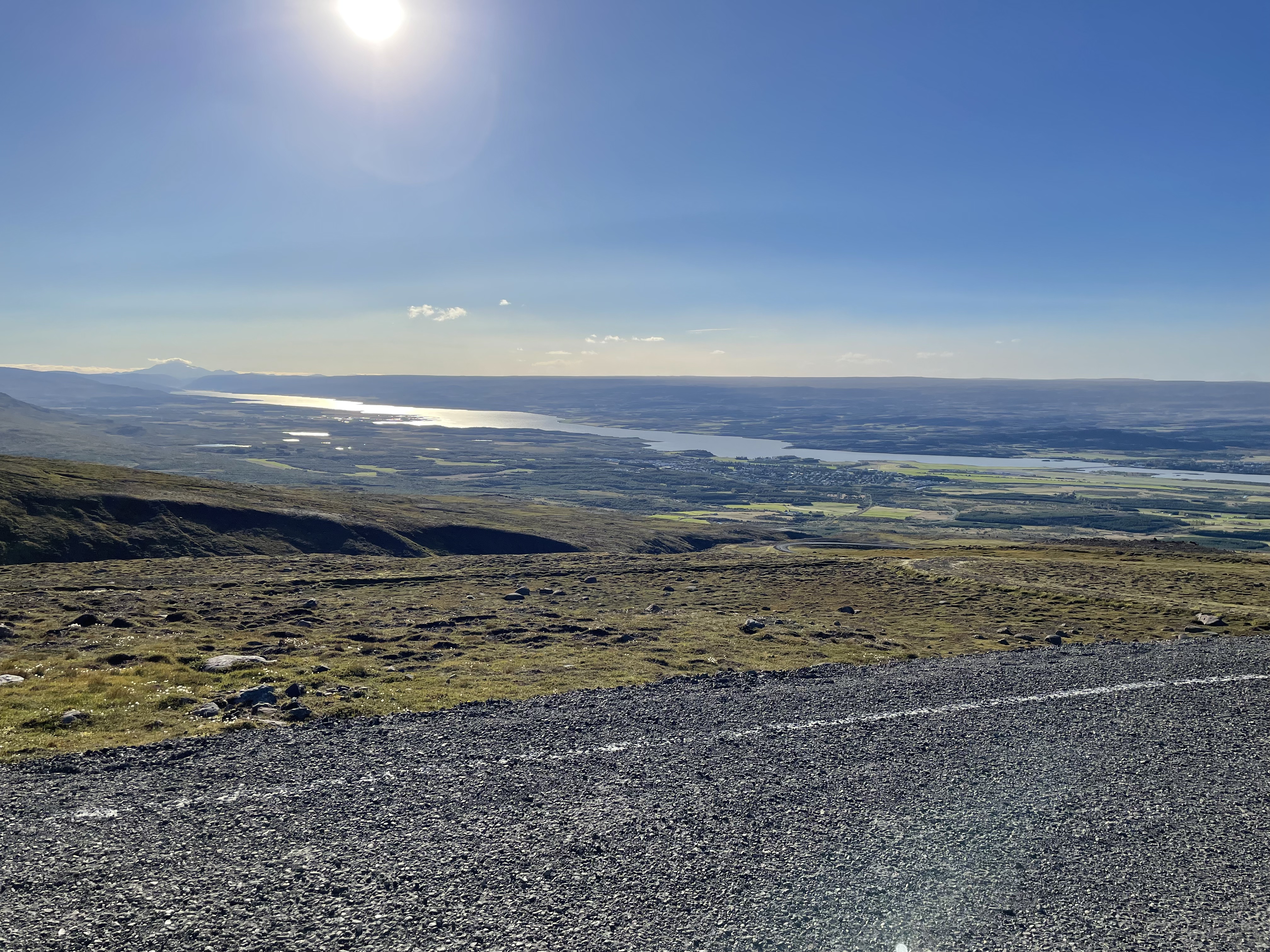
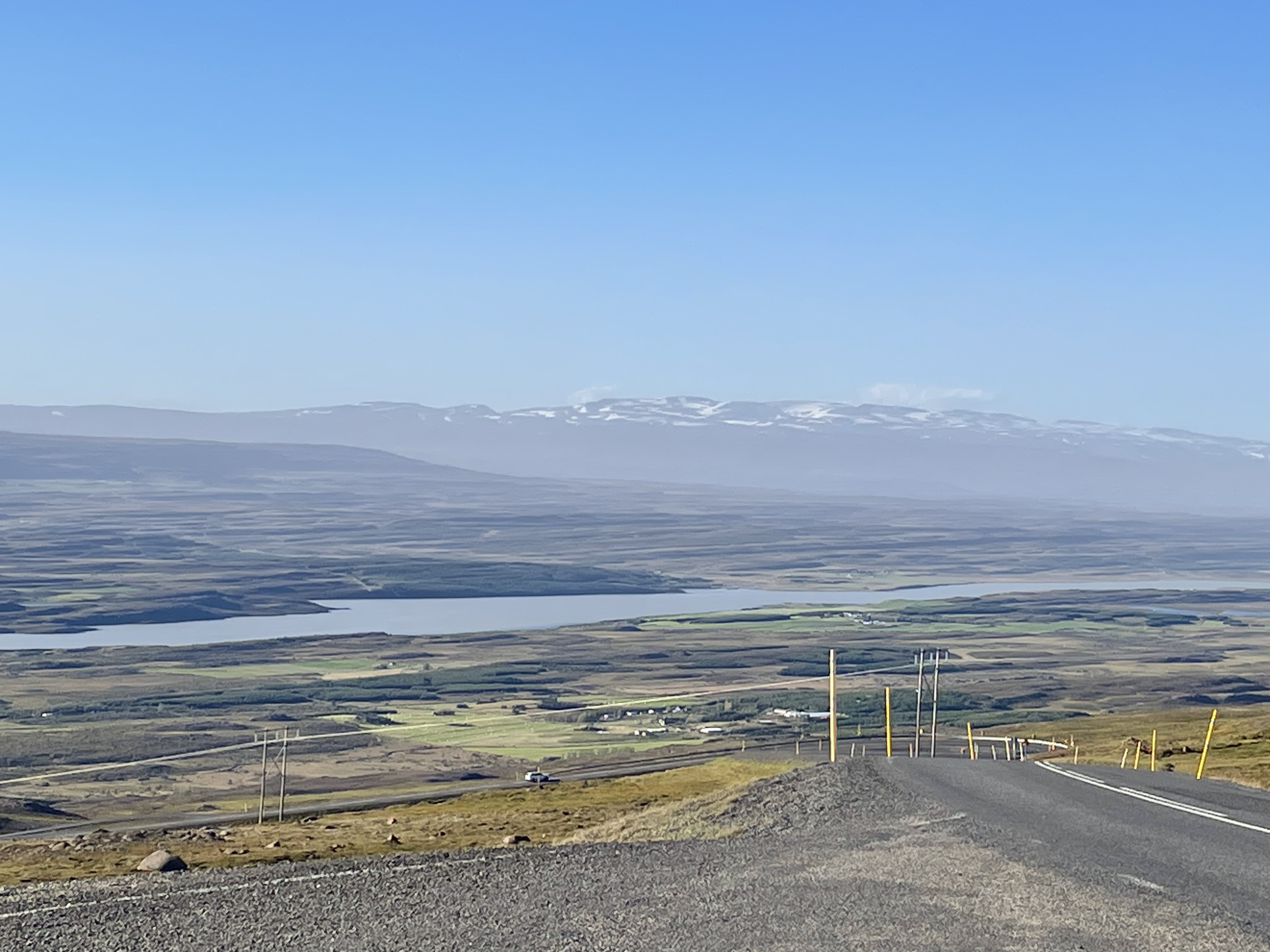
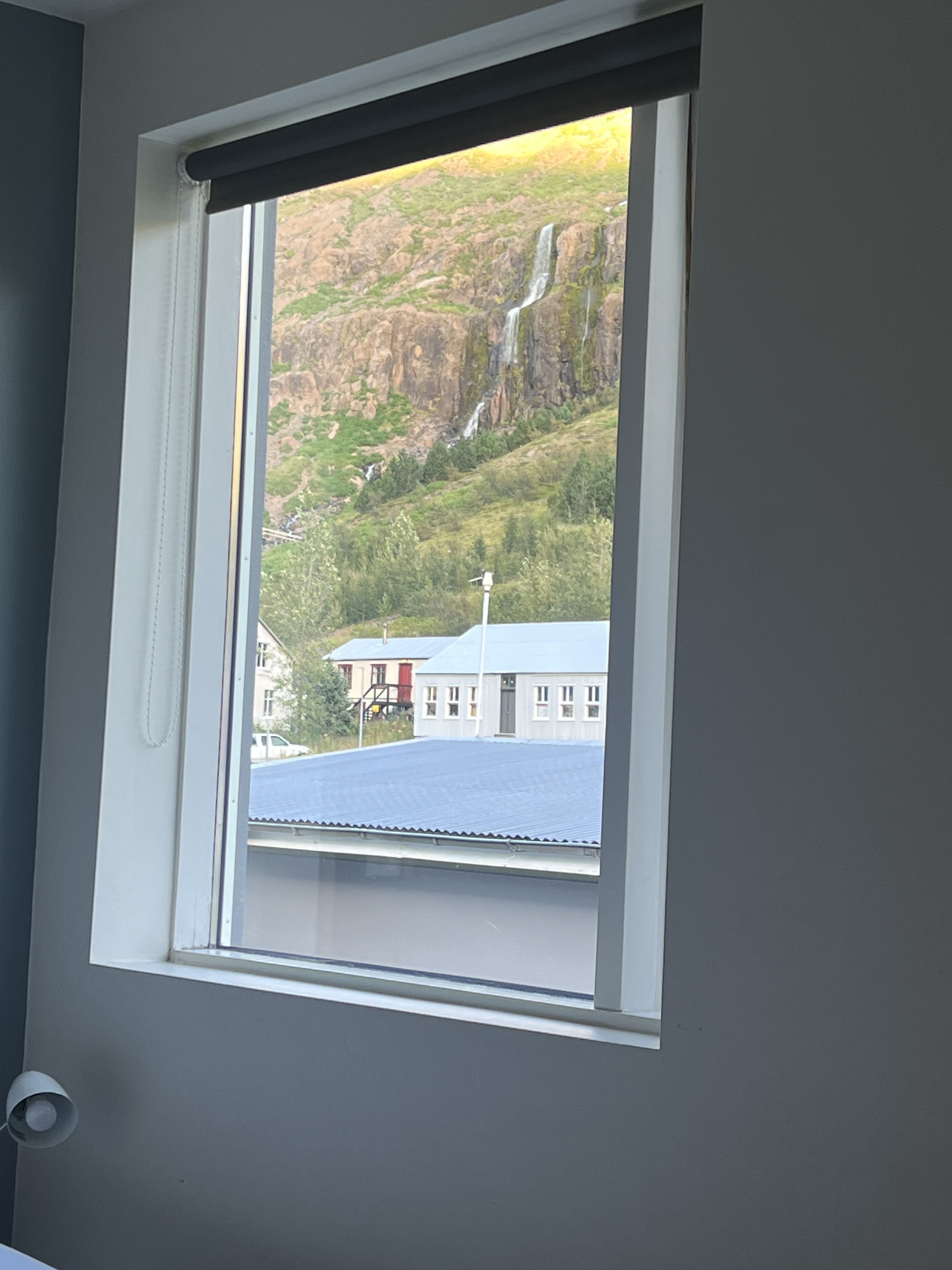
Seydisfjordur is very small with a population of about 675, just a few restaurants and very few options for accommodation. Book ahead! It’s a very picturesque town surrounded by mountains and waterfalls and has a fairly lively cultural life.

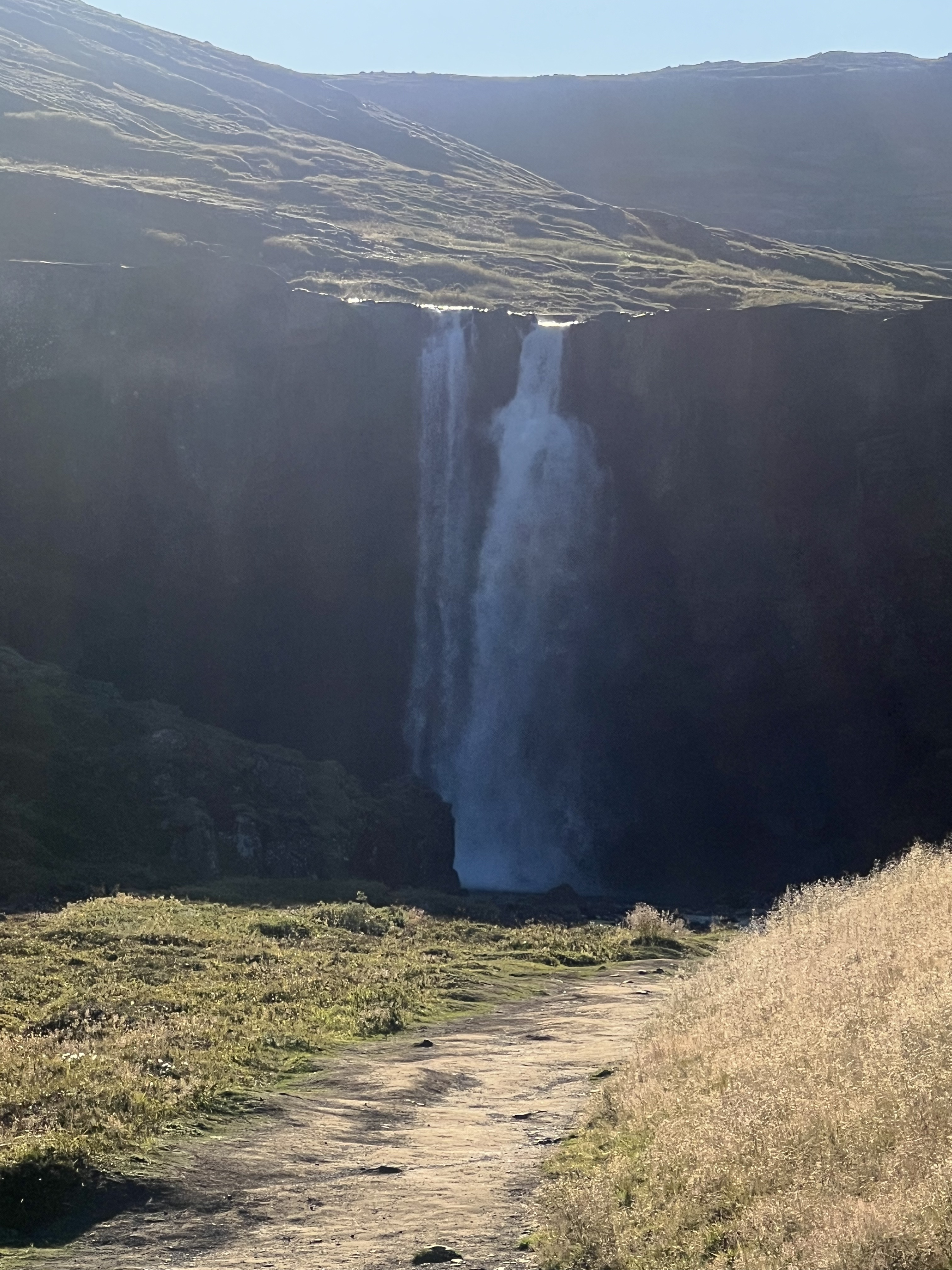
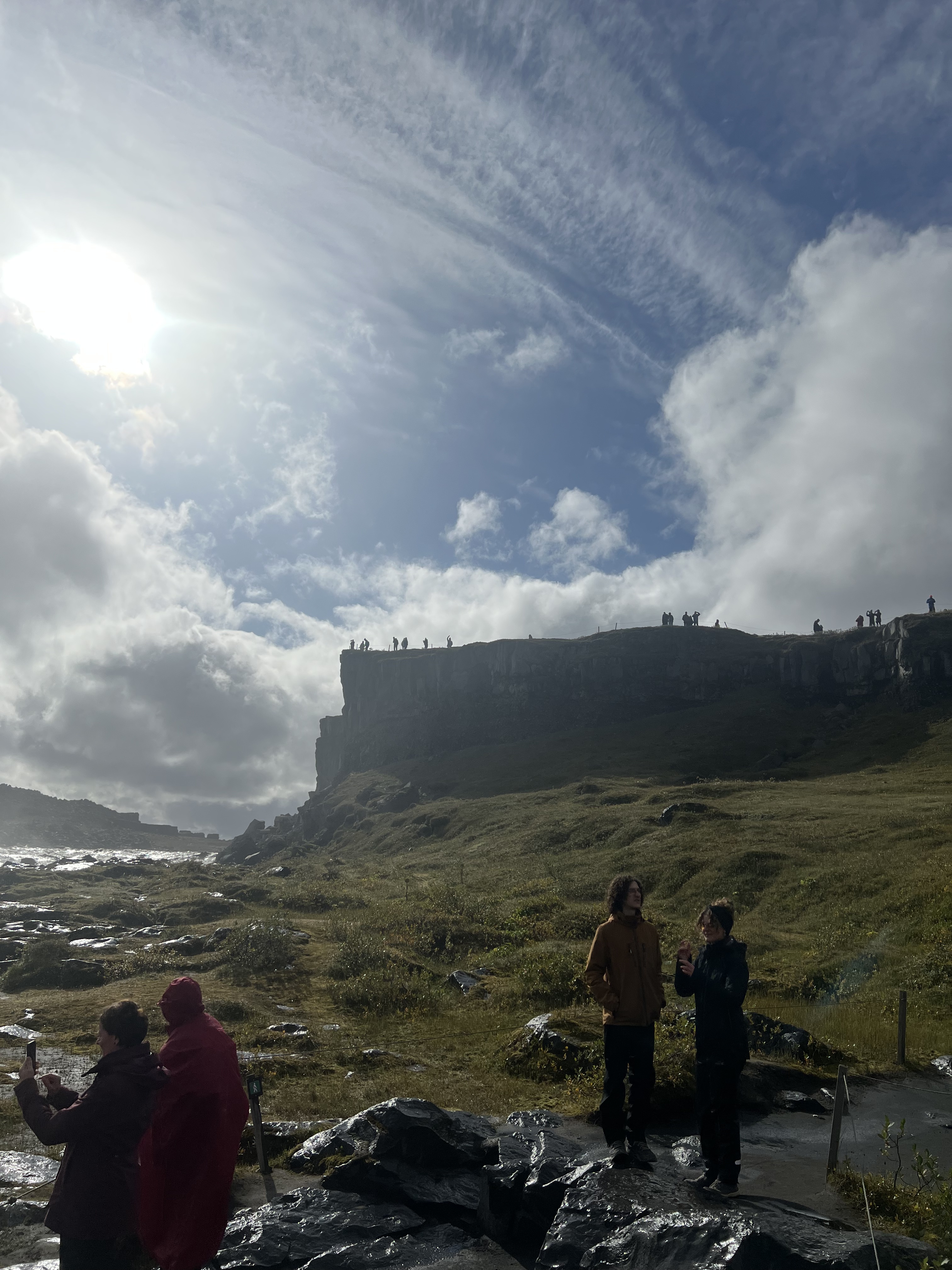
Day 7 – Continuing on along the ring road travelling northwest, our first stop was Dettifoss waterfall, ranked as the second most powerful in Europe. 100 metres wide, the water plummets 45 metres down into Jokulsargljufur canyon. It is definitely quite a sight and well worth the visit.
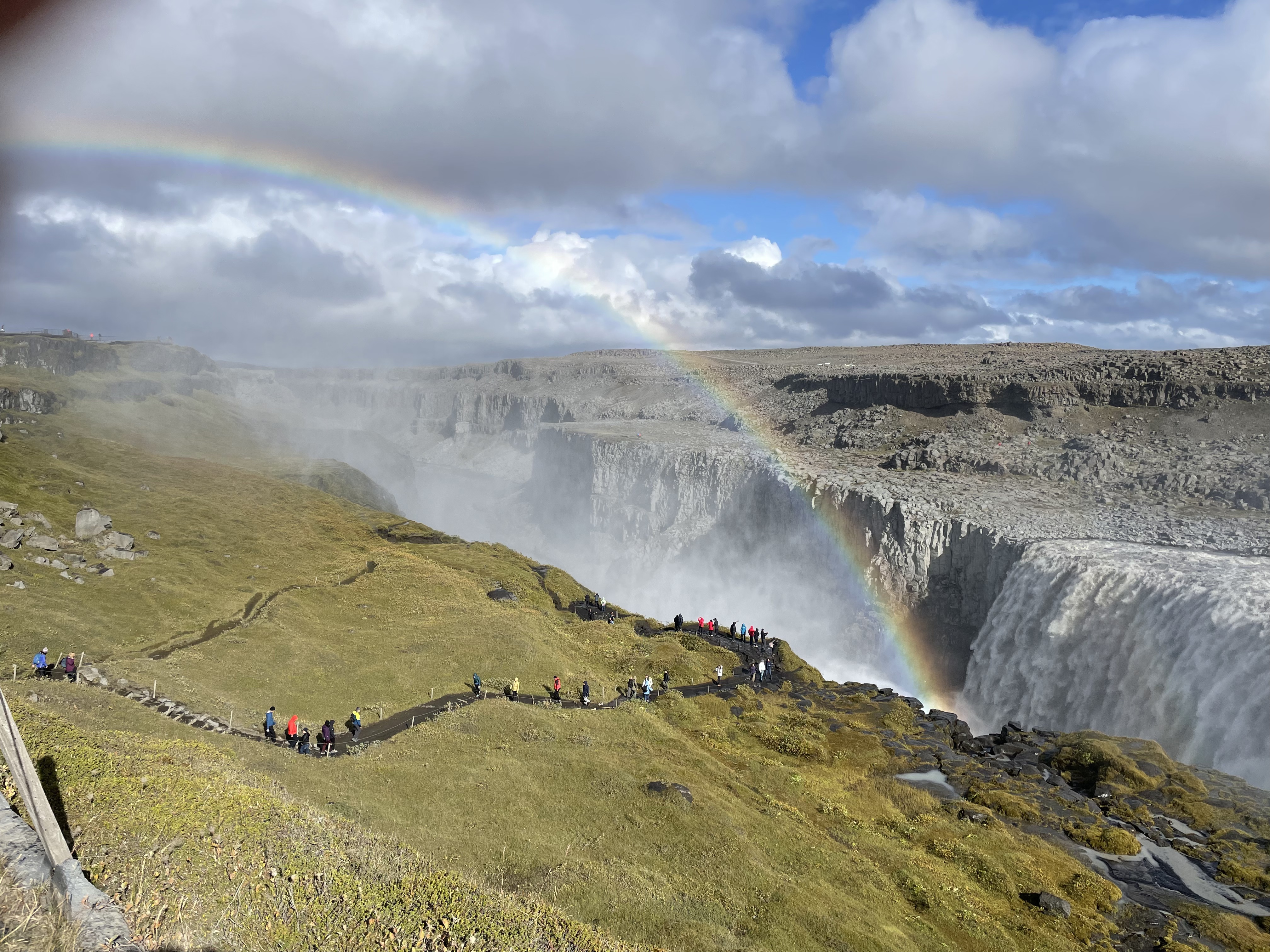
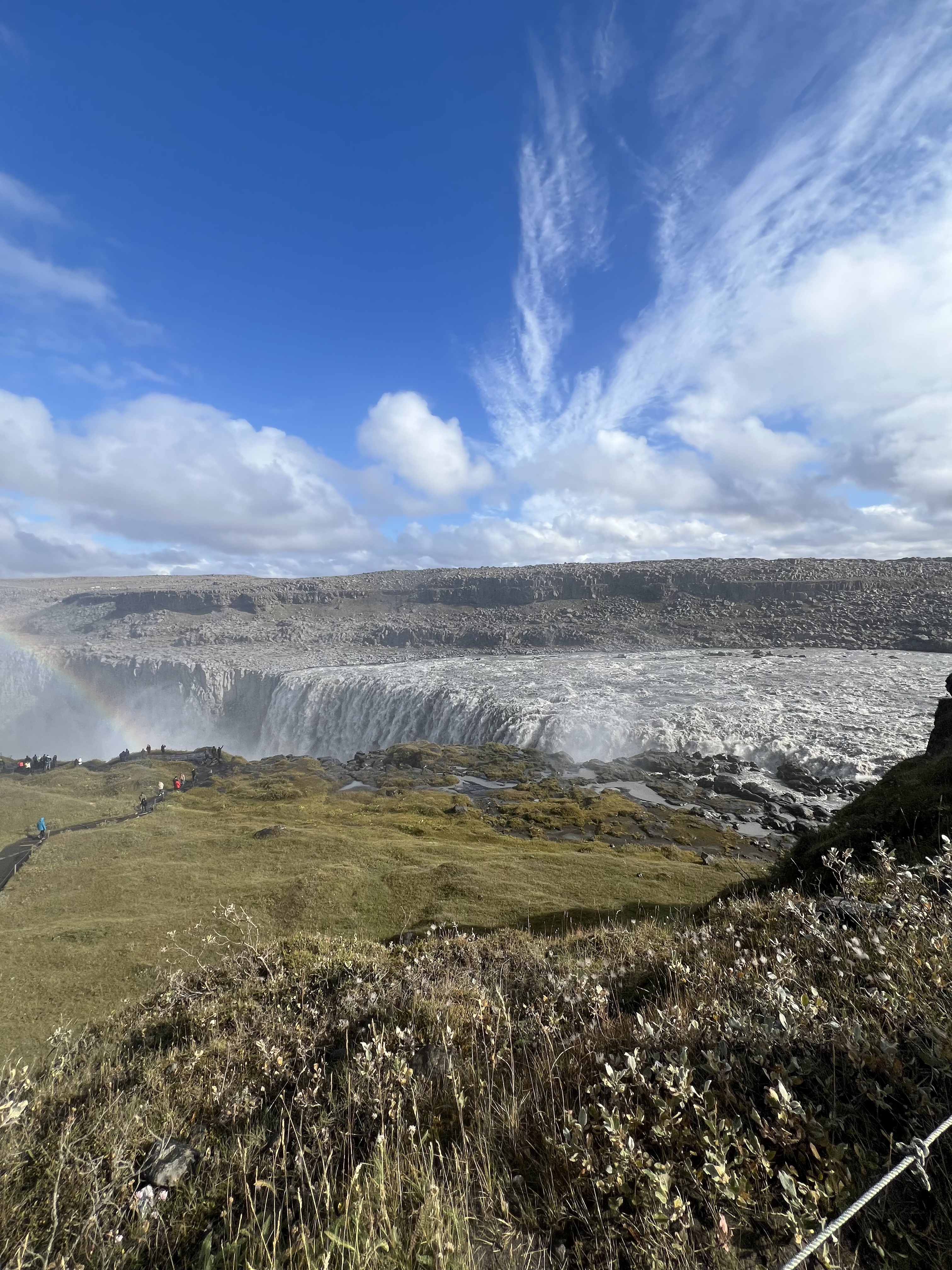
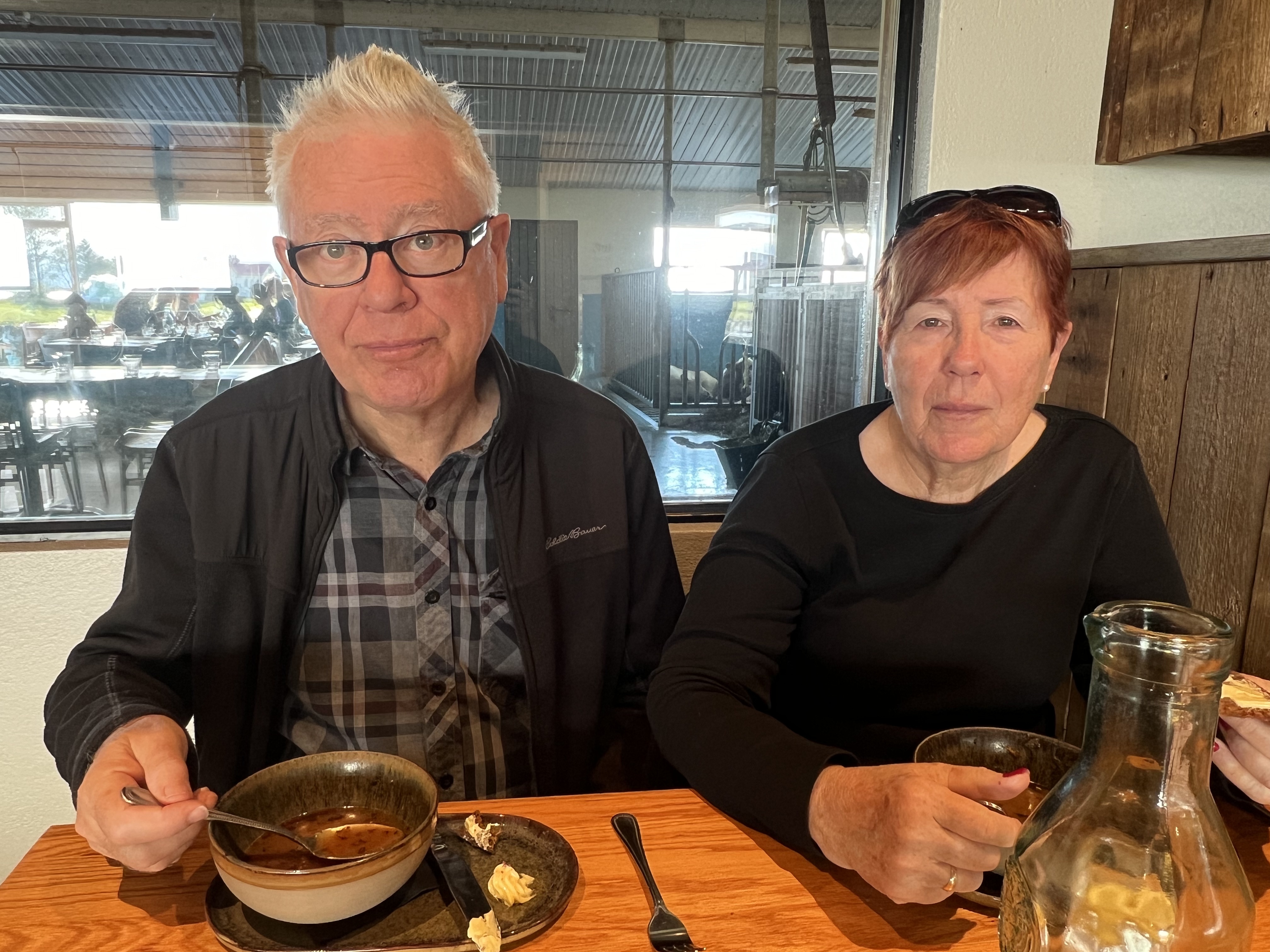
Our next stop was Myvatn, a geothermal area that is renowned for its wealth of flora and fauna, particularly its birdlife. Our first stop was a fun spot where we had lunch. Vogafjos Farm Resort is a family-run guesthouse which includes a restaurant adjoining the barn where one can watch, if you arrive at the right time, the cows being milked. Just about everything on the menu is grown and made on the farm. Great spot!
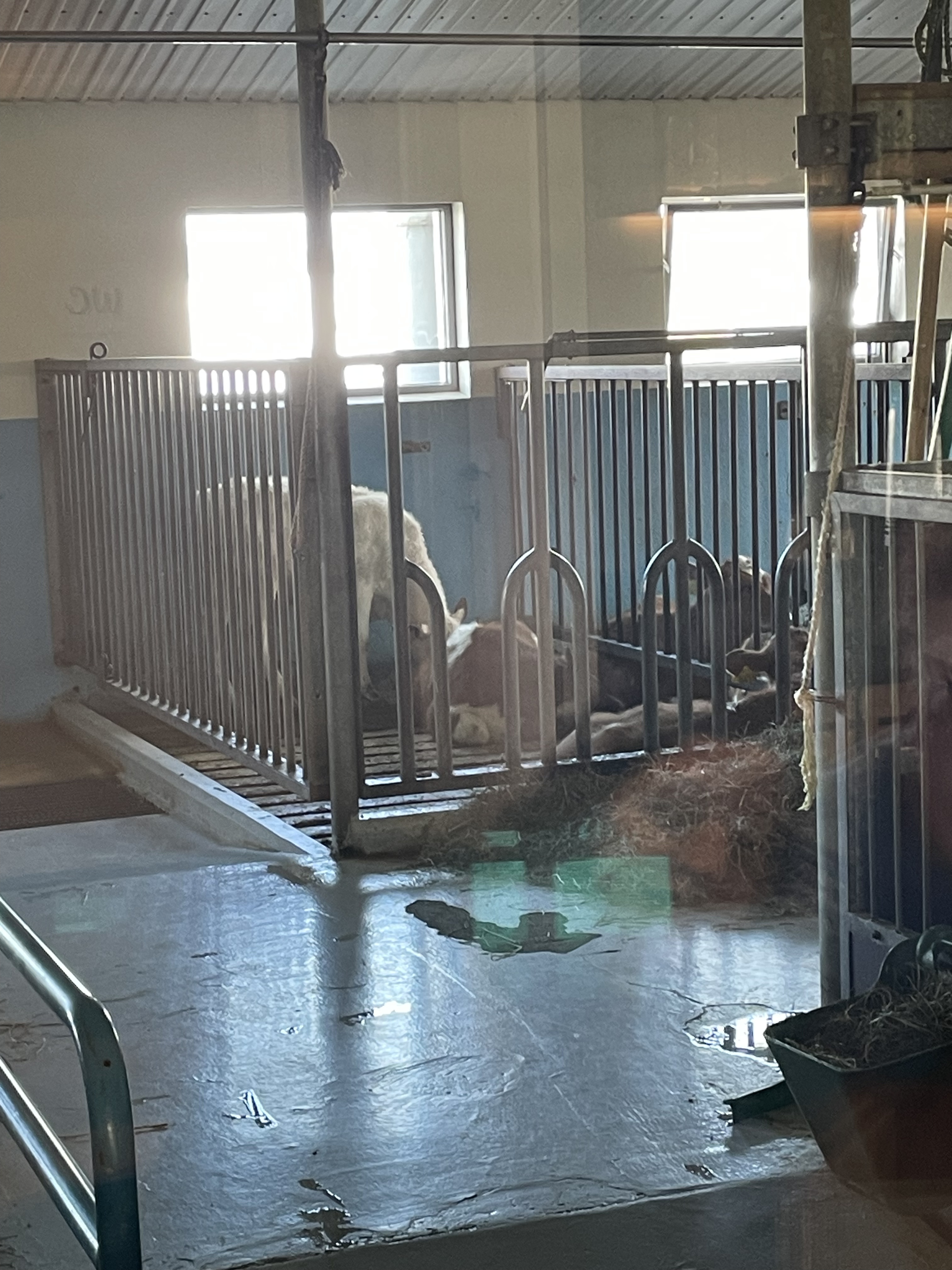
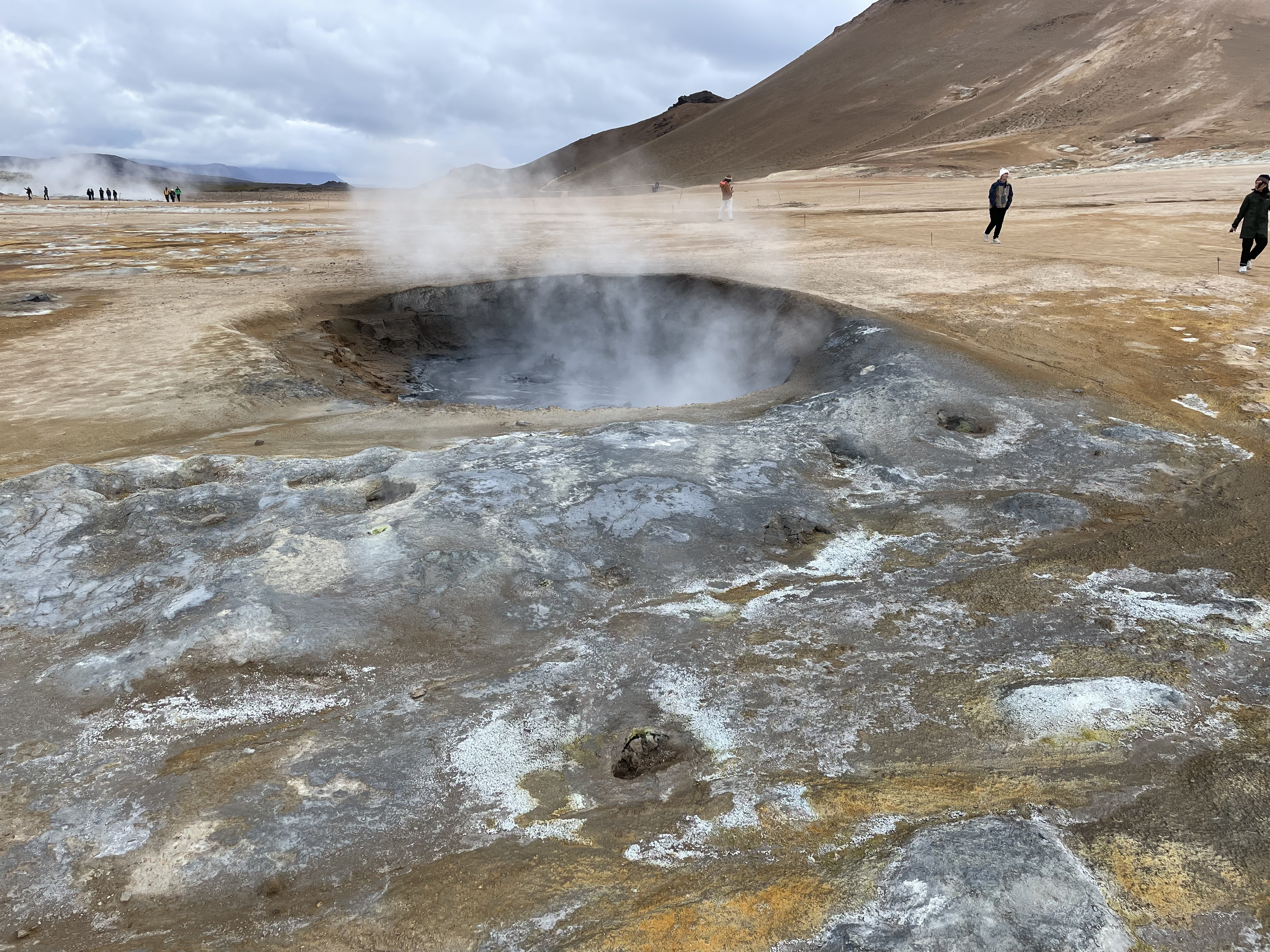
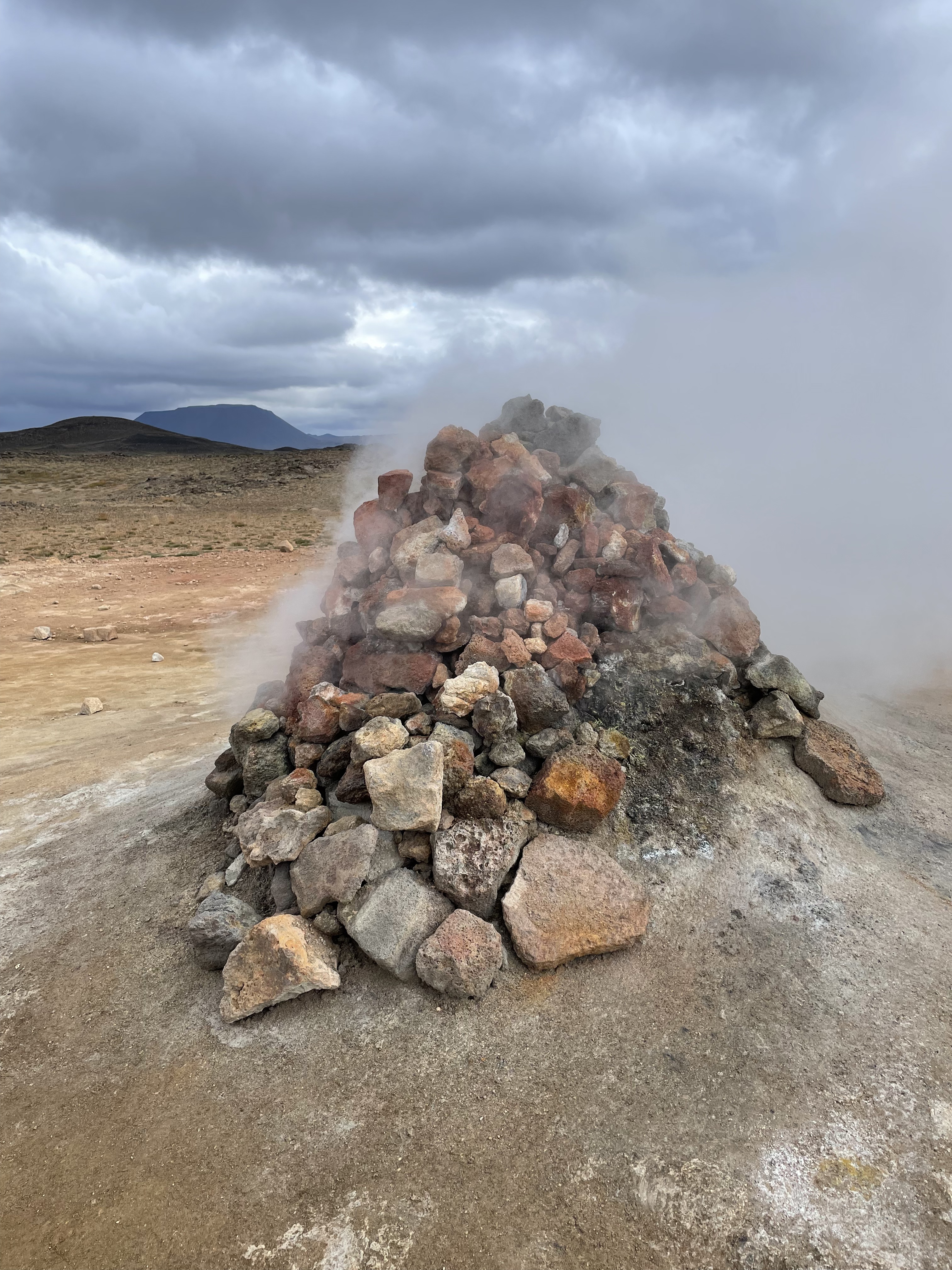
After lunch we travelled up the Namaskard Pass, on Mount Namafjall to the Namaskard Geothermal Area, a stark landscape defined by seething fumaroles, sulphuric smells and brightly coloured clay. Walking around this area makes it feel like you’ve entered another world. It’s hard to believe that just over the mountain is the lush landscape we had just left.

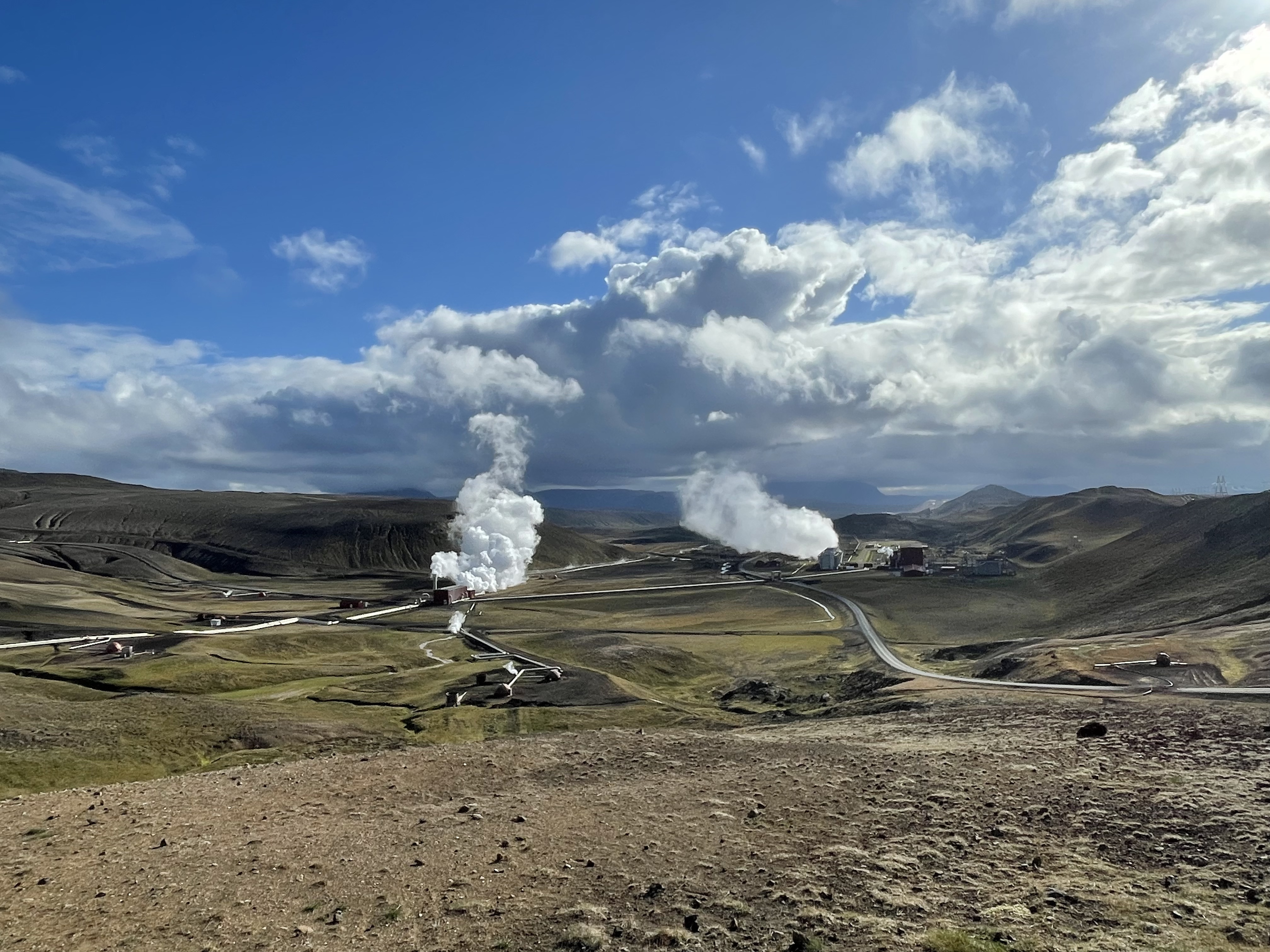
Also in this area is a large geothermal plant and Hverfjall Crater Mountain.

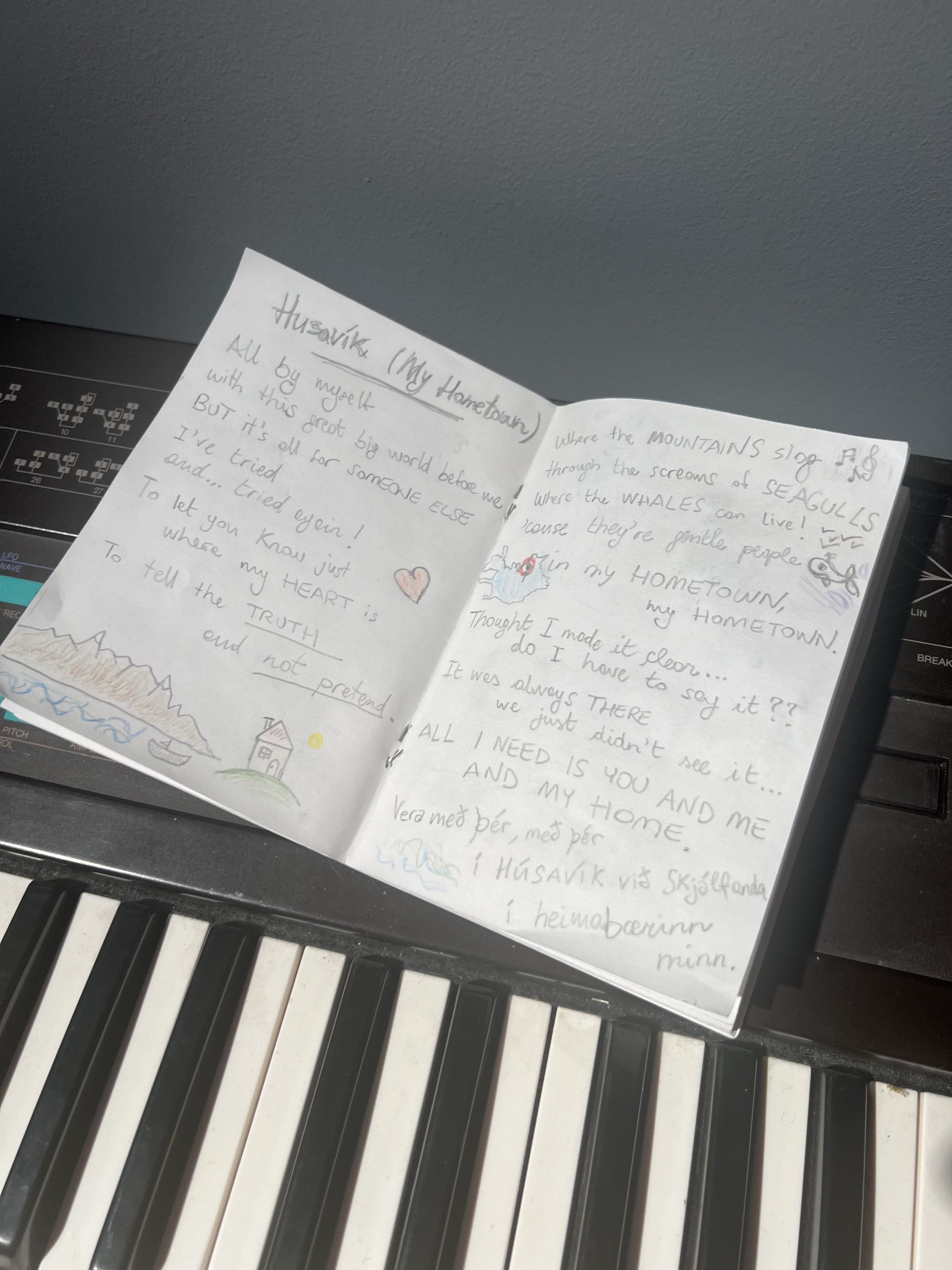
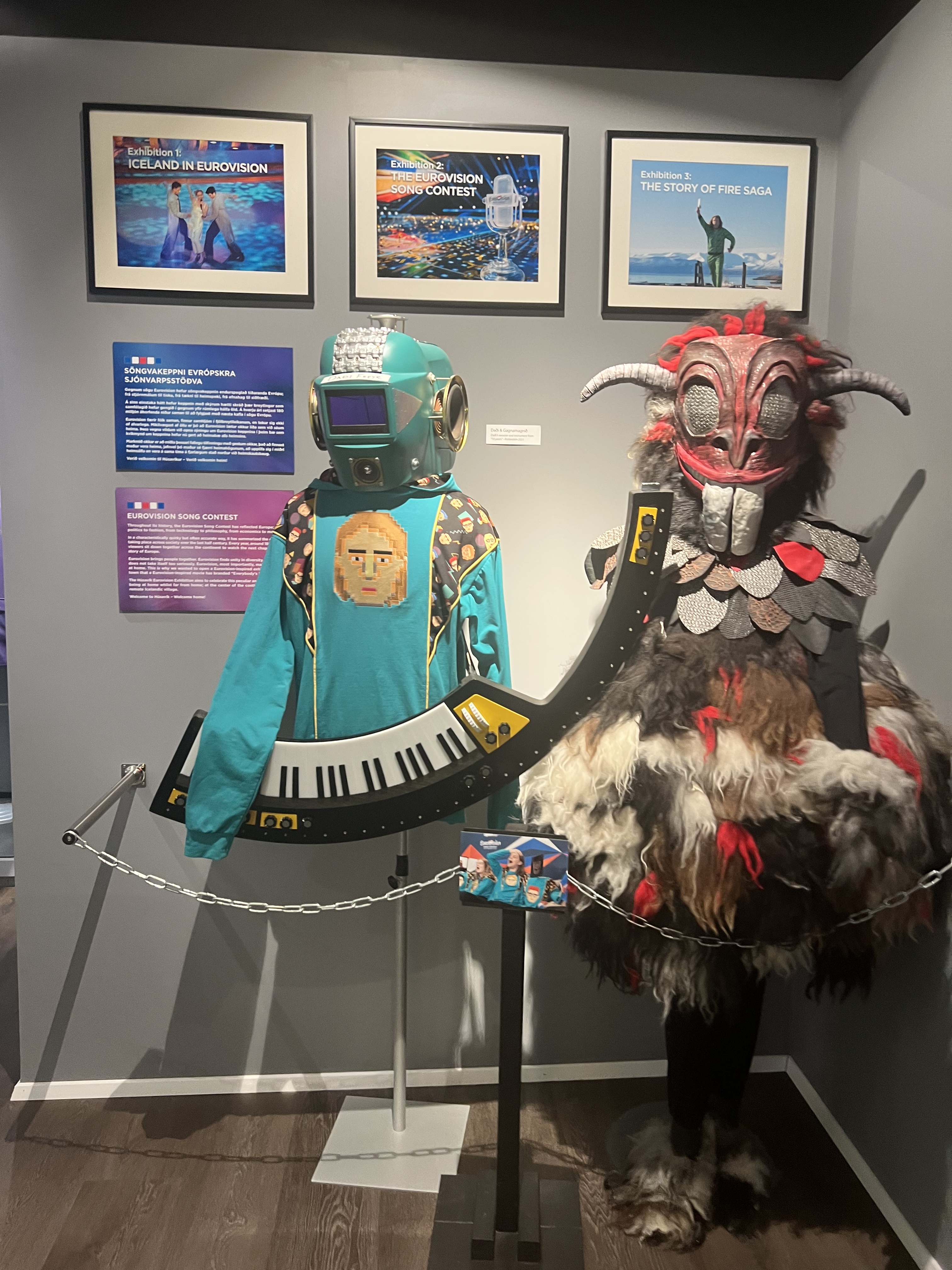
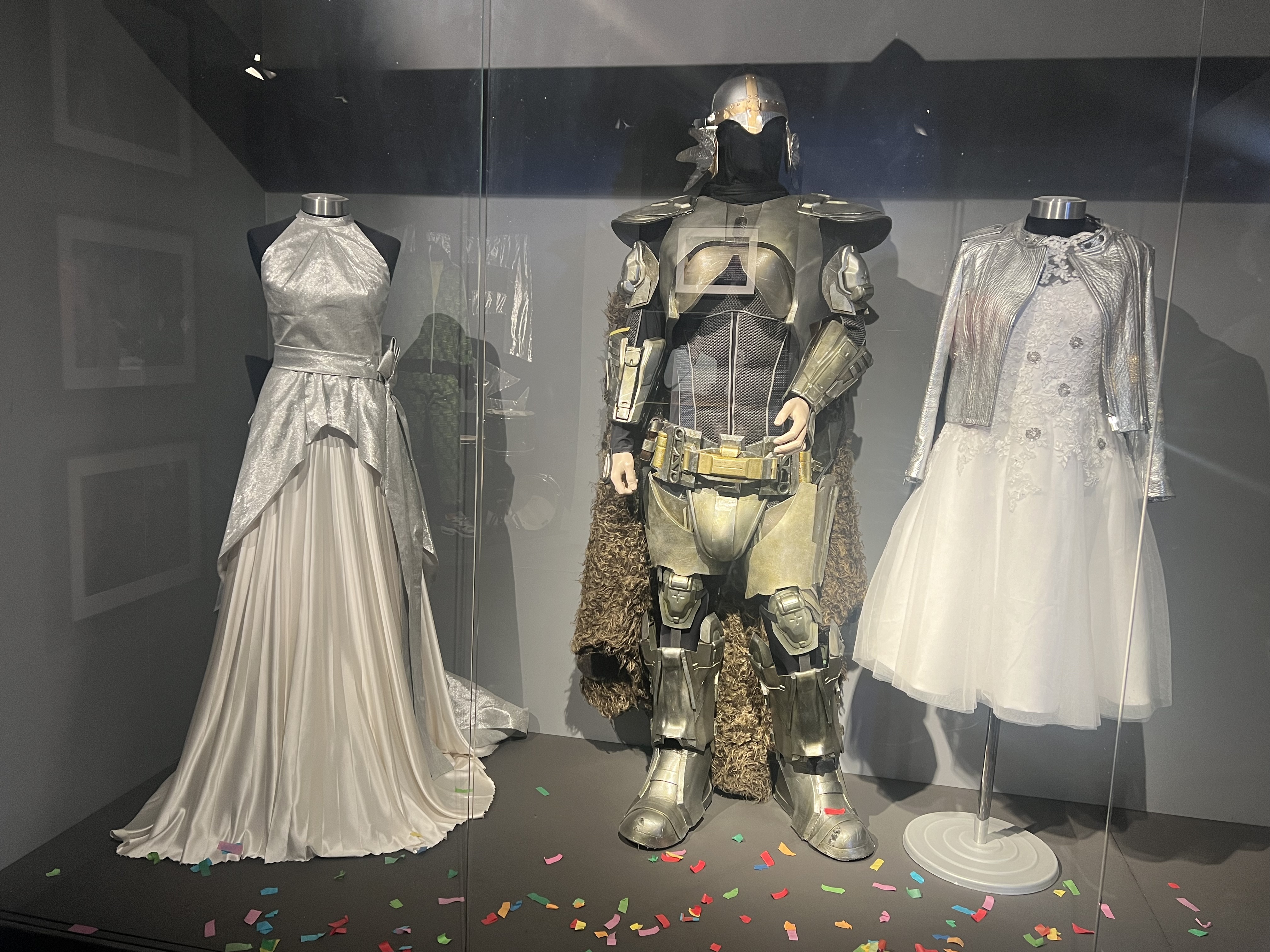
Our stop for the evening was Husavik. After a short rest we walked down to the harbour for dinner at Restaurant Salka, a great spot to eat. Then for our evening’s entertainment we visited the Eurovision Song Contest Exhibition. What fun! Based on the movie Eurovision Song Contest – the Story of Fire Saga the exhibition tells the story of the song contest, Iceland’s history at the competition and a behind-the-scenes look at the Netflix original film. Husavik, where some of the movie was filmed, became an overnight sensation.
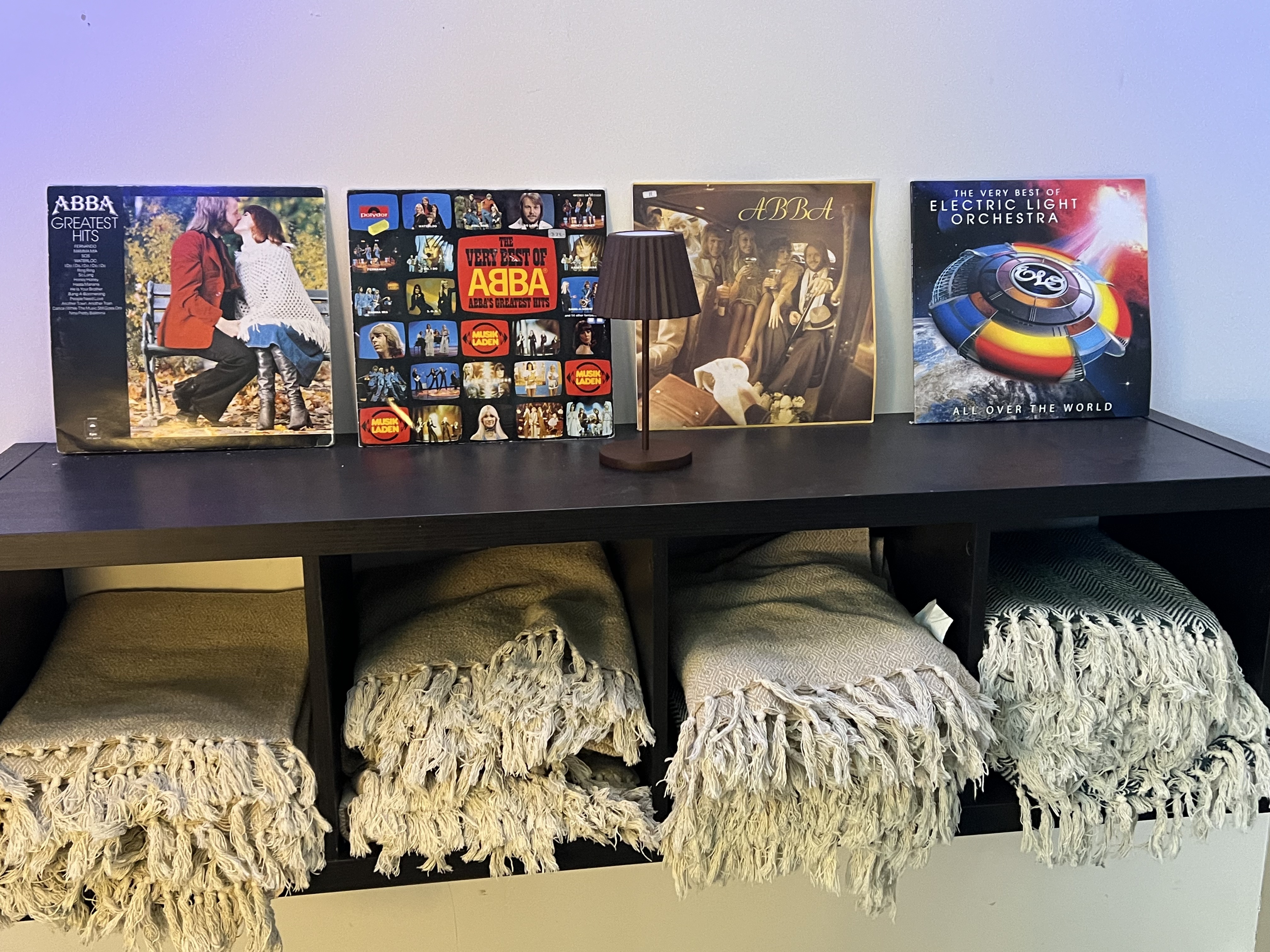
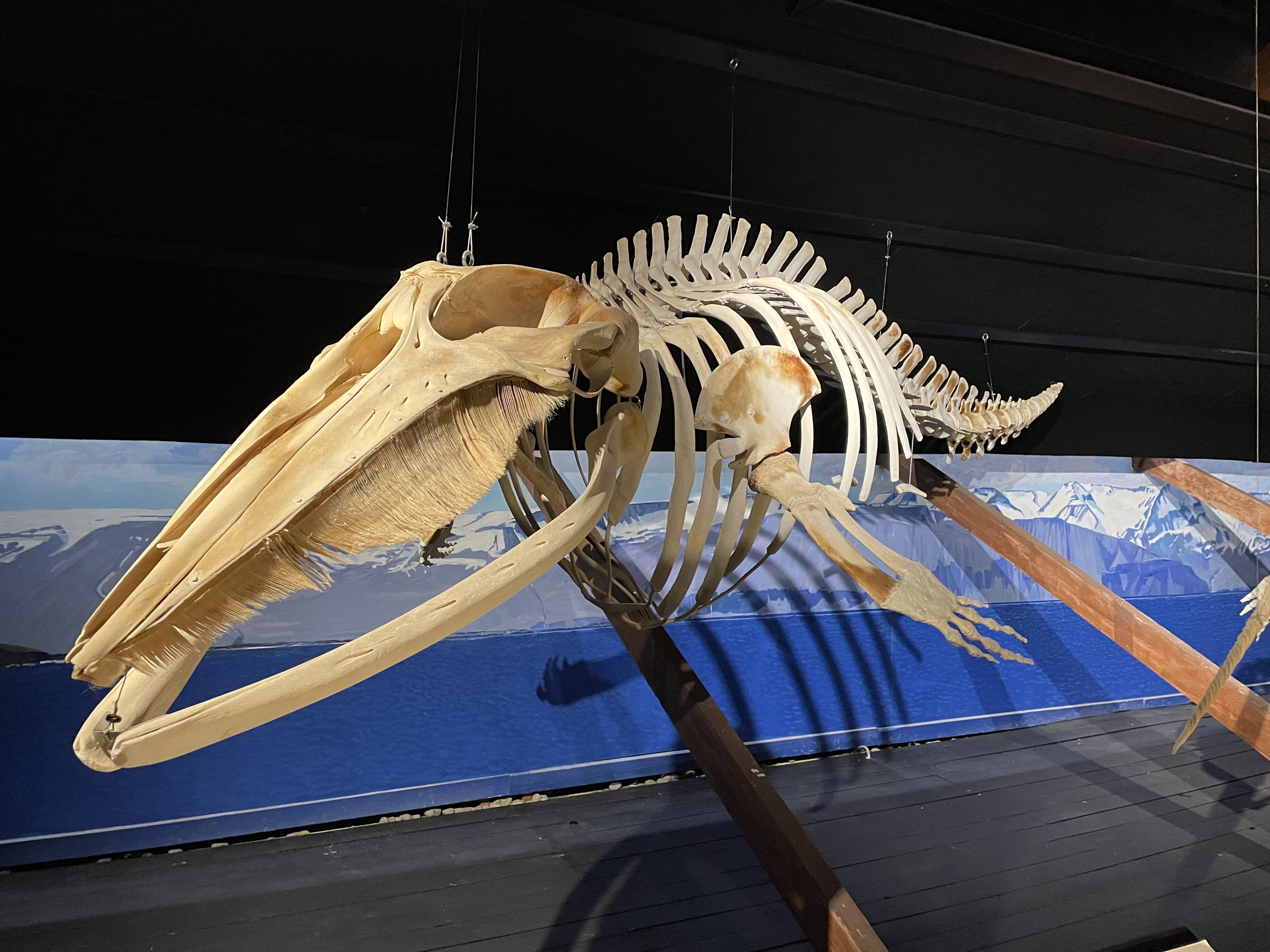
Day 8 – Our original plan was to perhaps go whale watching or to a spa in the morning but the weather wasn’t cooperative. Wet, cold and windy we opted for the Whale Museum instead. The museum includes 13 real whale skeletons, interactive displays, and informative presentations providing a deeper understanding of these magnificent creatures and their importance in the marine ecosystems. Of particular interest was a documentary on the pilot whale hunt that takes place on the Faroe Islands. Interestingly, Canada still catches the most whales under the aboriginal exemption provision of the International Whaling Commission. The debate continues.

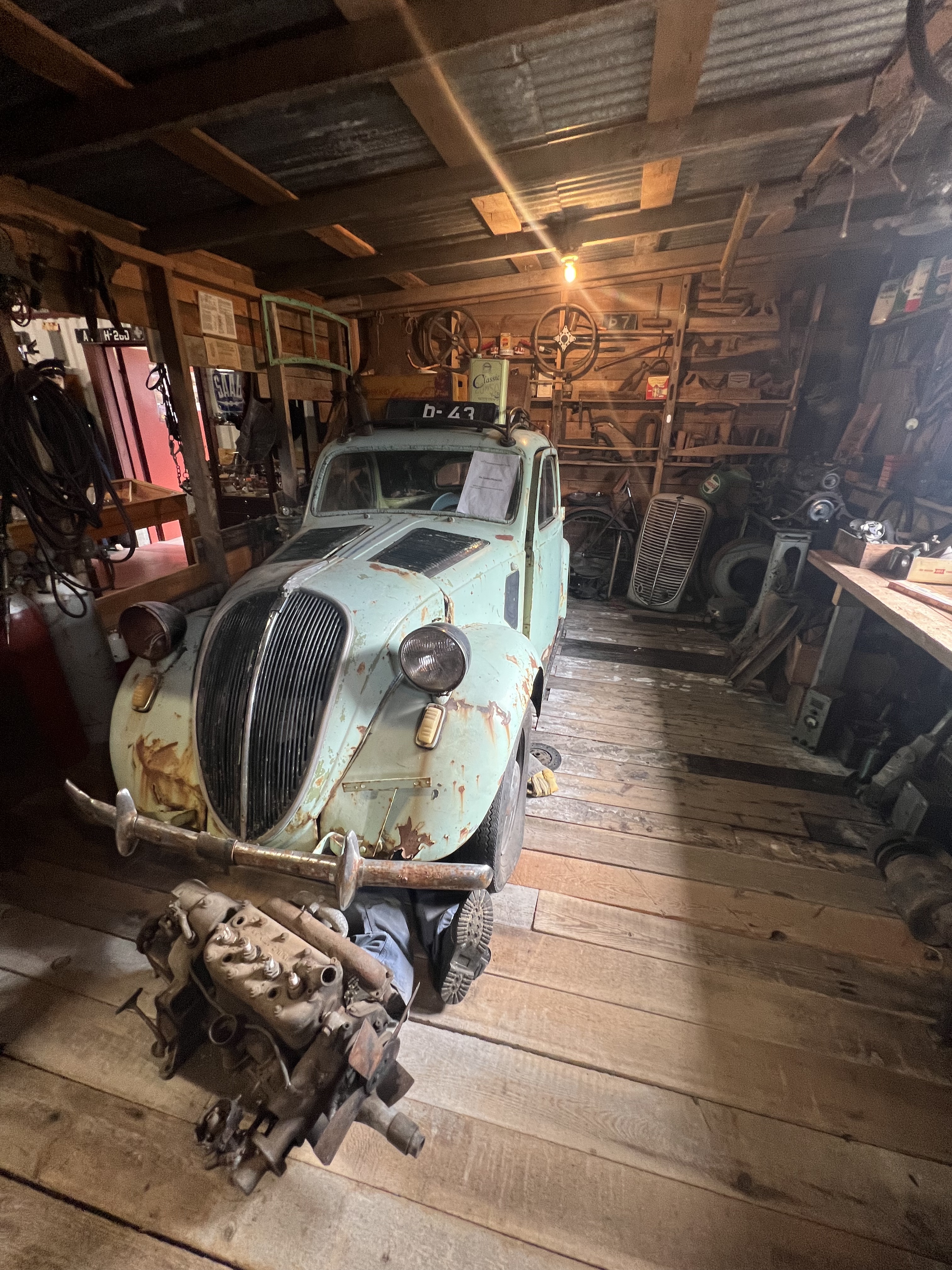
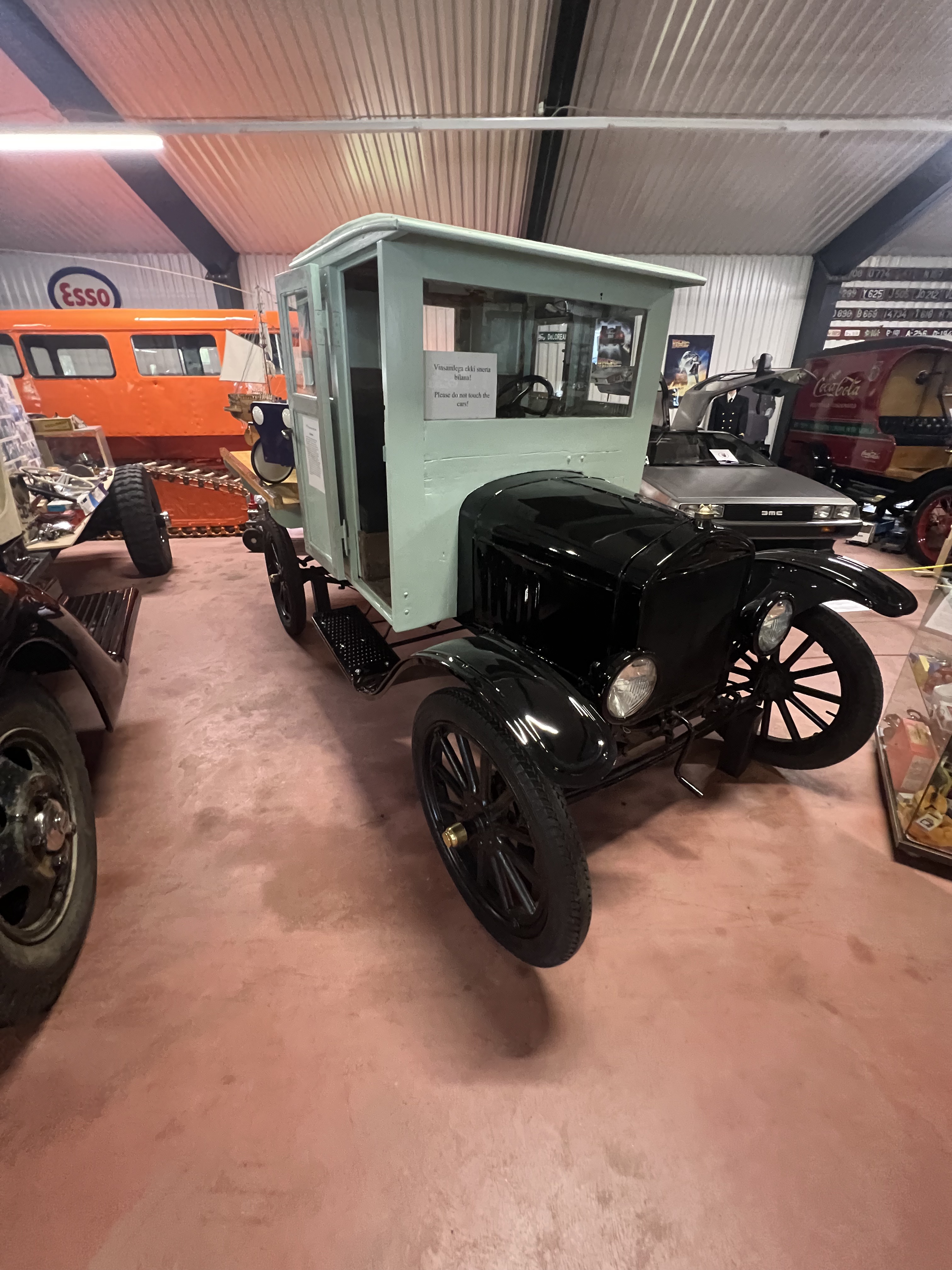
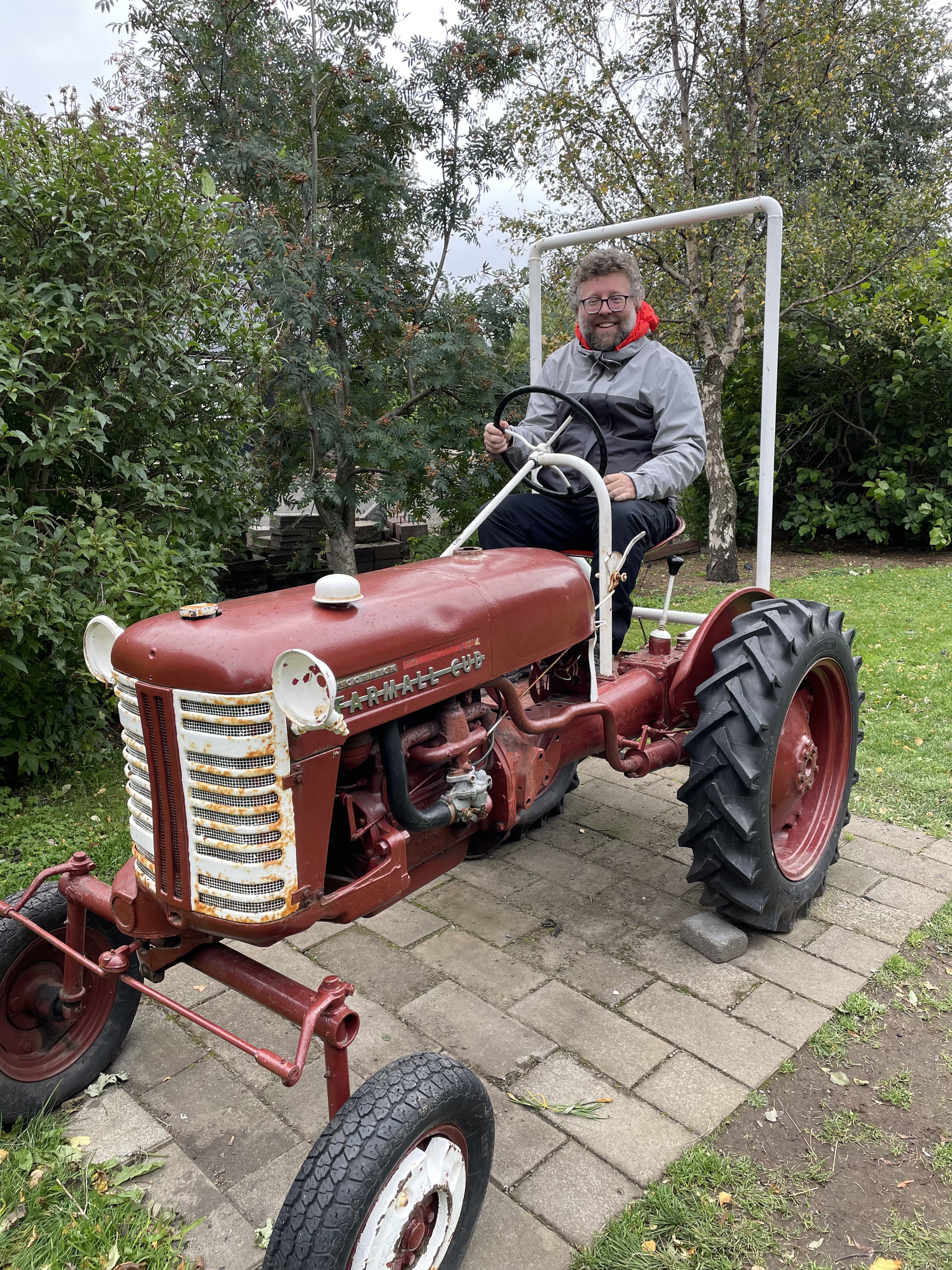
Our stop for this night was Akureyri, just an hour from Husavik. With a short drive we were able to make a couple of stops along the way and get into town early enough to enjoy some of the Akureyri sites. Our first stop was the Ystafell Transportation Museum, the oldest car museum in Iceland. Its main purpose is to preserve and show various ways and means of transportation and is the loving effort and dedication of one man and a team of volunteers.
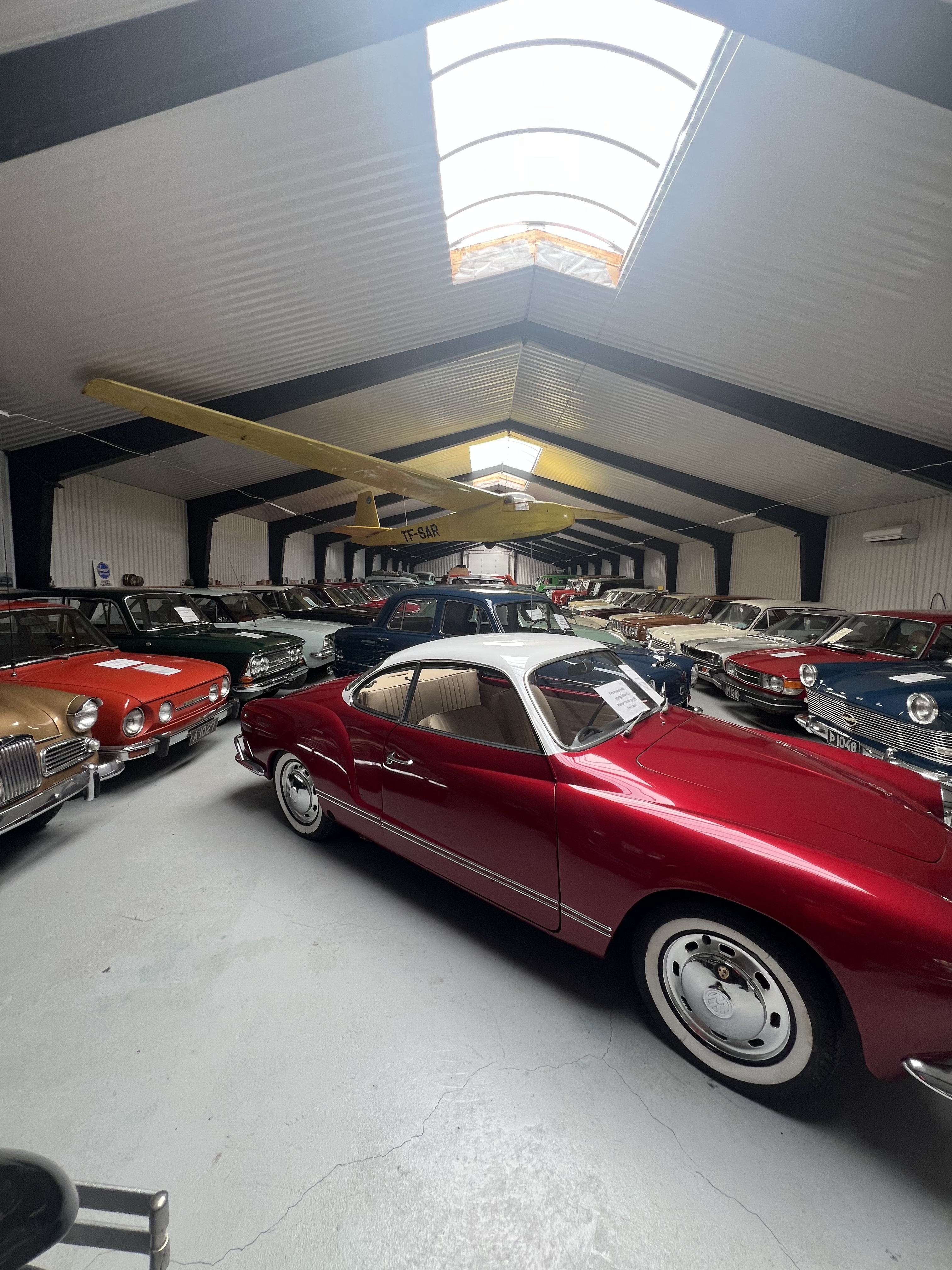
Then it was off to see yet another waterfall across the bay from Akureyri. The water was steaming but those who tried it reported that it was just warm, not hot as usual. We saw one brave fellow who had taken a dip. Given the 2C temperature, I’m not sure how he made it back to his car without turning into an icicle.

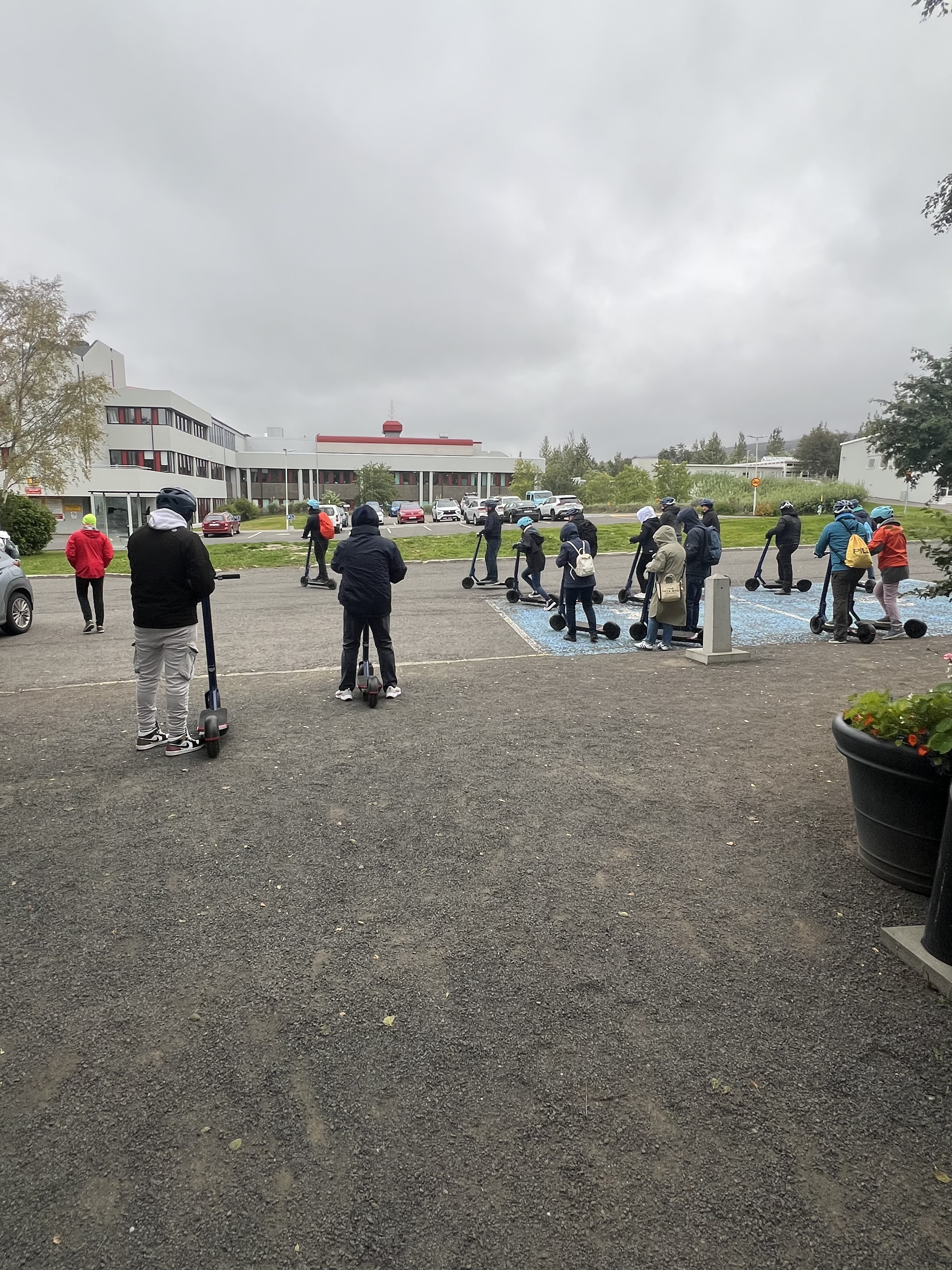
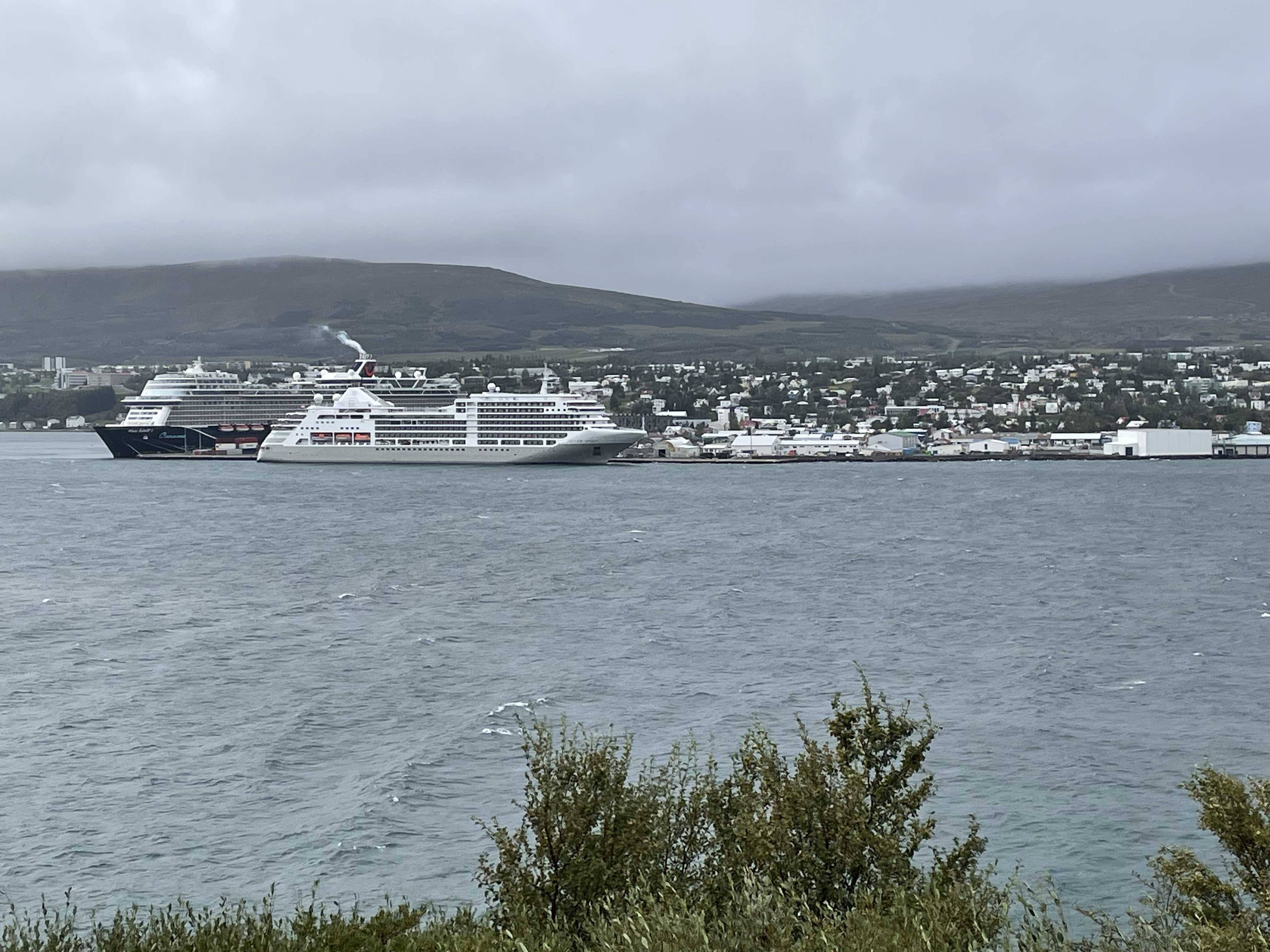
There were two cruise liners in port and while we were eating lunch George noticed a whole bunch of people on scooters. We figure that was one of the Port excursion tours offered.

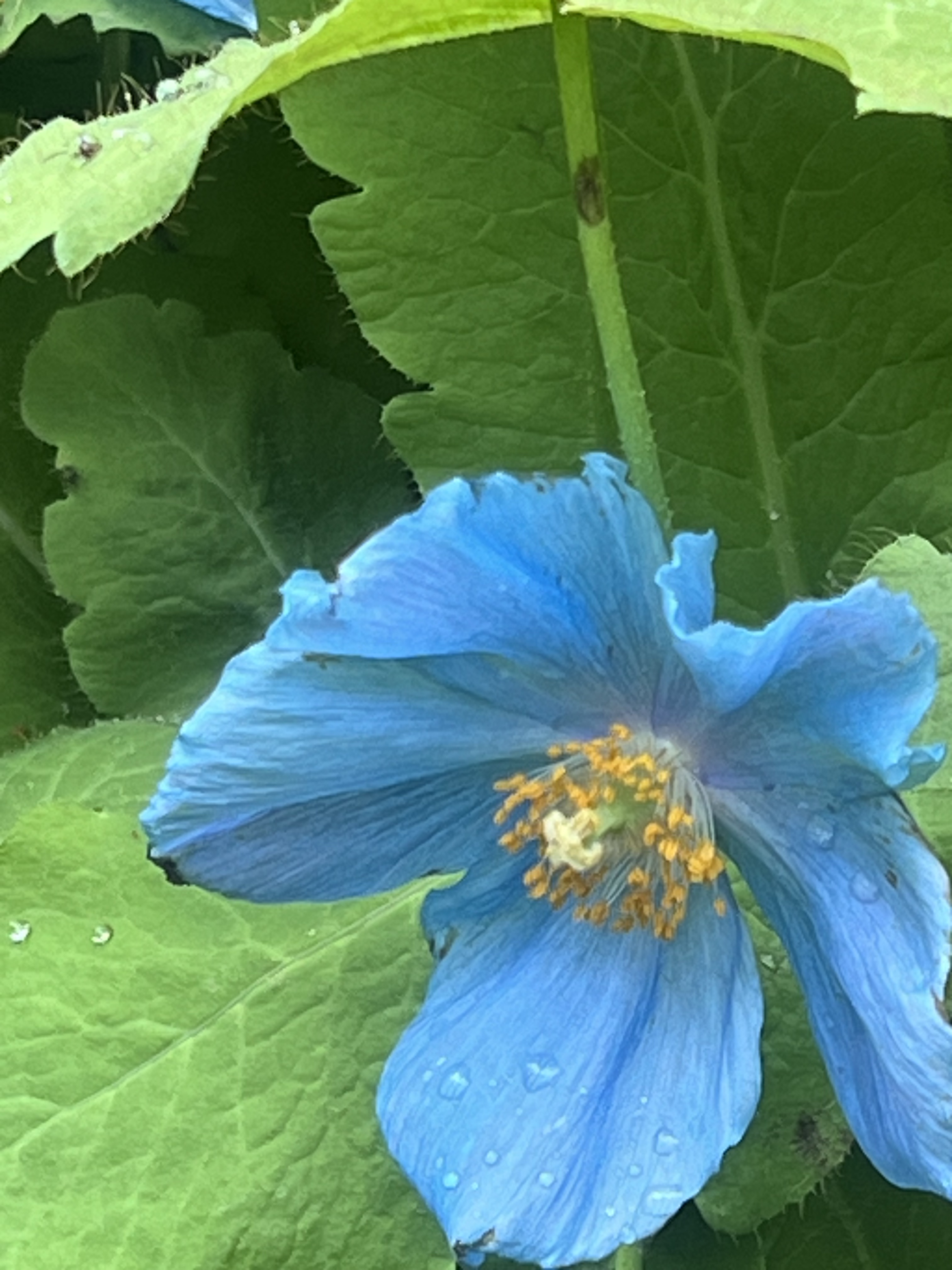
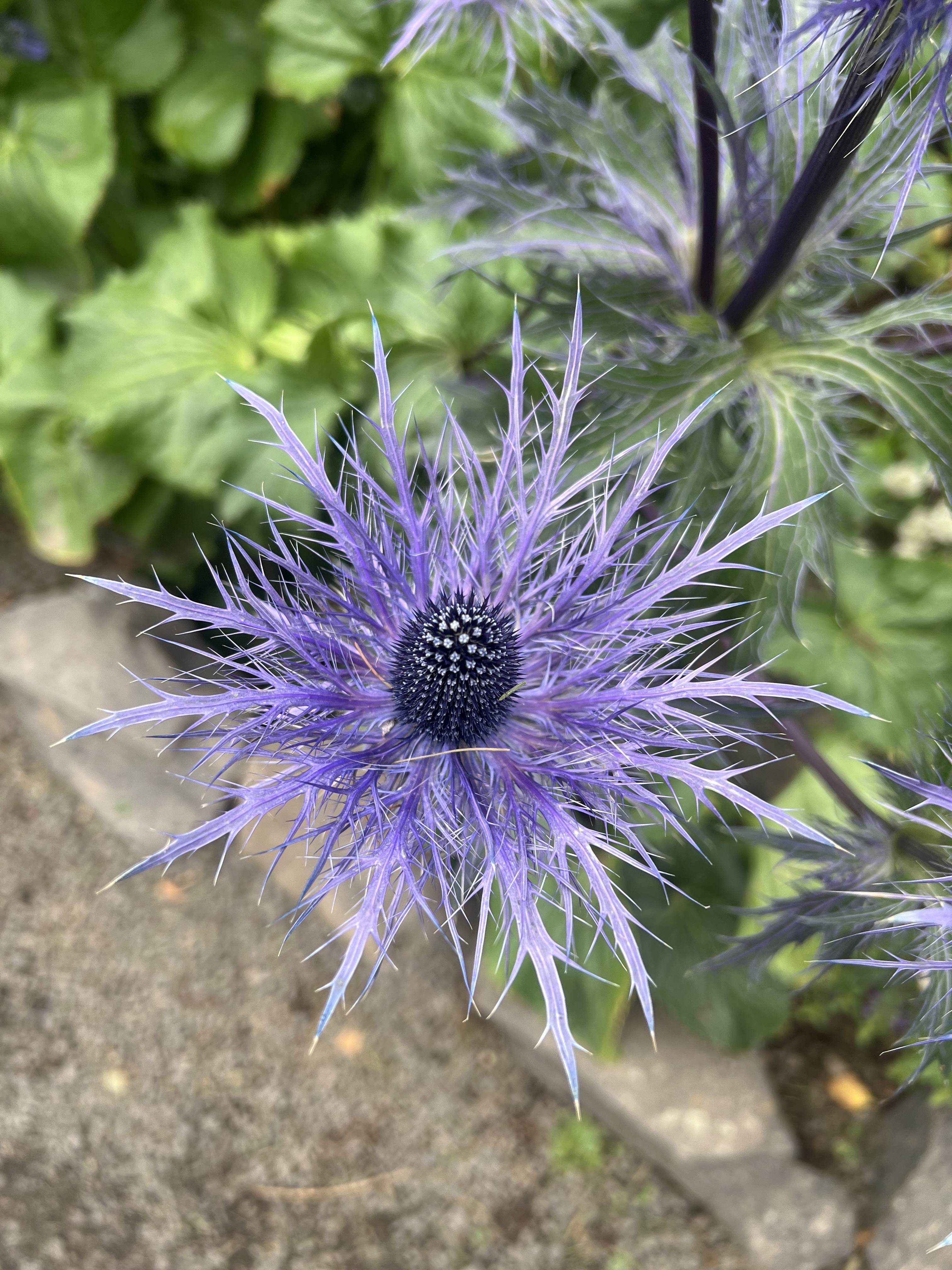
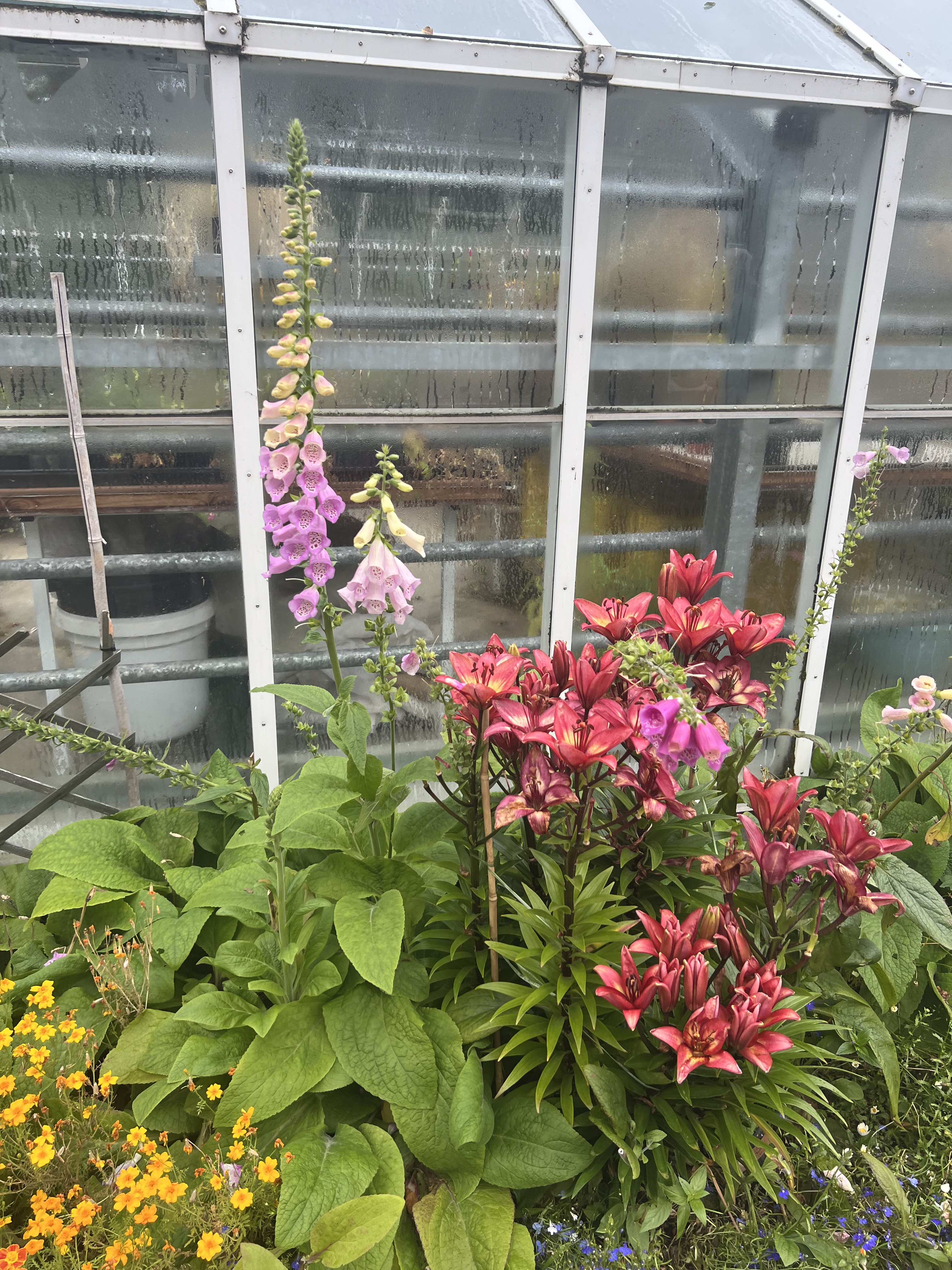
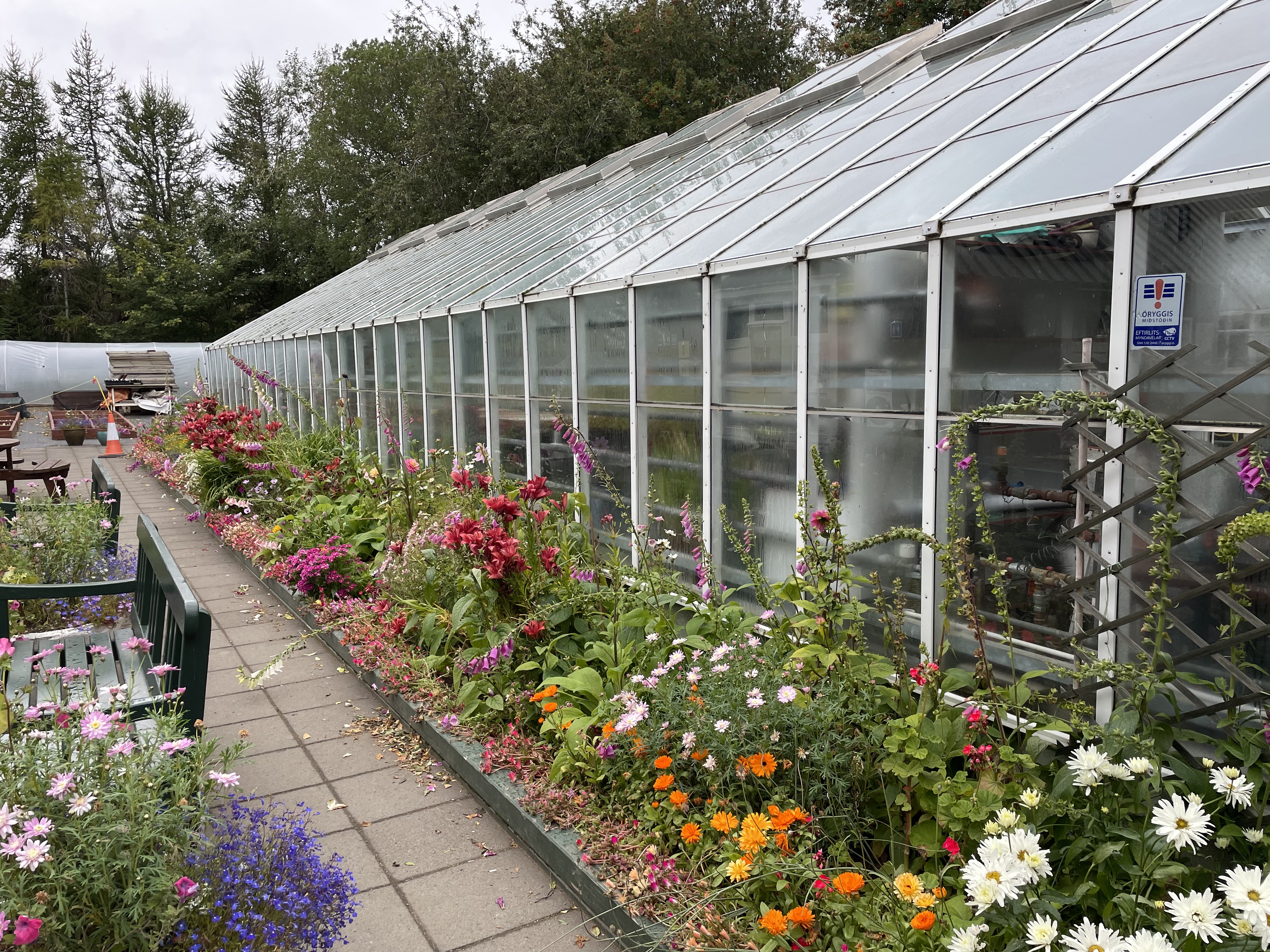
After lunch we went to the Botanical Gardens – one of the northernmost, sitting just 50 km south of the Arctic Circle. The Botanical Gardens in Tromso, Norway is further north. It was most interesting touring a garden in our winter garb and seeing lots of colourful flowers in bloom, many of which bloom in a different season at home. Delphiniums, foxglove, many varieties of asters, pansies and columbine were all in bloom together.
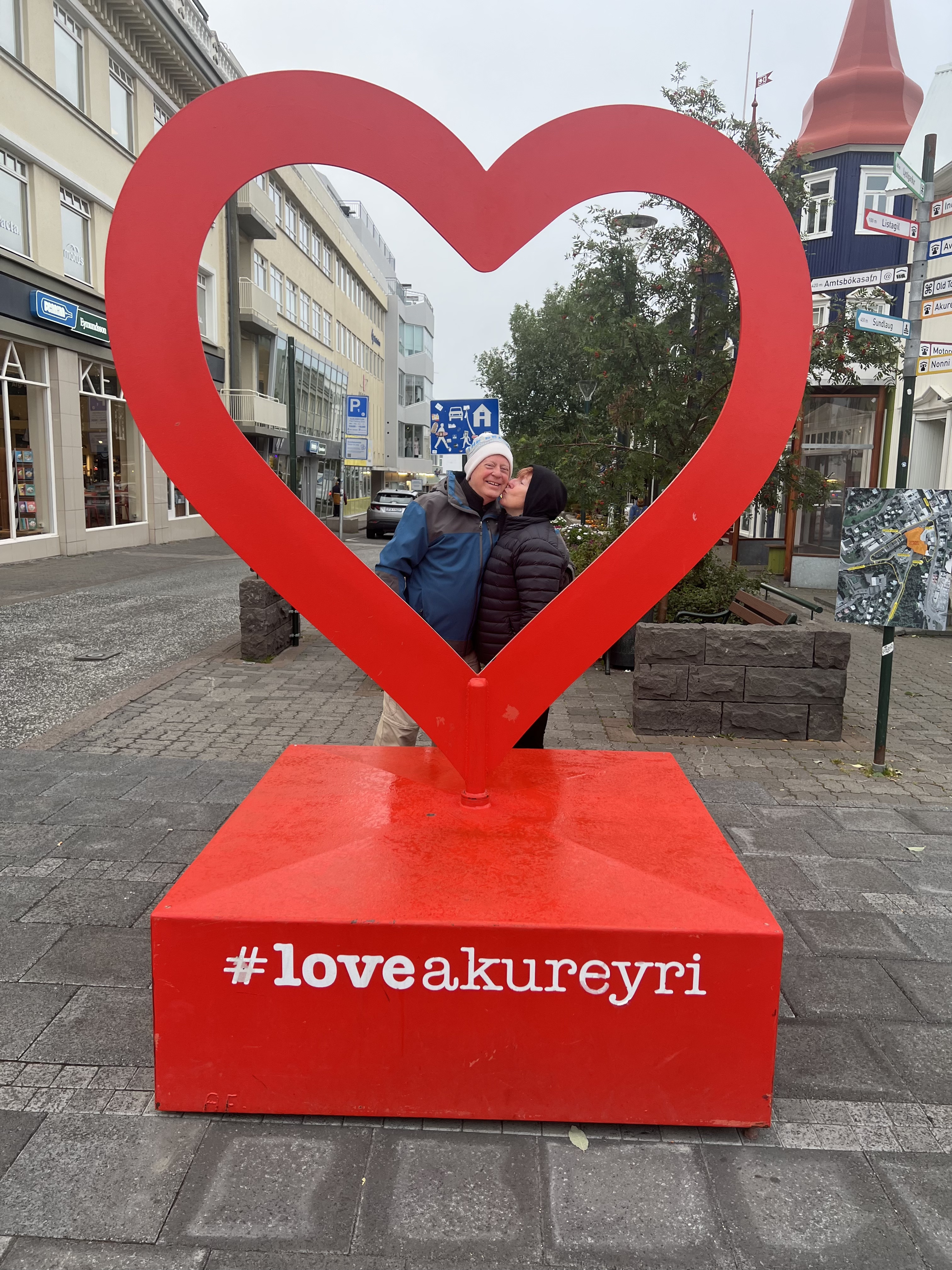
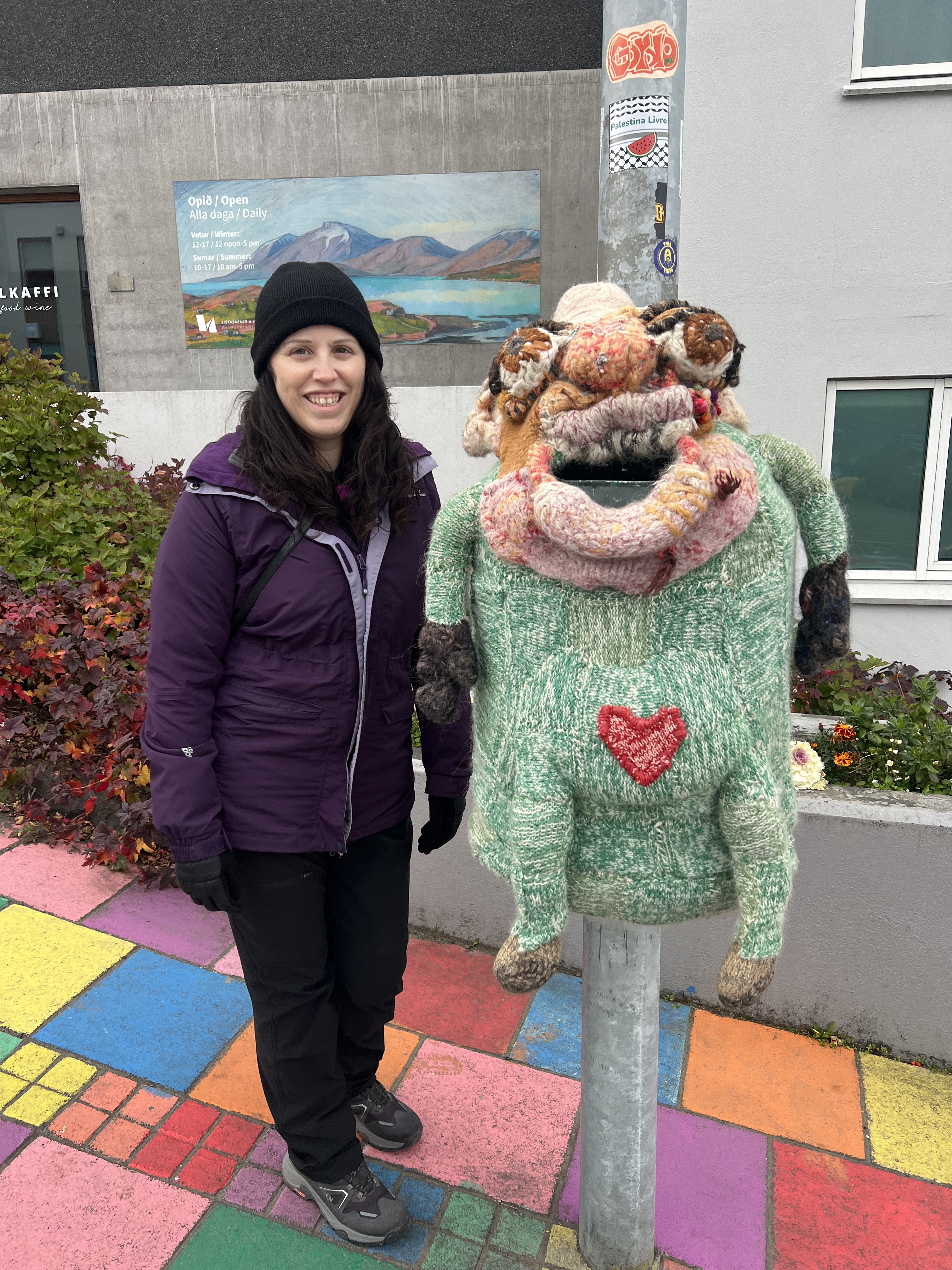
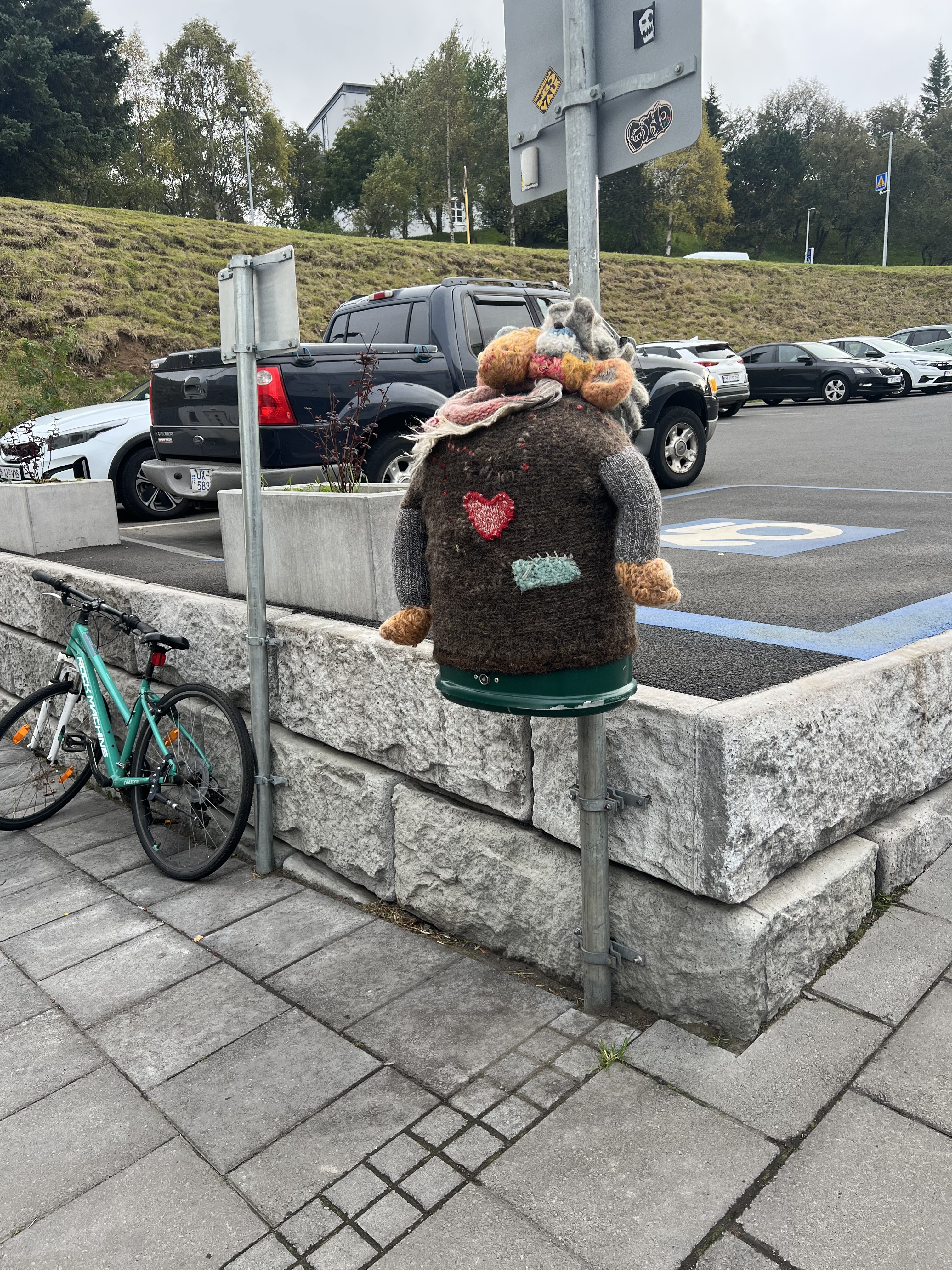
After checking into Hotel Kea, which is right downtown, we stopped for dinner at the Bautinn right across the road. After dinner we strolled through town. We found Akureyri quite a cute little town as we walked around. Where else do you see garbage pails disguised as trolls with knitted outfits? But beware: in one of the souvenir shops I found some cute aprons with puffins on them. I purchased three for a volunteer group that I work with back home. We thought they were about $10 each … turned out they were $60 each!
The Lutheran Church was consecrated in 1940 and holds a dominant place in town.

Day 9 – We debated staying in town for an extra hour to return the aprons, but we had a long drive ahead of us and abandoned the idea. Live and learn!

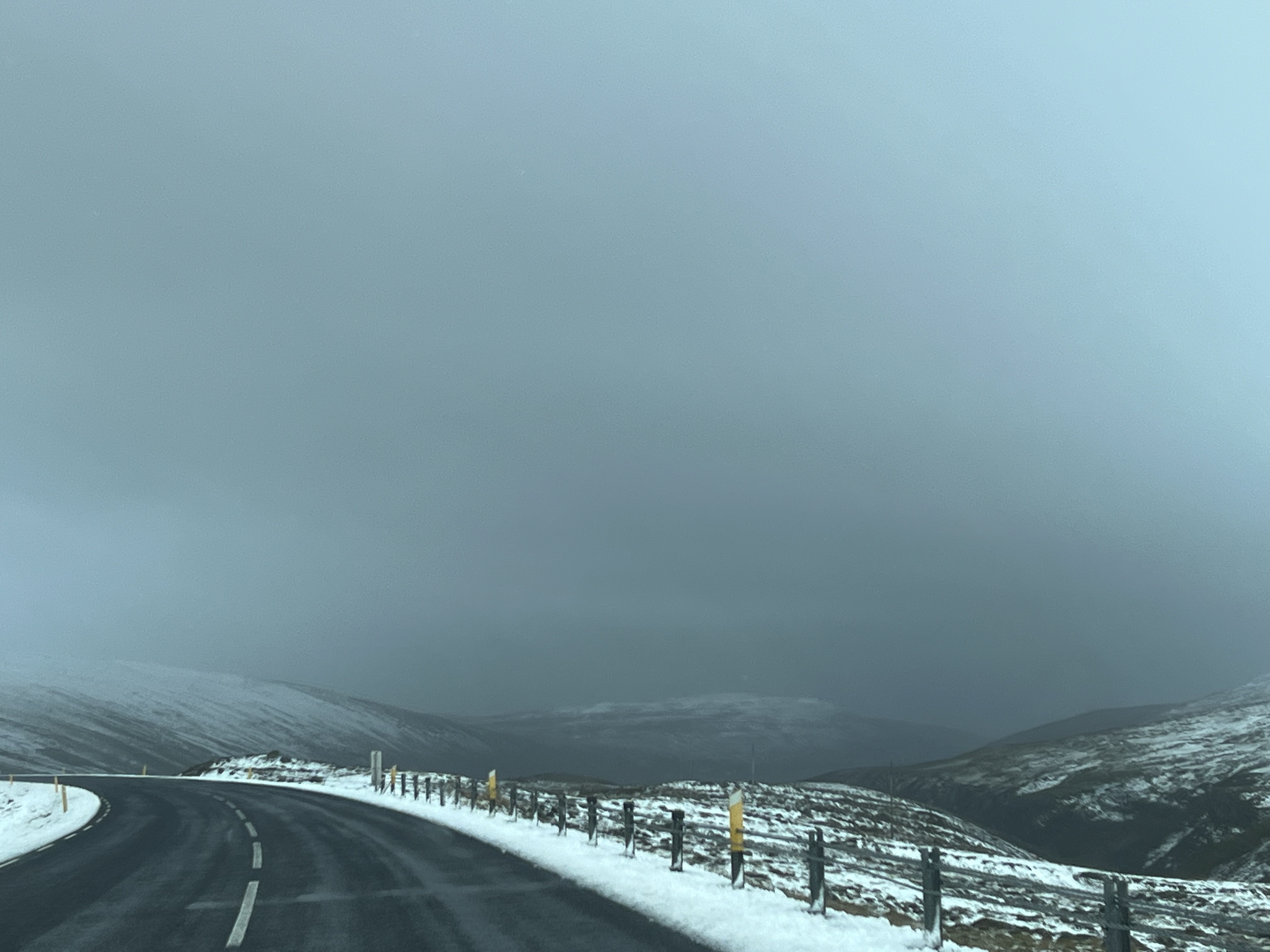
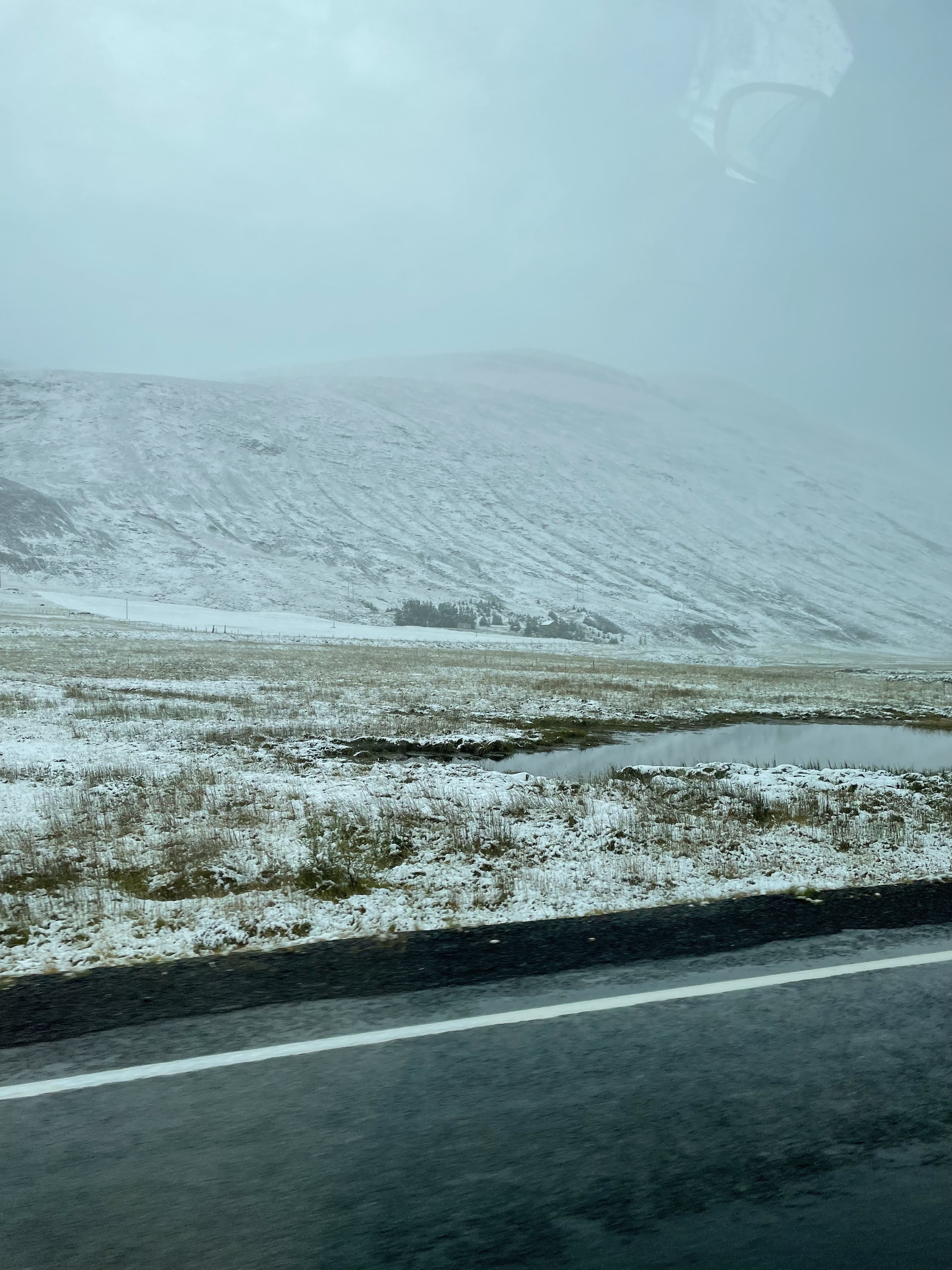
Winter finally caught up to us and we saw a fair bit of snow along the way. Fortunately, it didn’t collect on the road, ensuring a safe trip into Reykjavik. After a stop in Blonduos at a pizza restaurant, we motored on to Reykjavik, arriving late afternoon. There isn’t really much to see on that part of the circle road. A short stop at the Grabrok crater provided an opportunity for a bit of exercise. Over 3,000 years old, it is very visitor friendly and relatively easy to access. Once at the top, the view is quite stunning and you can see one other crater, Gravrokarfell, in the distance.

We did shorten the trip 45 km by taking the Hvalfjordur Tunnel – a 5.8 km sub-sea tunnel that only takes about seven minutes instead of one hour around the fjord.

Our hotel of choice was the Viking Hotel in a southern suburb. It was quite a fun-looking spot but not the best hotel on our trip. The rooms were quite small and breakfast offerings were minimal. Dinner that night was Ikea for meatballs – another cheap meal. Dad and I welcomed an early evening rest at the hotel, while George Jr and Jenn went off to the Lava Museum.
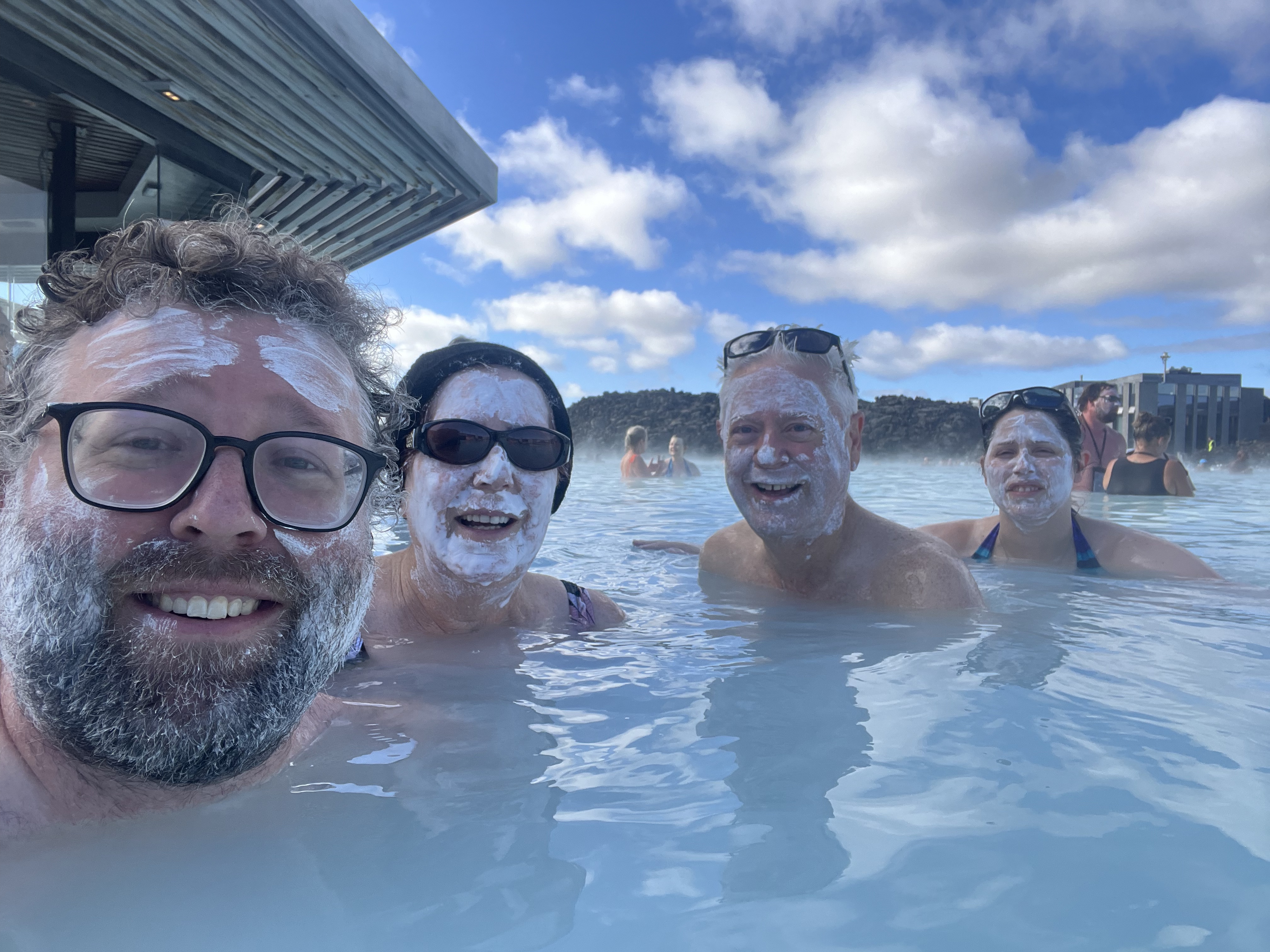
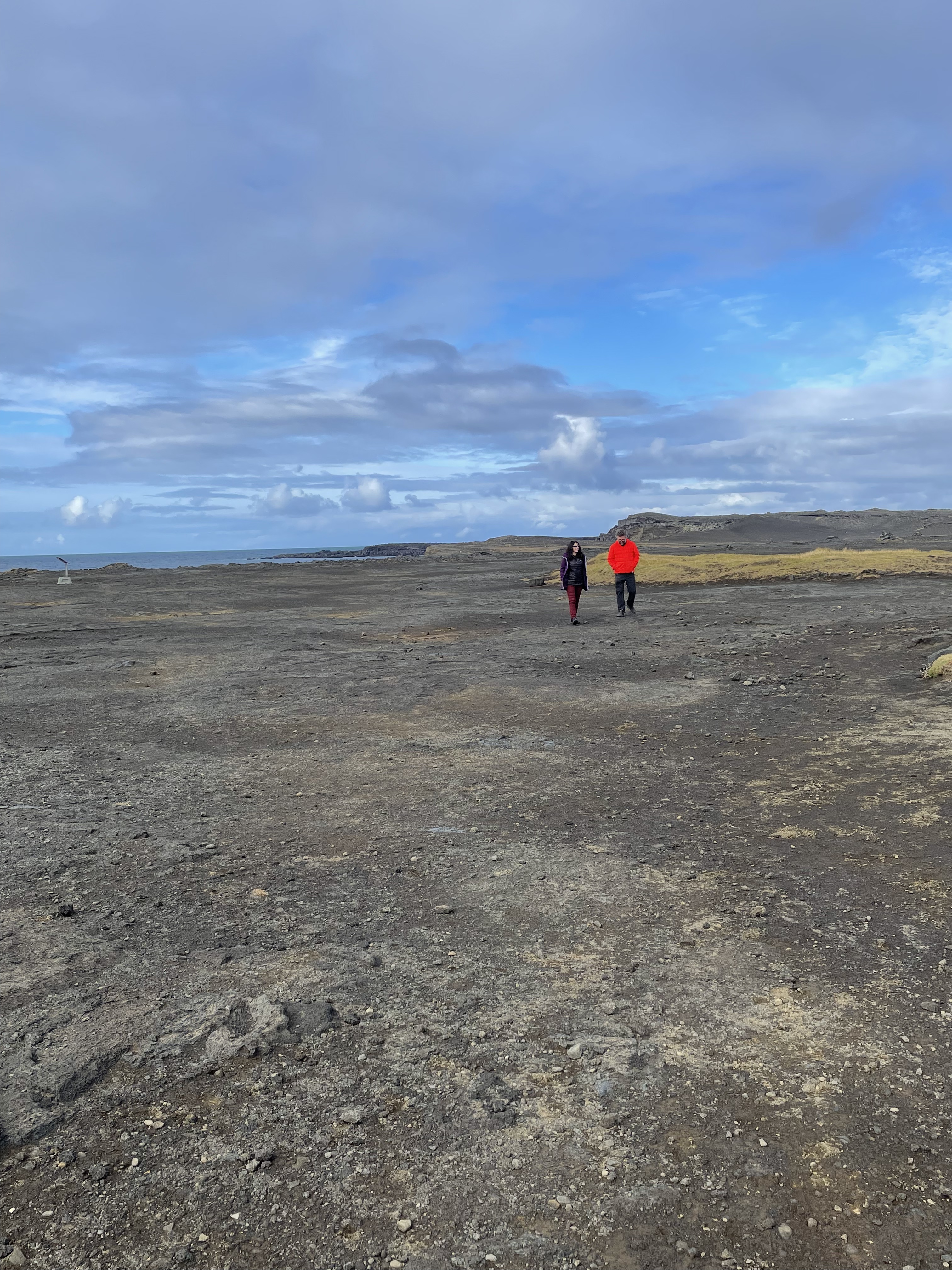
Day 10 – Today was spa day. The sun shone and it was actually warmer than the 8C forecast. Our first stop was the famous Blue Lagoon. For those who aren’t aware, it’s the most famous outdoor spa in Iceland and probably one of the largest complexes. While we planned for cold, with the sun shining and the steam coming off the water, it was a very pleasant experience. After changing and wading into the pool, we went over to get our free drink at the swim-up bar. Then it was off to get our mud mask. Some of us were obviously better than others at putting it on. There are a number of different areas in the pool and we were there for about 90 minutes altogether.

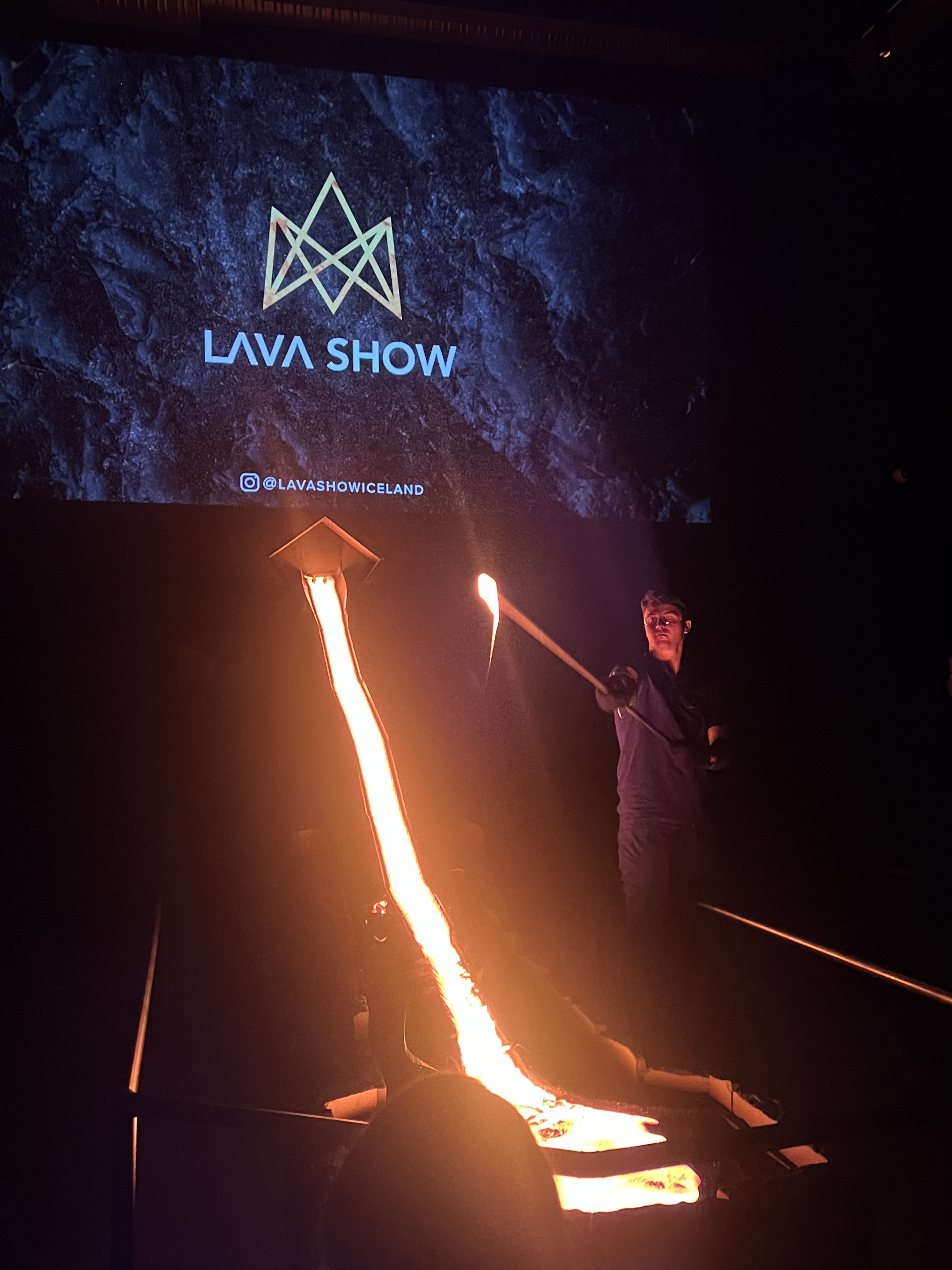
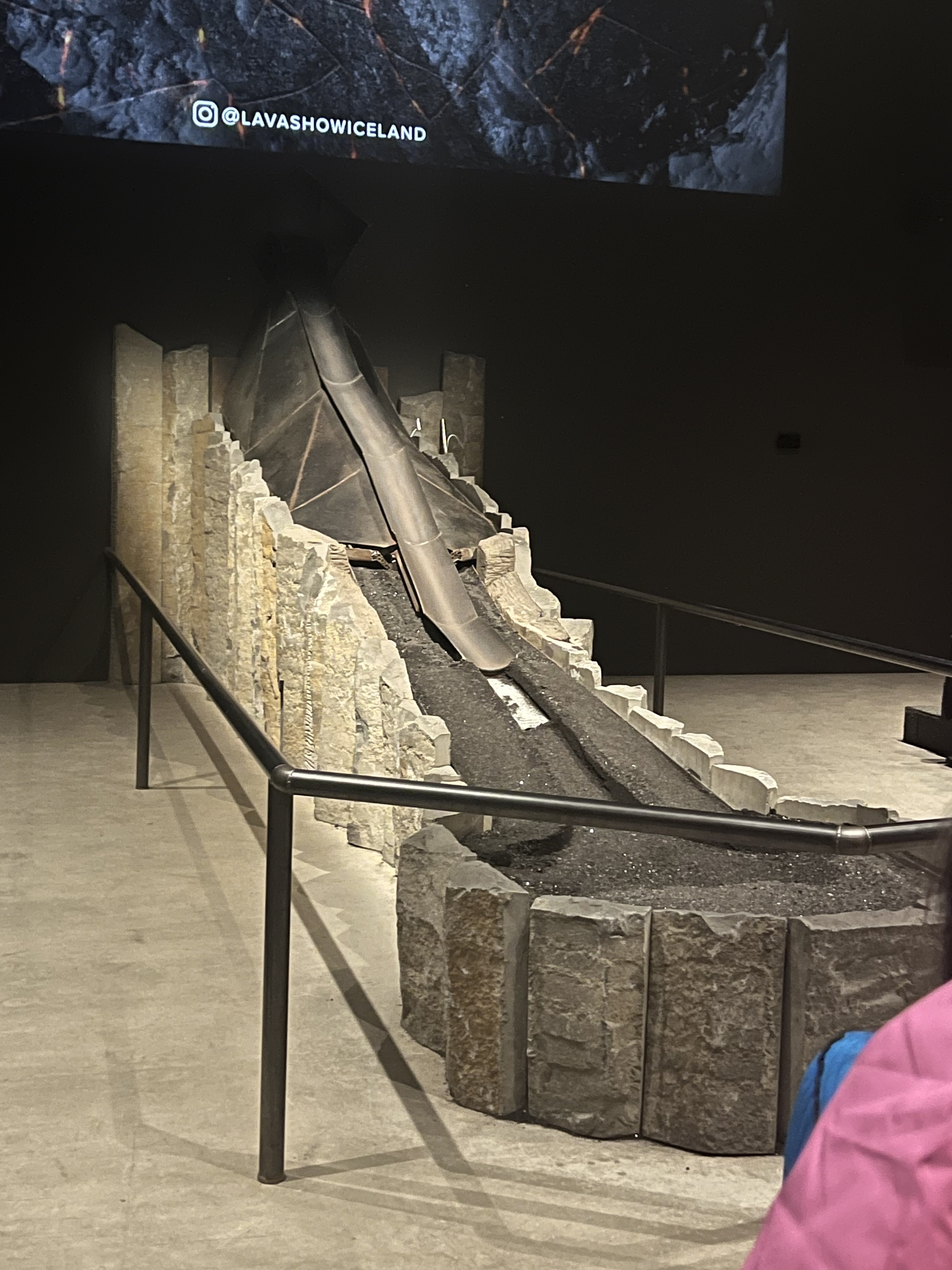
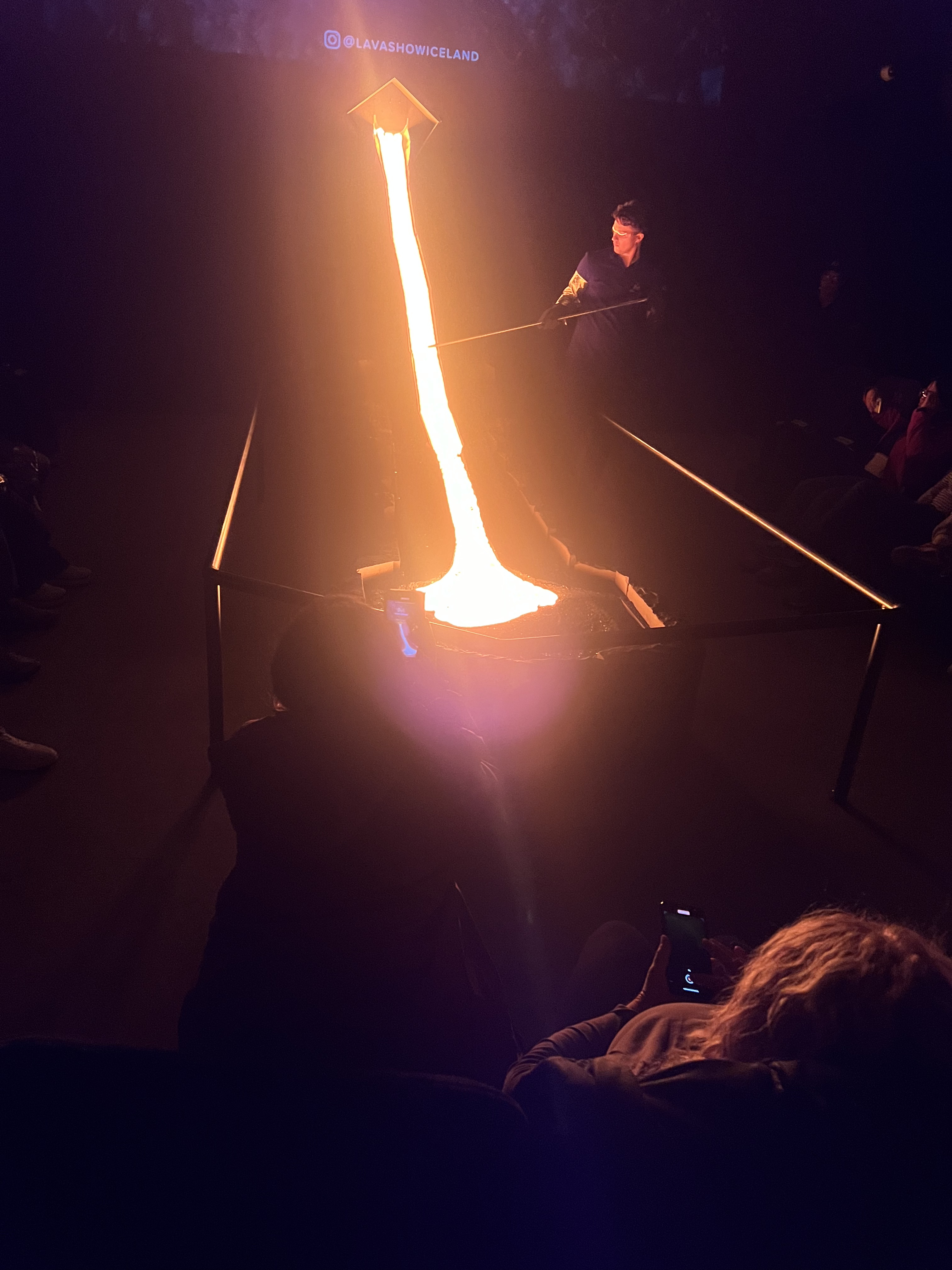
After lunch (at a Subway), the kids dropped dad and me off at the Lava Museum, and they went into town to do some shopping. The purpose of the presentation is to explain how volcanoes form, the different kinds of volcanoes, and how the lava flows. It was a fascinating show with real lava flowing in a controlled indoor setting. As the lava cooled, the presenter explained the properties of the lava, and demonstrated how hard it becomes as it cools. It has the sound and feel of glass, but underneath, it is still molten and very hot. While it would normally take about three days for it to harden completely, the technicians have a way to collect it and recycle it for the next show in less than two hours. We highly recommend this experience.
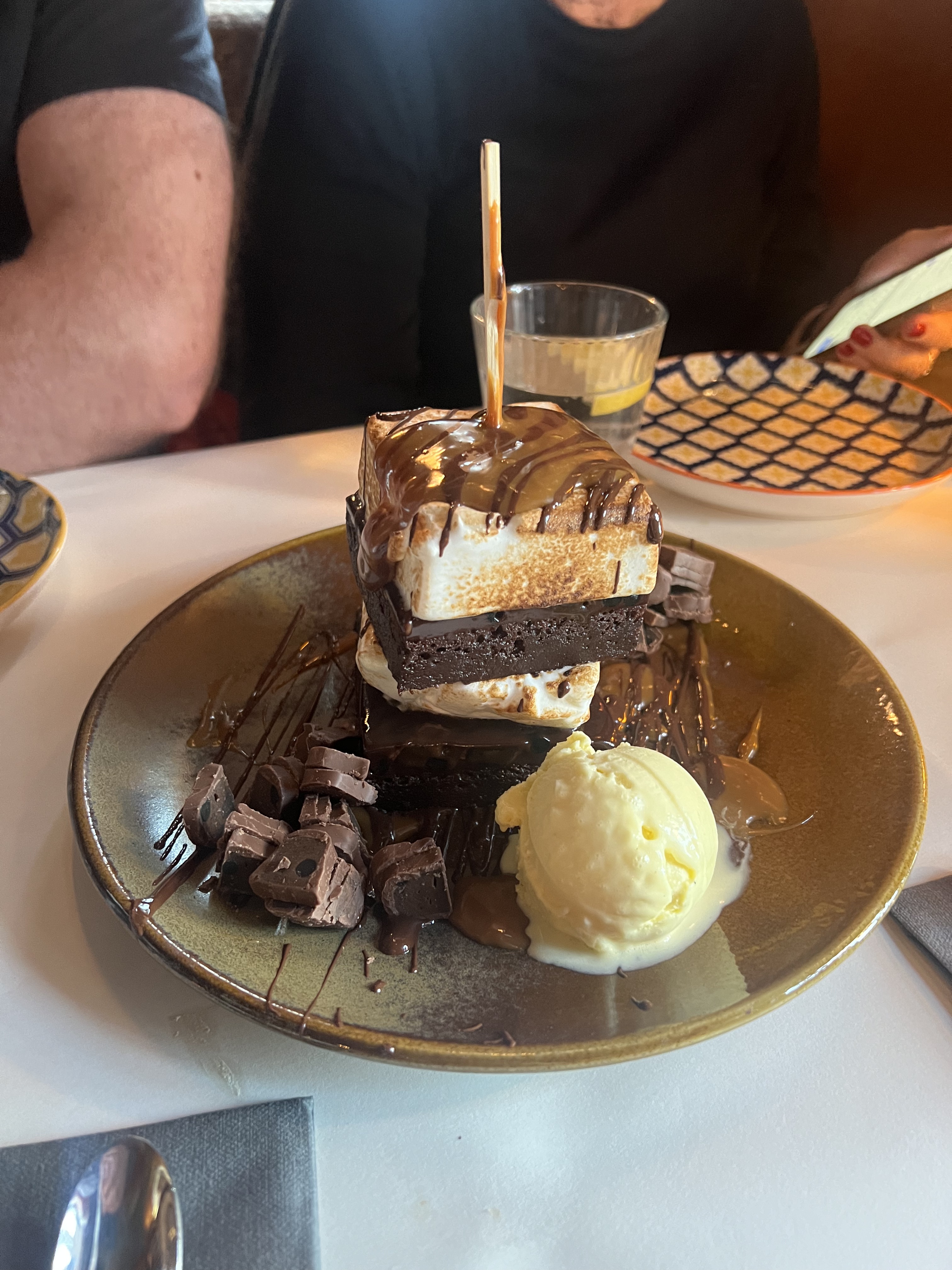
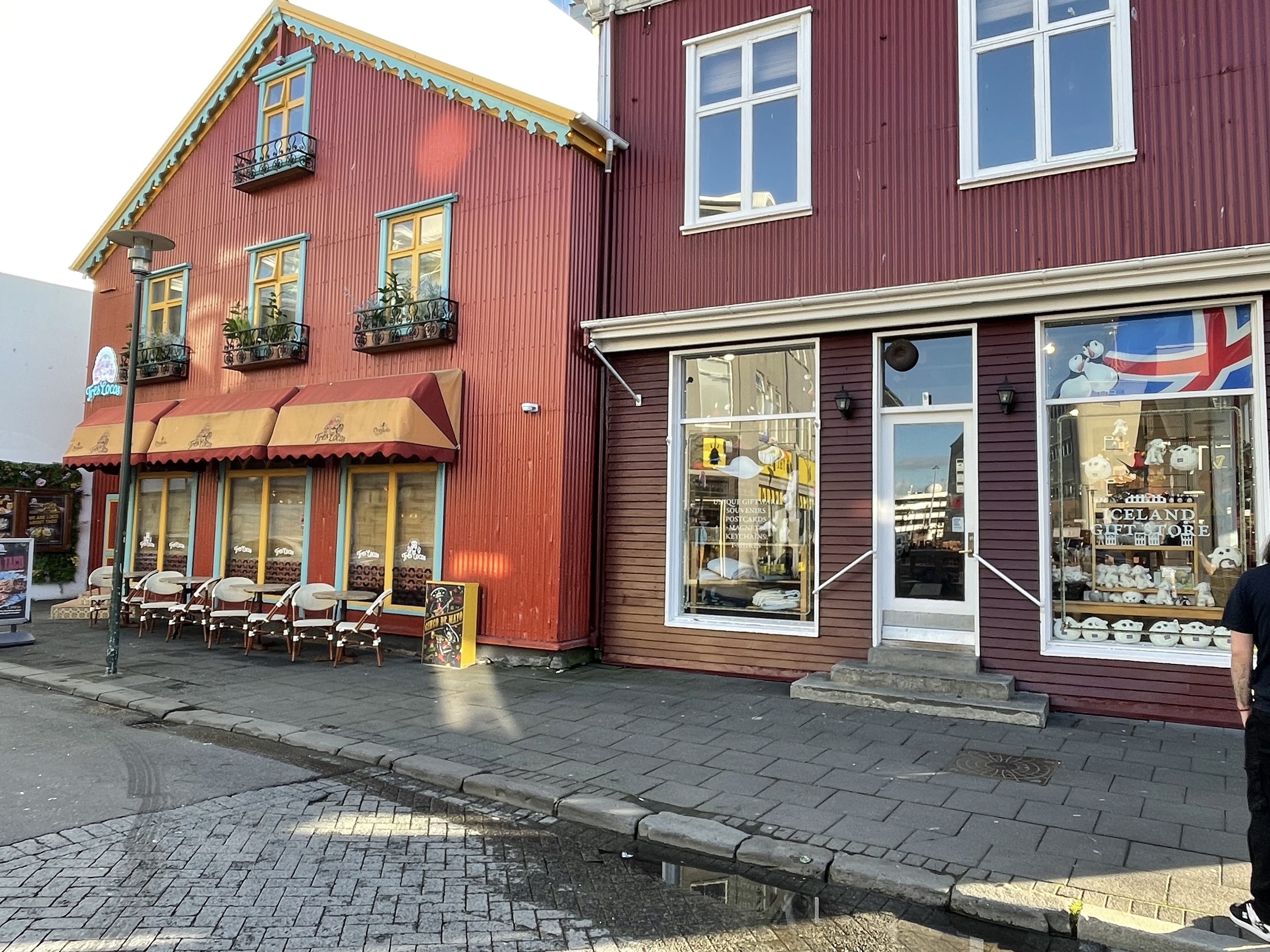
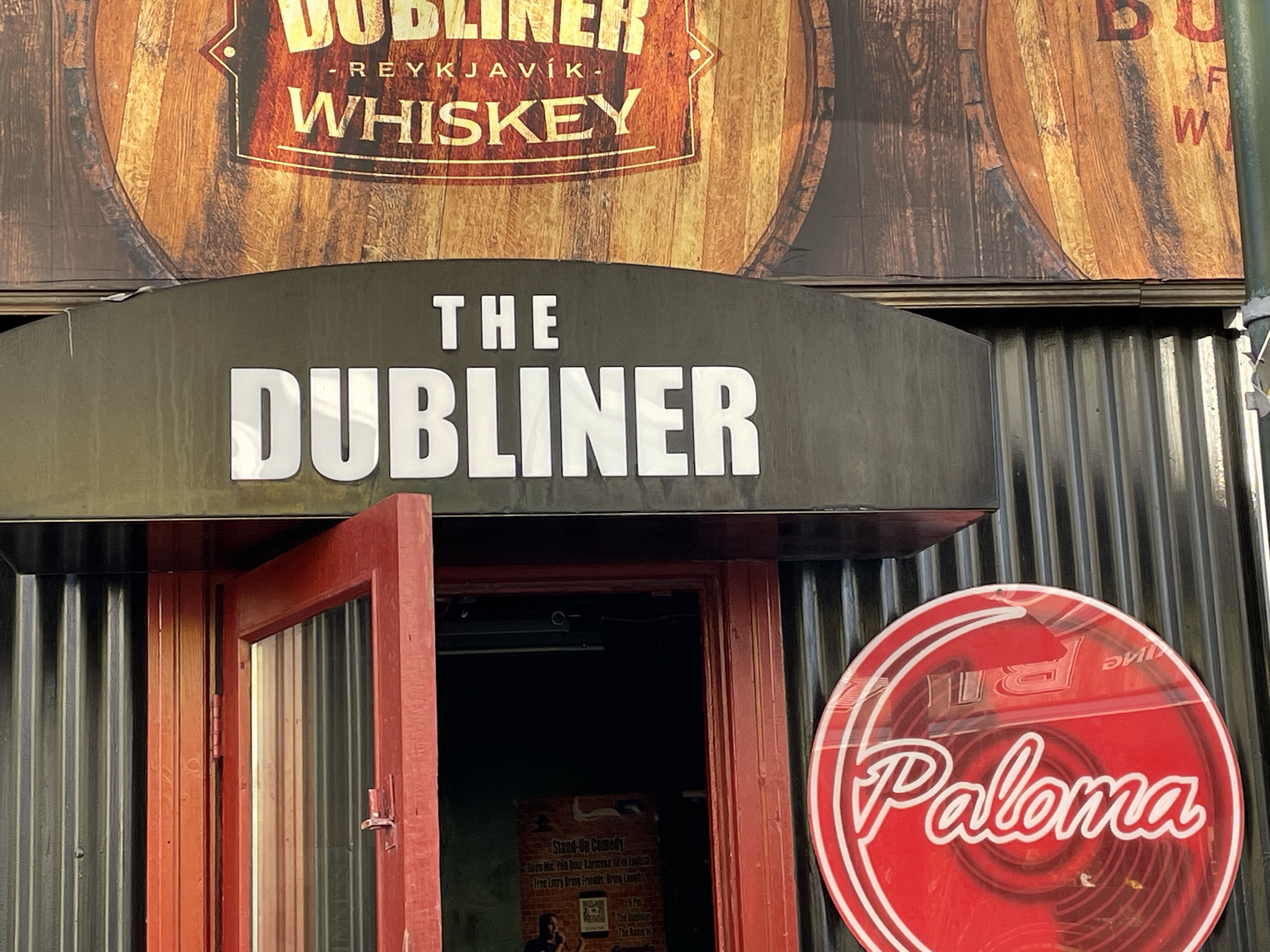
We walked back into town and met the kids for dinner at Saeta Svinid Gastropub. The portions were huge but dinner was absolutely delicious! Dessert was to die for and required a four-way sharing. While we were walking through old town, dad mentioned that it felt like we were in Dublin. Lo and behold, there was the Dubliner (pub) on the next street corner. After we returned to our car, our chauffeur took the long route back to the hotel around the peninsula and the suburb of Alftanes.
Then it was time to pack and get ready for our departure tomorrow.

Day 11 – All good vacations must come to an end. For our last few hours in Iceland, we visited the Viking World Museum which tells the story of how the Vikings settled in Iceland from Norway beginning about 800. By 930, they were convening a central annual gathering to consider issues affecting the whole island. Based on what we heard on Day 2, this would have been at Thingvellir. The structure has continued, with few lapses, to function as Iceland’s parliament. The main attraction at the museum is the Viking ship, The Icelander, which was sailed to New York in 2000 to commemorate Leif Erikson’s journey to the New World a thousand years earlier. Included in the presentation was some discussion about the Vikings’ travel and settlement in Canada.

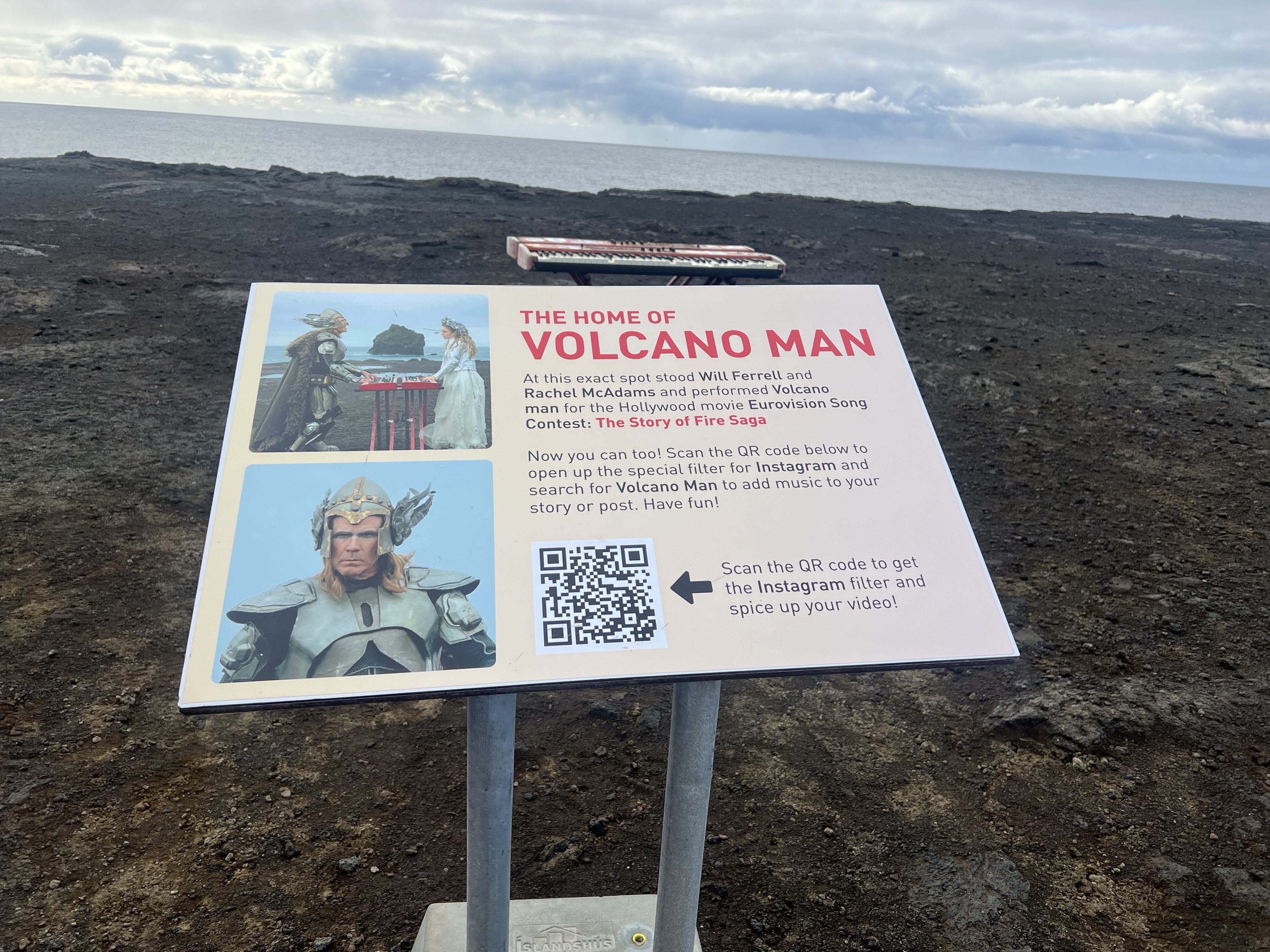
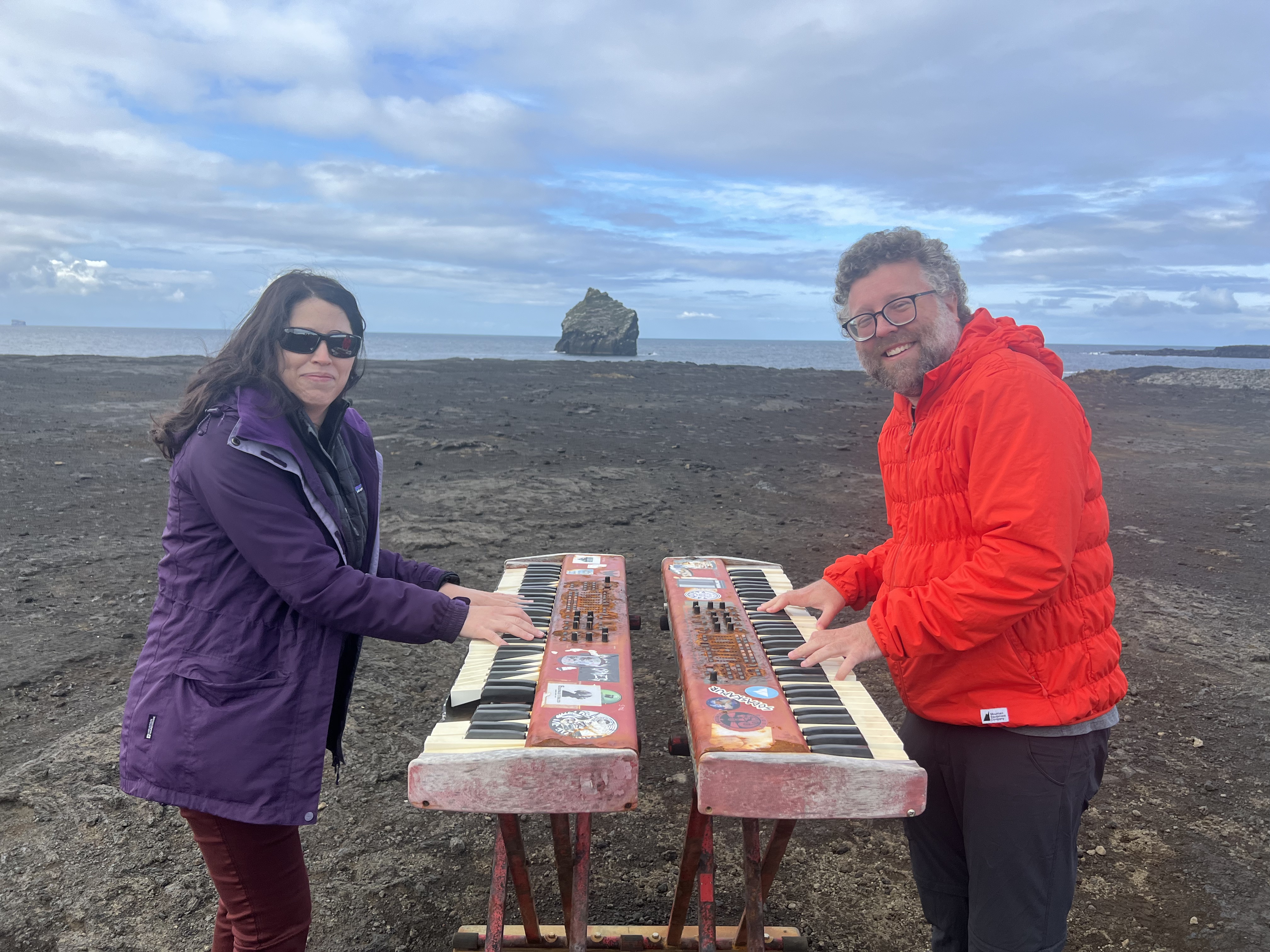
The last stop was a special surprise for Jenn. We travelled out to what seemed like the end of the world to the spot where Will Ferrell and Rachel McAdams performed Volcano Man for the movie The Story of Fire Saga. What a fun way to end our 11 days in Iceland!
Then it was off to the airport and our flight home. I must say we loved the Hamilton airport. It’s small, there was no wait for luggage or customs, and our driver met us right outside the airport terminal. A very civilized airport experience!

Now on to planning our next adventure to France.

Family Trip to Ireland – August/September 2023

Tags

, , , ,

We have always wanted to take our adult children to Ireland to experience and learn about one portion of their heritage. George’s mom was born in Ireland and emigrated to Canada with her family (single mother and seven siblings) when she was 11. George’s dad, while born in Canada, was also part-Irish. Money from my dad’s estate gave us the financial ability to pay for much of the trip.

George, Jennifer and I left on August 25th and met George Jr in Belfast shortly after landing. We had mapped out our itinerary and booked our accommodations in advance. Some tours/entrance fees were booked before we left Canada to ensure availability, others were booked on-the-go one or two days in advance.

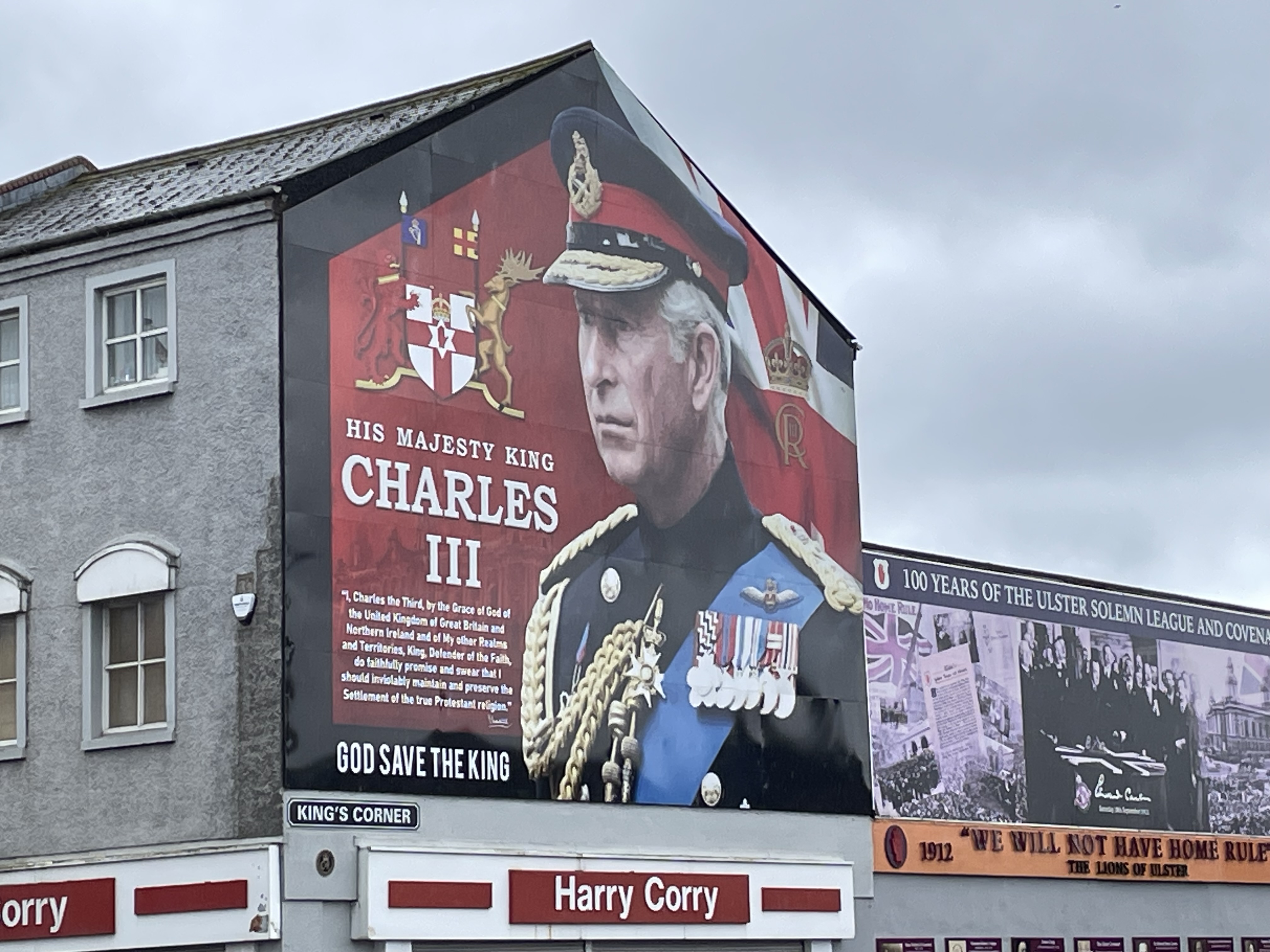
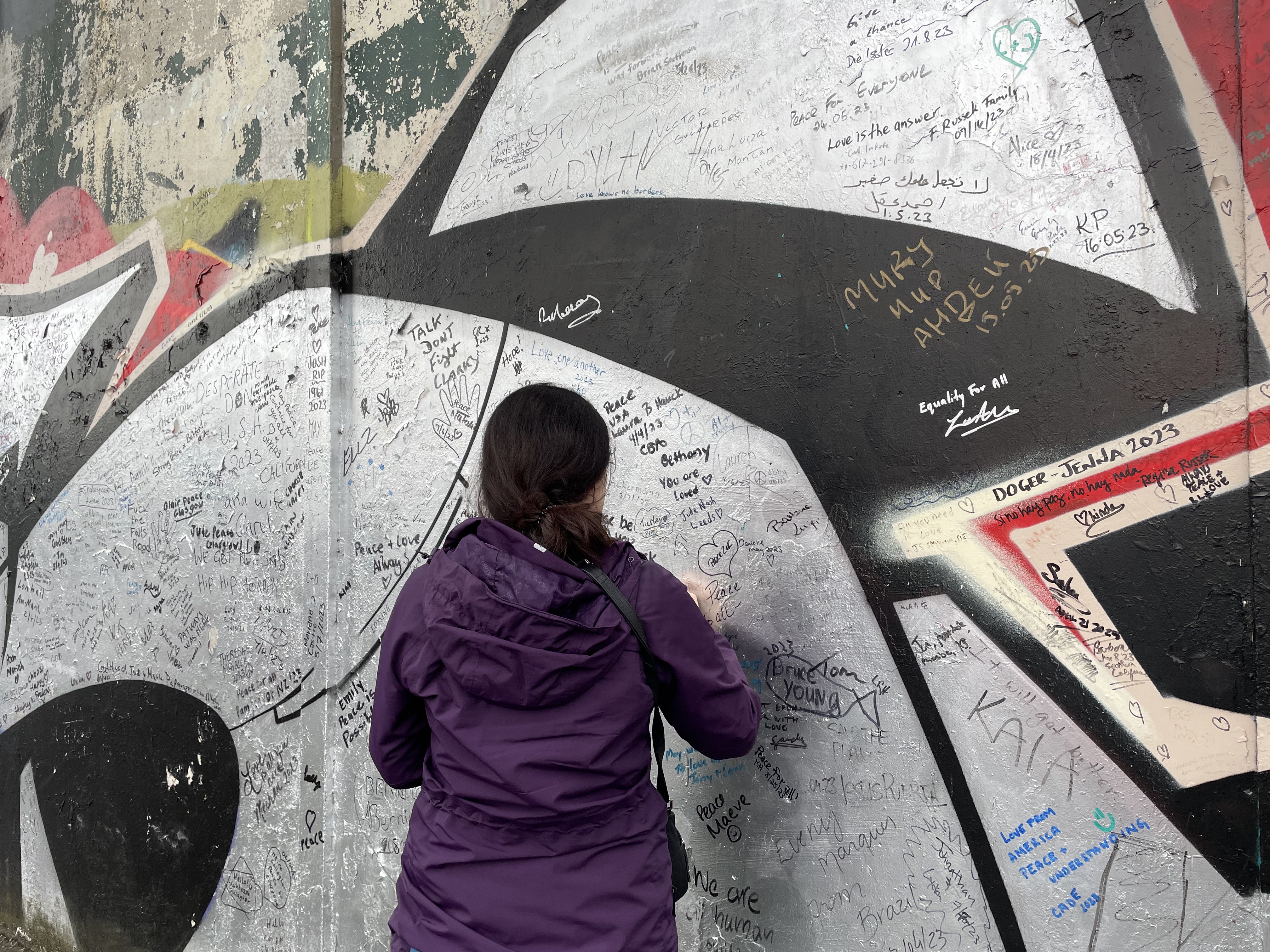
Belfast – We spent three nights in Belfast at the downtown Holiday Inn. The location was ideal for walking into the city core, which we did the first evening after a brief rest. A well-recommended fish and chip shop was our dinner choice. The next day we took a Black Cab tour – a private tour for the four of us. Our cabbie was generous with his time, well-informed, and provided interesting commentary on a number of sites related to “the troubles.” Belfast is definitely a city of murals, and one can’t travel far without being confronted by the history of the events of the past. The cabbie’s question of whether we had Irish roots, prompted a discussion of where George’s mom lived prior to emigrating and his promise to take us by her street on our way back to the hotel. It was so kind of him to stop his cab and offer to take pictures for us. The afternoon was free time, which allowed for some of us to have a rest and for others to go walk around town. Sunday night’s dinner was at a Thai restaurant just around the corner from the hotel.

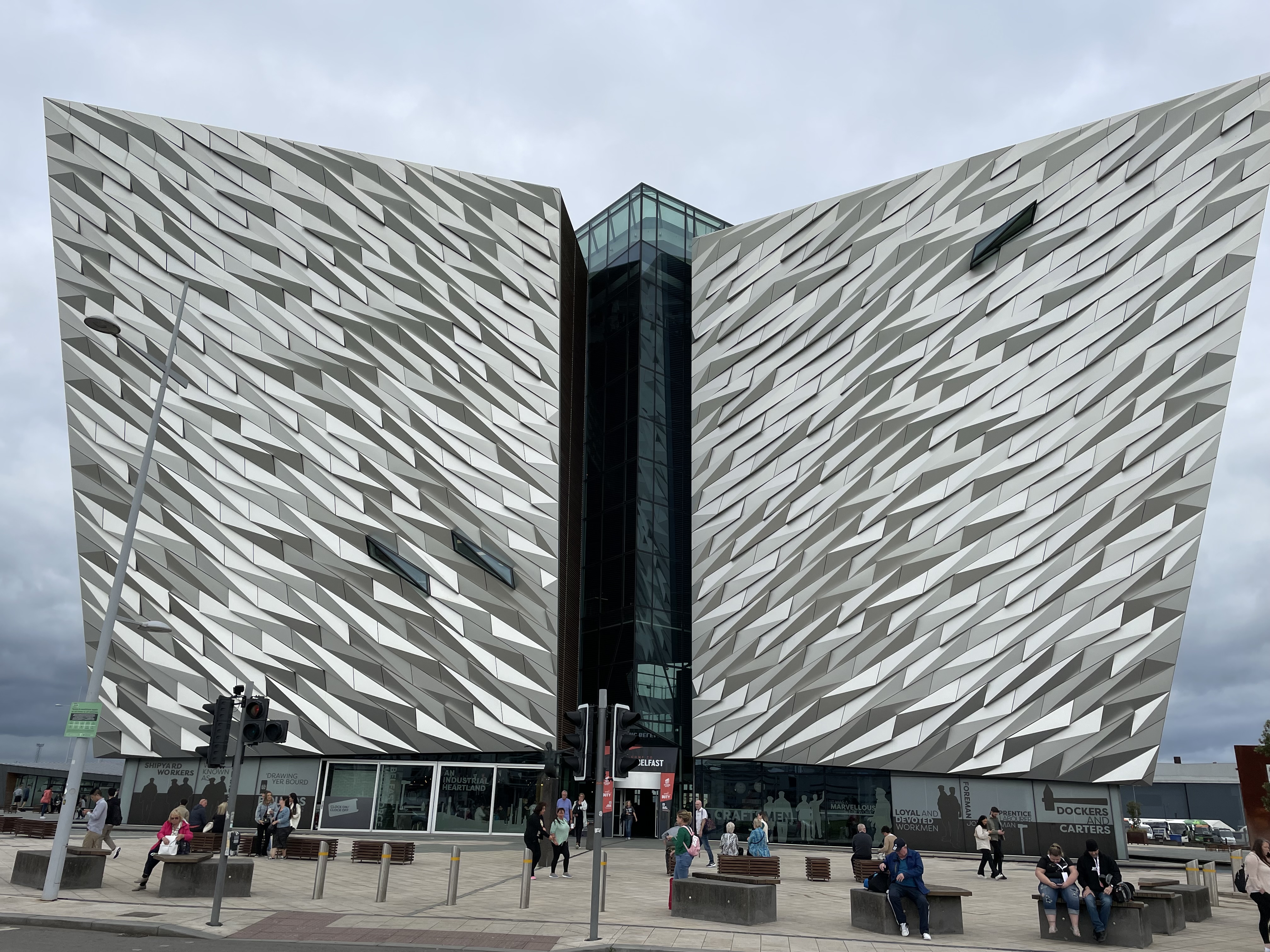
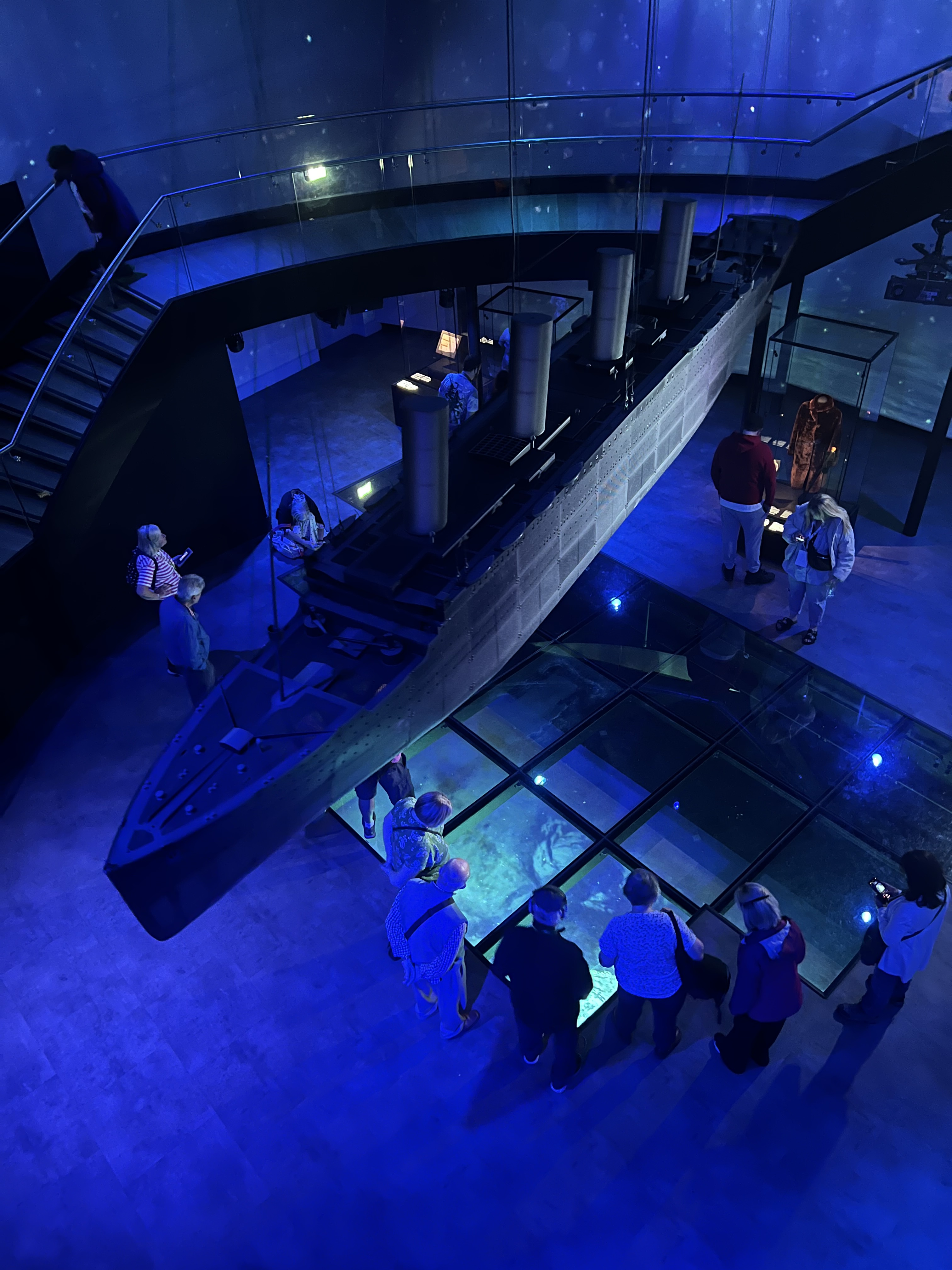
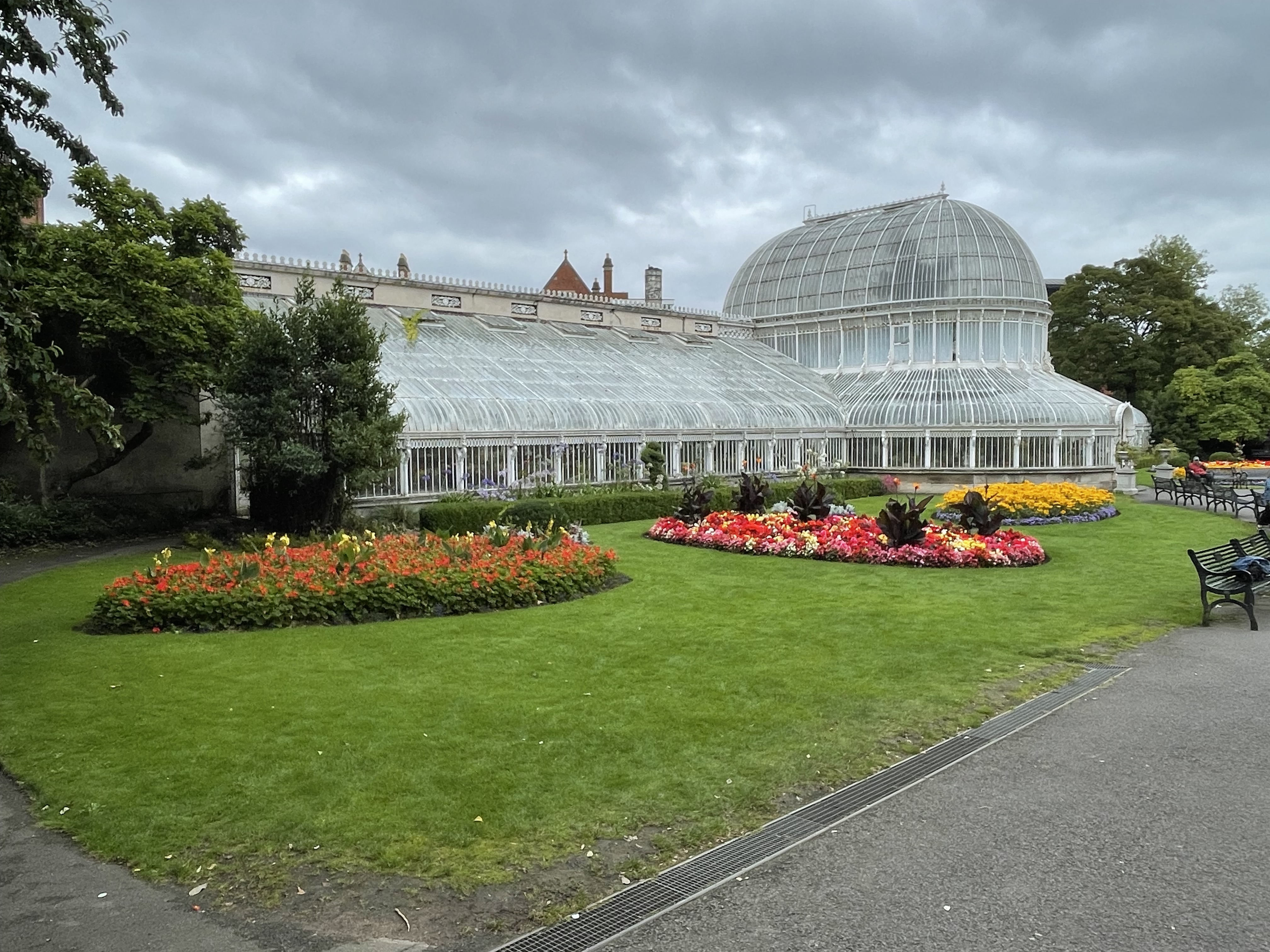
We spent Monday morning at the Titanic Museum, which is a must for anyone visiting Belfast. Our children declared it one of the best museums they have ever been to and as inveterate travelers, they have been to many. The story of the building, launching, and passengers on the Titanic was so well told in many different ways. One of the most impactful moments for me was the wall of remembrance which was two-storeys high and recorded all the names of the more than 1,500 people who died. Lunch in the Cafe was good; since the portions were quite large, we realized later that sharing would have been a better option. In the afternoon we drove out to the Botanic Gardens and spent about 90 minutes wandering through the gardens and the iconic Palm House.

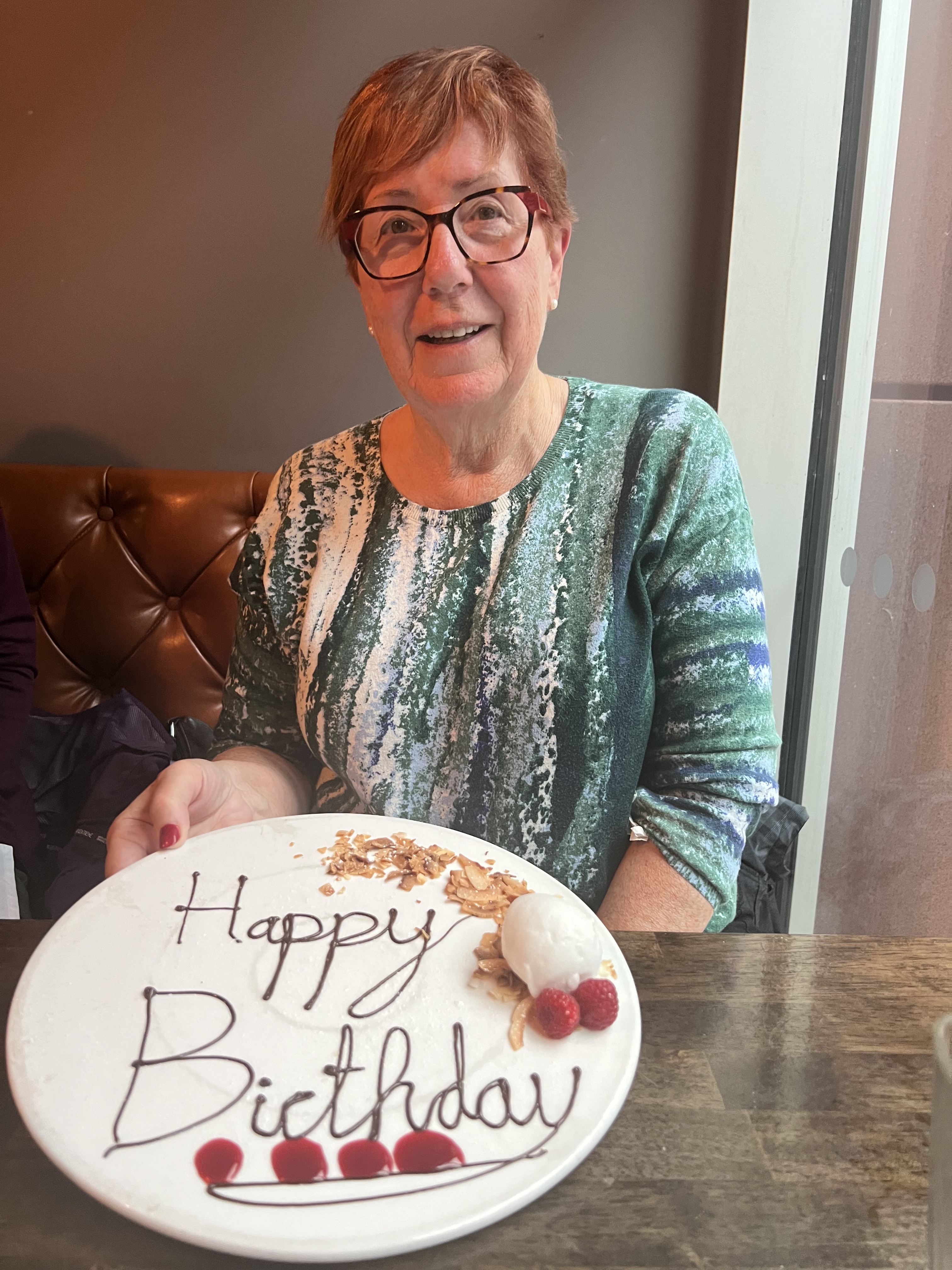
Dinner Monday evening was a special occasion as it was mom’s 75th birthday. We went to a most novel restaurant called Stix and Stones, a steakhouse. The novelty centered around how the steaks are cooked. In the kitchen they just sear the steaks and bring them to the table on a board that includes a stone heated to 450F. By slicing and cooking your steak at the table, each mouthful is hot, succulent and tender. It truly was a unique experience and a wonderful birthday celebration.

Londonderry – On Tuesday, we left Belfast and headed out towards Londonderry. We had planned a number of stops along the way but the wet, windy weather preempted some of those. We passed on a stop at the Carrick-a-Rede-Rope bridge which was closed due to high winds. We made a brief stop at the Dark Hedges, which appeared to be a popular spot. Dad and I had not seen any of the Game of Thrones series but our kids were fans. A nice cafe provided a quick stop for hot chocolate.

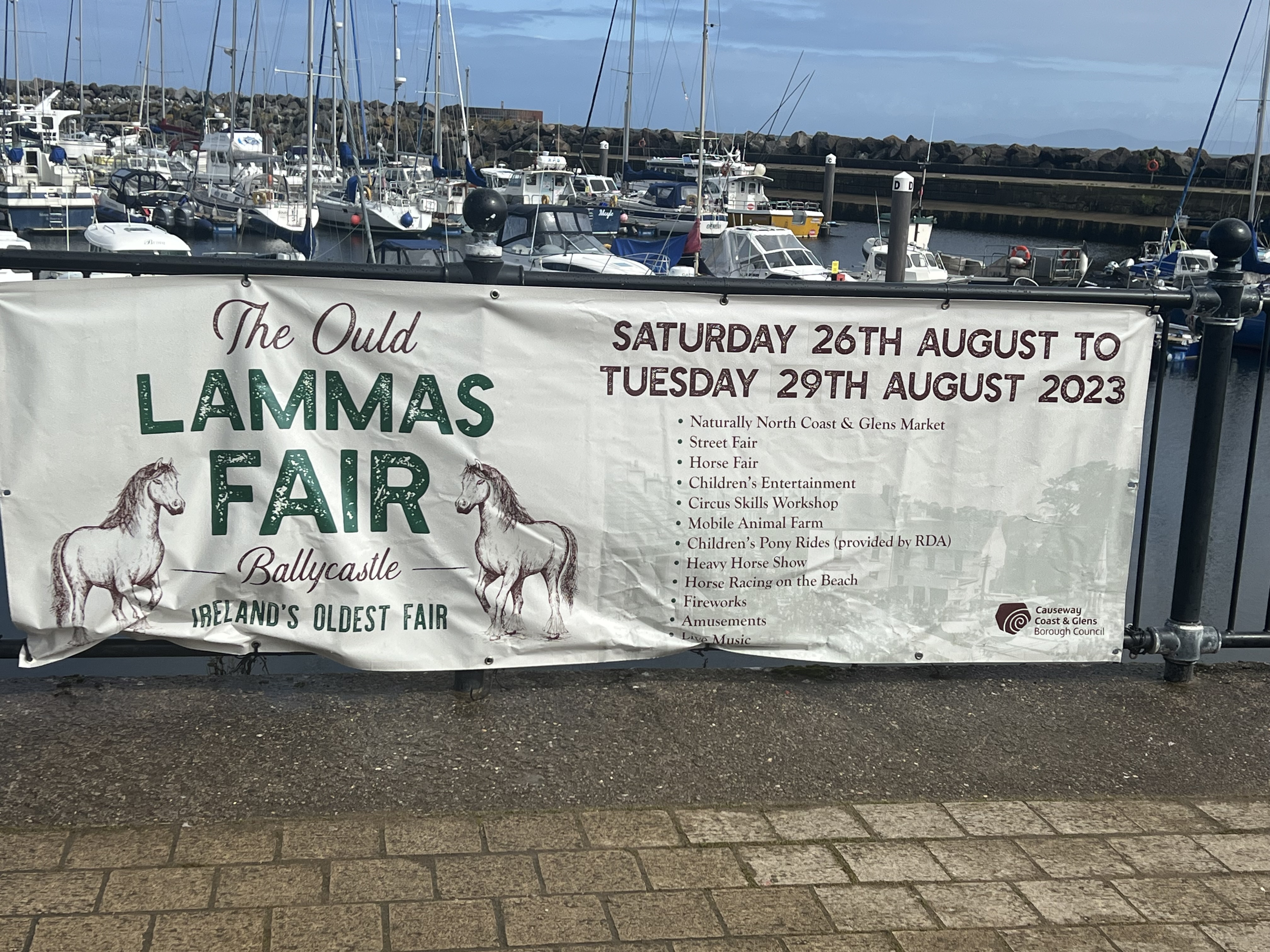
Our lunch spot was a serendipity as the town (Ballycastle) where we planned to stop was holding its Ould Lammas Fair – a celebration of the harvest. We decamped and wandered through the stalls, each choosing a lunch item, and sat listening to music while we ate. It certainly was a busy spot and the weather was much nicer than earlier in the day.

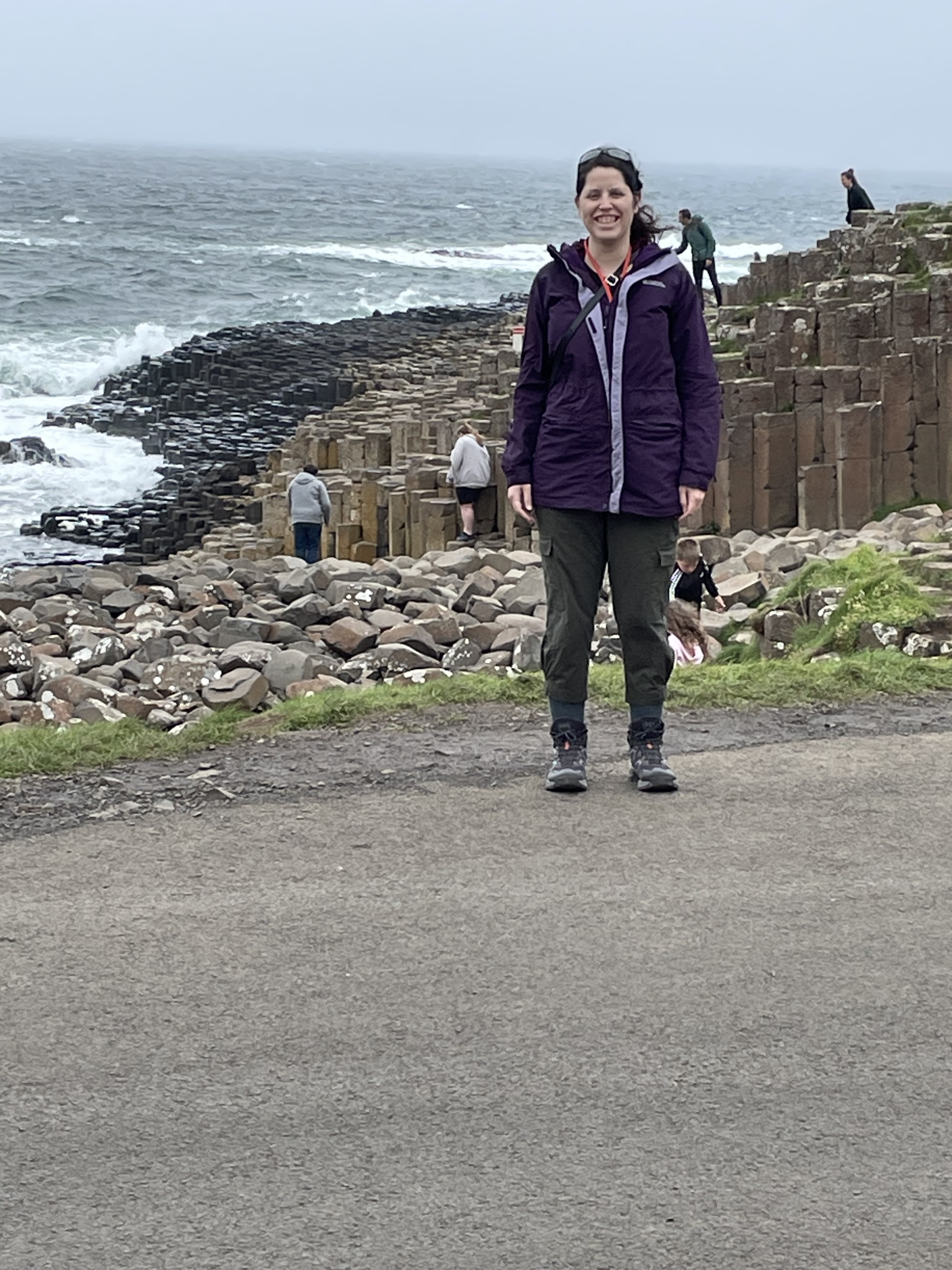
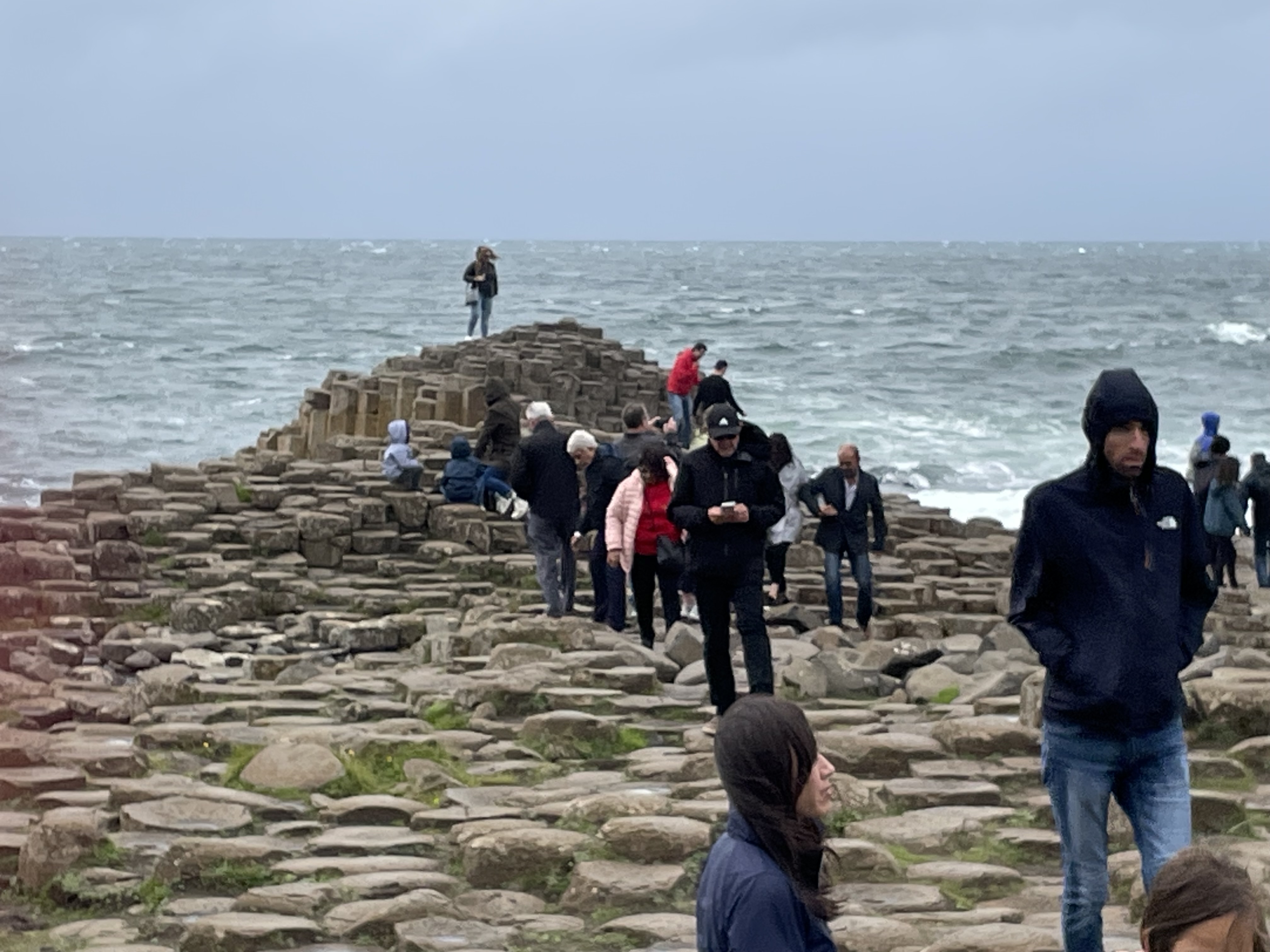
The next stop was the Giant’s Causeway. Because of the wet, windy weather (it returned!), Jenn and I spent just a few minutes down around the stones, which were very slippery, and then took the bus back up the hill to the visitor’s centre. George and dad hiked to the top of the far hill and back again. It’s an unbelievable spot to visit, but is better when it’s sunny and dry!

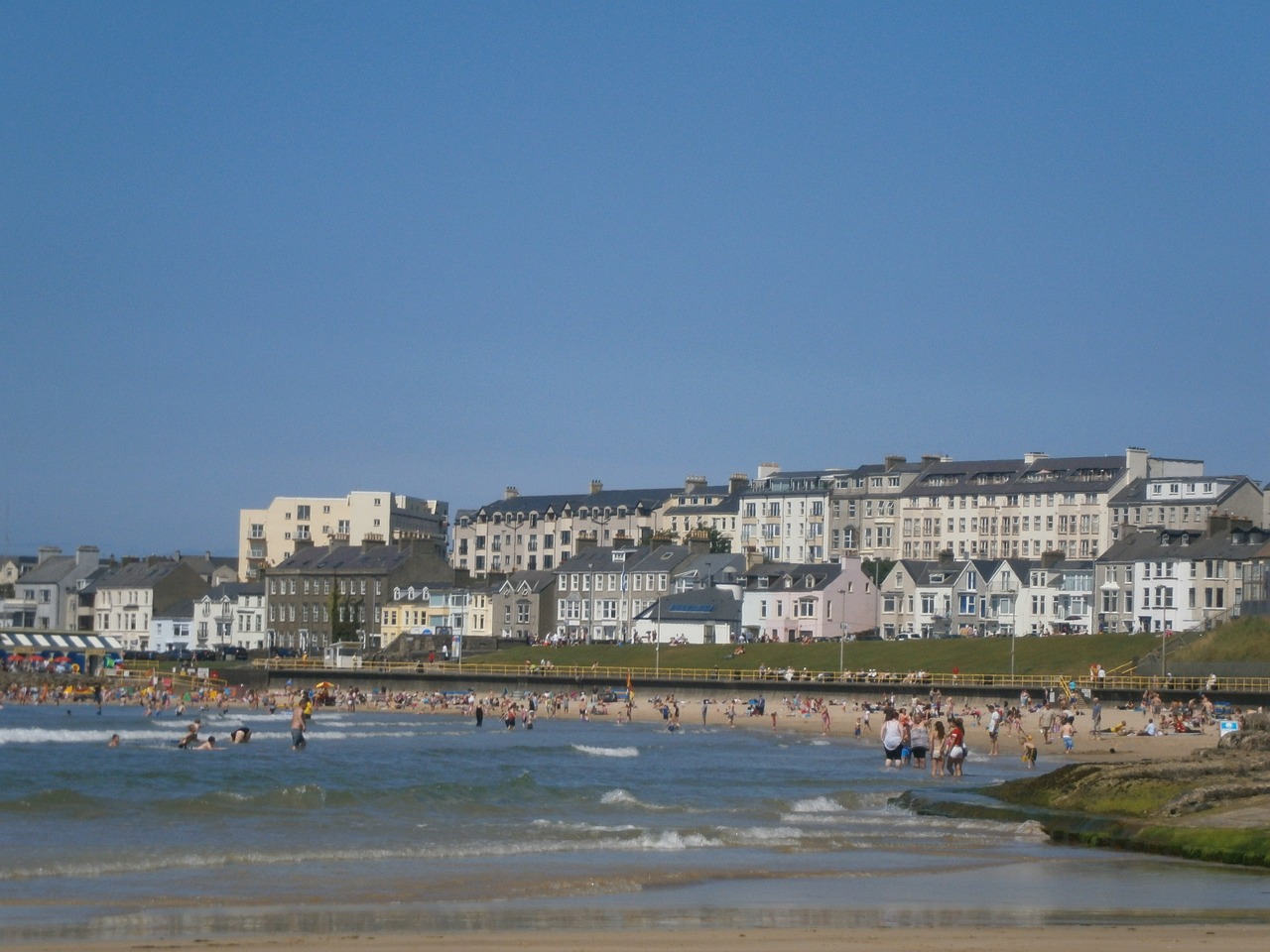
On our itinerary was a brief visit to Portrush, home of PGA golfer, Rory McIlroy. In the end, it became our stop for dinner as we had spent so much time at the Giant’s Causeway and the Ould Lammas Fair. By the time we arrived, the clouds had parted and the sun made its second appearance for the day. A resort town, it is home to popular places like Barry’s Amusements, some amazing beaches, and, of course, a very well-known golf club.

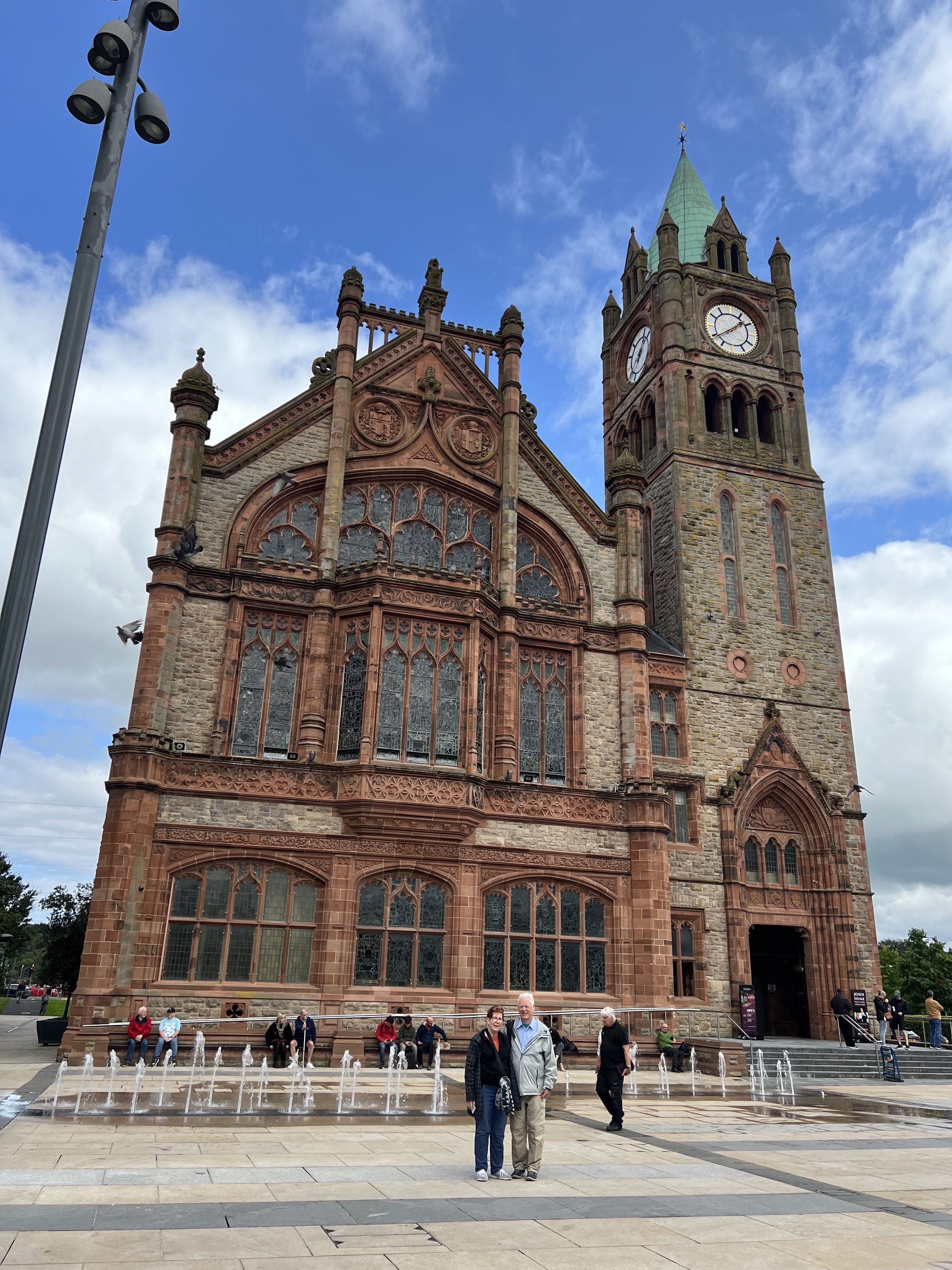
Our stop for the night was the Holiday Inn in Derry, well situated downtown for our walking tour the next day but somewhat difficult to access as the unloading area is right on a very busy main street. The tour took us through a section of Derry covering the history of the Battle of Bogside and Bloody Sunday Massacre, and pointing out various landmarks including the Free Derry Corner and Bloody Sunday Monument. Again, as in Belfast, murals everywhere are a reminder of the troubled times many lived through. While Dad and I had done both tours on a previous trip to Ireland, we were pleasantly surprised to hear our children’s favourable comments about both tours including their impression that the Belfast tour told the story from the Protestant perspective while the Derry tour told the same story from the Catholic perspective. Both, they felt, were well-balanced reflections.

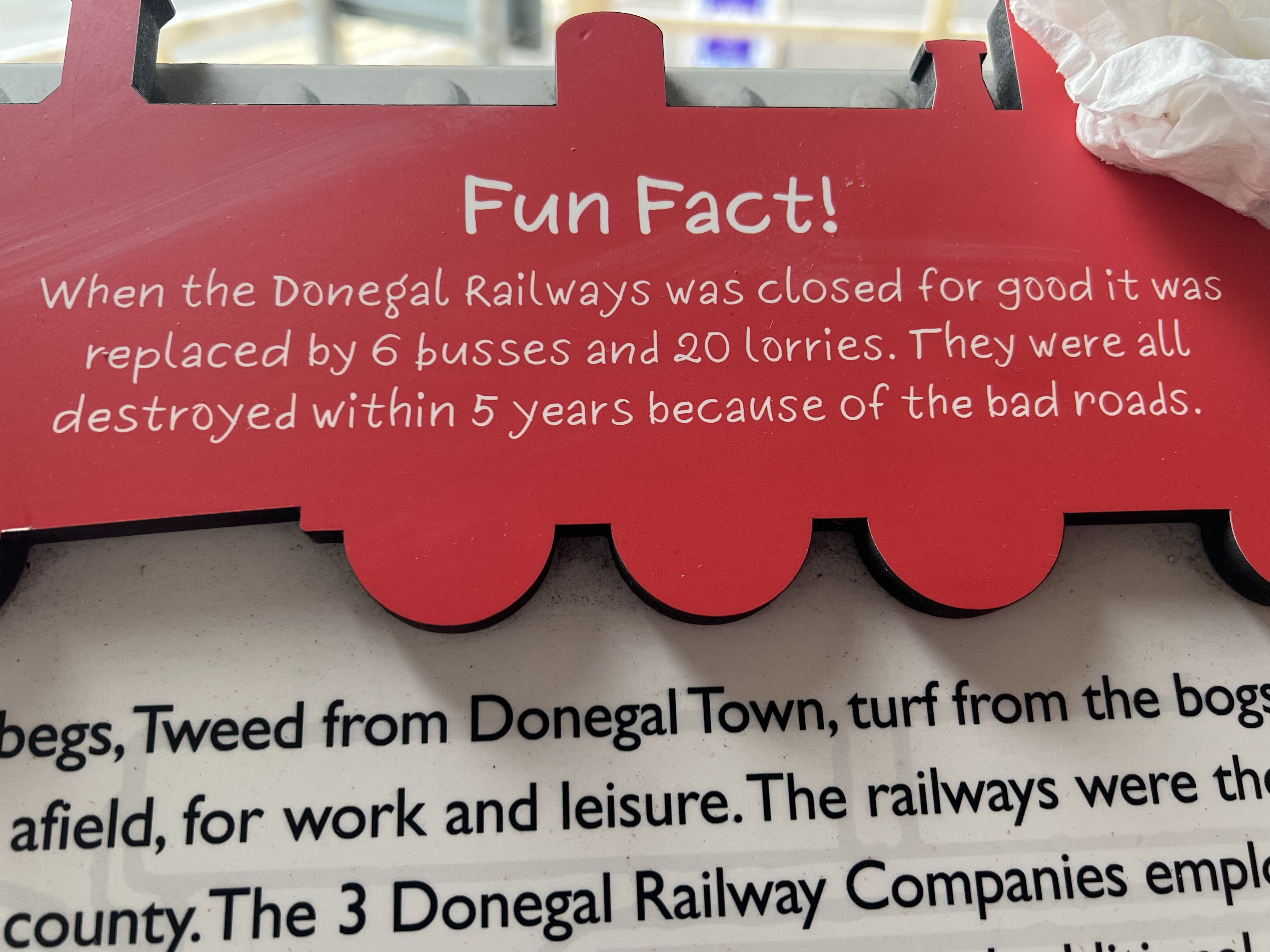
Sligo – On Wednesday after lunch, we left Derry en route to Sligo. While it’s a relatively short distance, there is a lot to see along the way and many diversions to be taken. We stopped in Donegal so the train buffs amongst us could visit the Railway Heritage Museum. The County Donegal Railway was the largest narrow gauge railway system in the British Isles and operated in various lengths, routes and varying degrees of success from the 1840s to the 1950s. Much of the railway’s locomotives, railcars and rolling stock has survived in various museums, including here in Donegal.

Our stop for the next two nights was the Riverside Inn in Sligo. The hotel is well situated in town with some rooms having lovely views of the river. After dinner at the Mill Bar on site, we went for a short walk around town before turning in for the night.

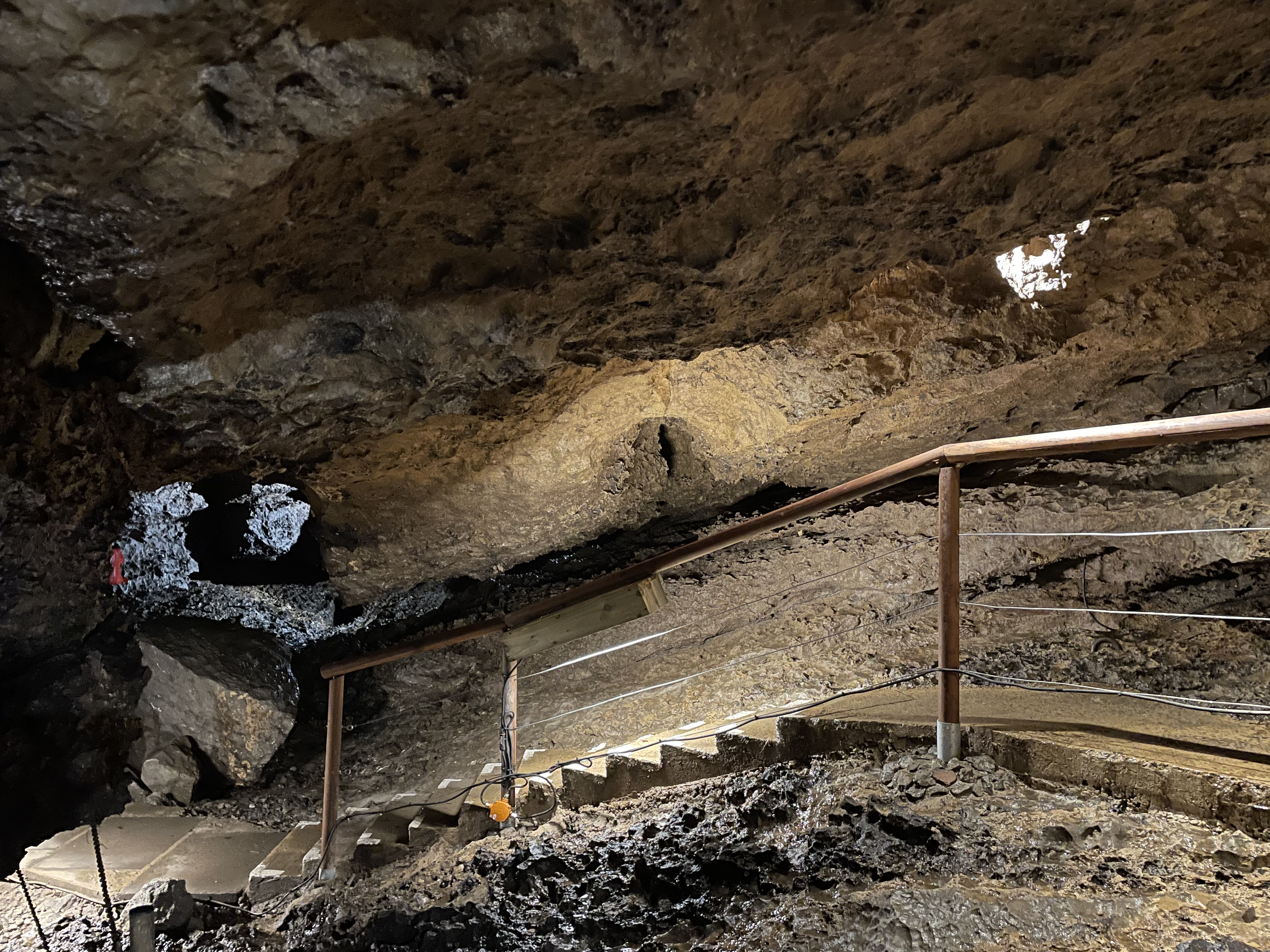
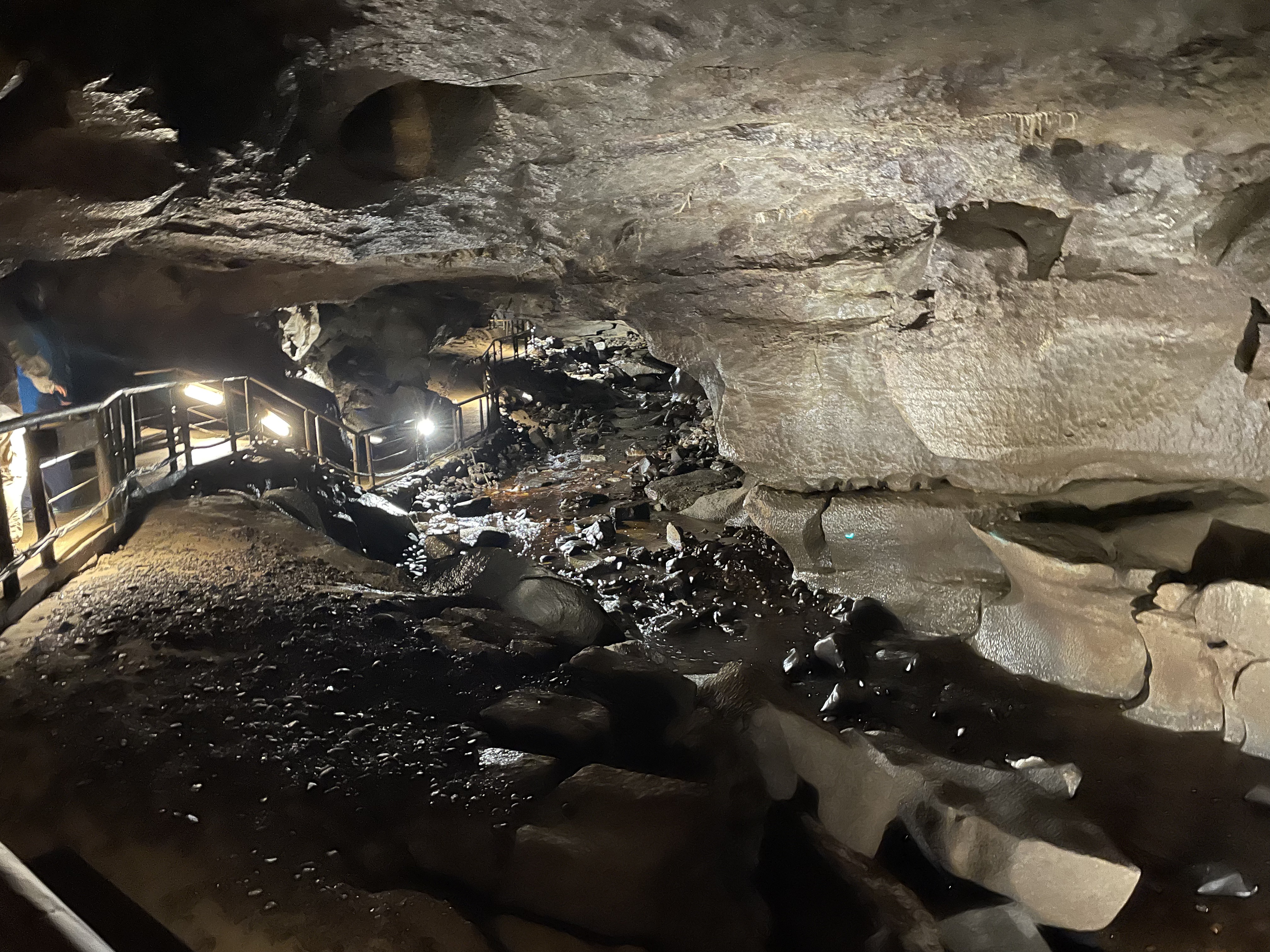
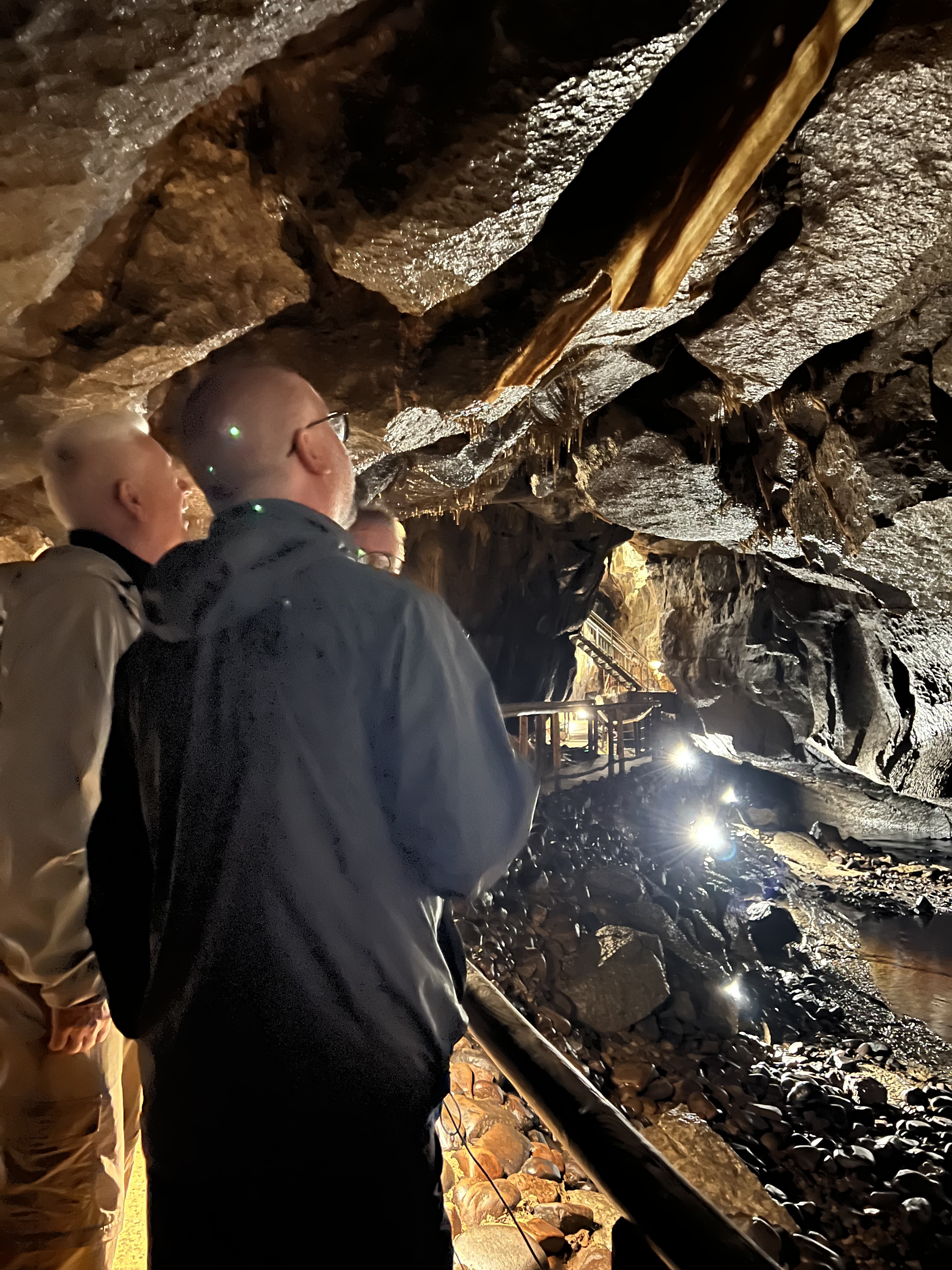
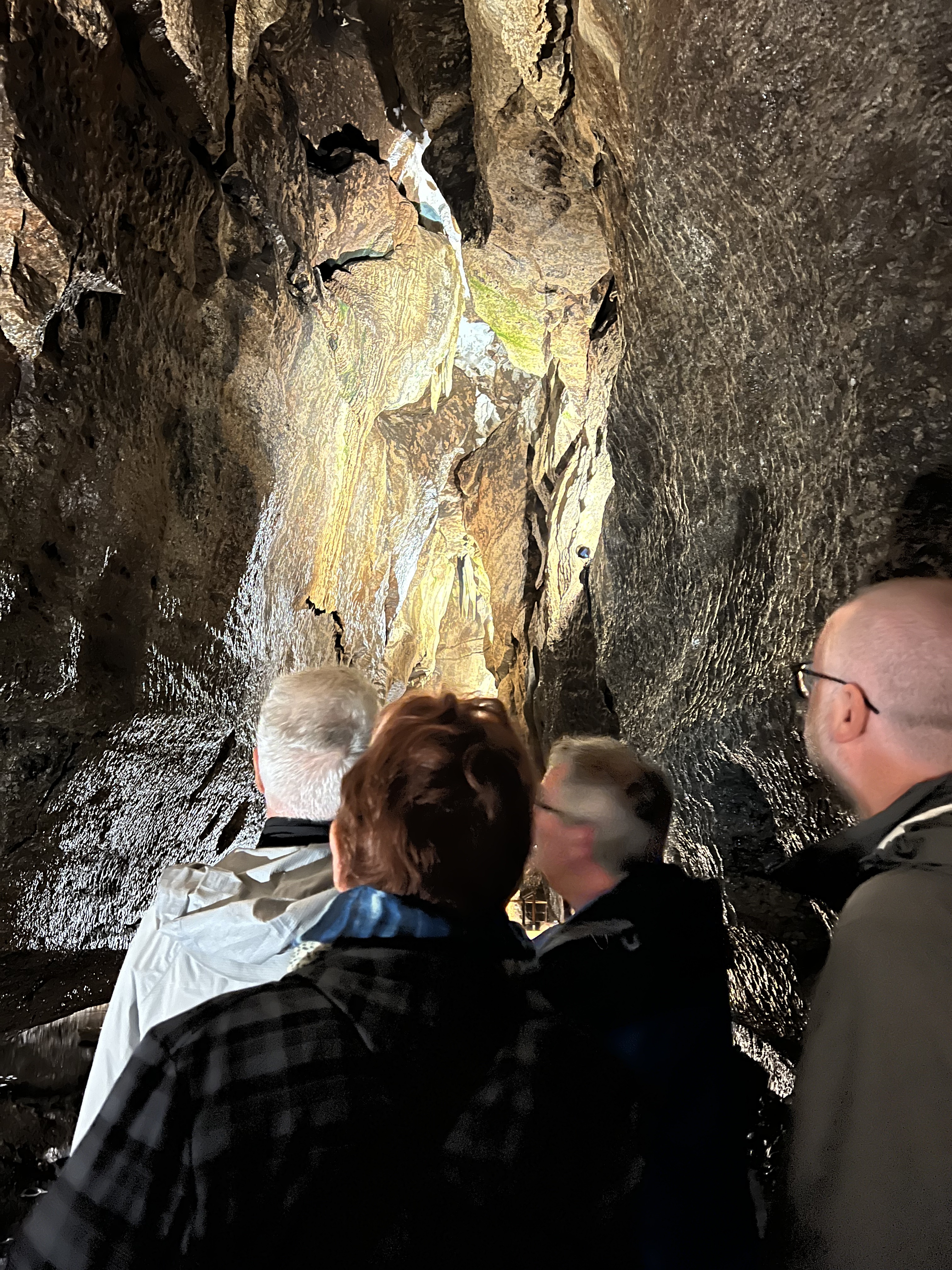
On Thursday, our travels took us to Yeats Country to visit the Marble Arch Caves, Benbulbin mountain & Glencar Waterfall. Under the vibrant green hills of Fermanagh lies a labyrinth of caves, sinkholes and subterranean rivers. Amongst them is the Marble Arch Caves which is the most active river showcave in Ireland and the UK and a key site within the Cuilcagh Lakelands UNESCO Global Geopark. A guided tour begins with a descent to an underground walkway, followed by a short boat trip, an informative description outlining how the caves were formed, viewing of various awe-inspiring formations, and a return to the visitor’s centre. The onsite cafe provided a welcome stop for a quick lunch. There are a number of hiking trails nearby and some of our group trooped off in search of a boardwalk, which they didn’t find.

Benbulbin mountain is a large flat-topped mountain protected as a Geological Site. It is a favourite hiking spot for locals – a gentle climb on the south side but a hazardous climb on the north side caused by the impact of high winds and storms from the North Atlantic. We chose to see it from a distance as time did not permit hiking. The drive through to the Glencar waterfalls was a pleasant trip through peaceful countryside aided by the appearance of the sun.

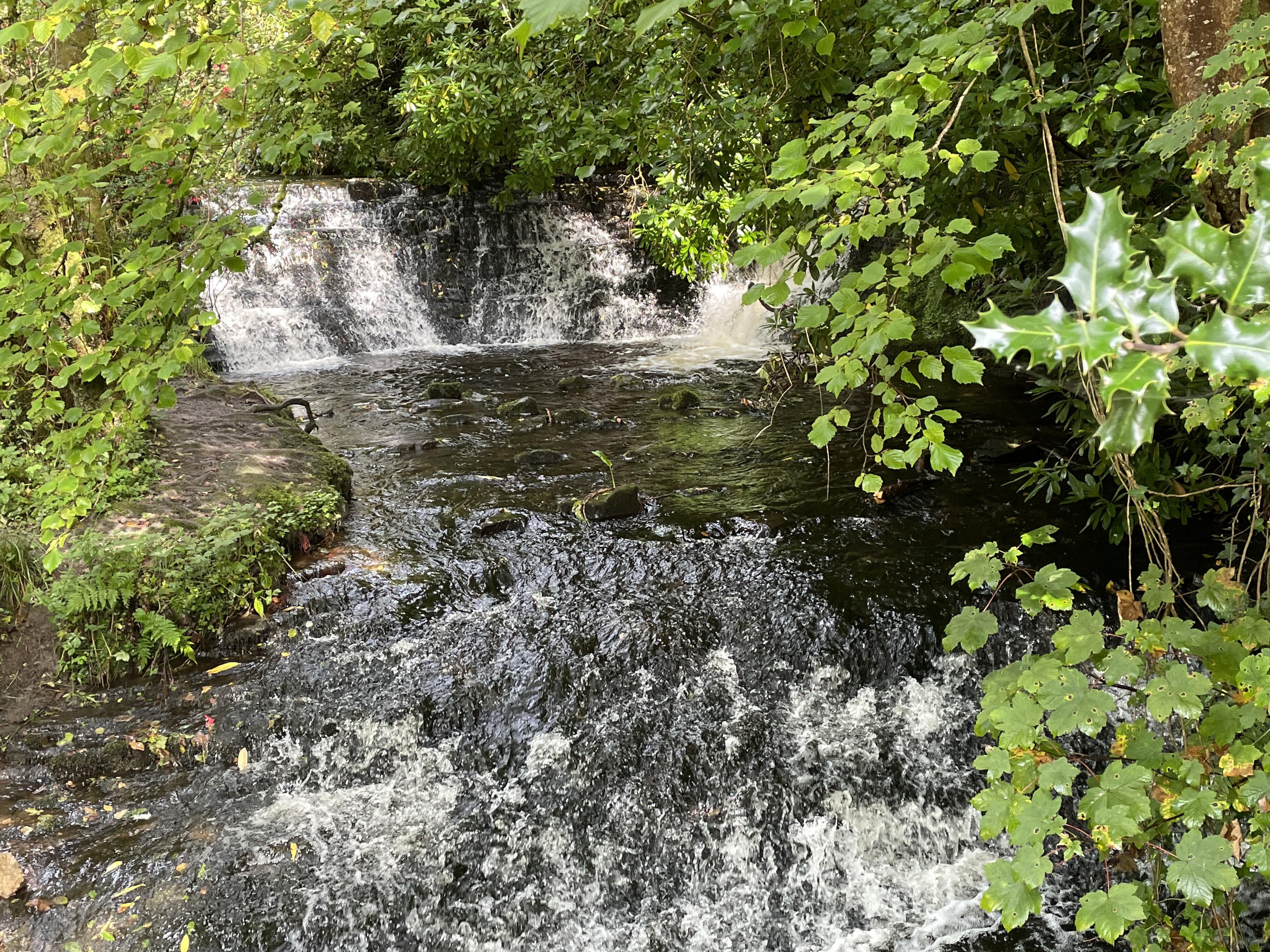
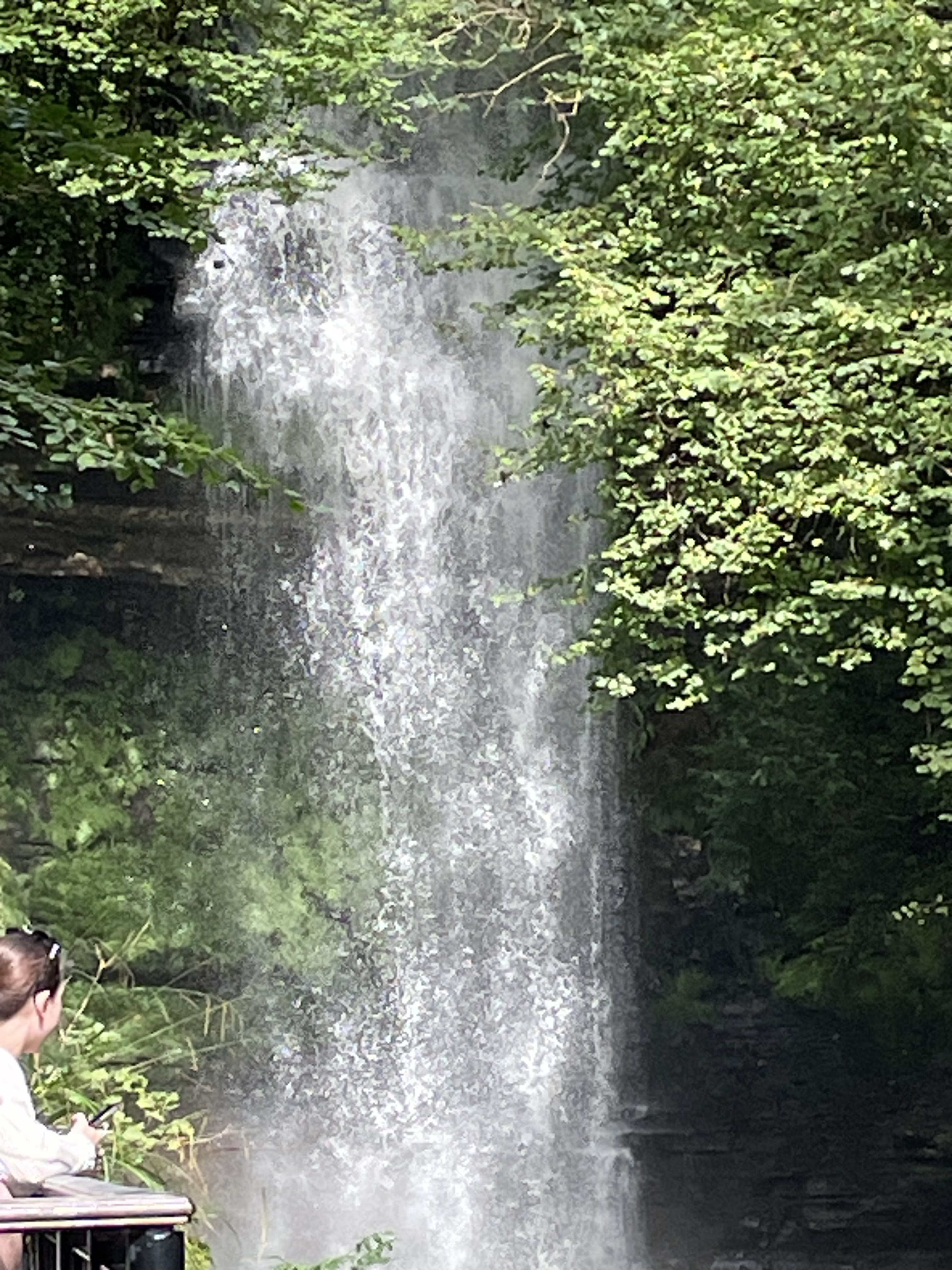
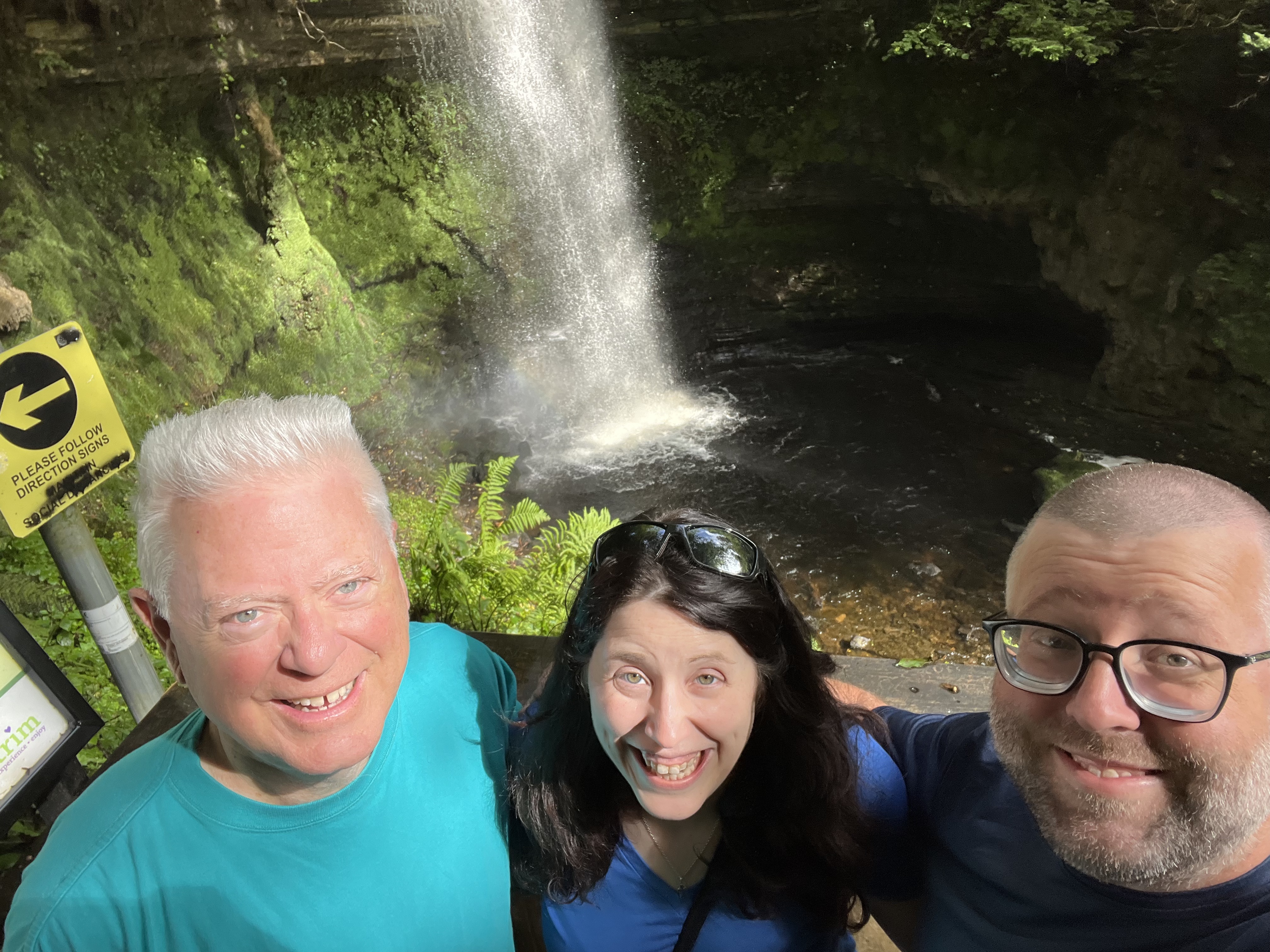
Hidden away within lush forest just north of the lough, Glencar Waterfall isn’t the biggest waterfall in Ireland but it’s undoubtedly one of its most picturesque. The green foliage, craggy rocks and cascading water all make for a gorgeous scene – basically, you can see why Yeats was so inspired!

We returned to Sligo in time for dinner, again at the Mill Bar. Afterwards we strolled through town, some of us in search of dessert and others in search of Irish music. Both groups returned to the hotel having found what they went in search of but also a little damp having experienced the famous unexpected Irish shower.

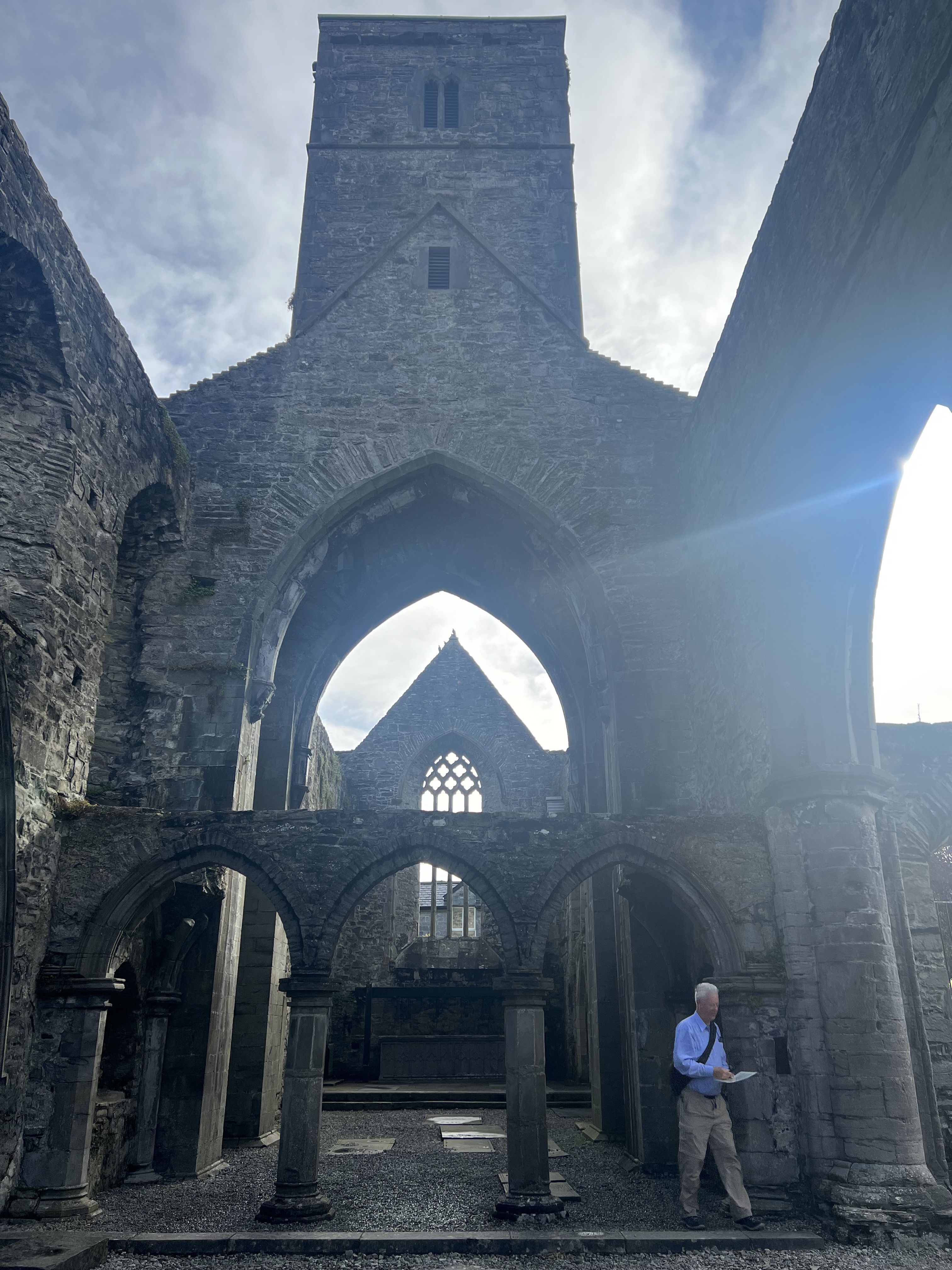
In the morning, I went off with George Jr to do laundry at an outdoor laundromat – definitely a new experience – but it worked. Dad and Jenn toured the Sligo Abbey, a Dominican convent founded in 1253. It was built in the Romanesque style with some later additions and alterations. Extensive ruins remain, mainly of the church and the cloister.

Galway – We left Sligo mid-morning and stopped at Cawley’s Guesthouse in Tubbercurry for lunch. A nice patio in the back provided for an al fresco dining experience. The food and service were both topnotch. Our stop for the next two nights was the Coach House Hotel in Oranmore. Service was very spotty and the rooms booked were not provided on check-in requiring a subsequent move. Parking is quite limited and we found it easier to just park in the town lot a short distance from the hotel. An on-site restaurant provides breakfast but doesn’t open until 8:30. After decamping we drove into Galway in search of dinner and a stroll around town. We chose a steakhouse called Rouge for dinner. Originally just open for dinner, Rouge pivoted during the pandemic to also offer a daytime menu of french pastries and coffees. In the evening there’s live music and a french vibe.

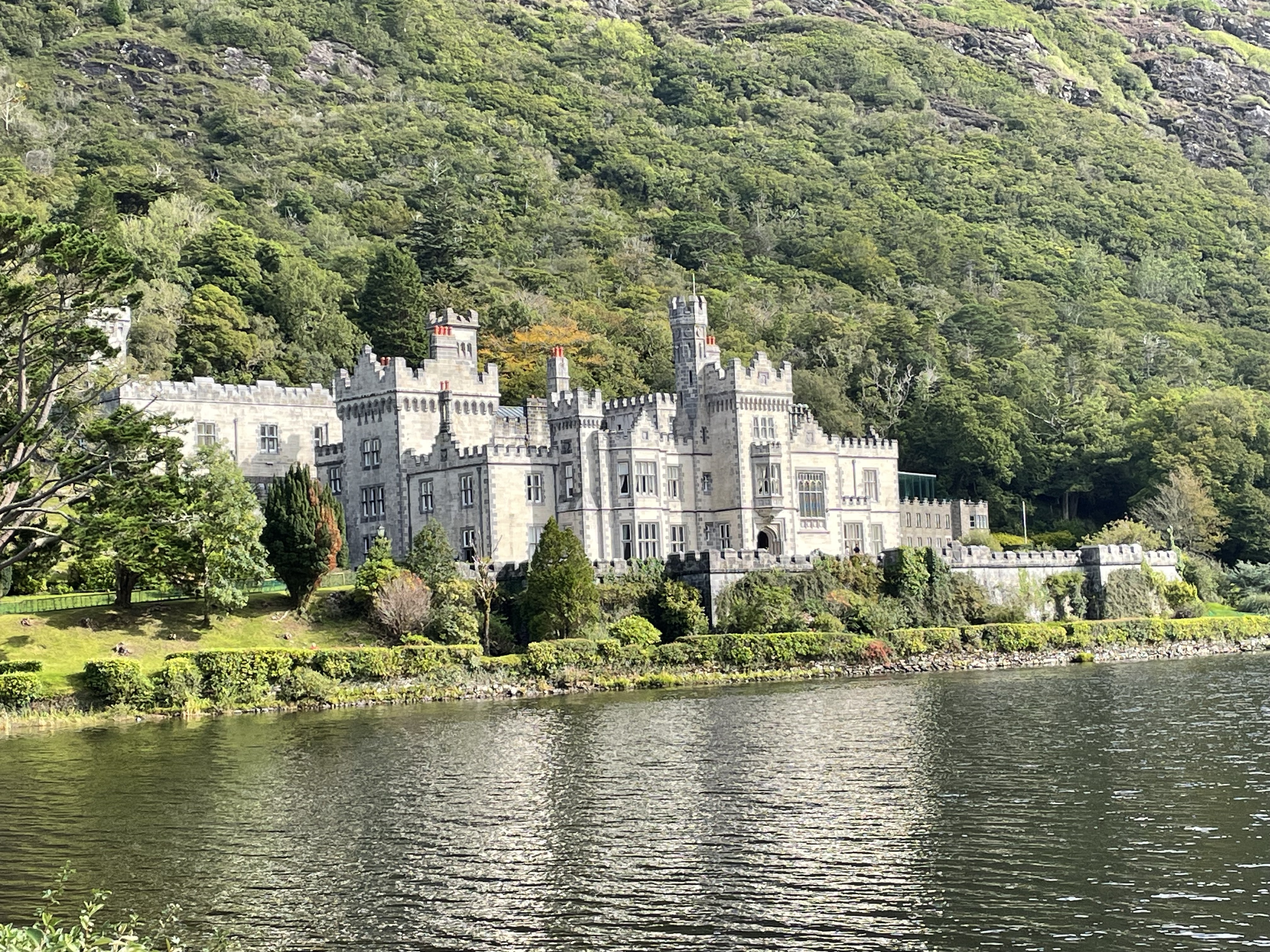
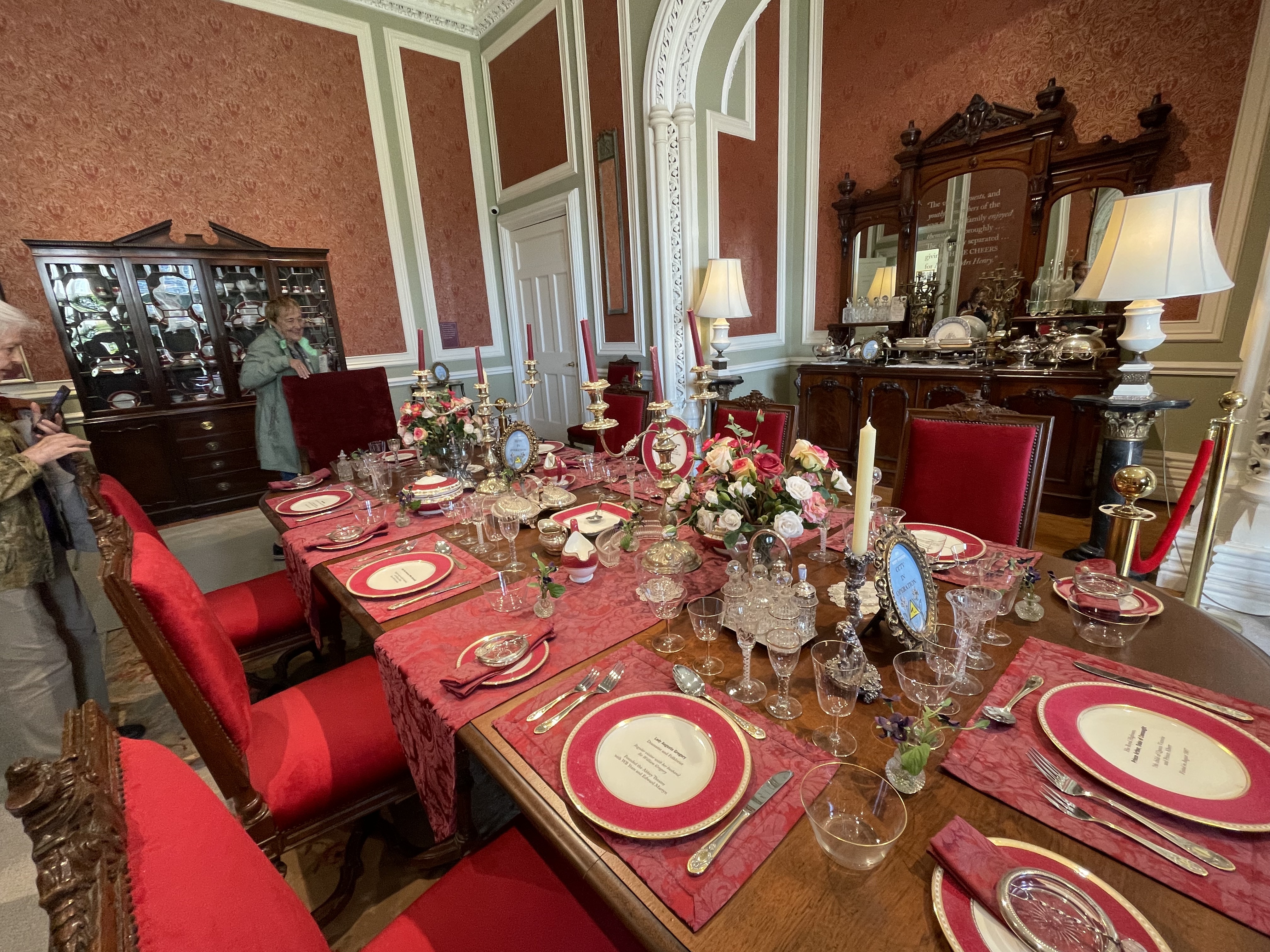
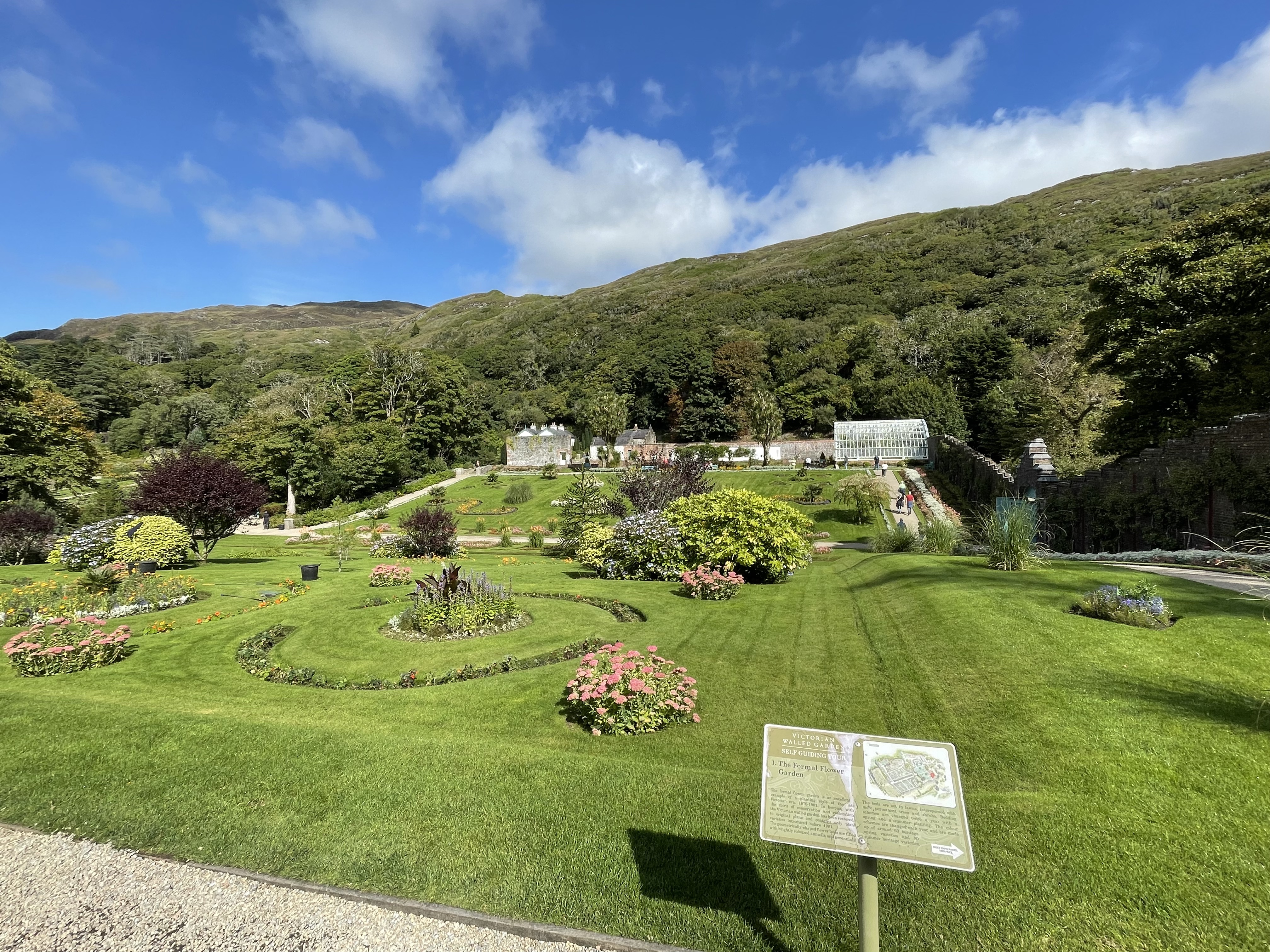
Saturday was a very busy, full day. We left early morning to visit mom’s favourite spot in Ireland – Kylemore Abbey. Kylemore Castle was built in 1868 as a private home for the family of Mitchell Henry, a wealthy doctor from London whose family was involved in textile manufacturing in Manchester, England. He moved to Ireland when he and his wife Margaret purchased the land around the Abbey, after having travelled there on their honeymoon in the mid-1840s. He became a politician, becoming an MP for County Galway from 1871 to 1885. The grounds include a Gothic chapel, family mausoleum, and a Victorian walled garden that is being returned to its original plan. The property was sold to the Duke and Duchess of Manchester in 1903. In 1920, the Castle became a Benedictine Monastery founded by nuns who fled Belgium during WWI. Although there are few nuns left living at the Abbey, the Kylemore Trust continues to operate the property, intentionally restoring portions of it to its original design, and has a unique partnership with Notre Dame University in the United States. Our visit was brief because we had to return to Galway by mid-afternoon, but everyone enjoyed the visit immensely.

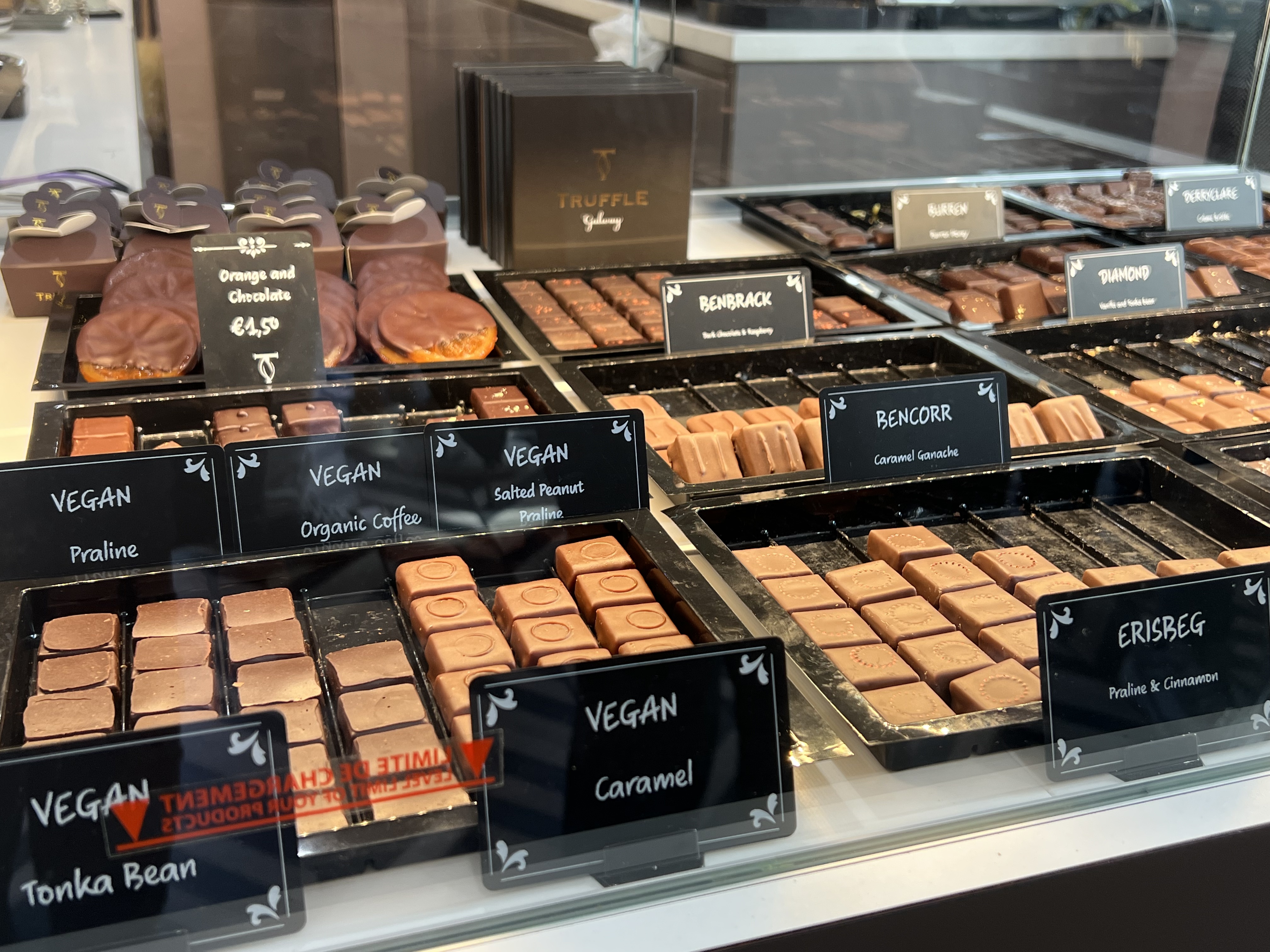
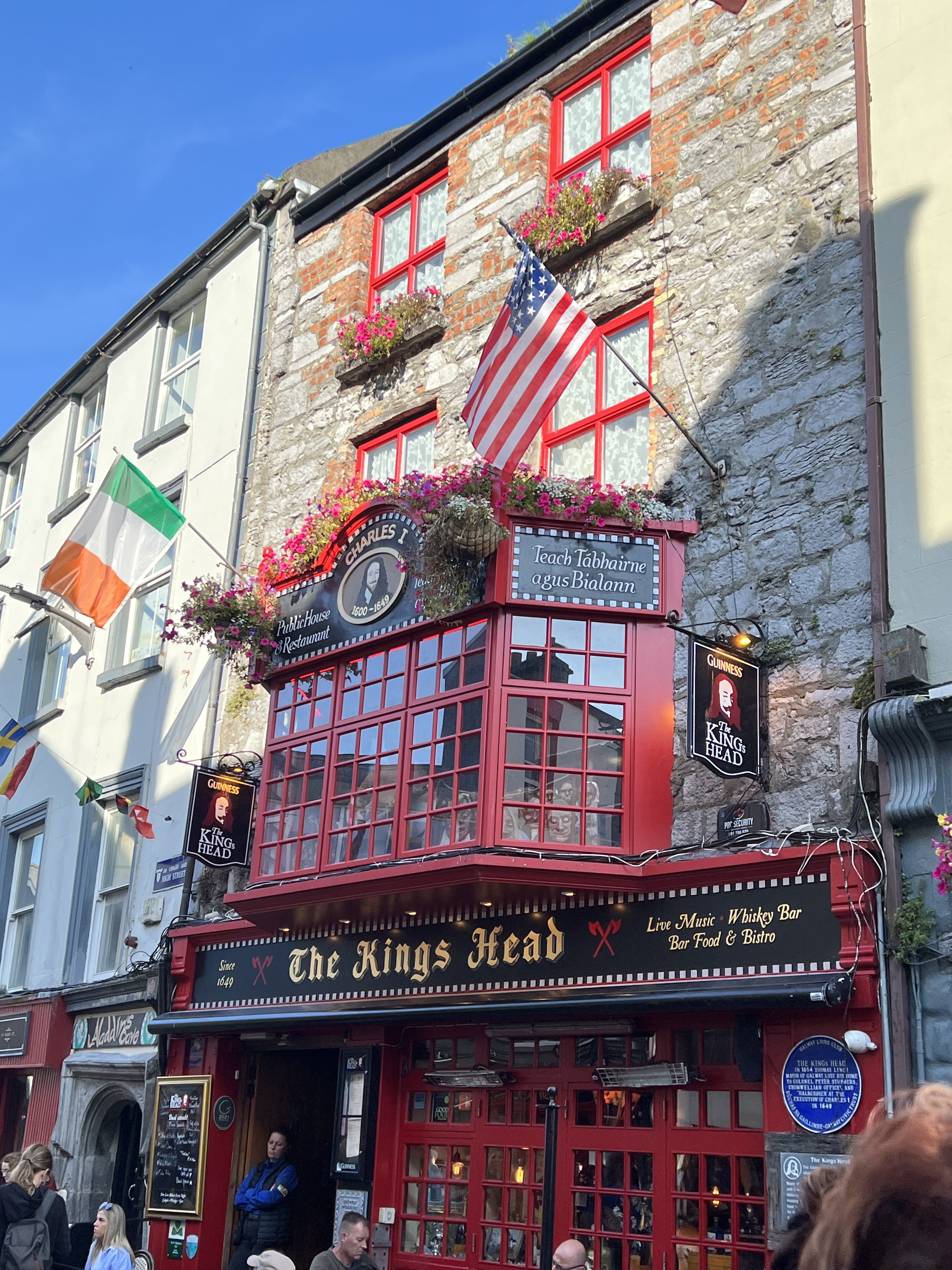
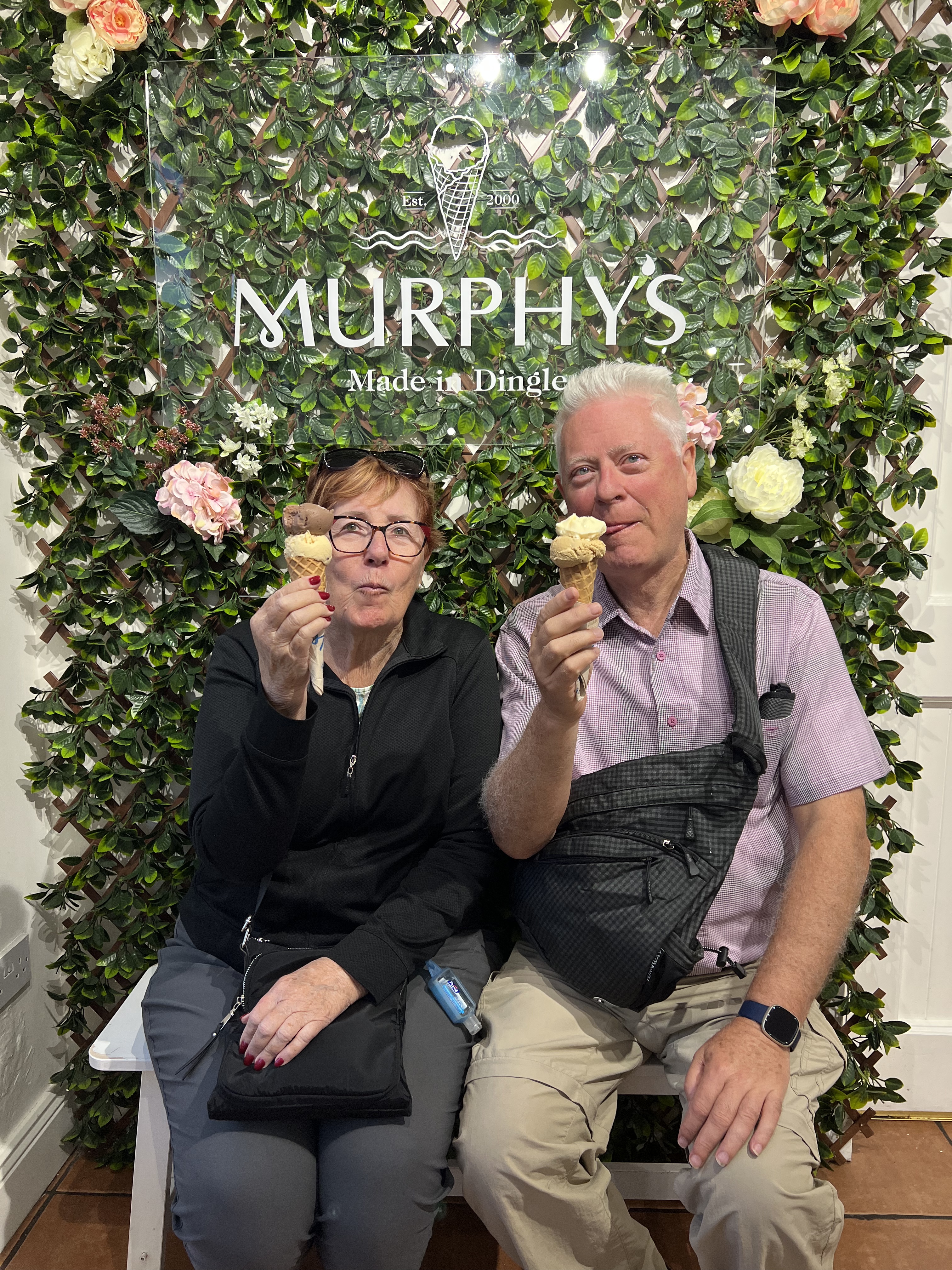
Back in Galway, Jenn and I did the Food Tour which had been recommended by one of her friends. Galway is becoming well known as the food capital of Ireland and our tour included stops with samples at many craft businesses, up-and-coming restaurants and well-known establishments. This tour is highly recommended but book early – it sells out quickly. Dad and George did a walking tour of Galway which covered the history and architectural features of the city. Dinner was at the King’s Head Pub, but Jenn and I could only watch. We were too full from our tour except to enjoy a Murphy’s Ice Cream on our way back to the car.

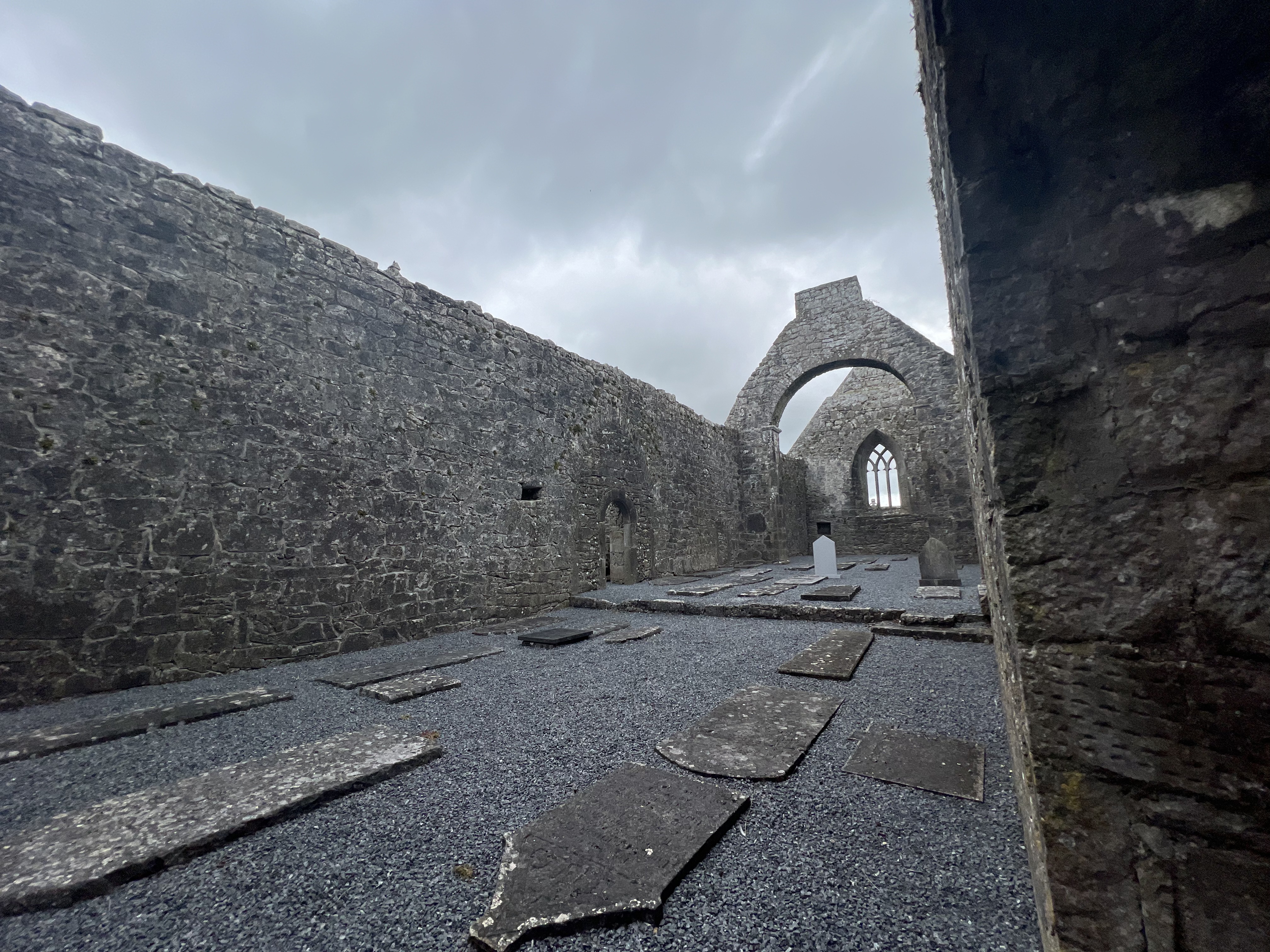
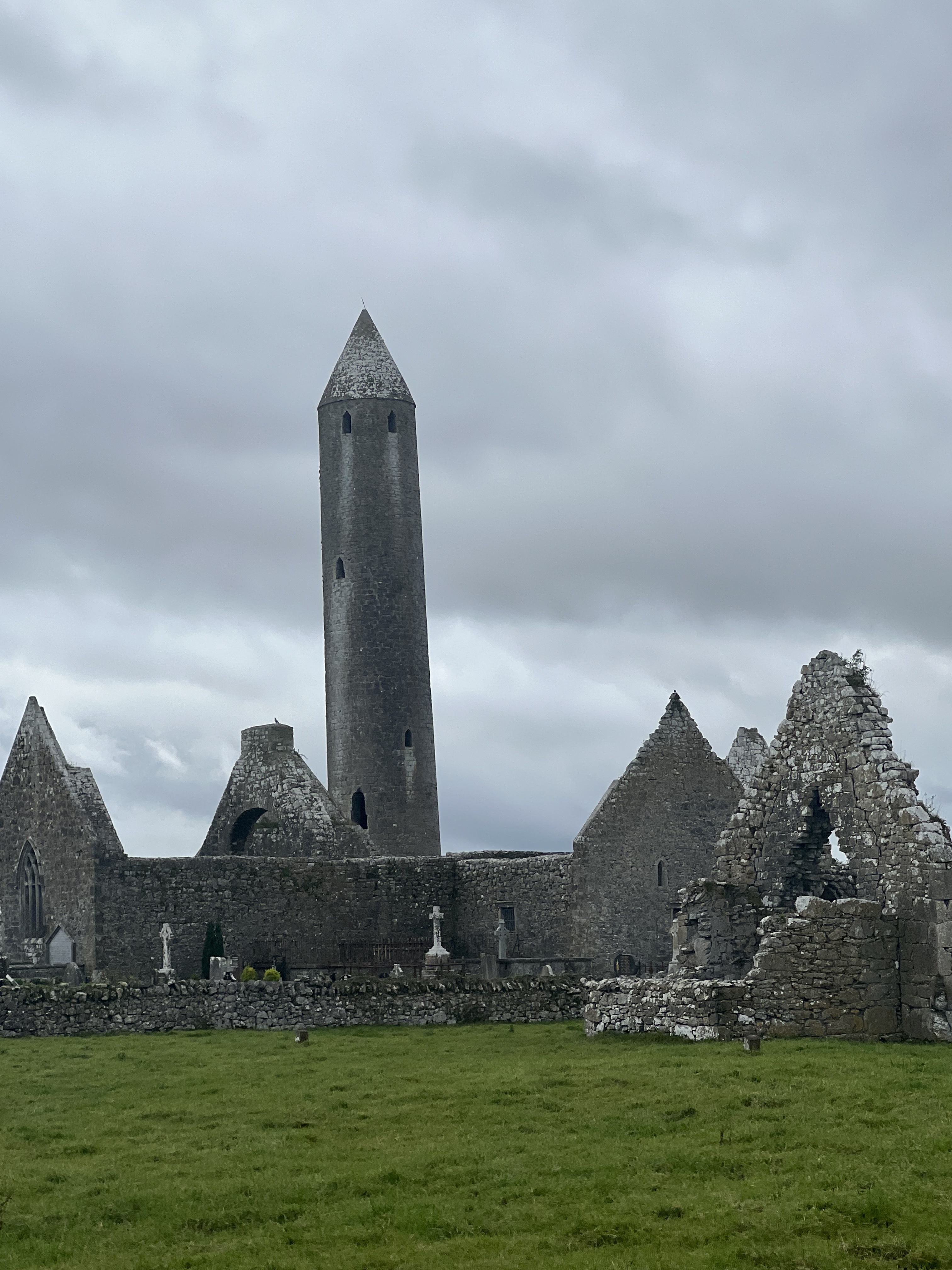
Killarney – Sunday was a long day as we headed for Killarney with a number of planned stops. First up was a trip out to Kilmacdaugh Abbey. The road was quite exciting with some of us wondering if our driver really knew where he was going! The site is thought to date back to the seventh century although the current buildings are not originals. It’s thought that the “leaning” tower dates back to the 10th century.

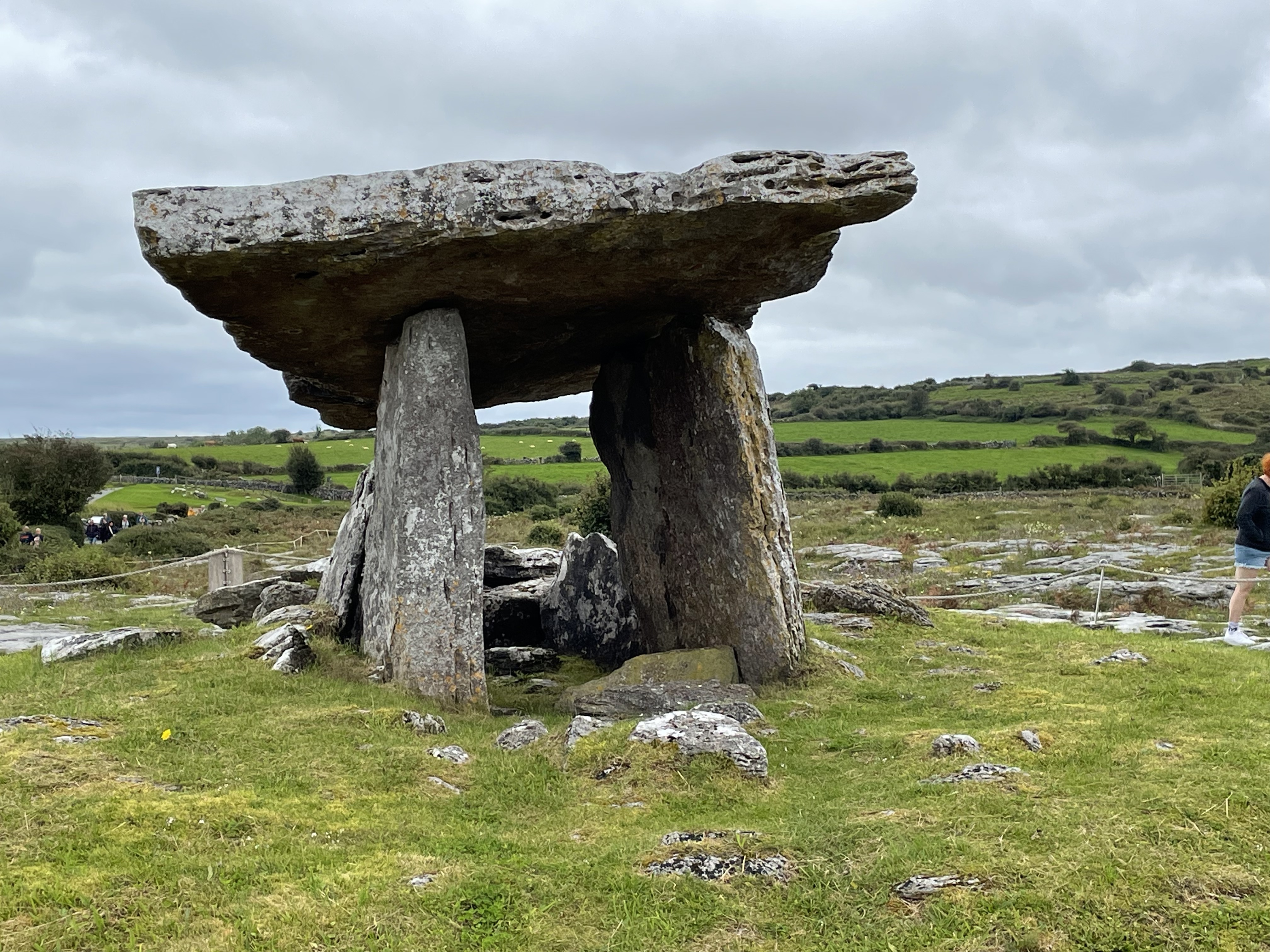
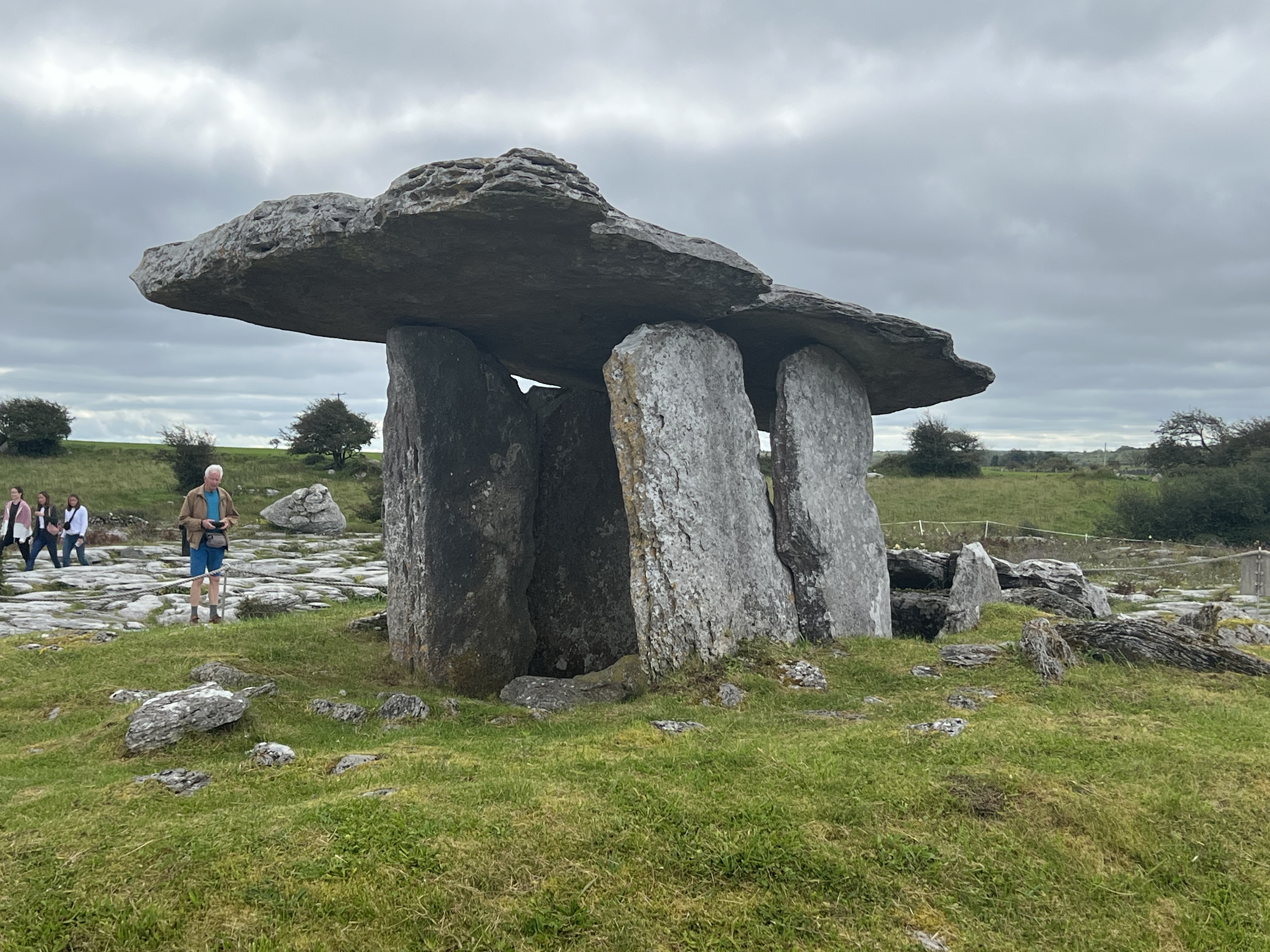
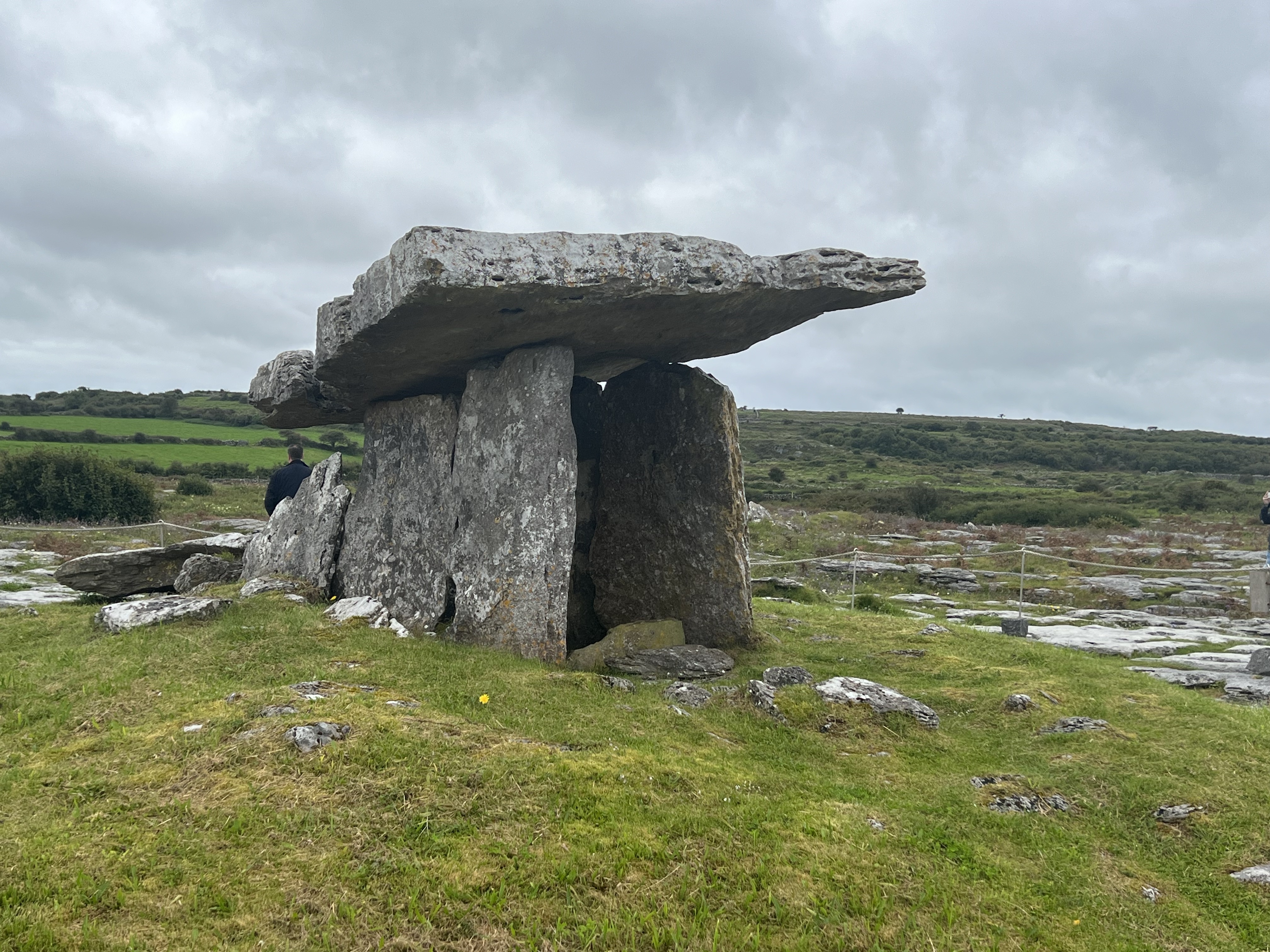
The next stop across the Burren was Poulnabrone Domen, a large single-chamber portal tomb. Situated in one of the most desolate and highest points in the area, it consists of three portal stones and a horizontal capstone. It’s thought to date back to the Neolithic Period, around 3800 and 3200 BC. When the site was excavated in the 1980s, the remains of 33 adults and children were uncovered including stone and bone objects buried with the dead. It was a very interesting stop, one that we might have missed if not for George Jr.

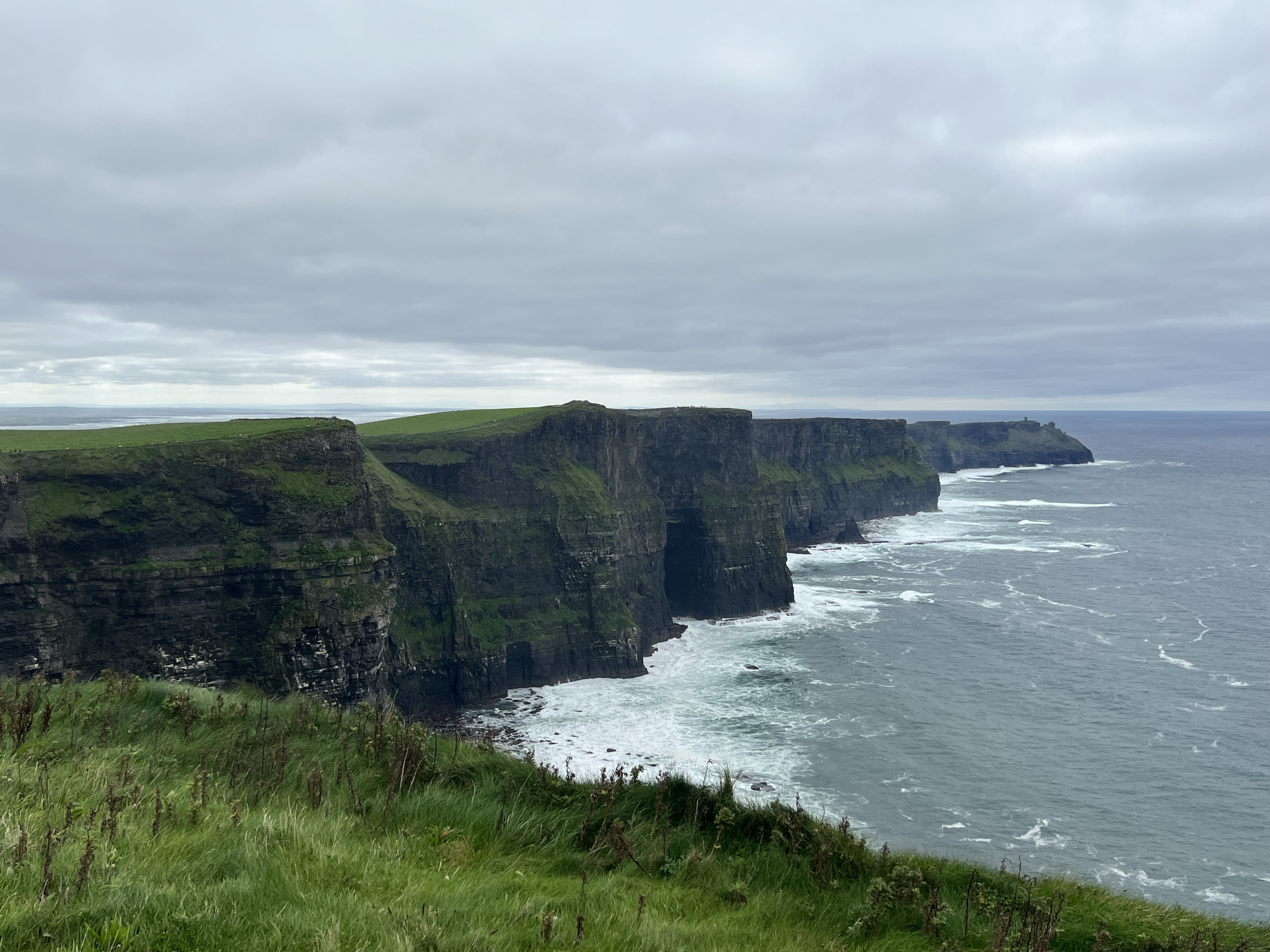
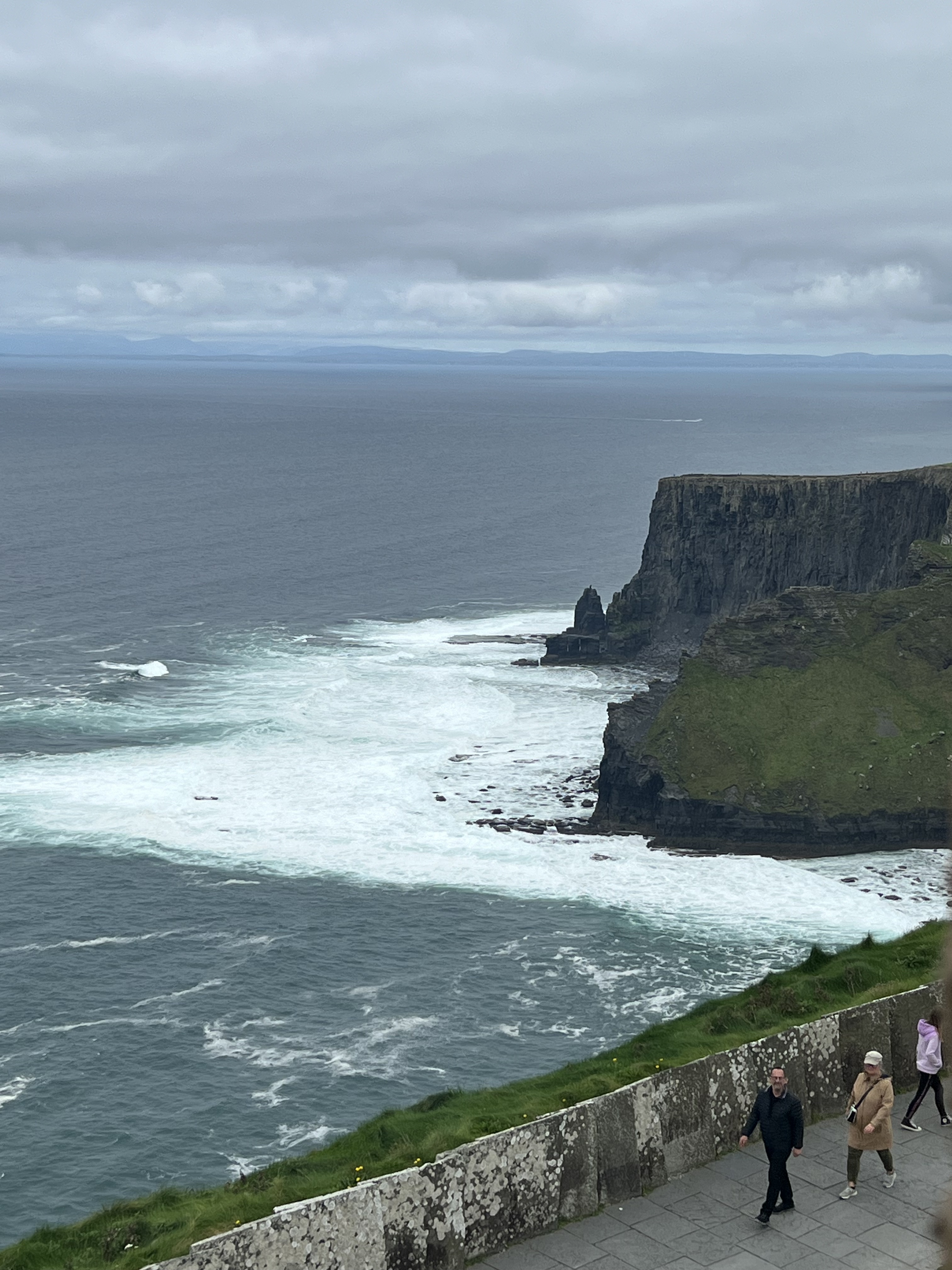
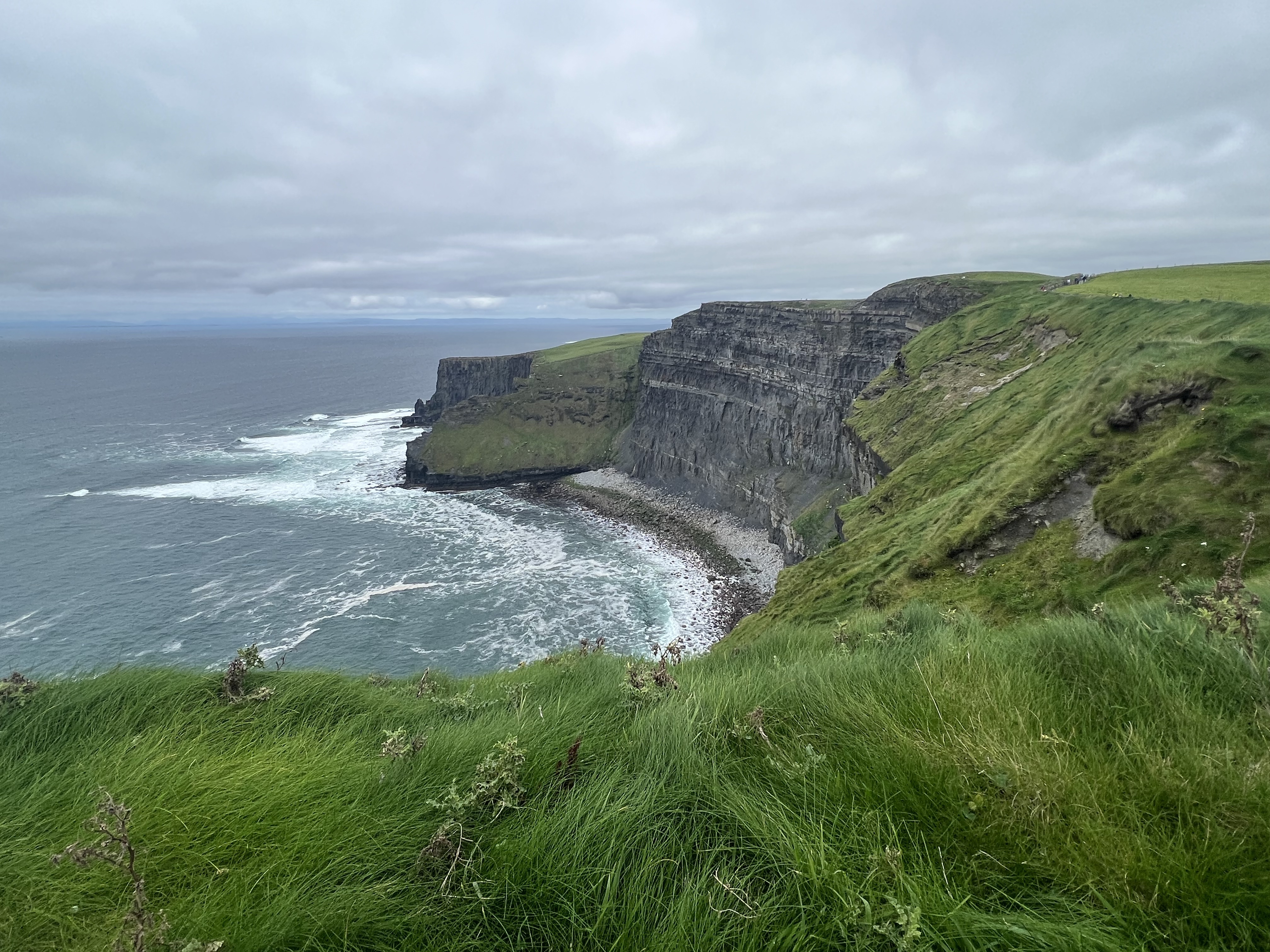
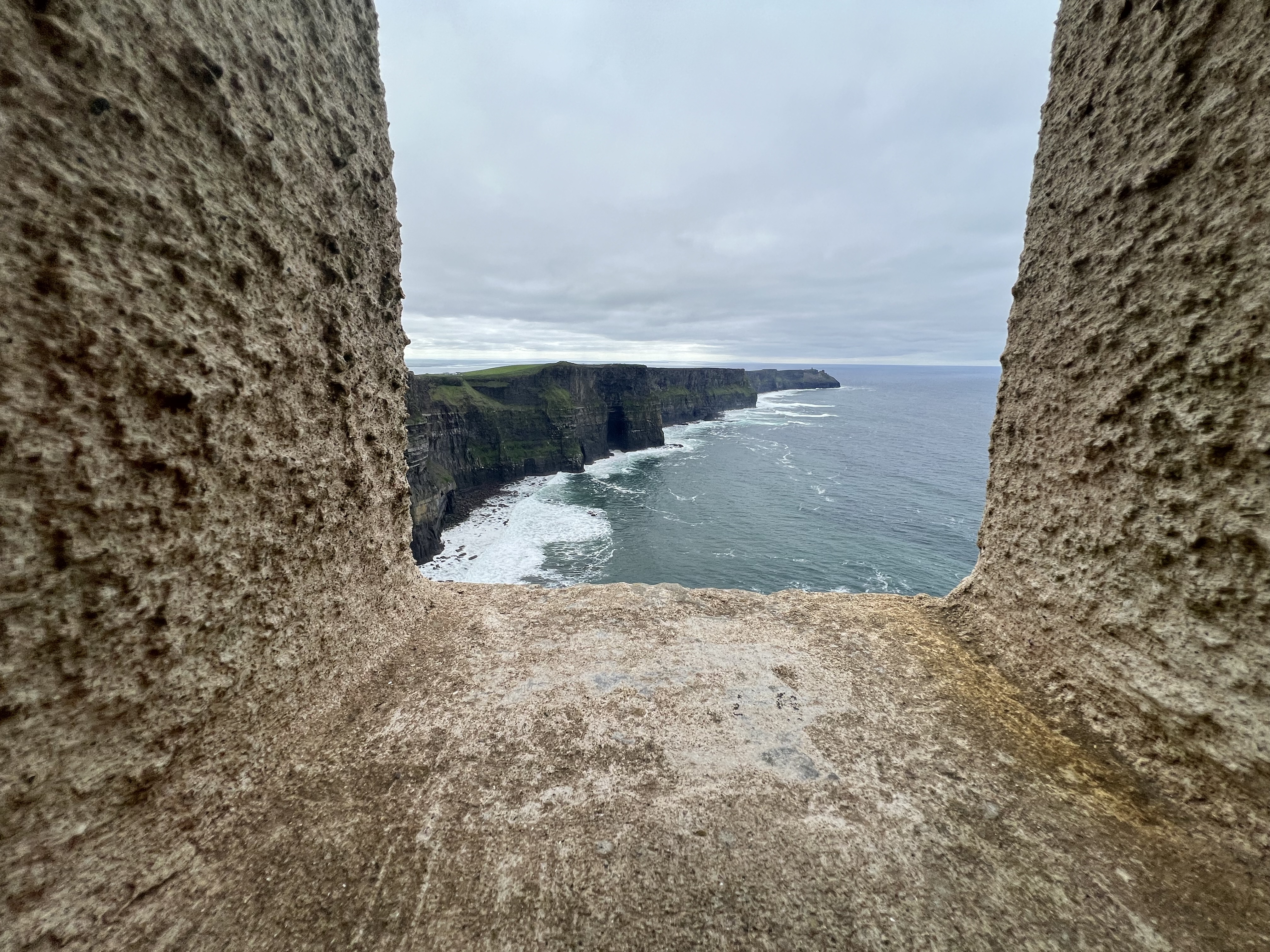
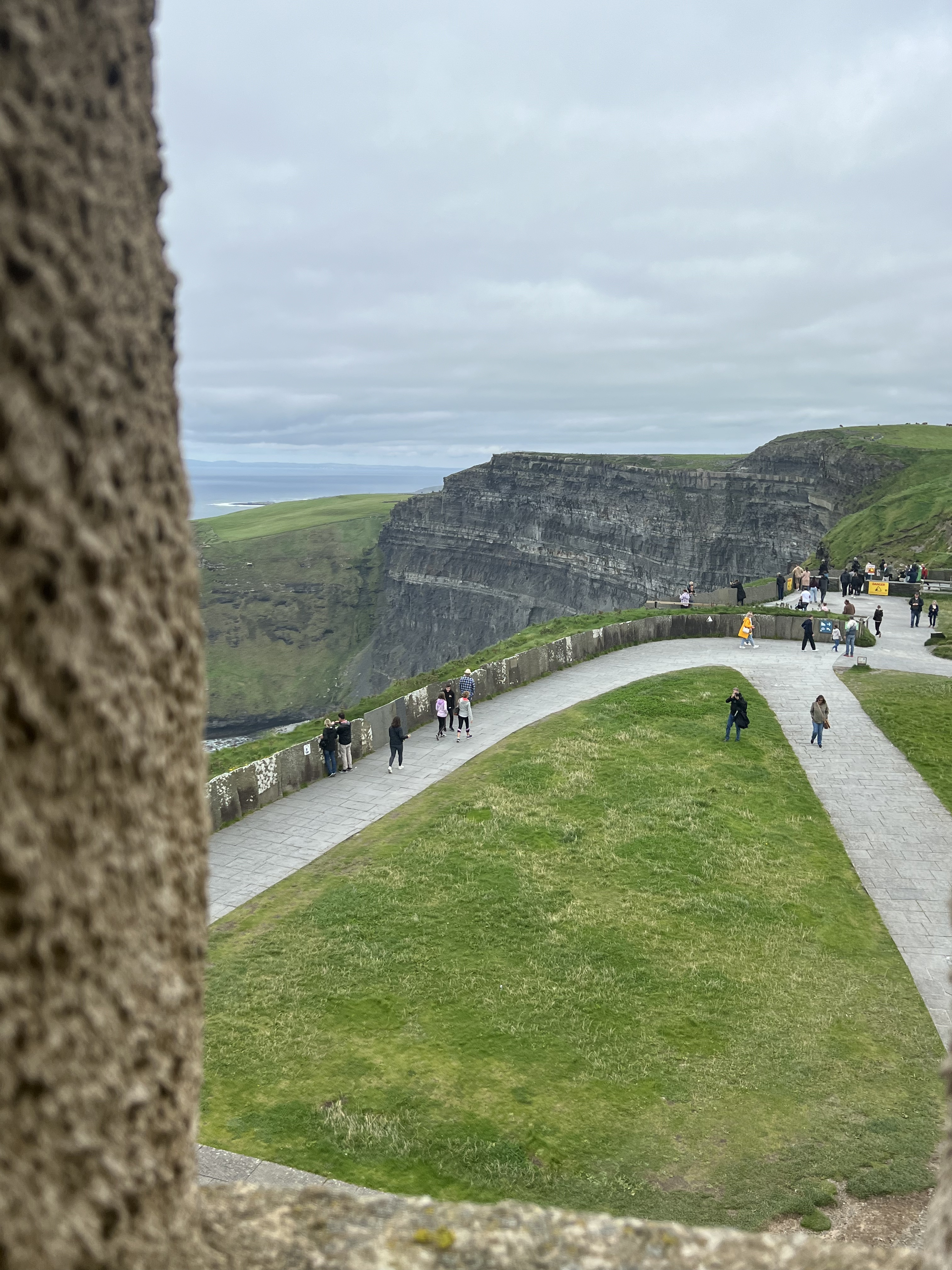
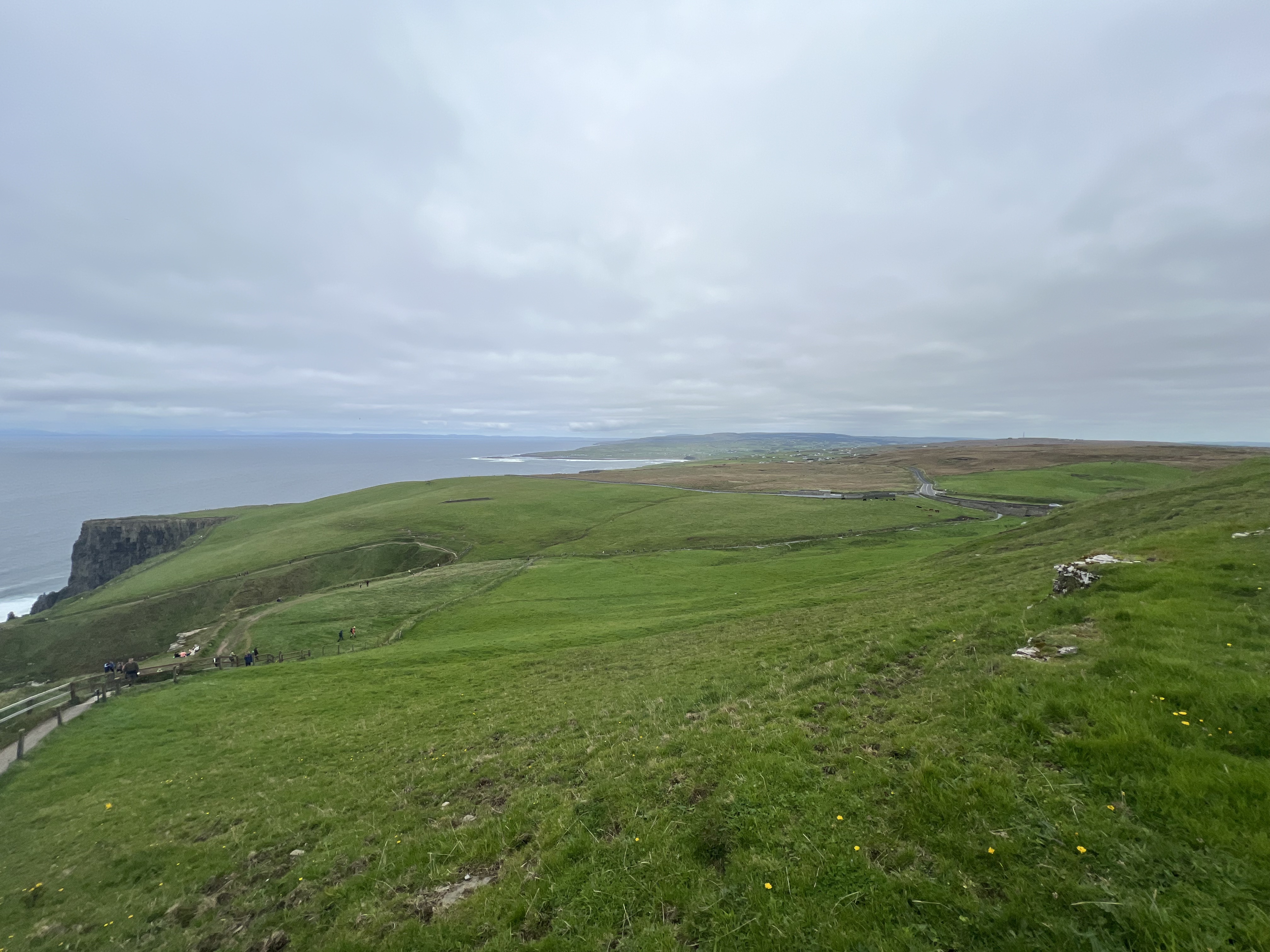
Then it was off across the Burren to The Cliffs of Moher. Probably Ireland’s most visited tourist spot, the cliffs run for about 14 km along the Atlantic Ocean with spectacular views from 120 – 214 meters above the ocean. While Dad and I had visited the site twice before it was interesting to note the changes since our last visit, including a large car park across the road. After a quick lunch in one of the two cafes on the site, we parted company and each did our own thing. Some walked out to the point while others climbed O’Brien’s Tower and visited the interpretive centre (built into the side of the hill). After a quick stop for gas, we chugged on to Killarney and our accommodation at Ashbrook B&B.

Monday was our day to do the Ring of Kerry. A circular tourist route that covers 179 km, it takes about 10 hours with stops to enjoy the views and experience some of the major attractions. The road has been vastly improved since we first drove it in 2005, and we didn’t experience any problems with buses or lorries on the curves. We followed a guide that I had downloaded from the internet by The Irish Road Trip.

Our first stop was Ladies View and Moll’s Gap – a good spot for a snack but not a particularly super view this particular day. A slow drive (lots of traffic!) through Kenmare gave us a good look at this cute little town with picture-postcard colorful shops and pubs. Then it was on to Derrymane House and Beach. The beautiful white sand and warm sun was an attraction for adventurous bathers. By this time the sun was out and it had begun to warm up. Some of our group made it down to the beach. We decided to stop in Waterville for lunch. Some chose a pizza place while others of us enjoyed sitting in the sun at the little bakery cafe on the main street.

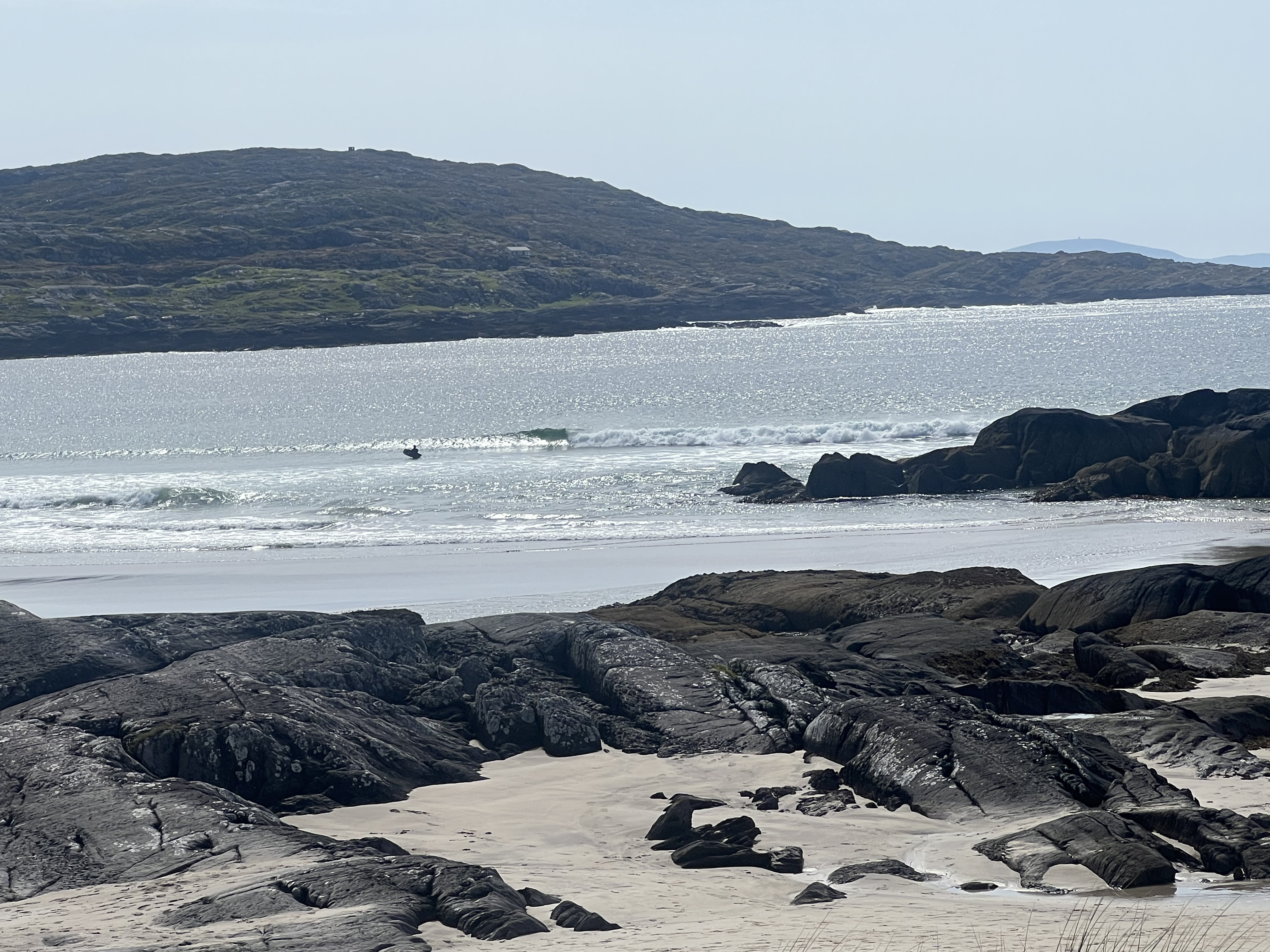
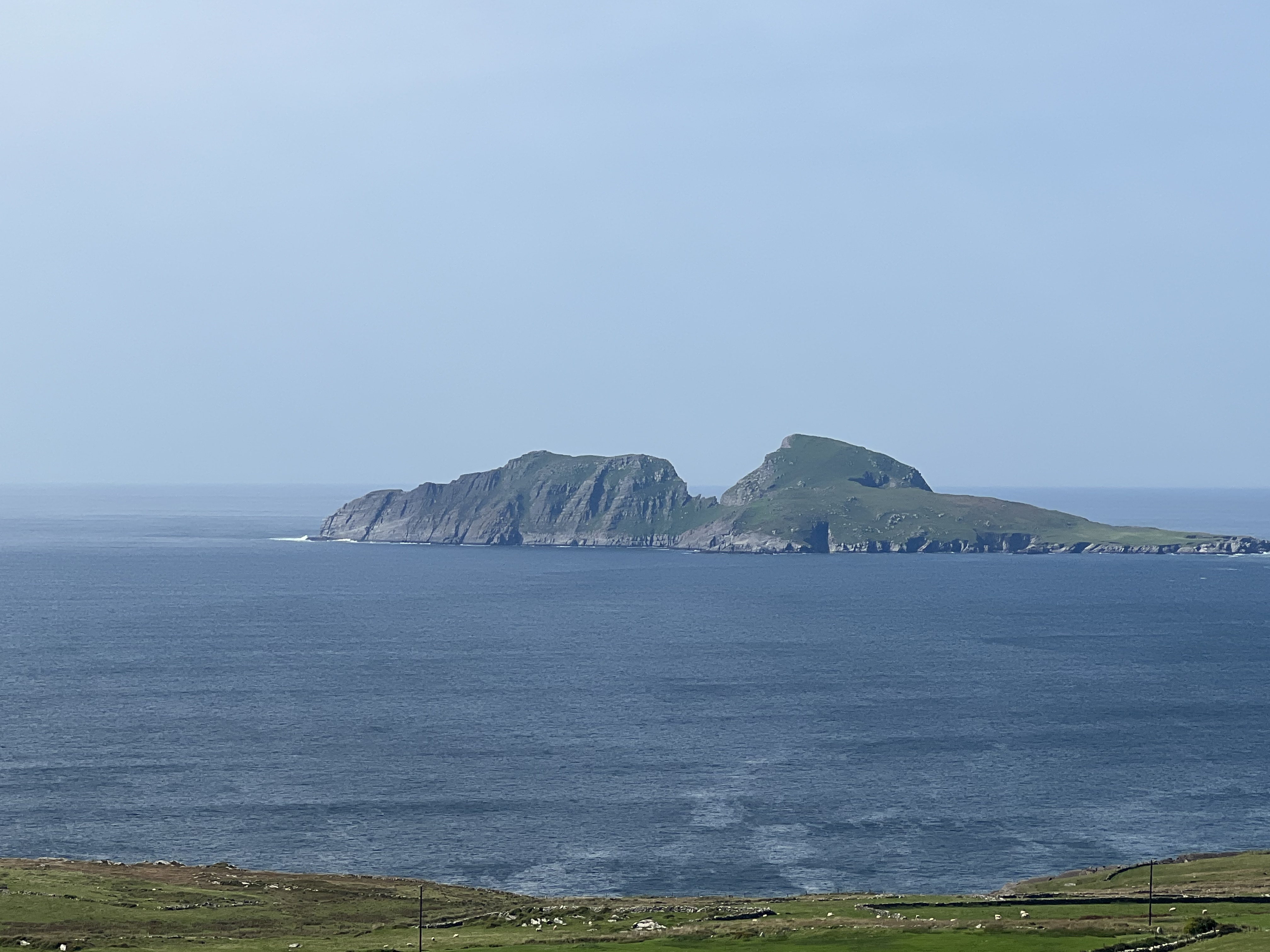
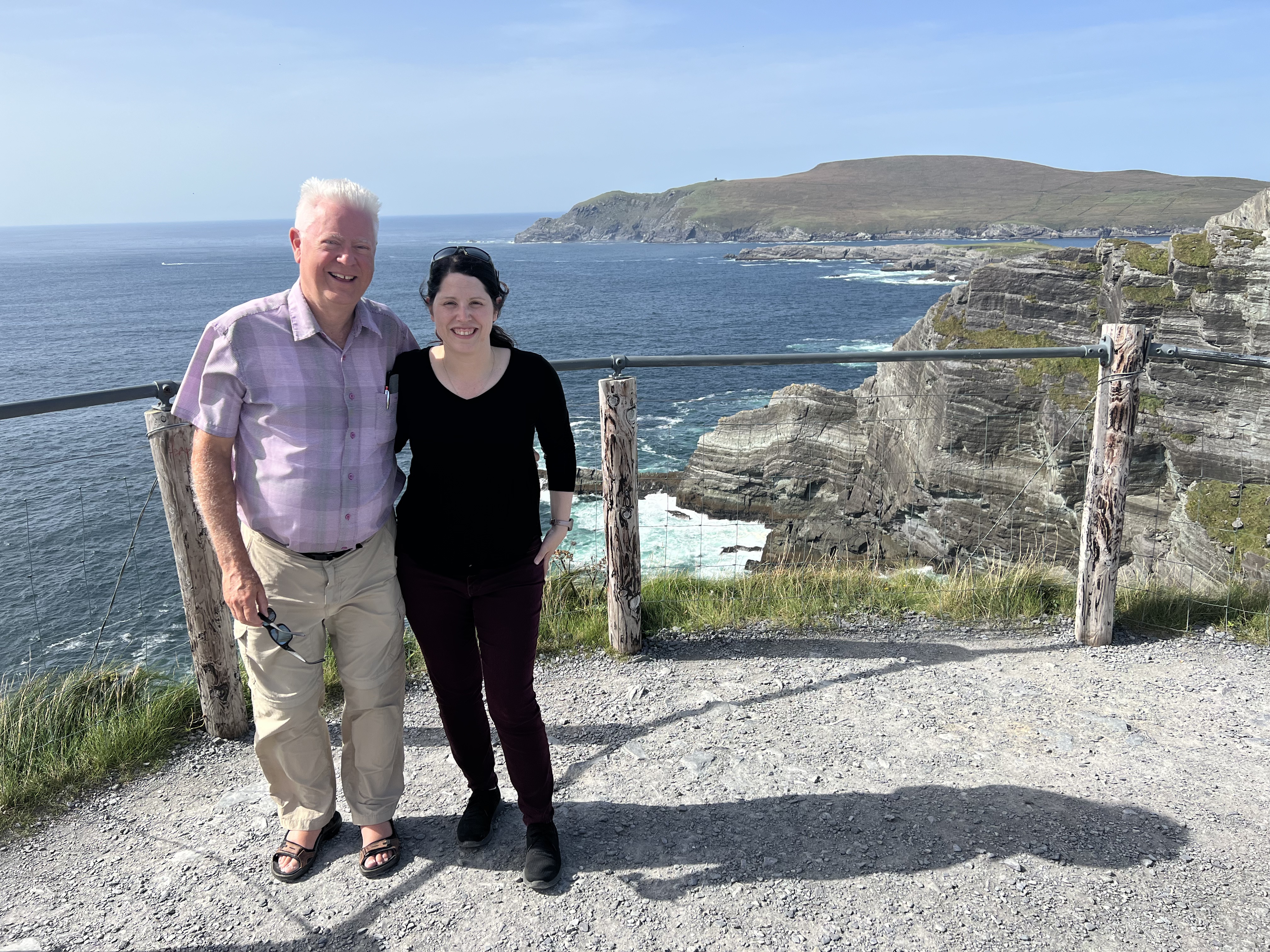
Our driver took us on a diversion from the main route to the Skellig Ring, with its rocky crags, quirkier attractions and UNESCO World Heritage site. Skellig Michael is a rock about 11km from Portmagee and was the site of a Jedi sanctuary in the latest Star Wars movie. Unfortunately, we didn’t arrive early enough or dressed warmly enough to take a boat tour out to the rock, to the disappointment of some in our group. Just across the causeway, at Portmagee, to Valencia Island is The Skellig Experience, a museum which is an excellent interpretive centre for the area. We spent about 30 minutes there. Other places we visited on the island were the lighthouse, the Grotto Slate Quarry (although we weren’t really welcome to be there and quickly turned around), the museum (closed unfortunately) that marked the terminus of the first transatlantic telegraph cable, and a walking path up to Kerry Cliffs at Foilnageragh (llamas included). The roads on the island are quite narrow, with lots of bends and hills. Our driver did an excellent job.

Then it was back to the main road and heading for home. We stopped at Rossbeigh Beach for a pit stop and since it was past dinner time, some of us bought food at the beach cafe to eat in the car. Our driver chose to wait for the Golden Arches back in town.

One day does not do justice to the Ring of Kerry. There is just so much to see and do in this area. I guess that’s why many folk stay for much longer than our itinerary allowed.

Kilkea – We don’t know of anyone who would have Kilkea on their itinerary, but it was on ours because mom had always wanted to stay at a castle and there is a great one in Kilkea. We planned two stops on the way from Killarney to Kilkea. The first at Blarney Castle and the second at Rock of Cashel – both well-known tourist stops.

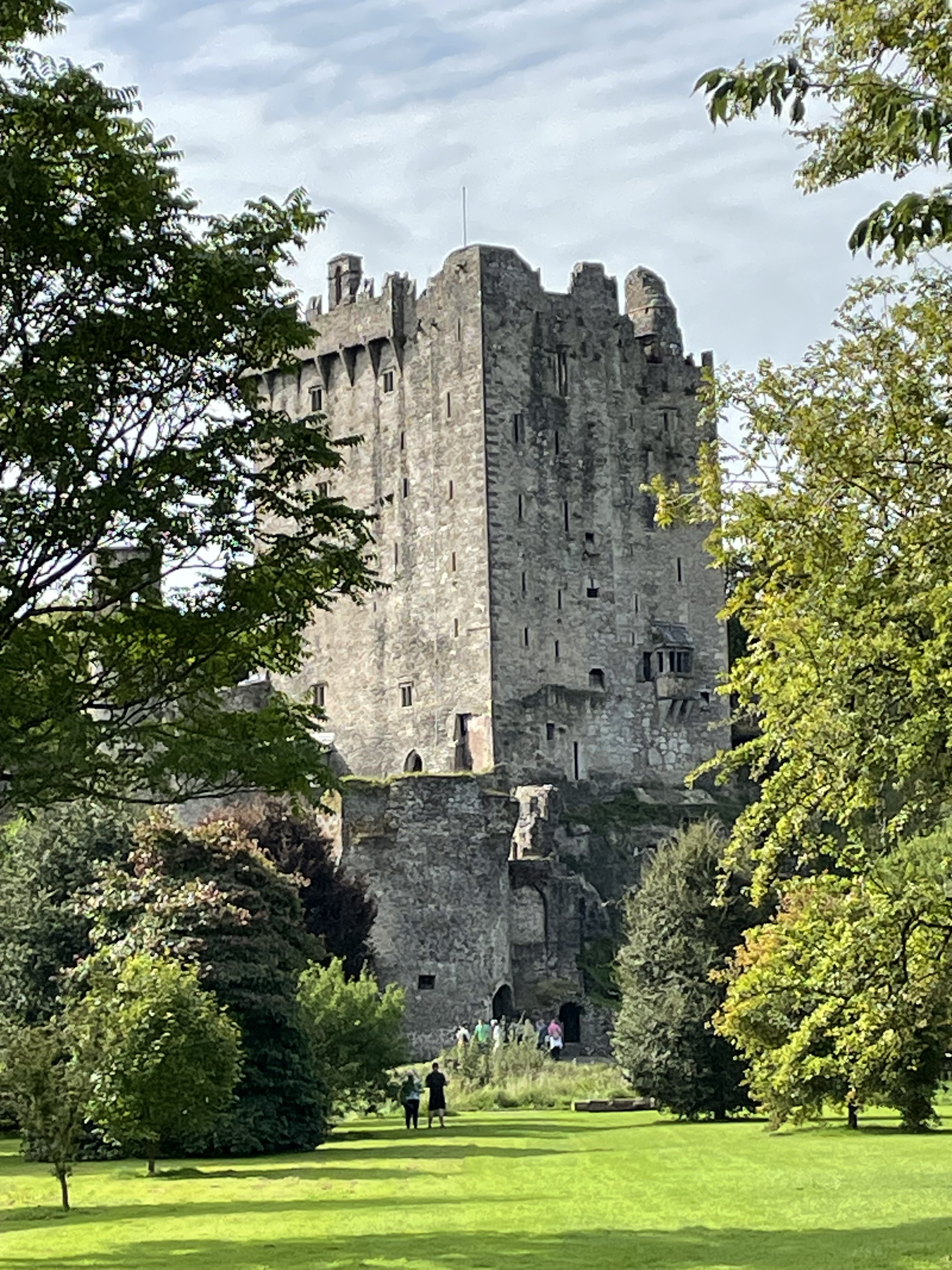
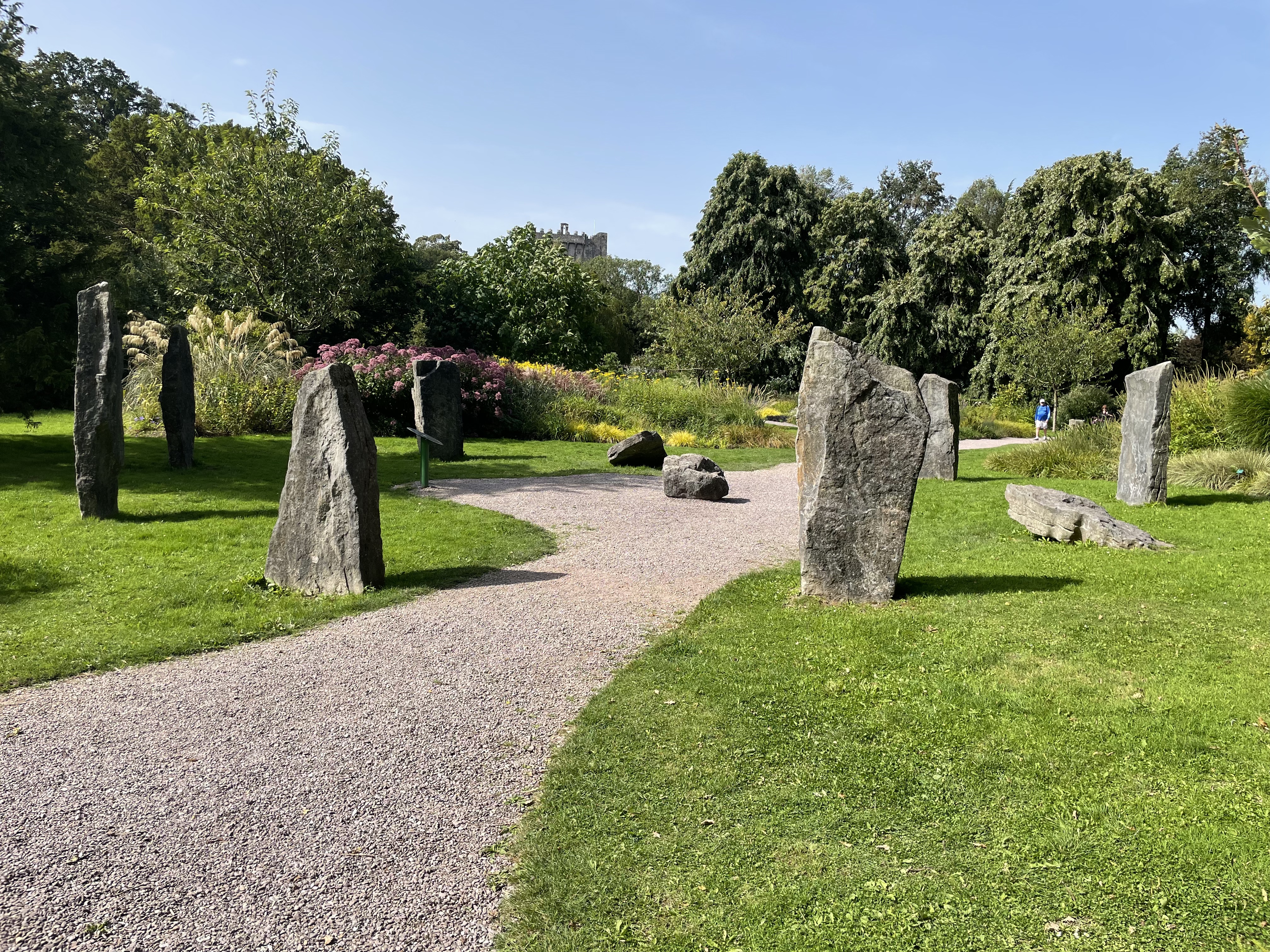
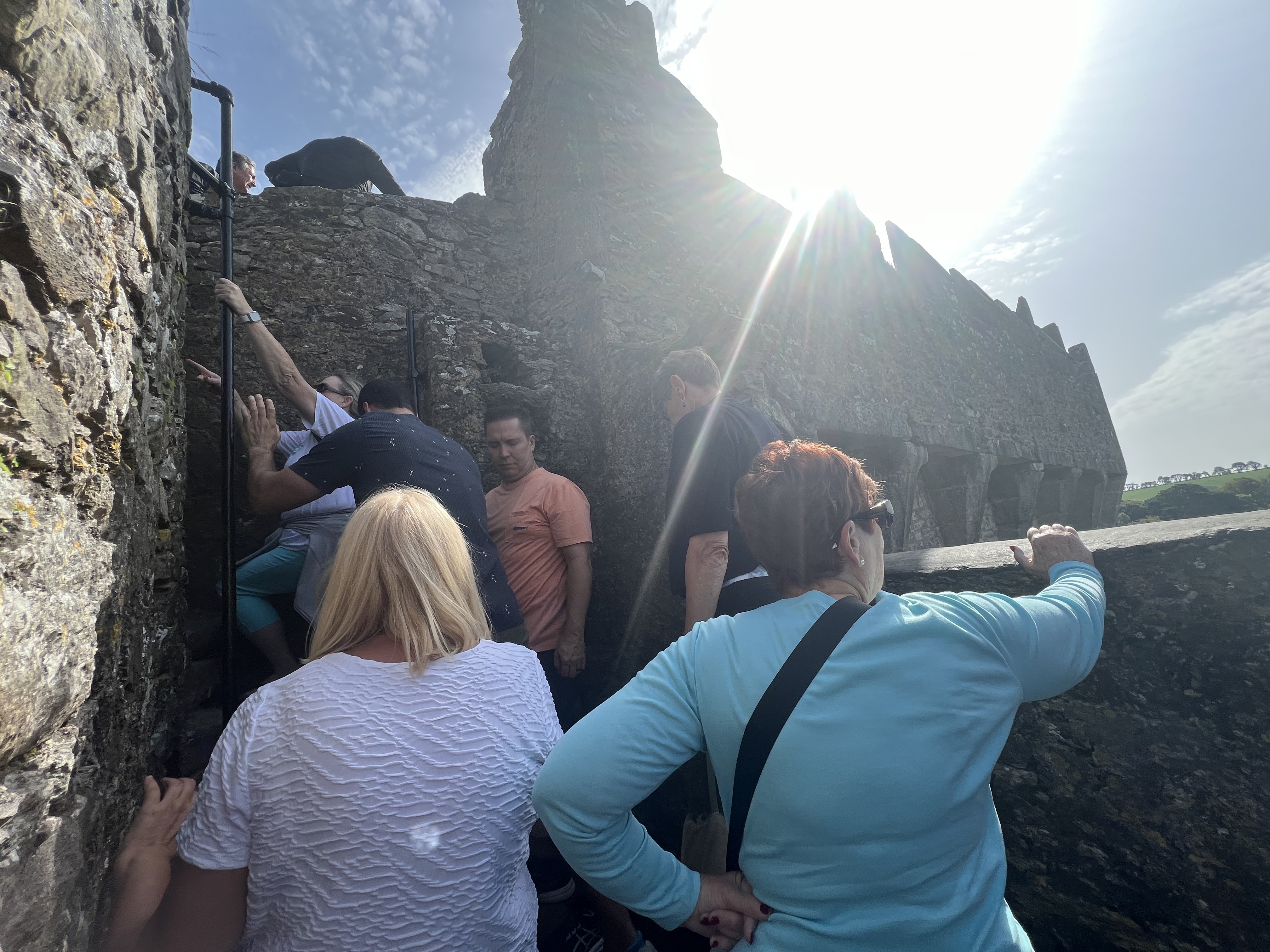
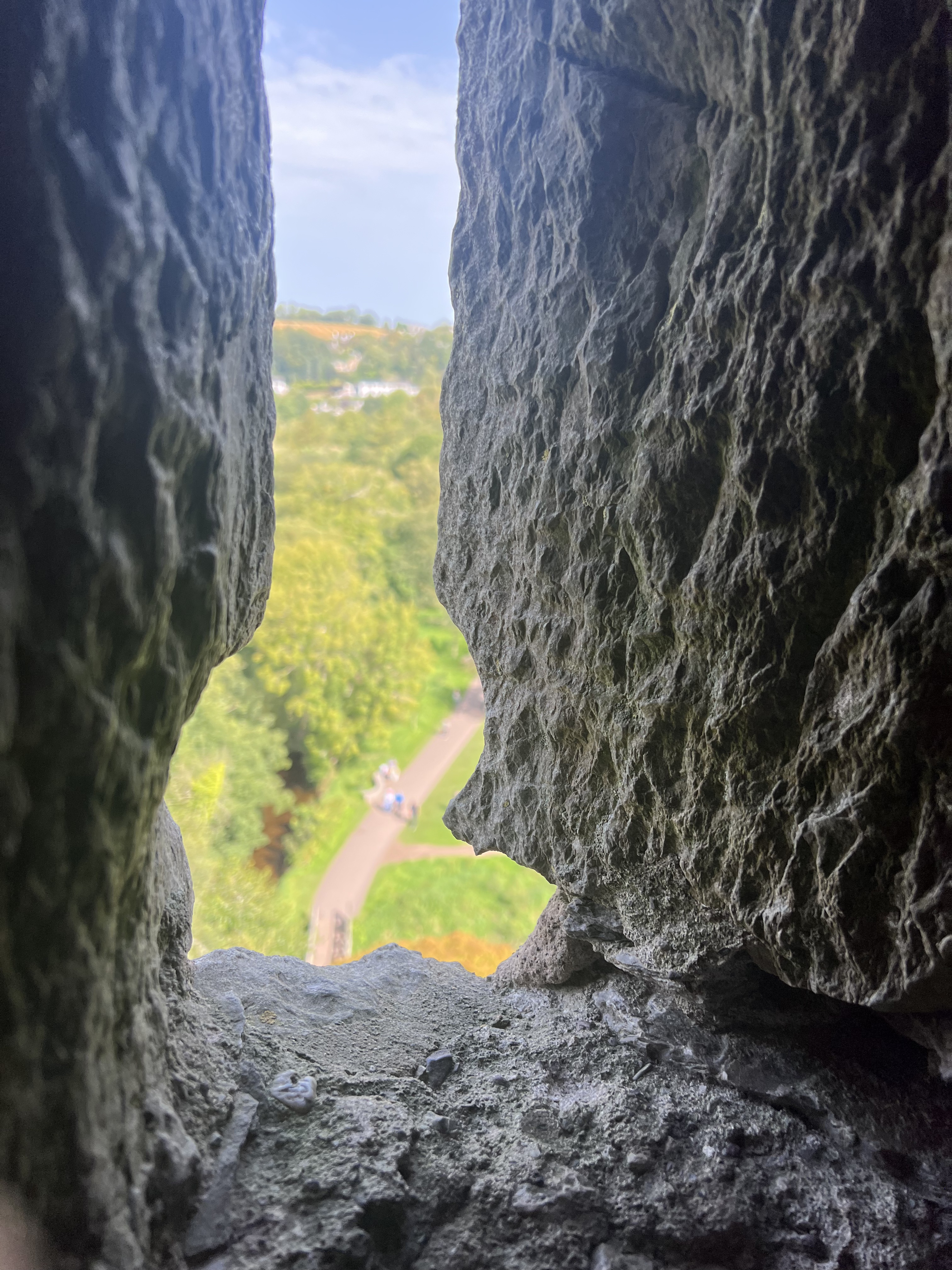
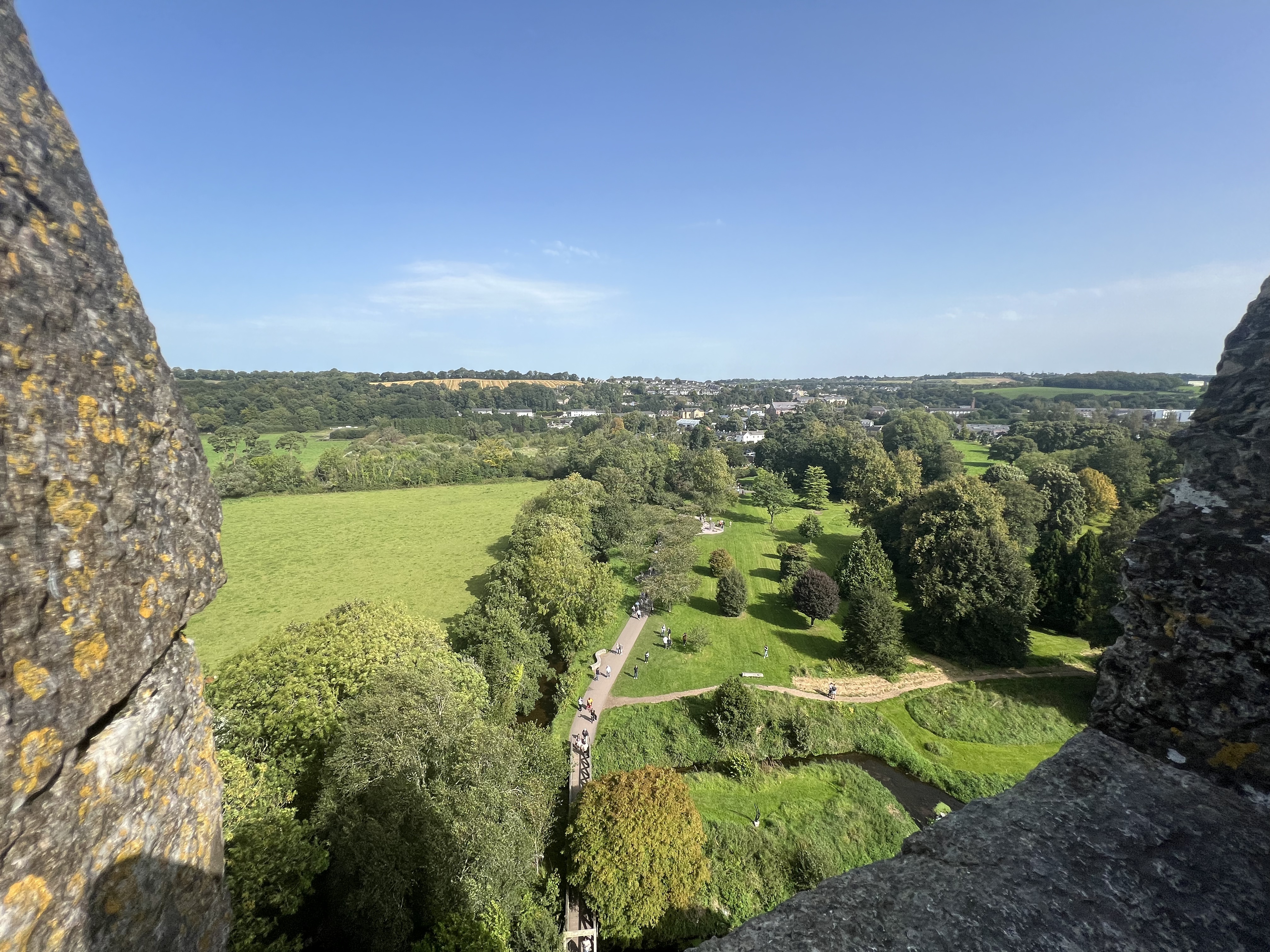
We spent about two hours at Blarney Castle, each doing our own thing. The ground level of the castle has an excellent museum which describes its history and architectural features including a ‘murder hole.’ George Jr and I hiked to the top of the castle so he could kiss the Blarney Stone. Because I’d done it on our first trip, I was just along to capture his moment. I still don’t think it helps with the gift of the gab. Between the entrance and the lake are about 60 acres of gardens to explore. They include themed gardens, three planned walking trails and a range of sculptures throughout. Lots to see!

The cafe had a limited menu; while three of us were able to find something to satisfy our craving for lunch, Jenn needed a quick stop at a bakery in Cork for a tuna sandwich.

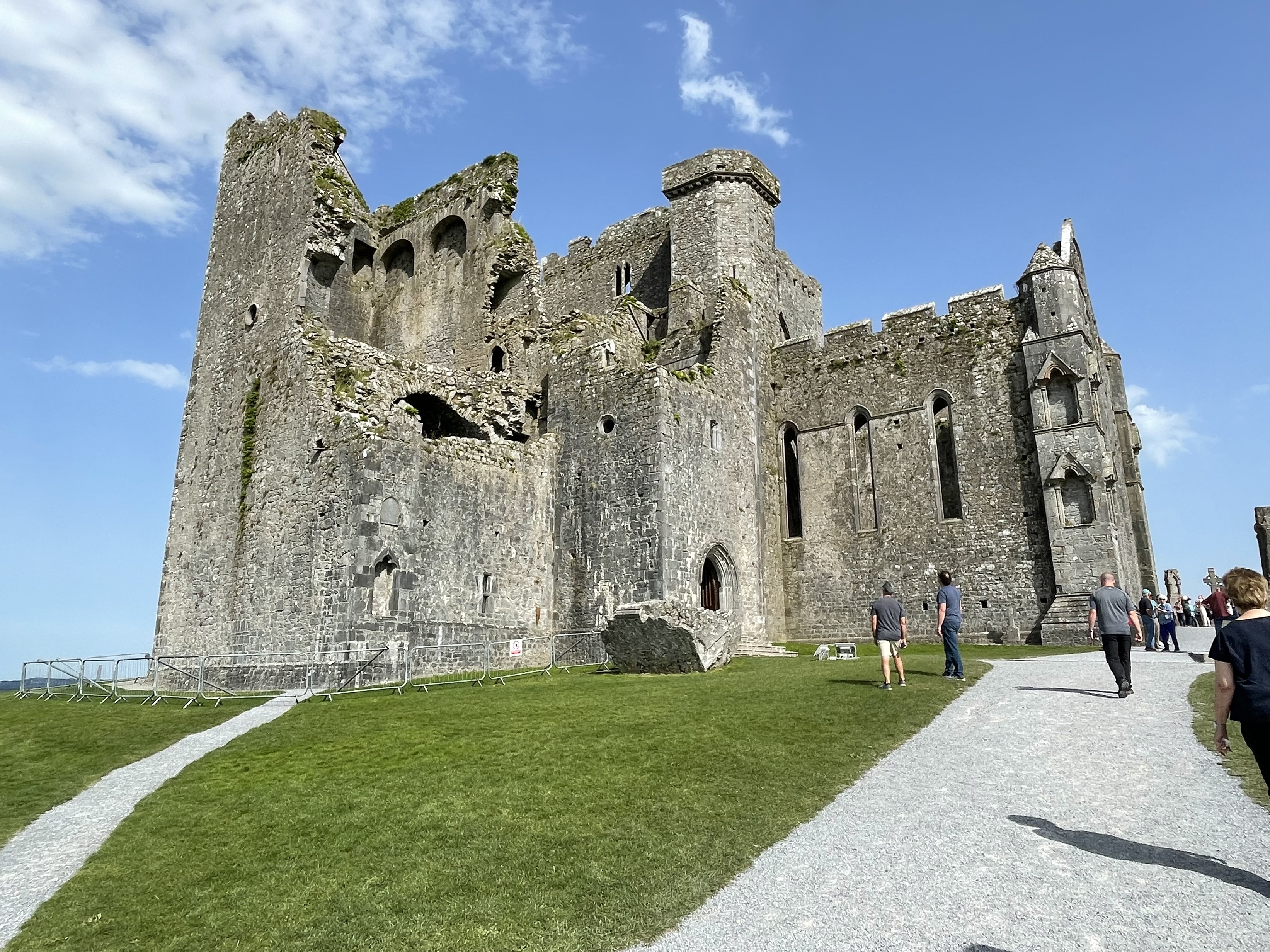
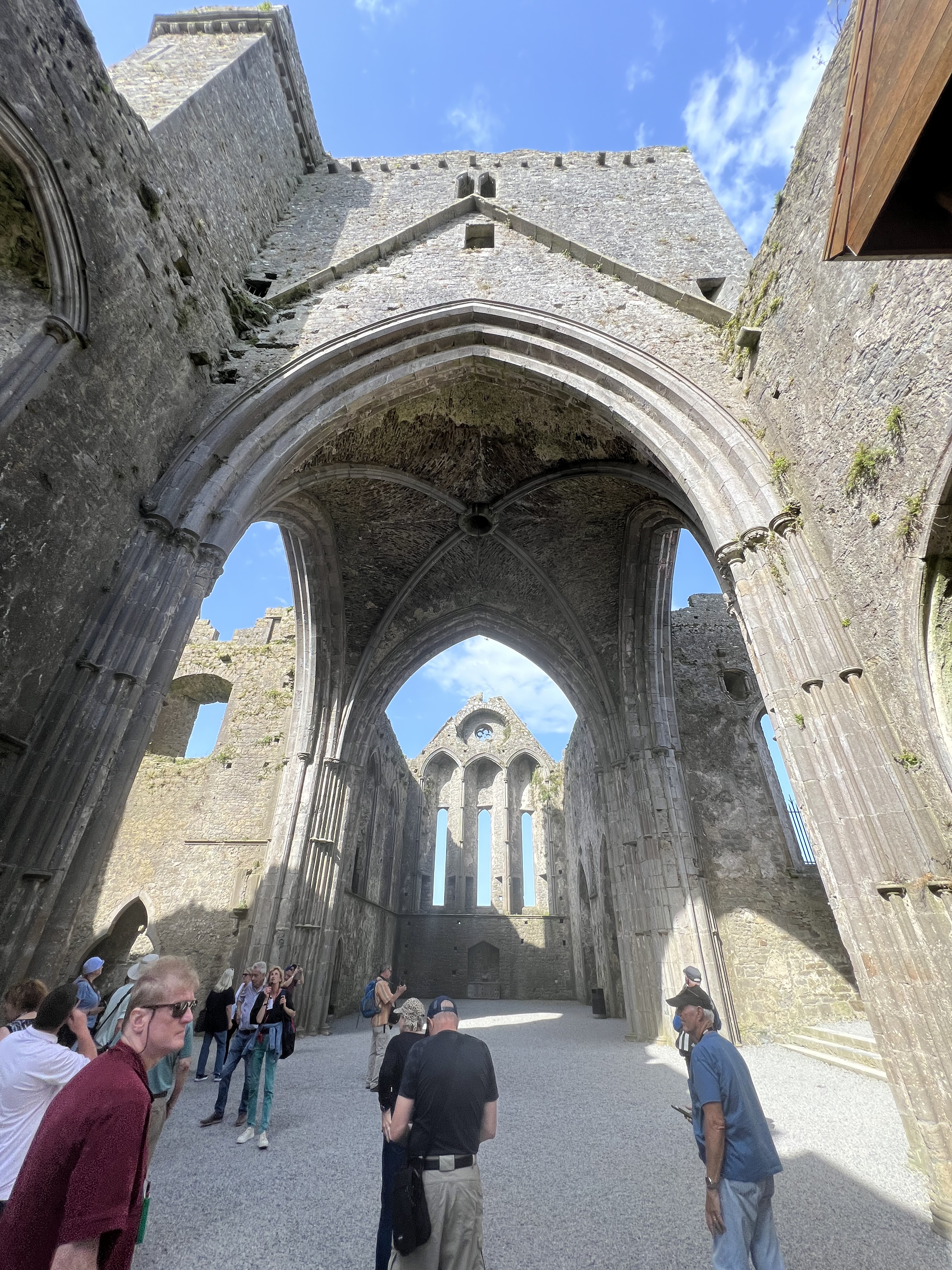
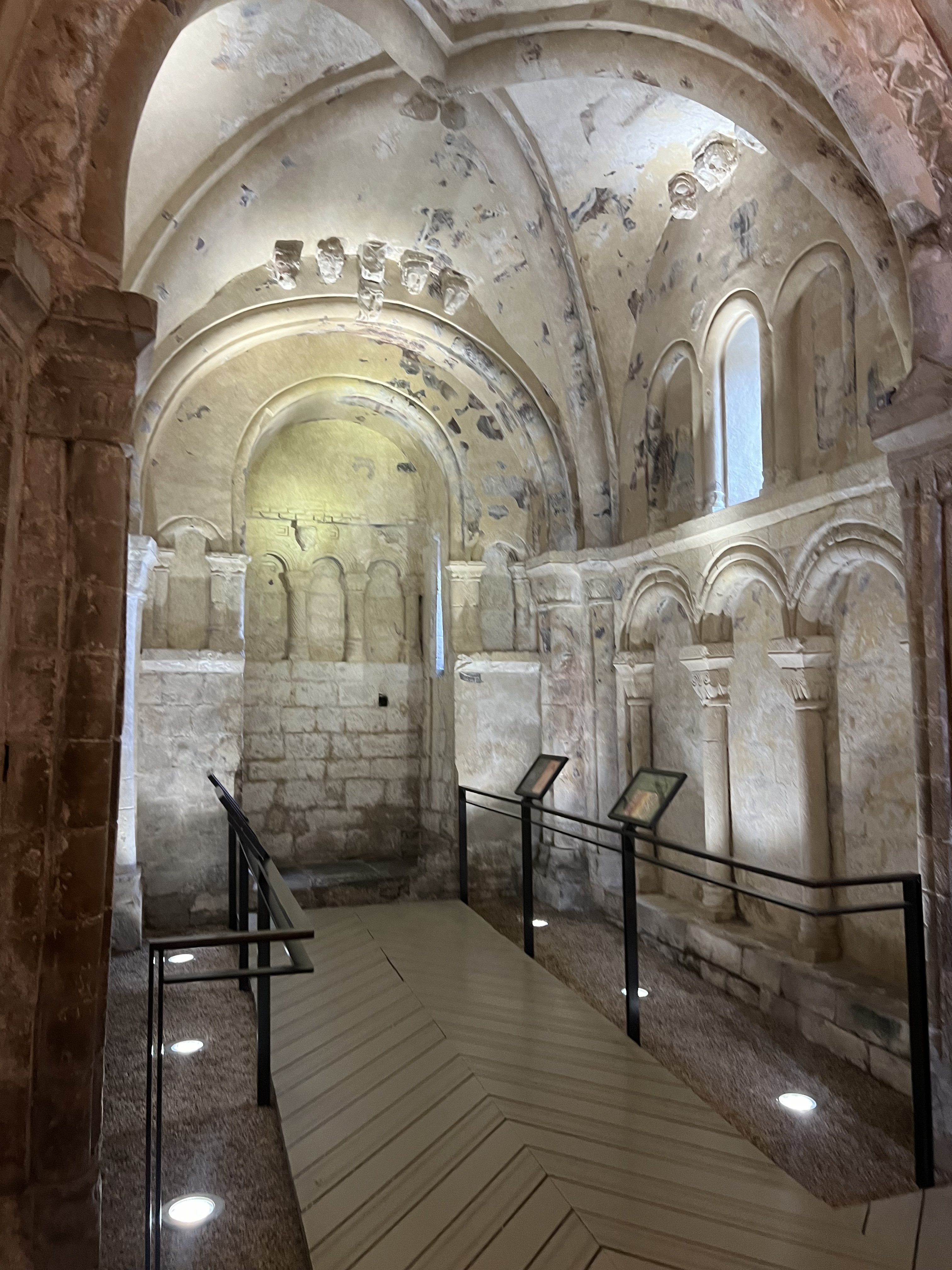
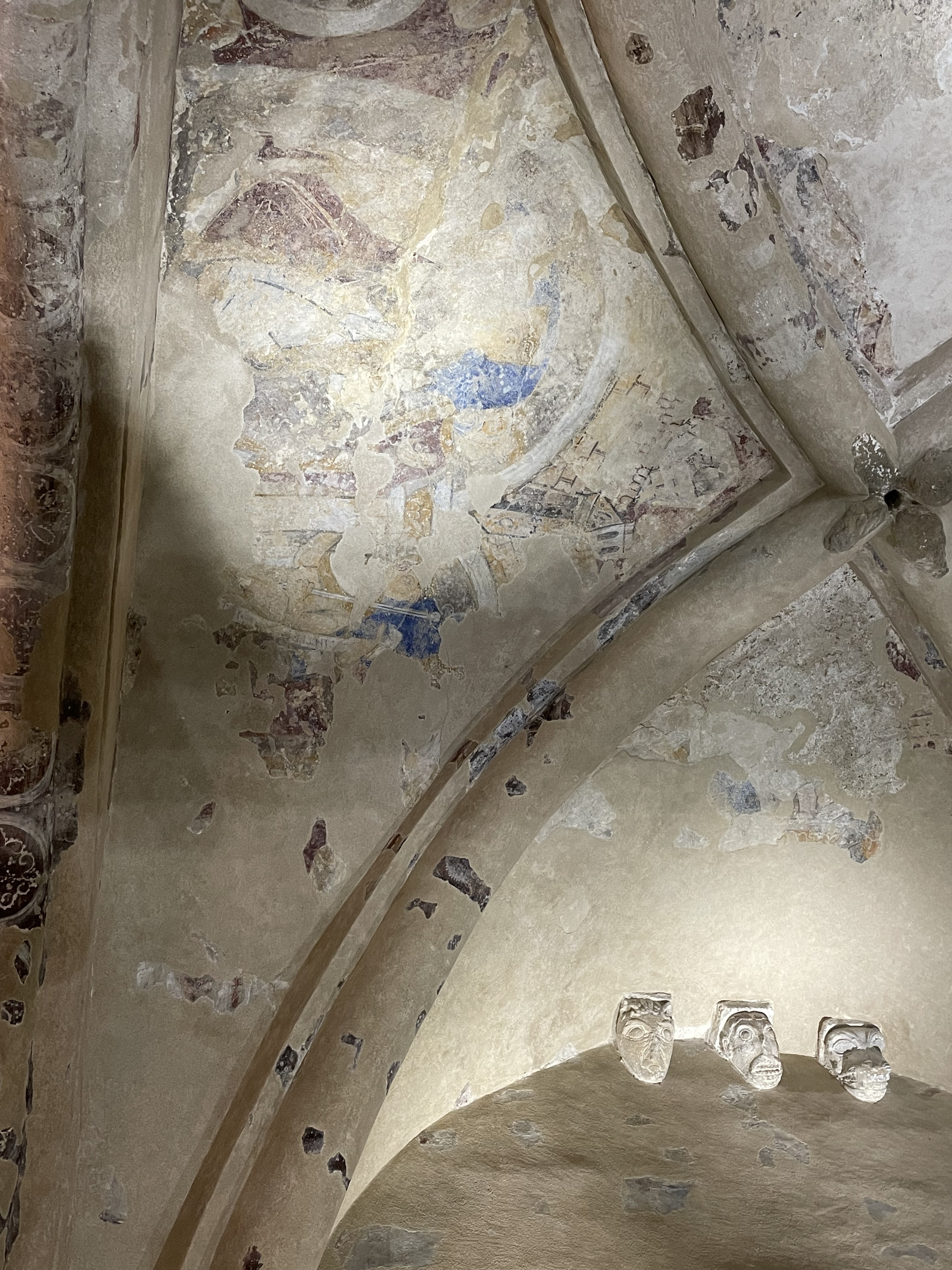
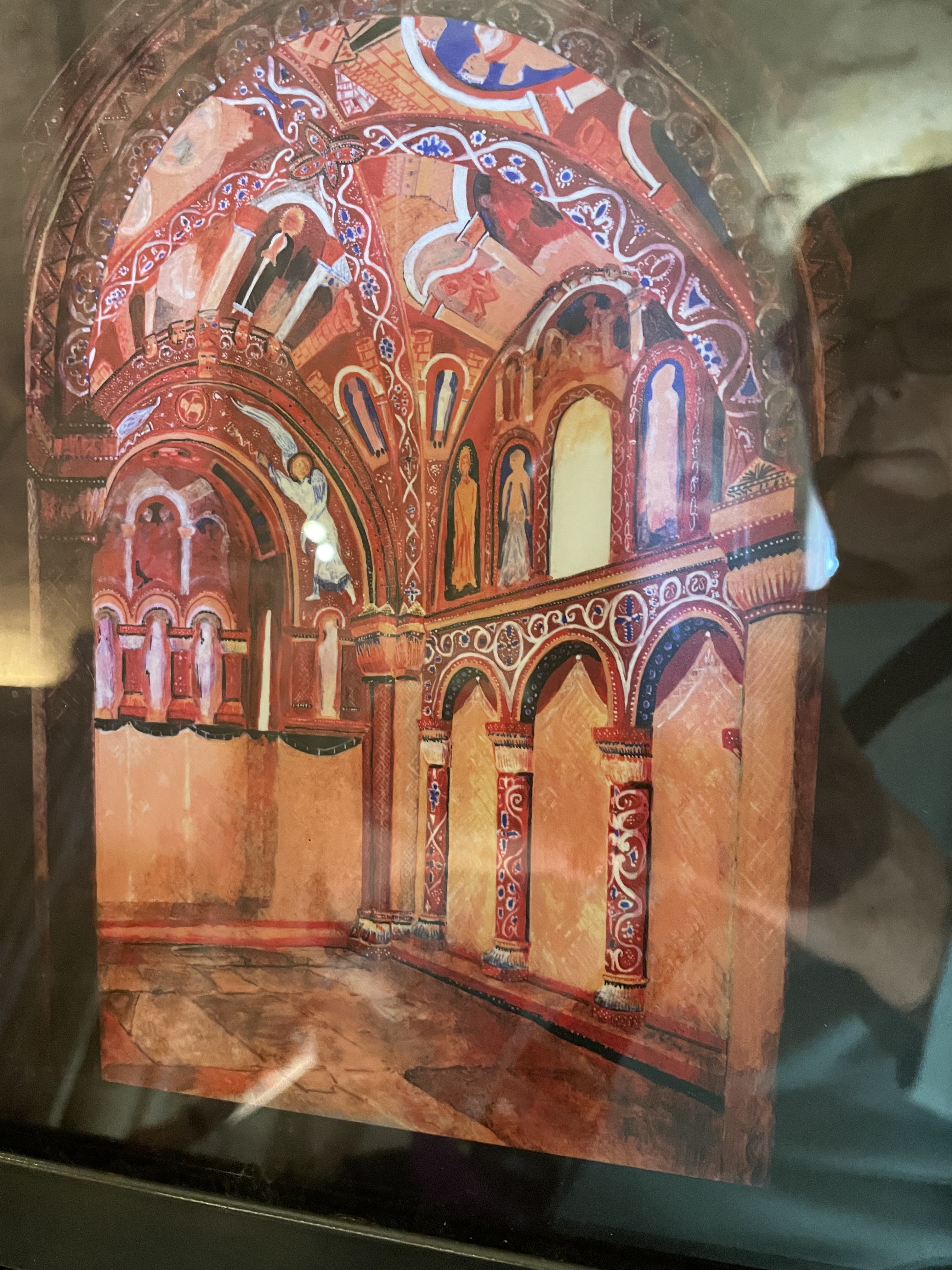
We arrived at the Rock of Cashel around 3 pm just in time to take a guided tour. This iconic site is said to possess the most impressive cluster of medieval buildings in Ireland. Originally the seat of the kings of Munster, legend has it that St. Patrick himself came to convert King Aengus to Christianity. Our tour included a guided tour of Cormac’s Chapel which contains the only surviving Romanesque frescoes in Ireland. Our guide was excellent and even pointed out for us North Americans the grave site of well-known sports broadcaster Vin Scully, who is buried in an ancient family plot.

Rock of Cashel

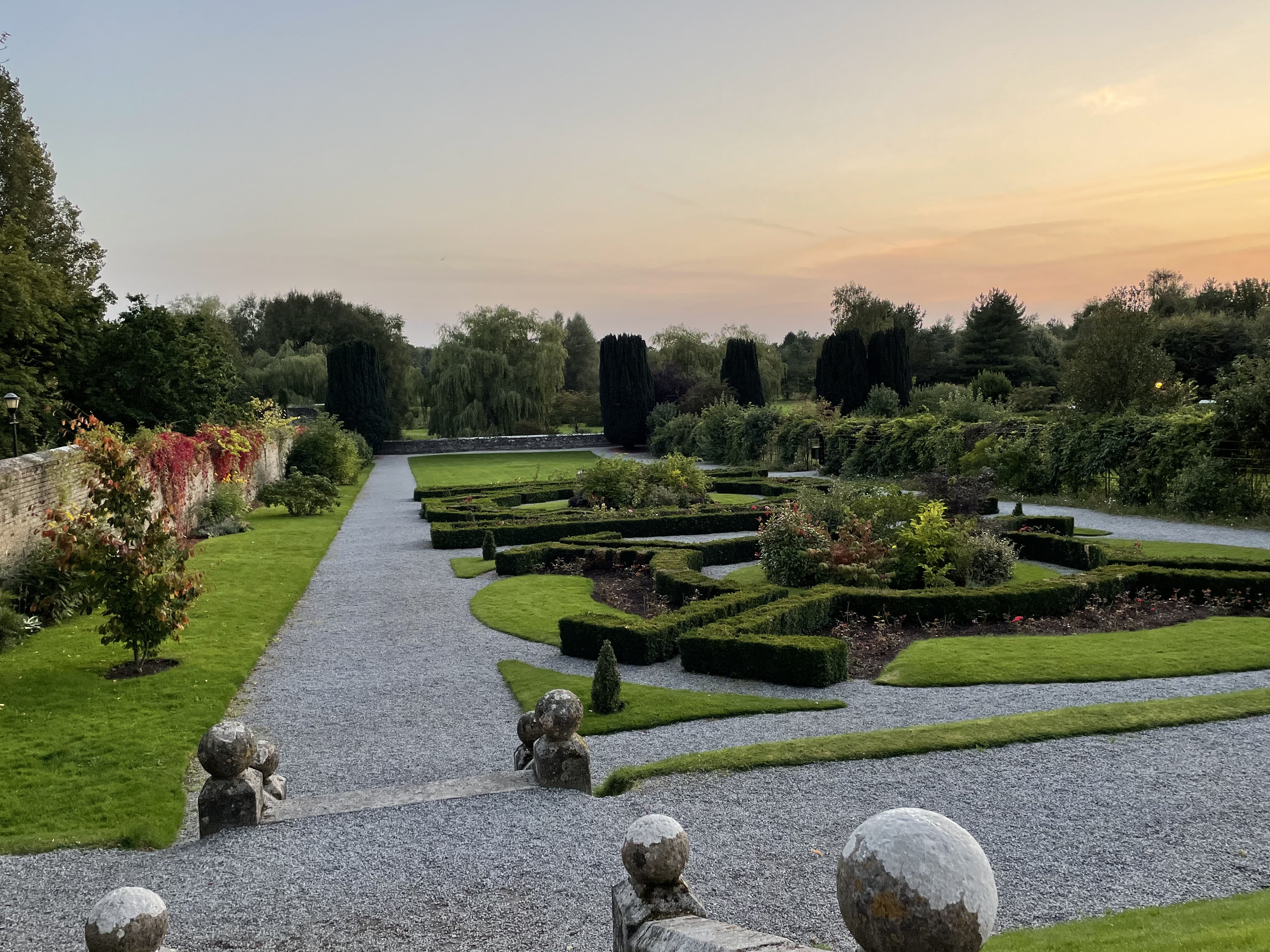
Our stop for the next two nights was Kilkea Castle and while we weren’t actually in the castle (our rooms were in the old stable building), we enjoyed visiting the castle for breakfast and afternoon/evening refreshments. After dinner on the first evening, Dad and I sat on the patio outside the bar and met a most interesting local who told us all about the area.

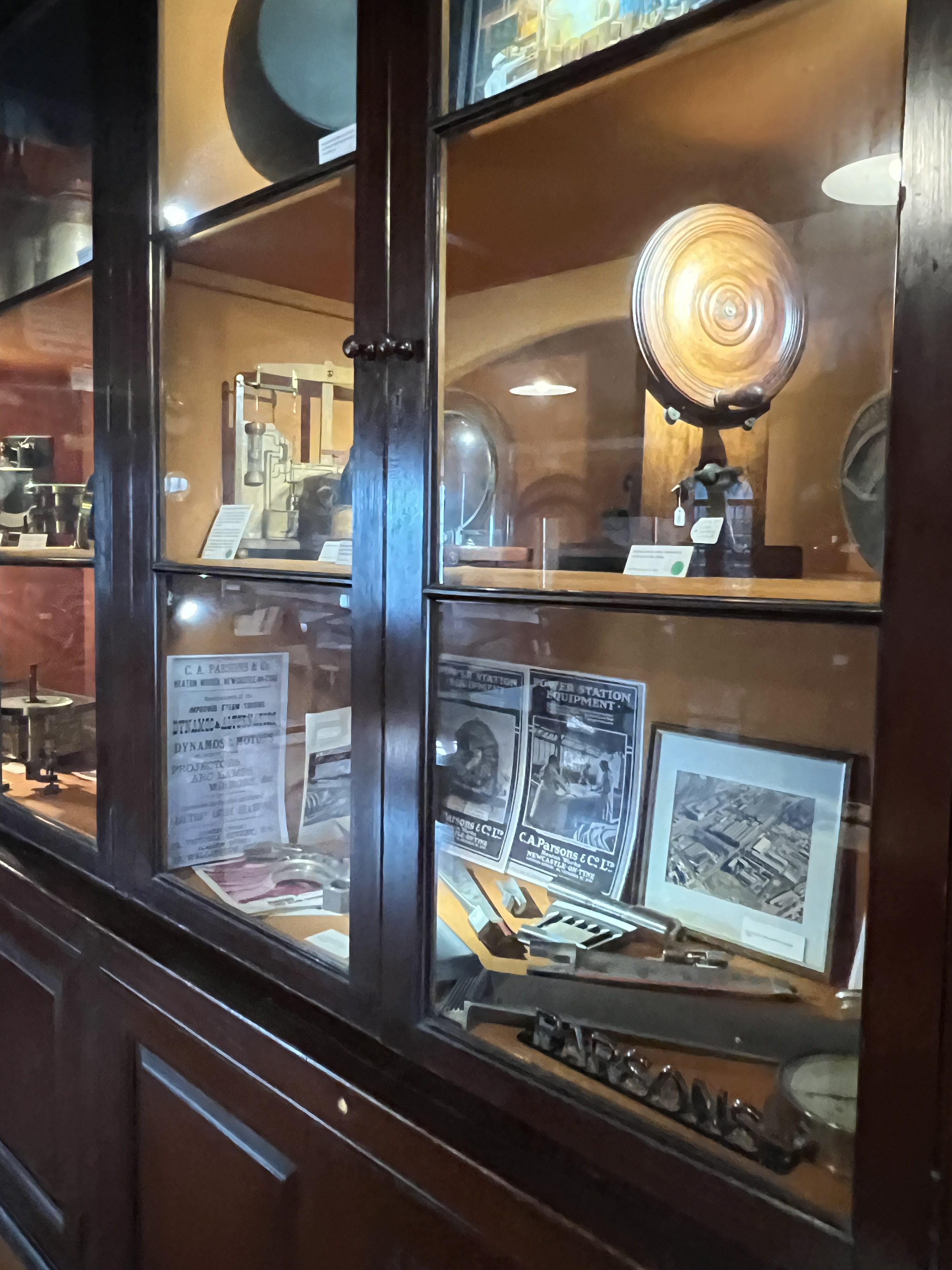
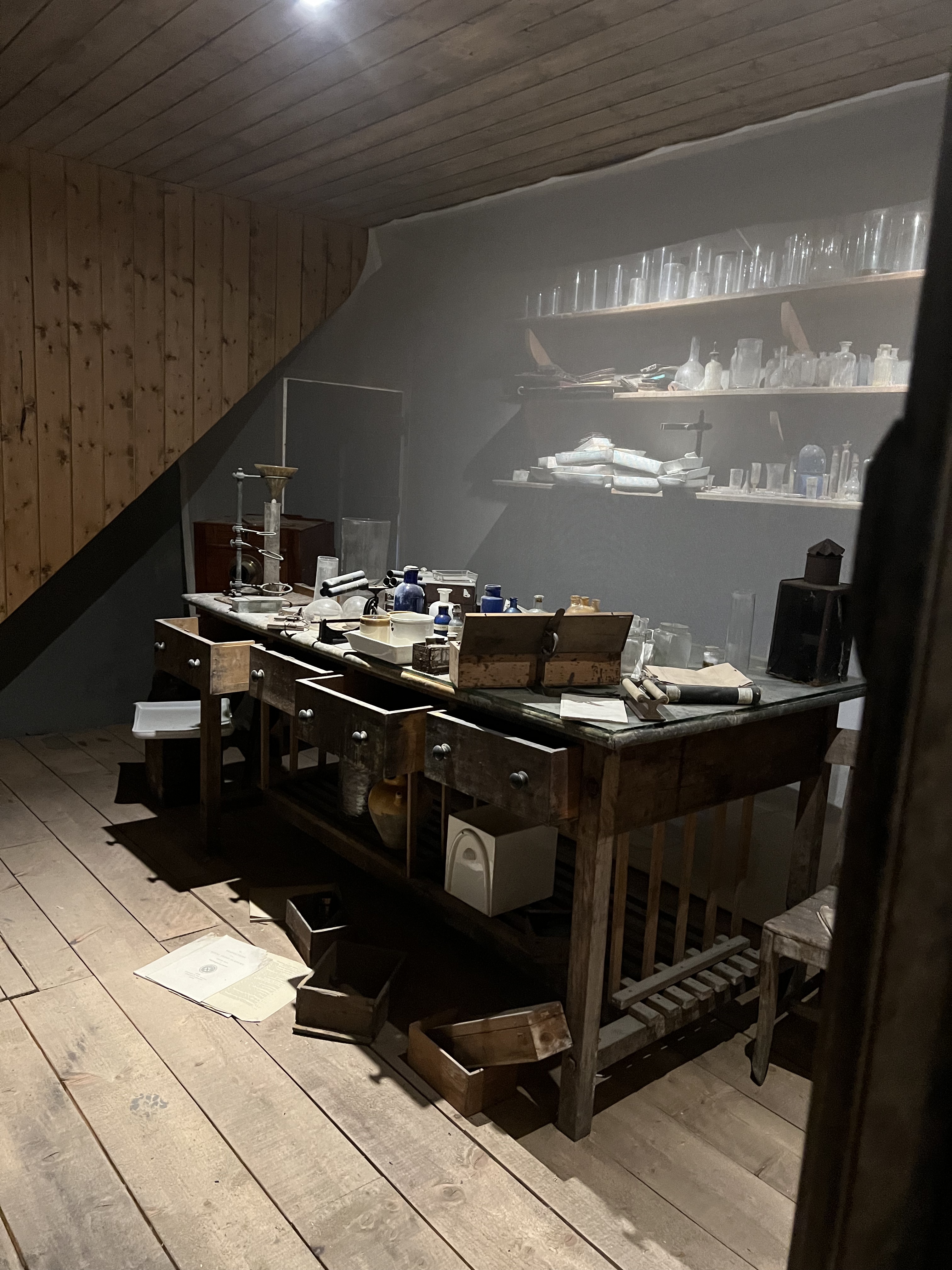
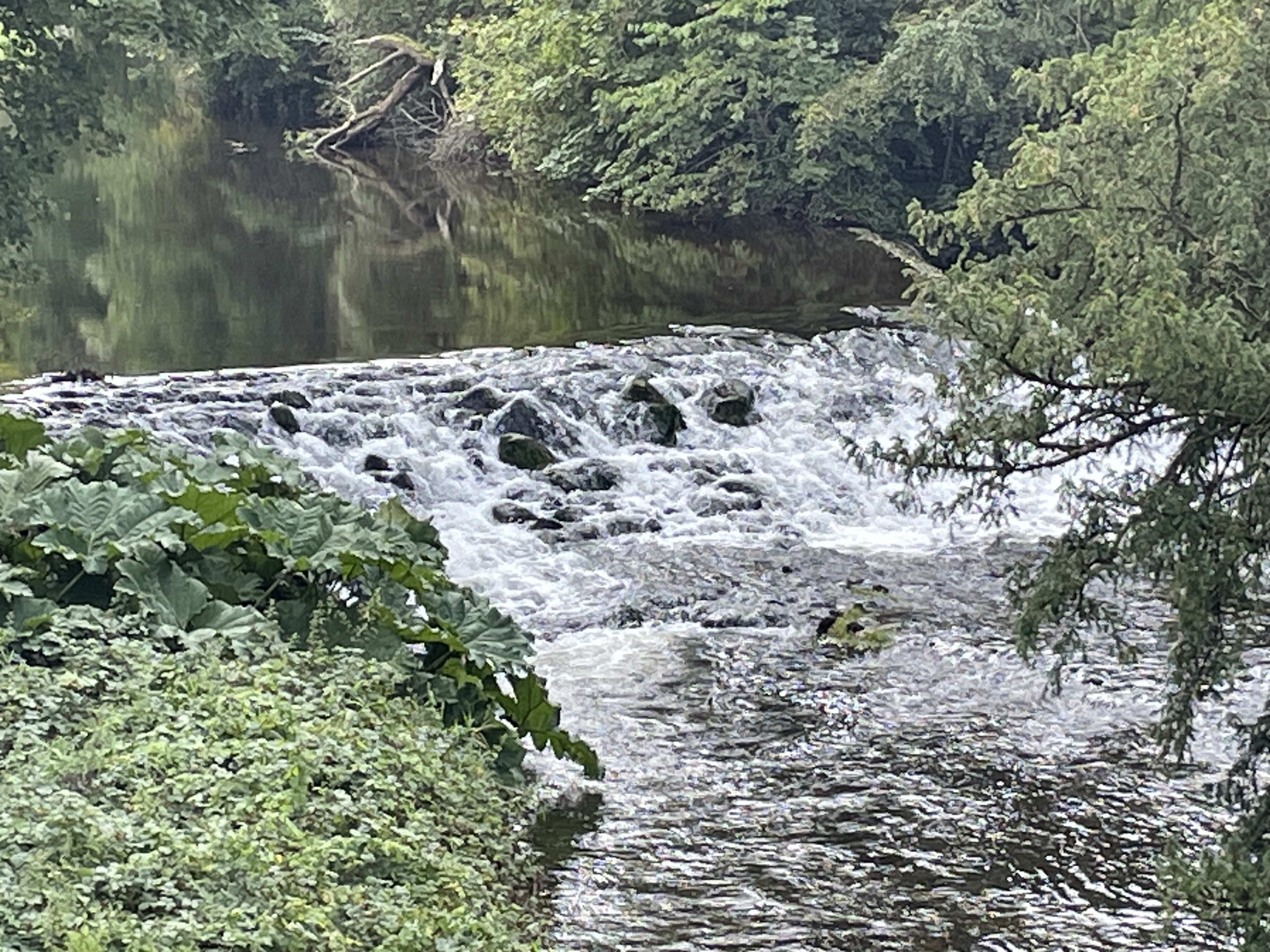
George Jr and I went off the next morning to Birr Castle Demesne. The property has been the home of the Parsons family for over 400 years. Throughout the years, the family has been known worldwide for its interest and inventions in the fields of engineering, astronomy and photography. Part of the castle has been developed into the Ireland Historic Science Centre but the real attraction is The Great Telescope. In the early 1840s, the 3rd Earl of Rosse, designed and built the largest telescope in the world. It attracted star-gazers from all over Europe and beyond and became known as the “Leviathan.” It remained the world’s largest telescope for over 70 years. Dismantled to aid the war effort, the model that exists today is a full-sized replica of the original. In partnership with Trinity College, astronomy continues as one of the main exploits at the castle. The grounds are also well worth the visit, with many walking paths, a delightful garden that features a welcoming waterfall and stream.

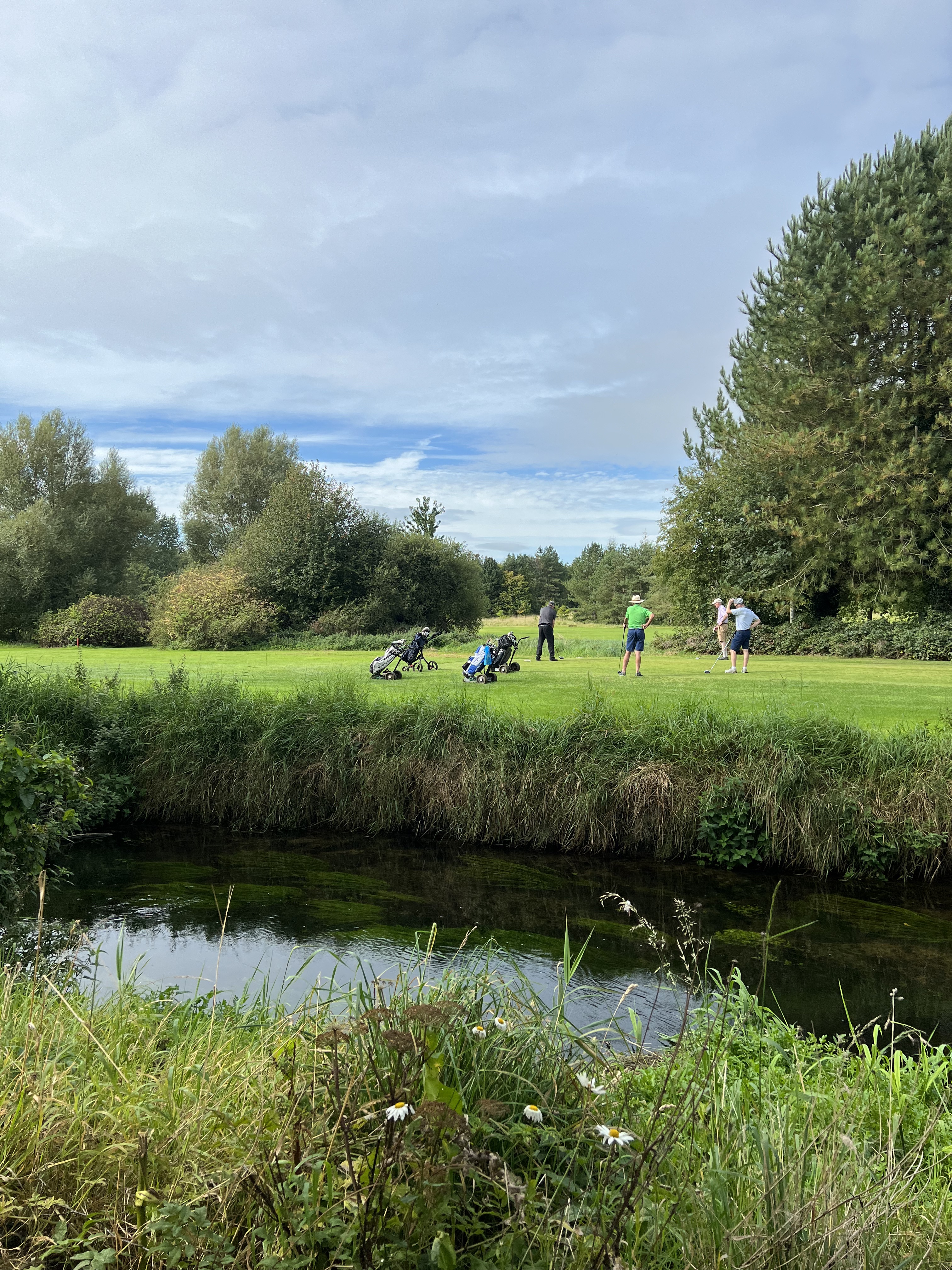
After a soup lunch at the castle, George and I returned to Kilkea to continue on with our afternoon plans. Dad and Jenn reported that they had spent the morning walking around the grounds of Kilkea Castle, exploring the golf course and the gardens.

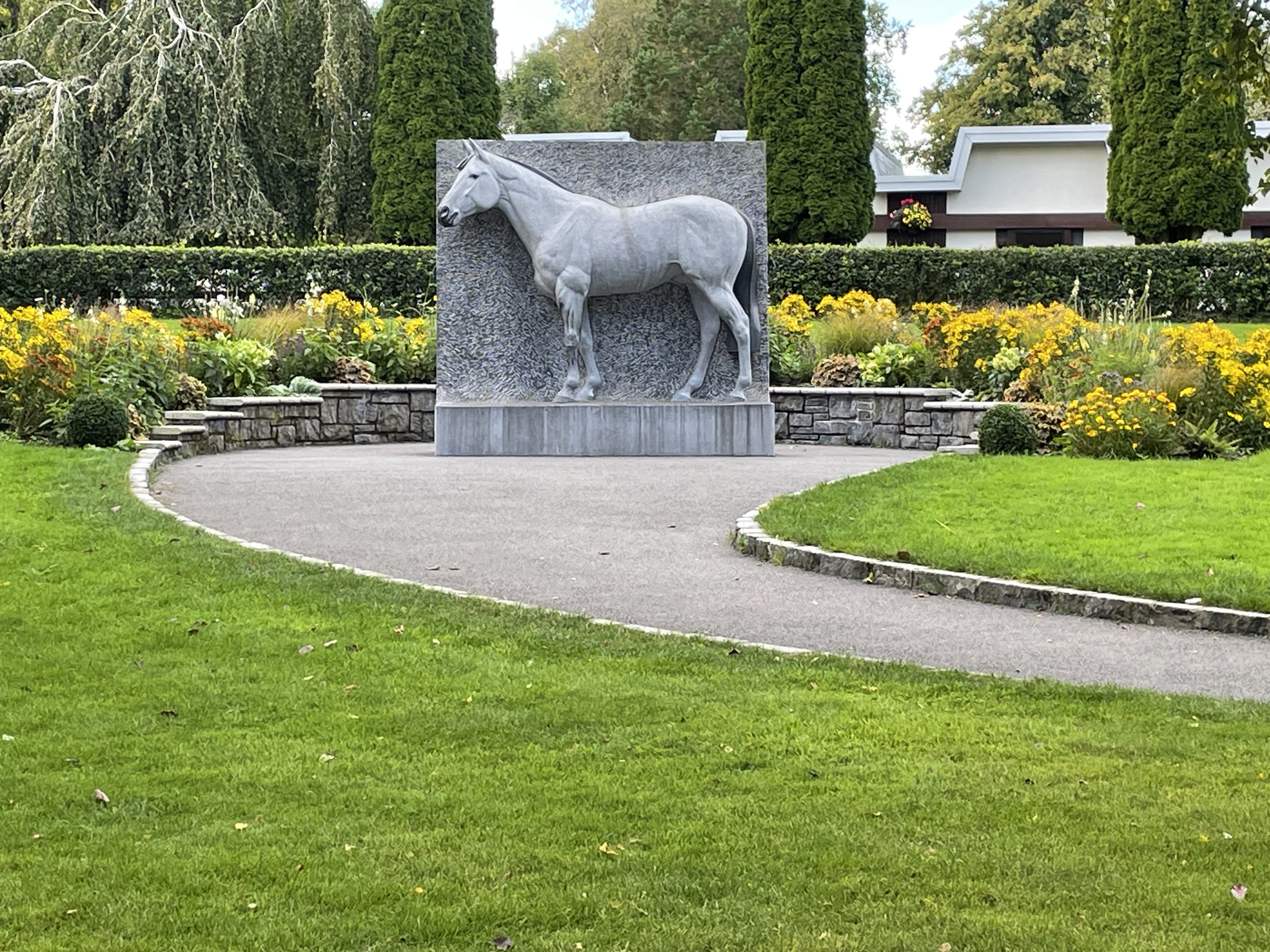
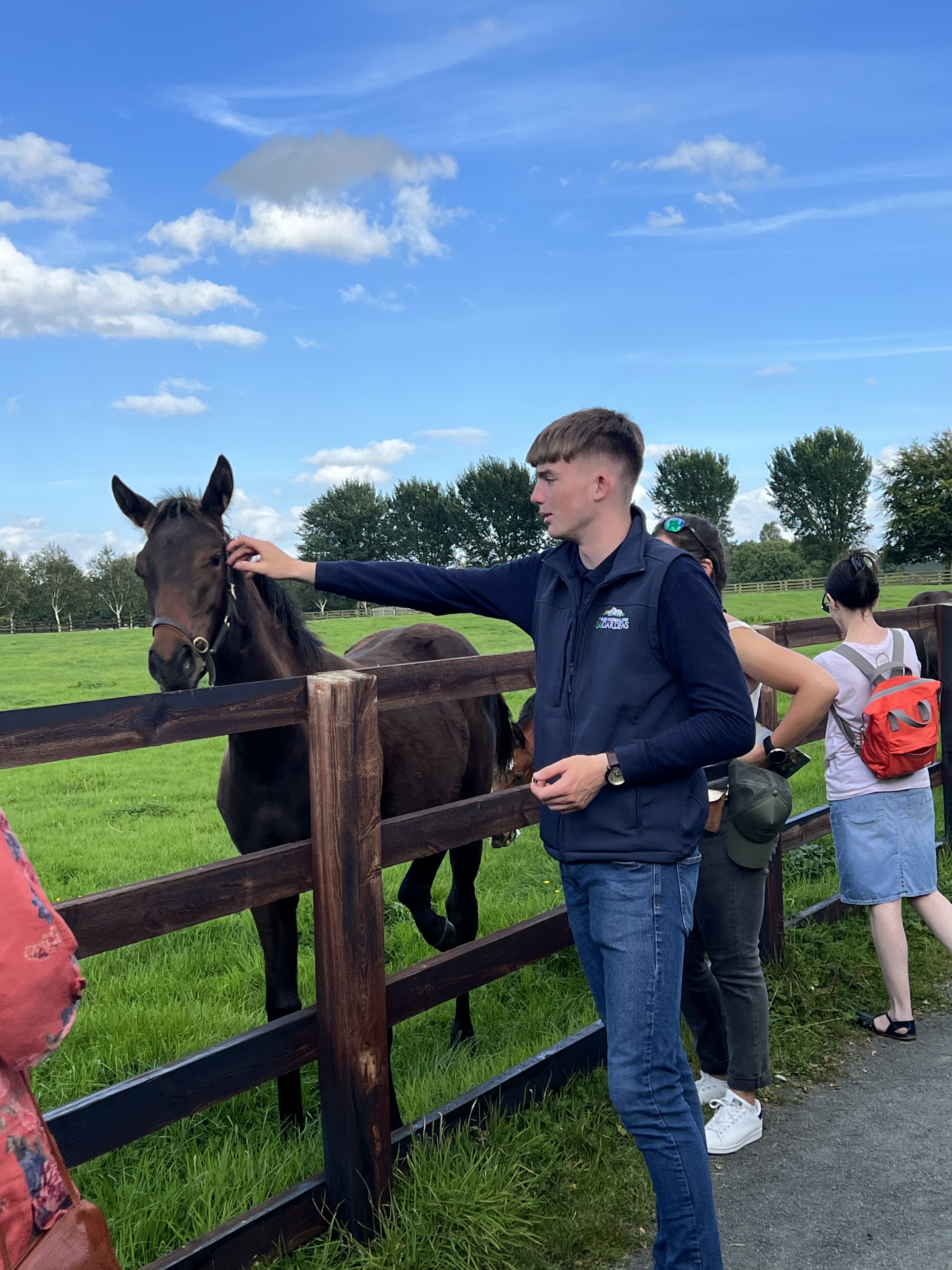
Our afternoon pursuit was to the Irish National Stud Farm, which was probably the most fun day of our trip. We were just three as George Jr decided to stay back at the castle and rest. There were three parts to our visit: a guided tour, a horse-racing experience and the Japanese gardens. Our guide was a passionate college student who told us all the ins-and-outs of breeding race horses. The farm has seven stallions, many of whom generate millions of euros for their owners. Invincible Spirit, great grandson of Northern Dancer, is the star stud!

The racing experience was so much fun! As you go in, you’re provided with an iPad which you use as you explore the exhibit to purchase a horse, engage a trainer, board and train your horse, choose your racing colours and your jockey. Then you go into a video room and race your horse against others. In our case, it was just the three of us. Dad’s horse won, mostly because my arms tired and Jenn couldn’t go fast because she was laughing so hard.

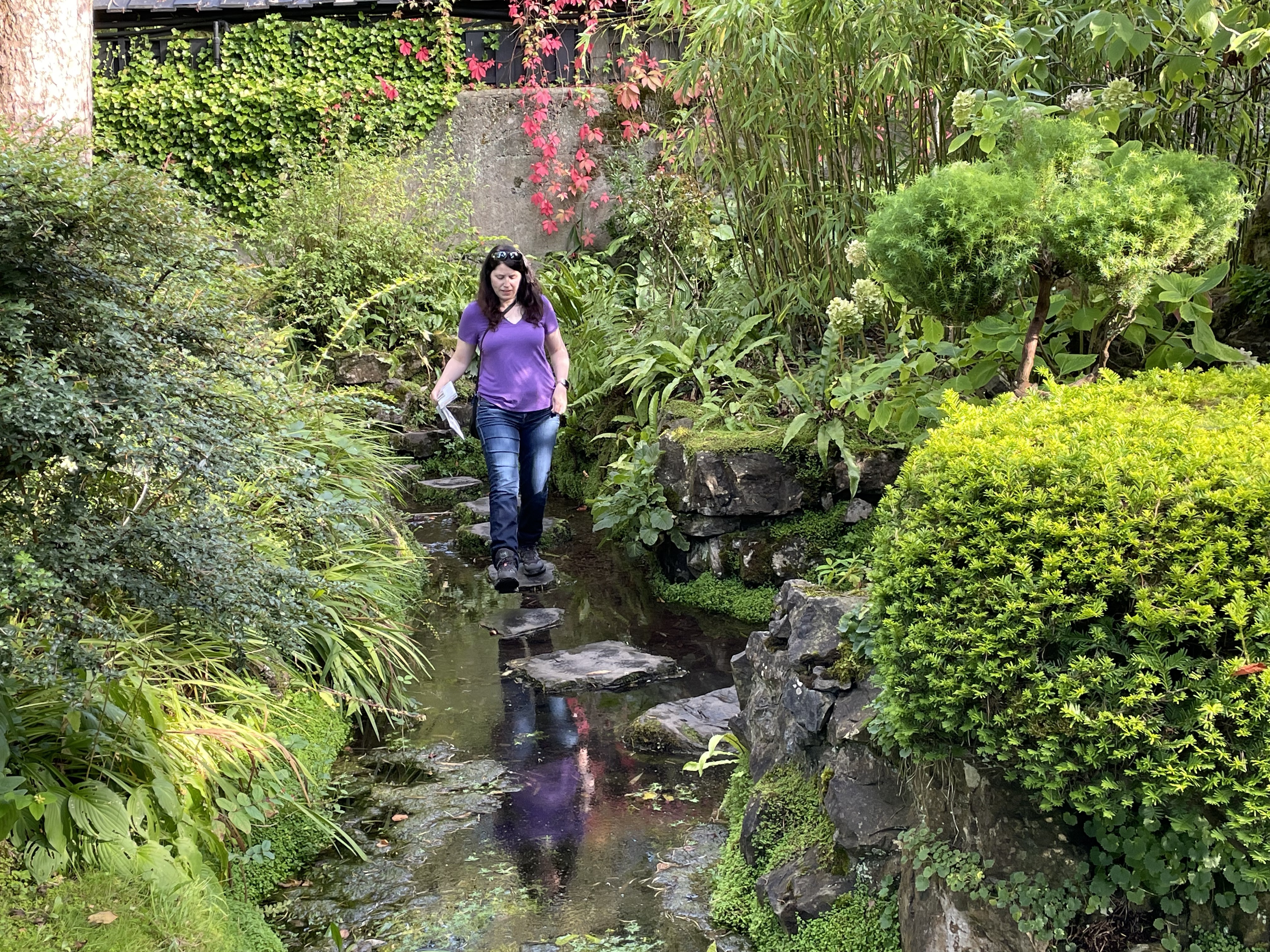
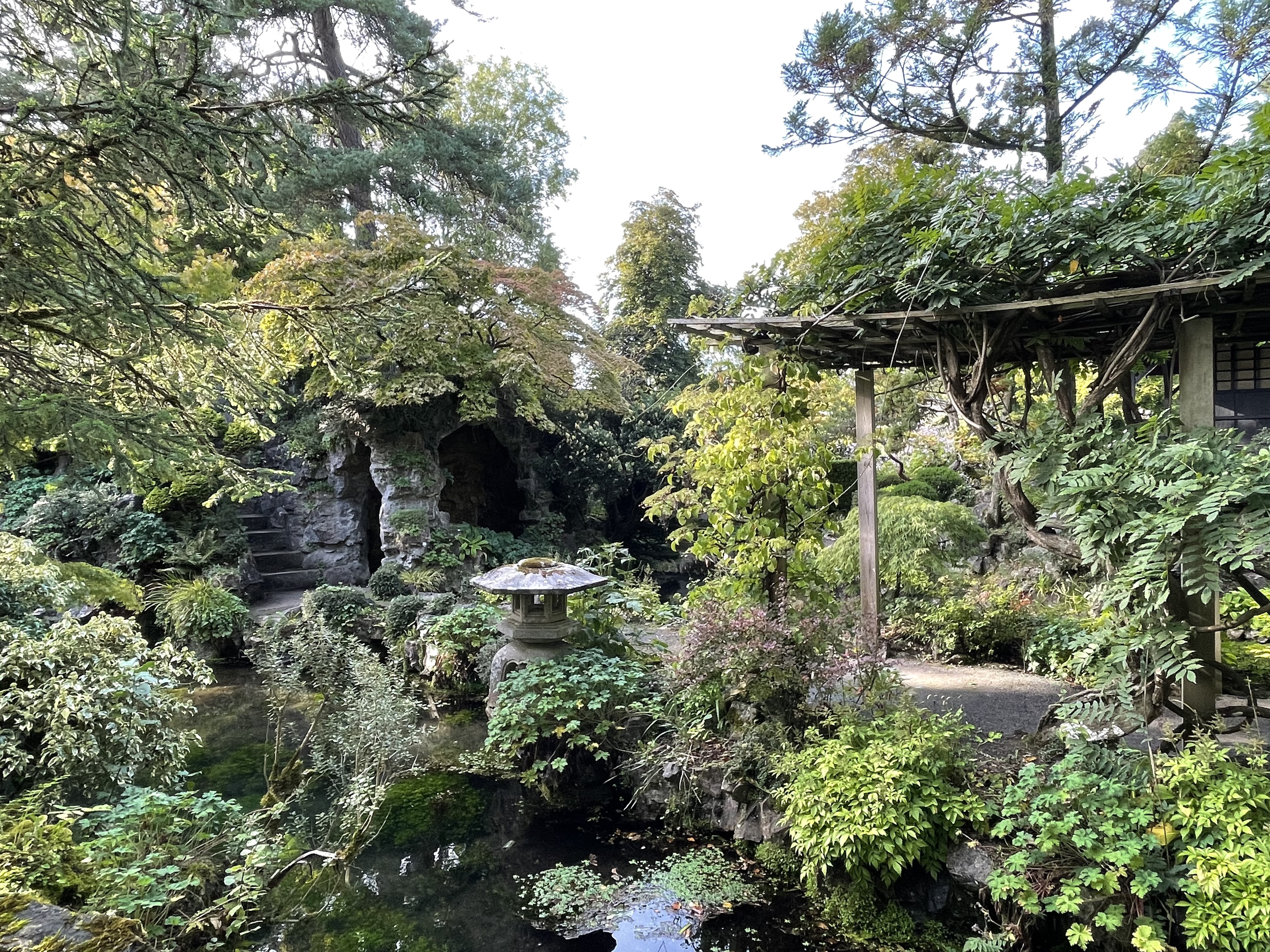
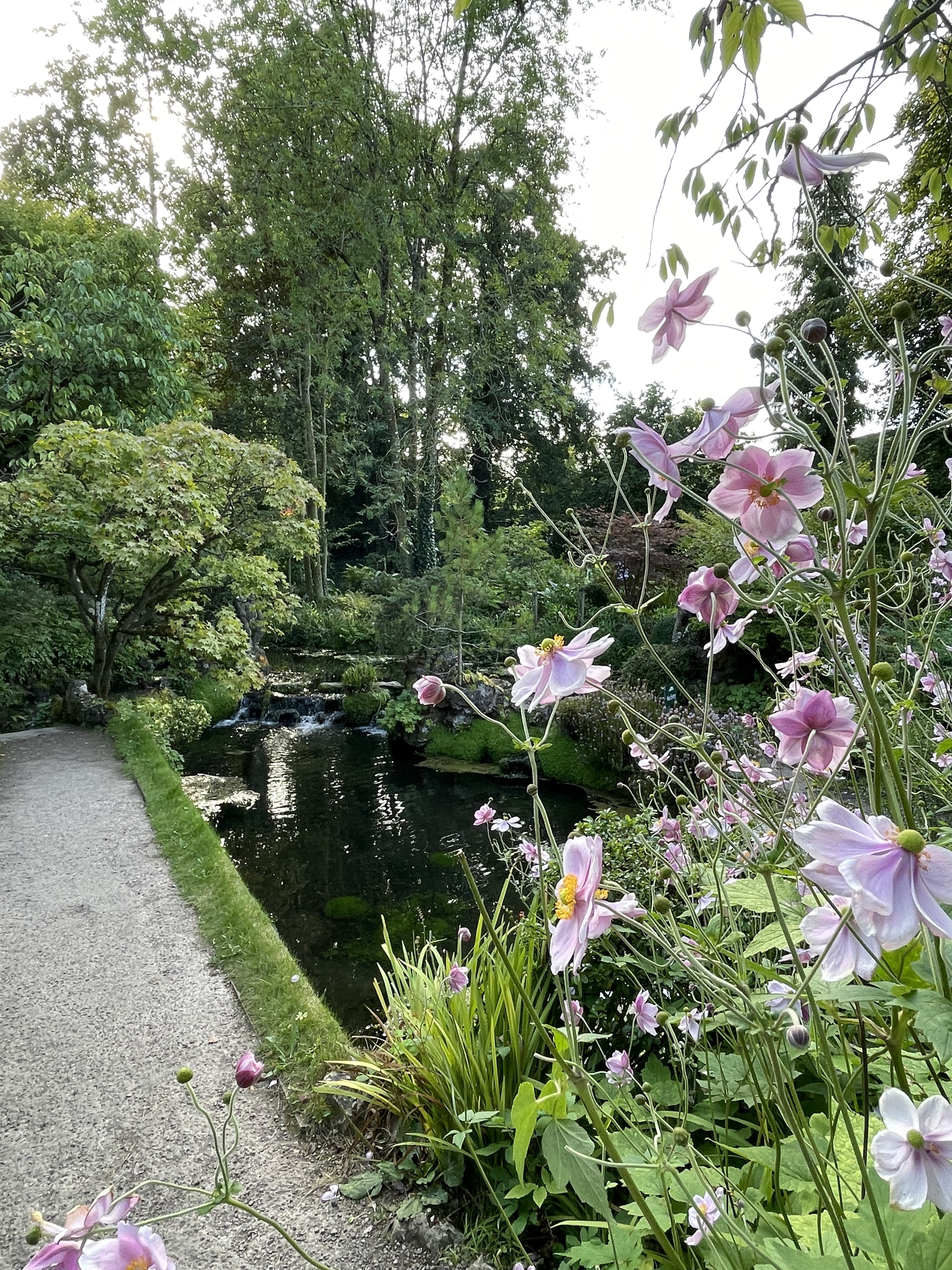
We finished our time at the stud farm, exploring the walking trails through the Japanese garden. Created between 1906 and 1910, the garden was designed to symbolize the Life of Man. Birth, childhood, marriage, parenthood, old age, death and the afterlife are all represented as one chooses easy or difficult paths to follow. The weather contributed to a shady, peaceful walk and time of reflection.

Dinner that night was at Kilkea Castle looking out over the 18th tee. After a long day, we turned in early preparing to leave on the last leg of our trip.

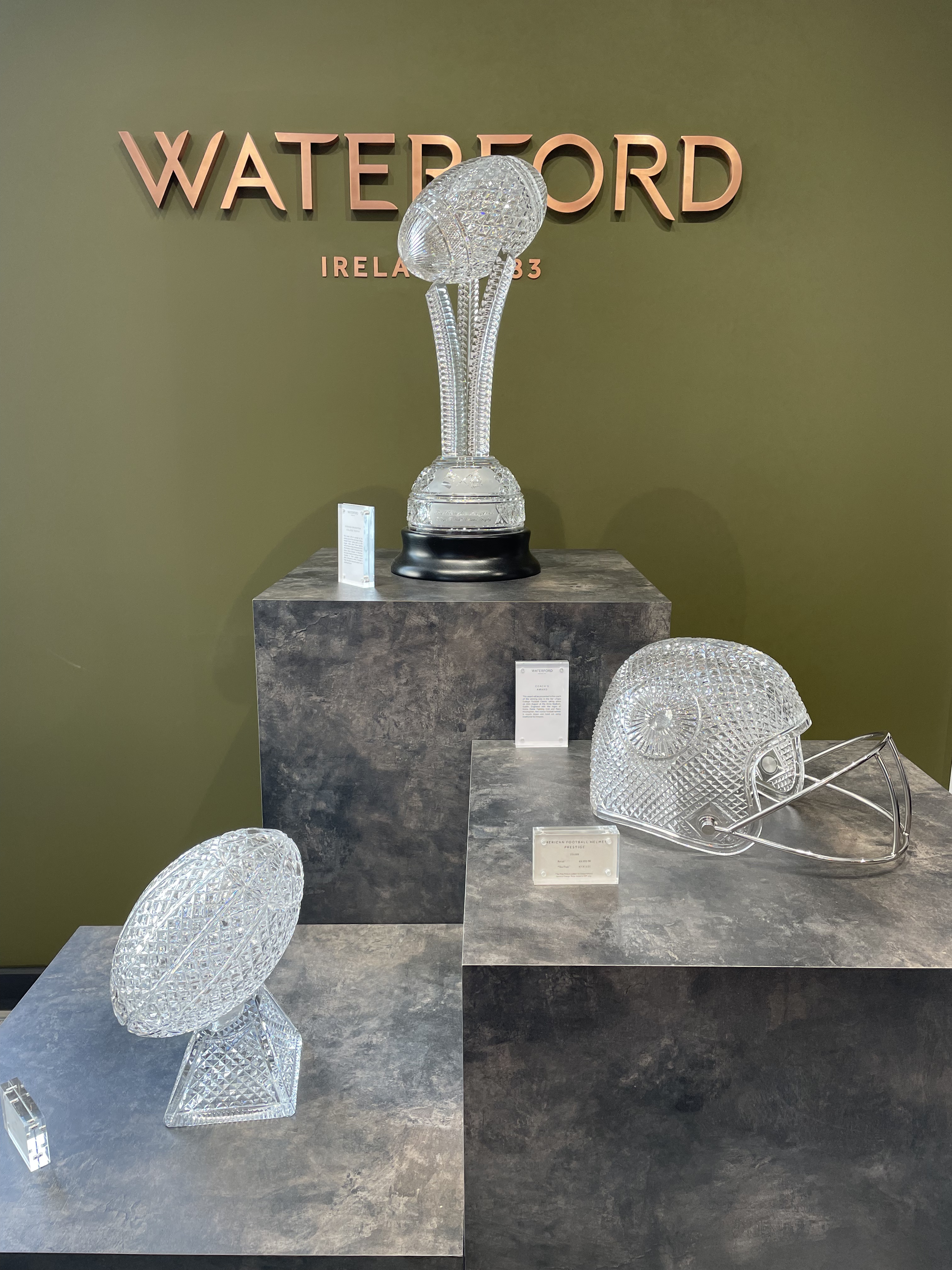
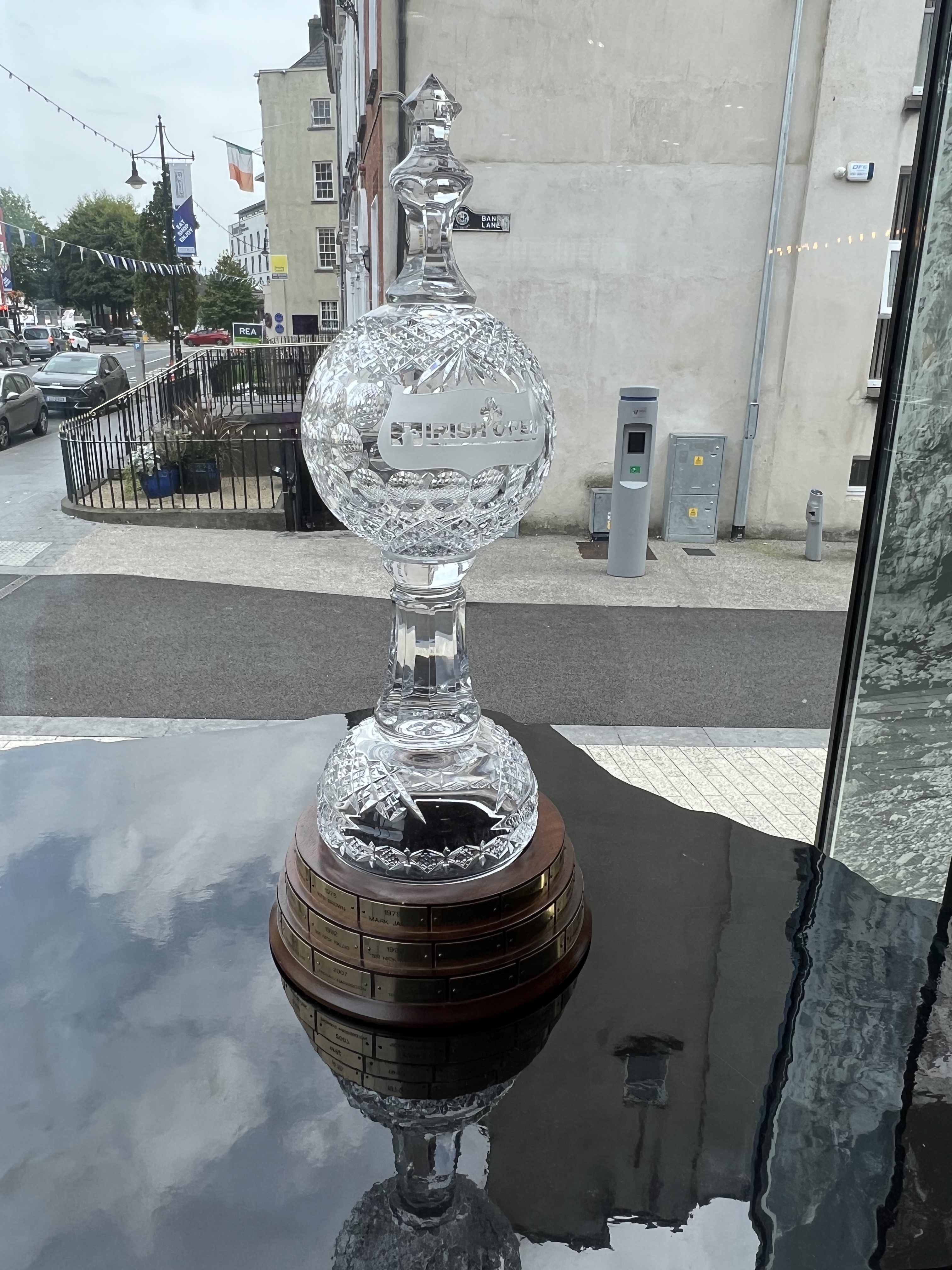
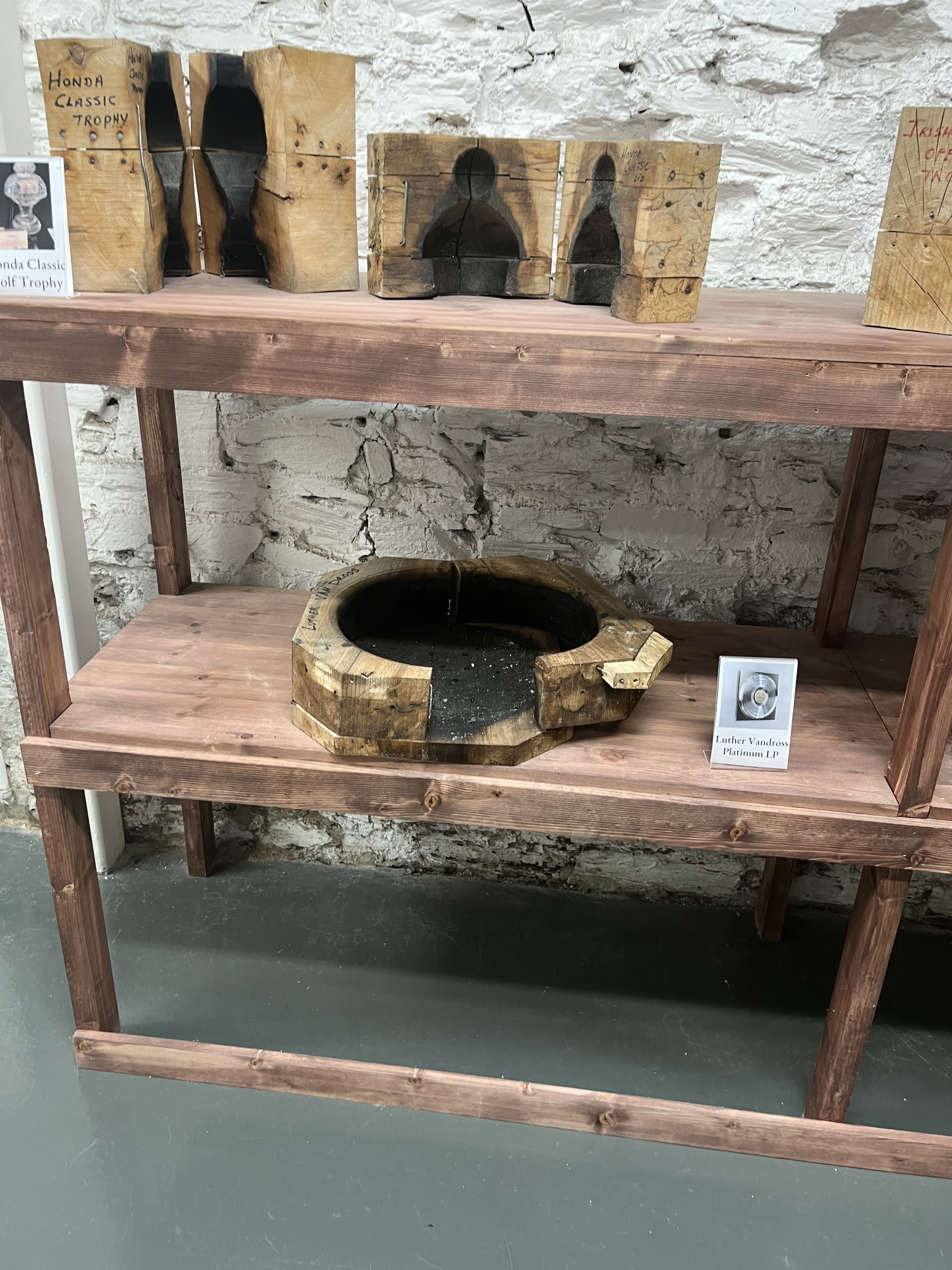
Dublin – Thursday morning, after a full breakfast, we packed the car ready for Dublin via Waterford. Waterford, of course, is the home to Waterford Crystal and since our kids will inherit our crystal, I thought it important that they see how it is made. We arrived a little early for our 11 am tour and spent the time musing through the showroom. In addition to the pieces they have for sale, a corner of the showroom is maintained as a museum of special pieces that have been made for sporting events, awards, etc. It was fun to recognize, for instance, the cups presented to the Solheim Cup and the PGA Honda Classic winners. Some of the decorative pieces are absolutely stunning.

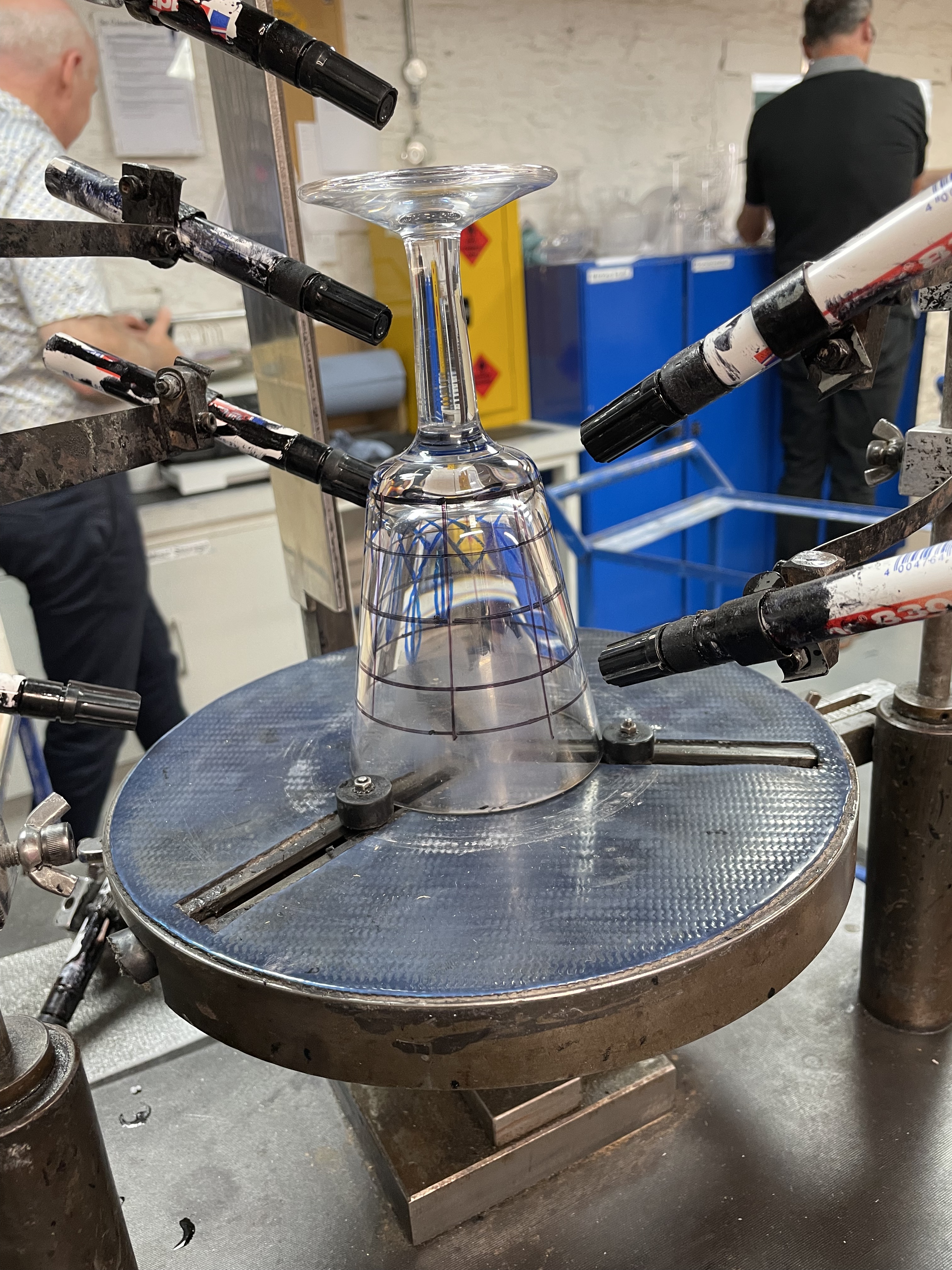
The tour began with a short presentation on the history of Waterford Crystal and its current ownership. Then it moved to the shop floor where we went through each of the steps in making crystal pieces: moulding room, blowing department, quality inspection, hand-marking, cutting department, sculpting and engraving. The process requires skilled craftsmanship and features detailed inspections each step along the way. Pieces that don’t meet their strict standards are melted down and the materials are reused.

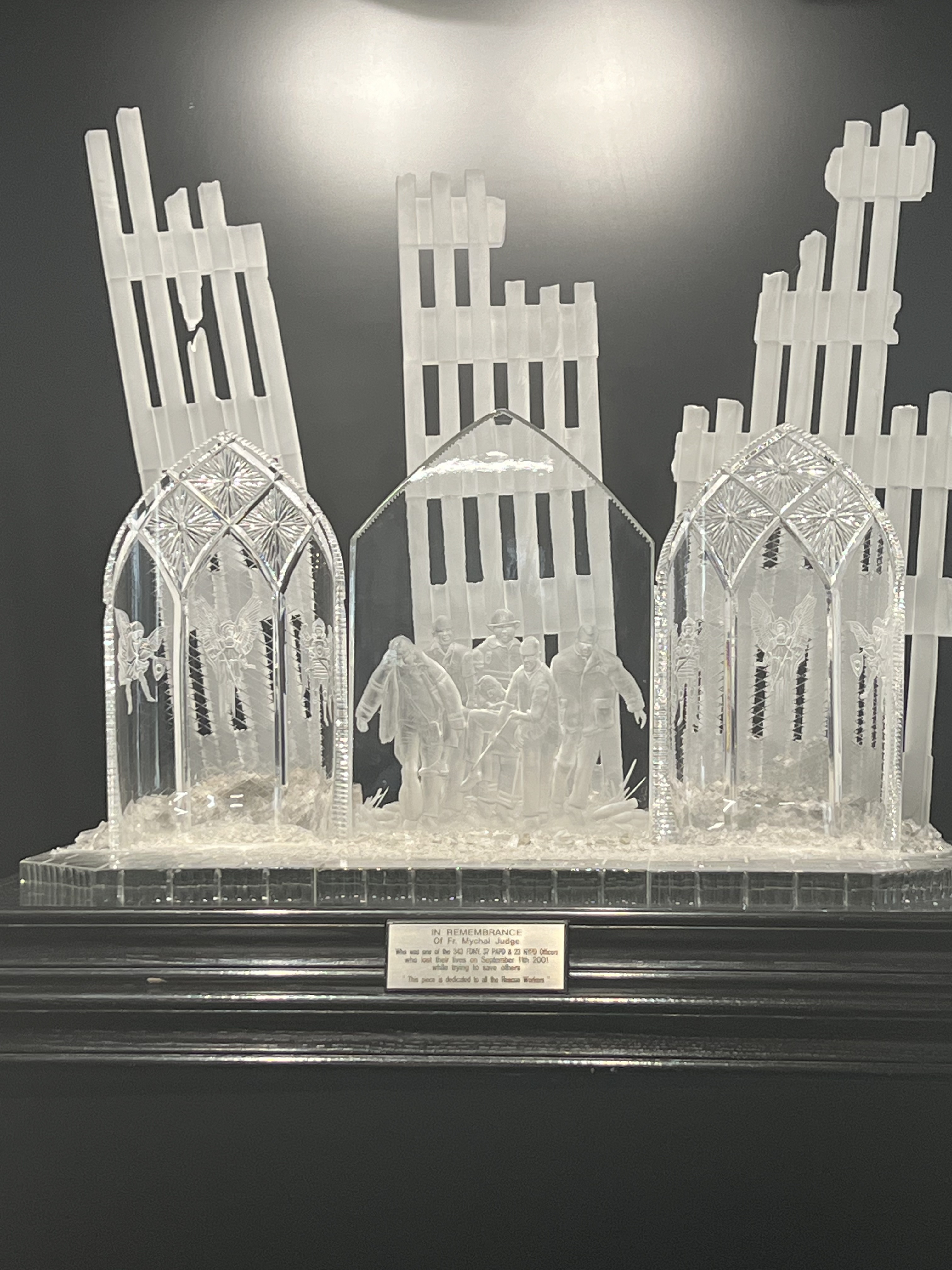
9-11 Remembrance

After the tour, we ate an excellent lunch at the little cafe on site. We purchased a small vase for our neighbour, Jess, who was looking after our house for us.

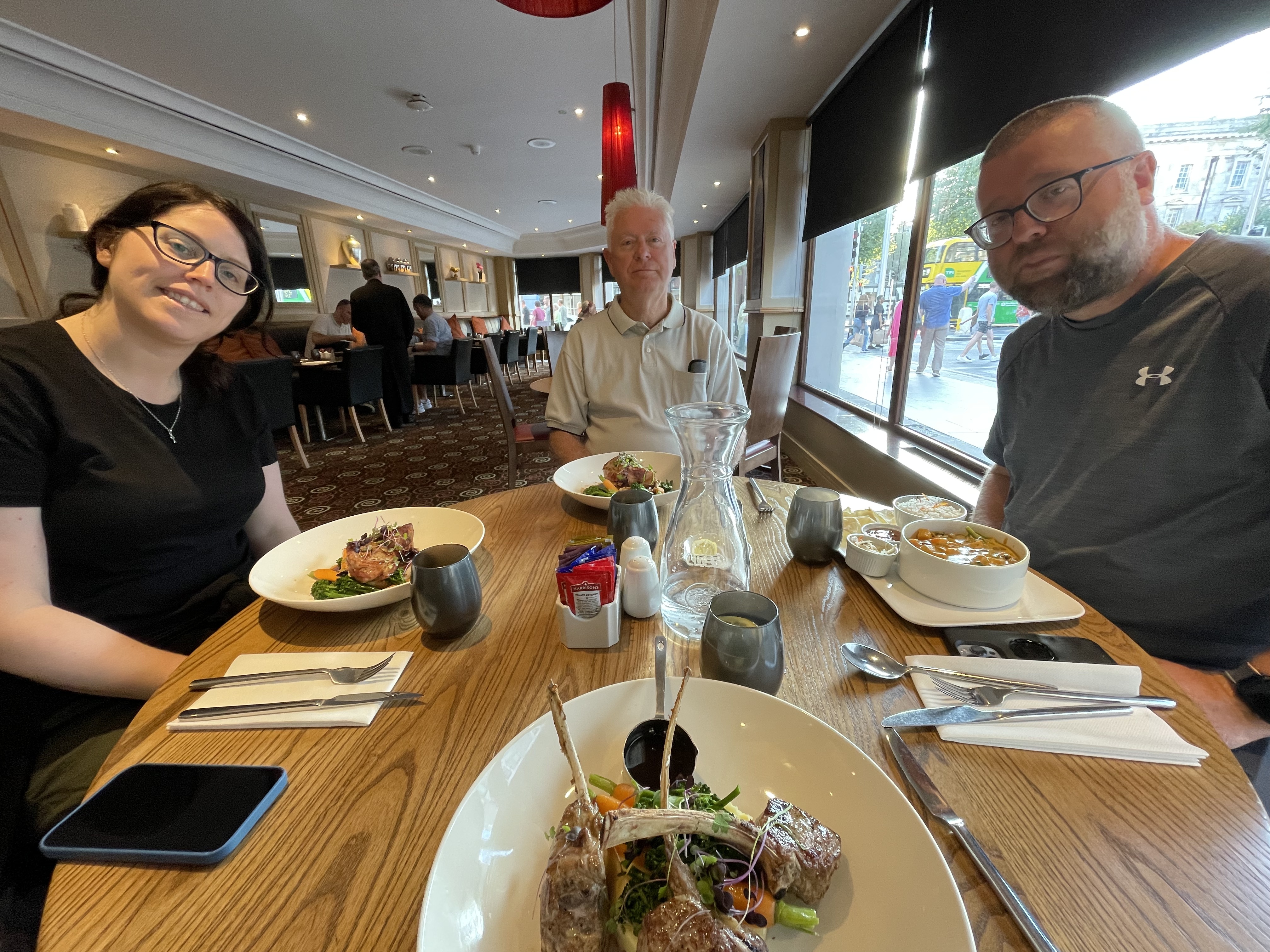
Then it was back to the car one last time and off to Dublin. We decided to drive to our hotel and drop all our bags and then Mom and George Jr took the car back to the airport. We also took a bag of hiking boots, poles, etc. that wouldn’t be needed in Dublin with us and checked them at the airport. The return trip from the airport was quite easy on the Dublin Express. Even though it was rush hour we made the trip in just 45 minutes. While we were away, Jenn and Dad went for an extended walk through the Temple Bar area and had dinner at a restaurant recommended by one of Jenn’s friends. Mom and George had dinner at a cute little Thai restaurant just down the street from the hotel. Our hotel, by the way, was the Holiday Inn on O’Connell Street, which was centrally located and very convenient for tourists. There’s really no need for a car in Dublin.

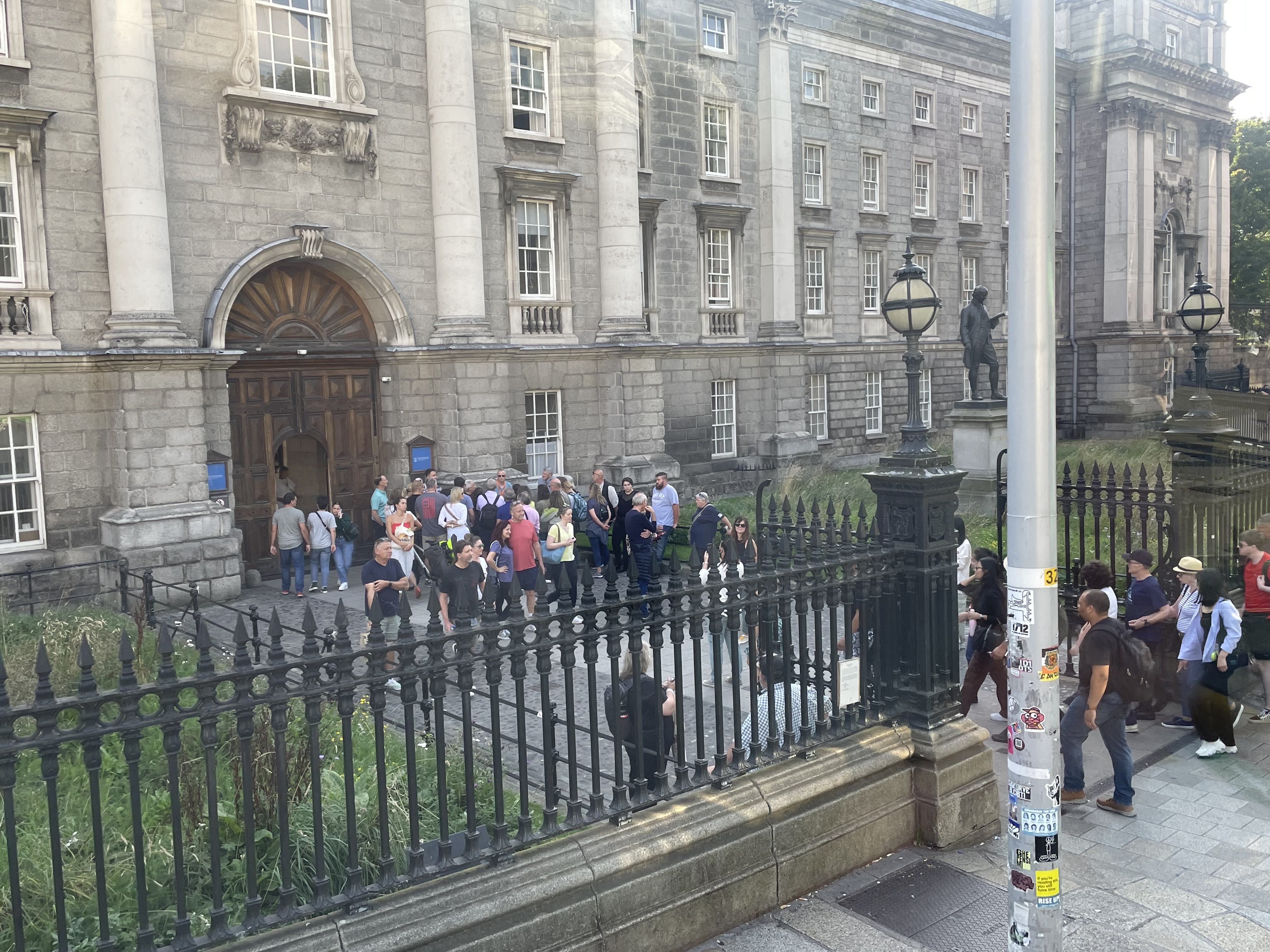
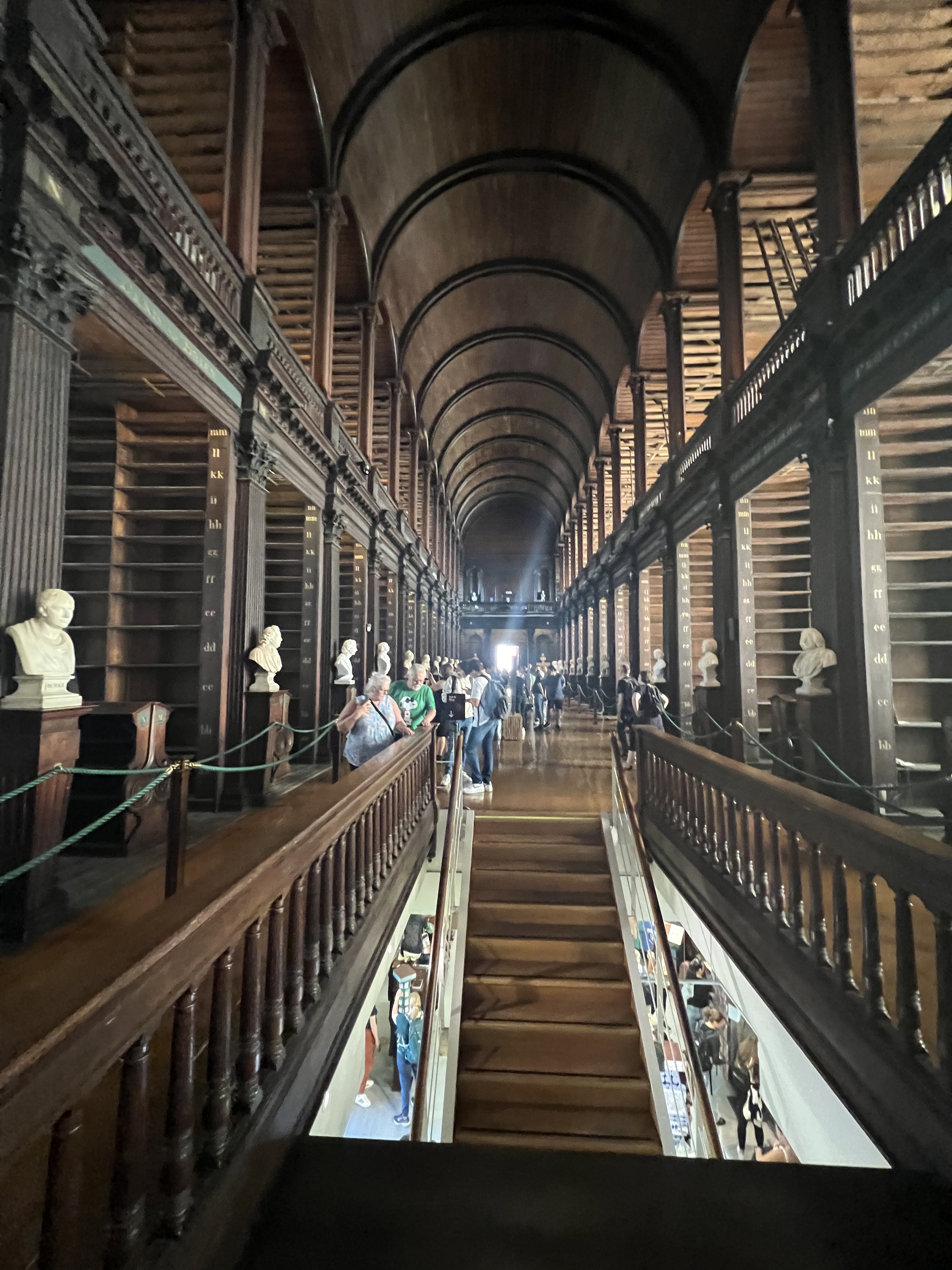
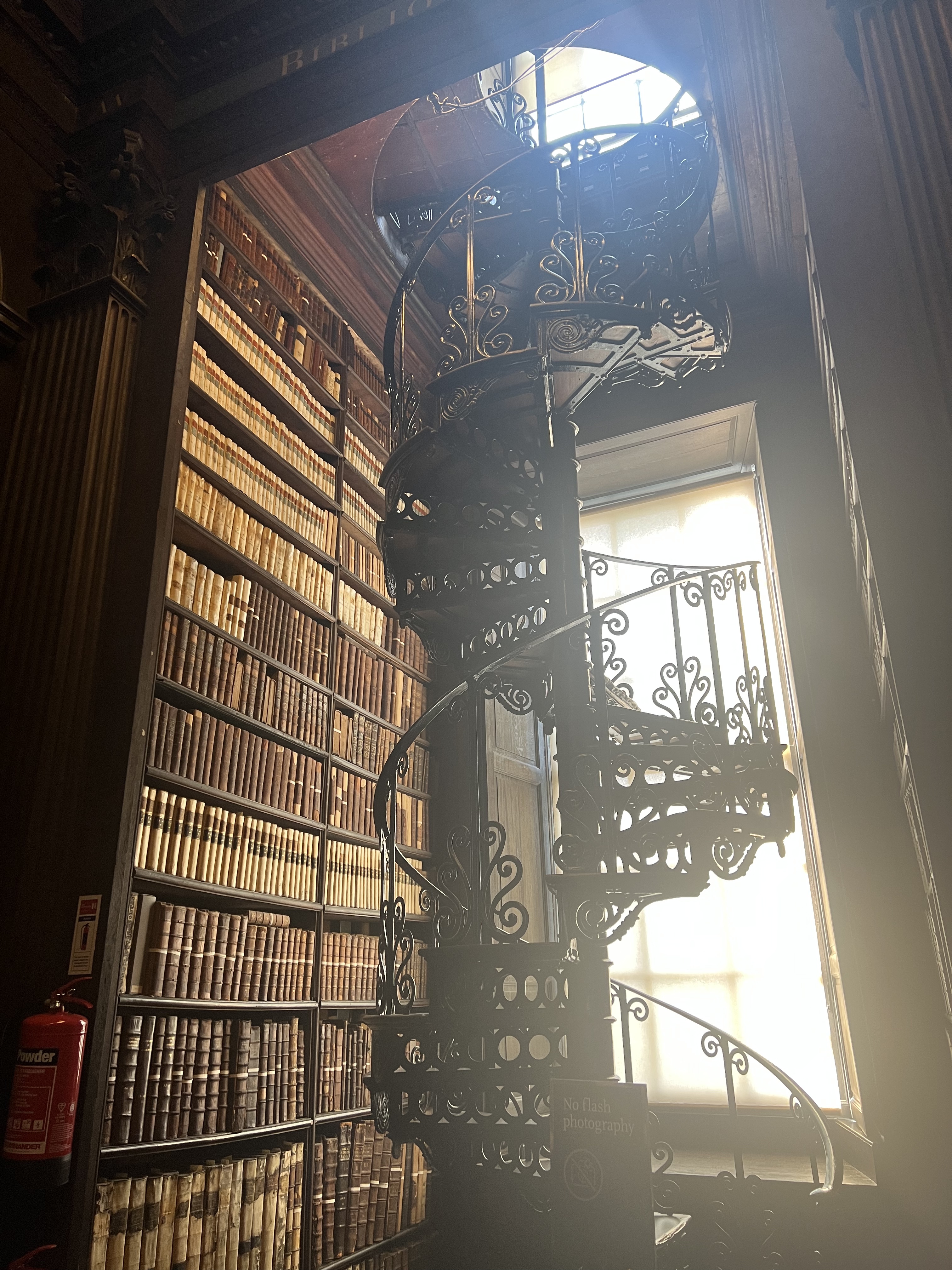
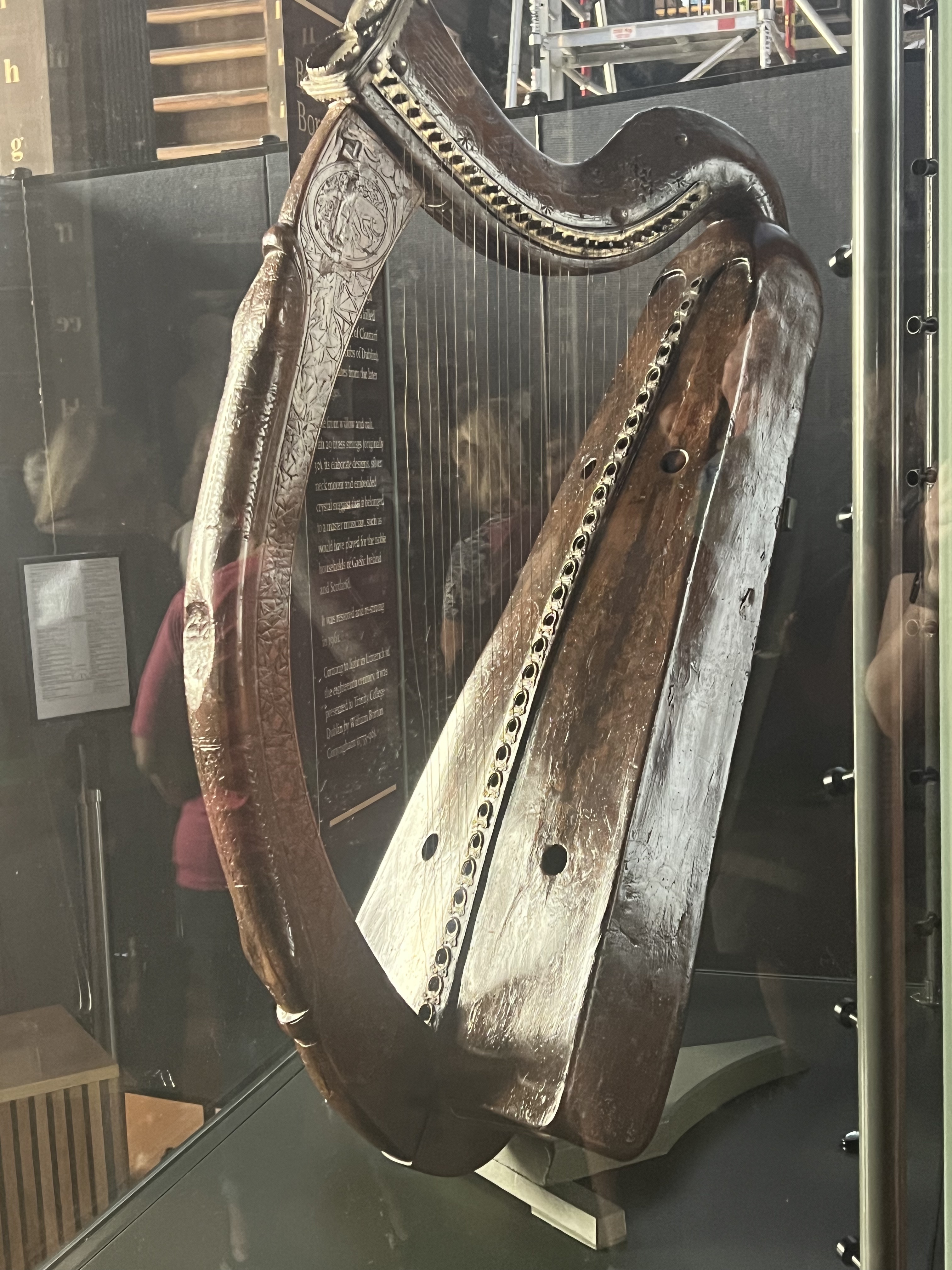
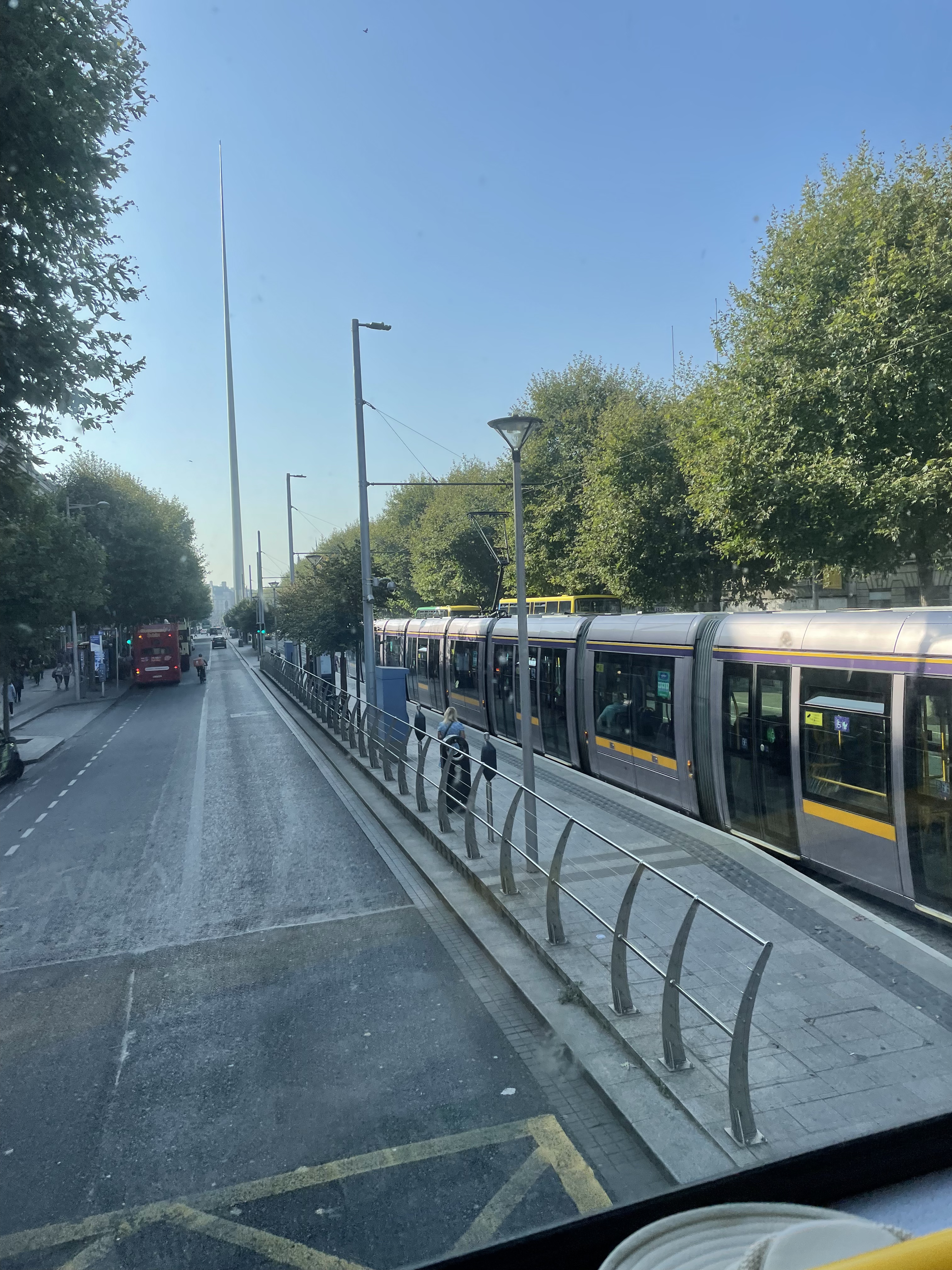
Friday morning, the kids had tickets to the Book of Kells exhibit at Trinity College. Unfortunately for them, the library was under redevelopment and all the books had been removed but their photos still captured the beauty of the old library dating back to 1732. While they were there, Dad and I caught the Hop On, Hop Off and did a round trip to get our bearings. We met the kids at lunch time and the guys went in one direction and the ladies another.

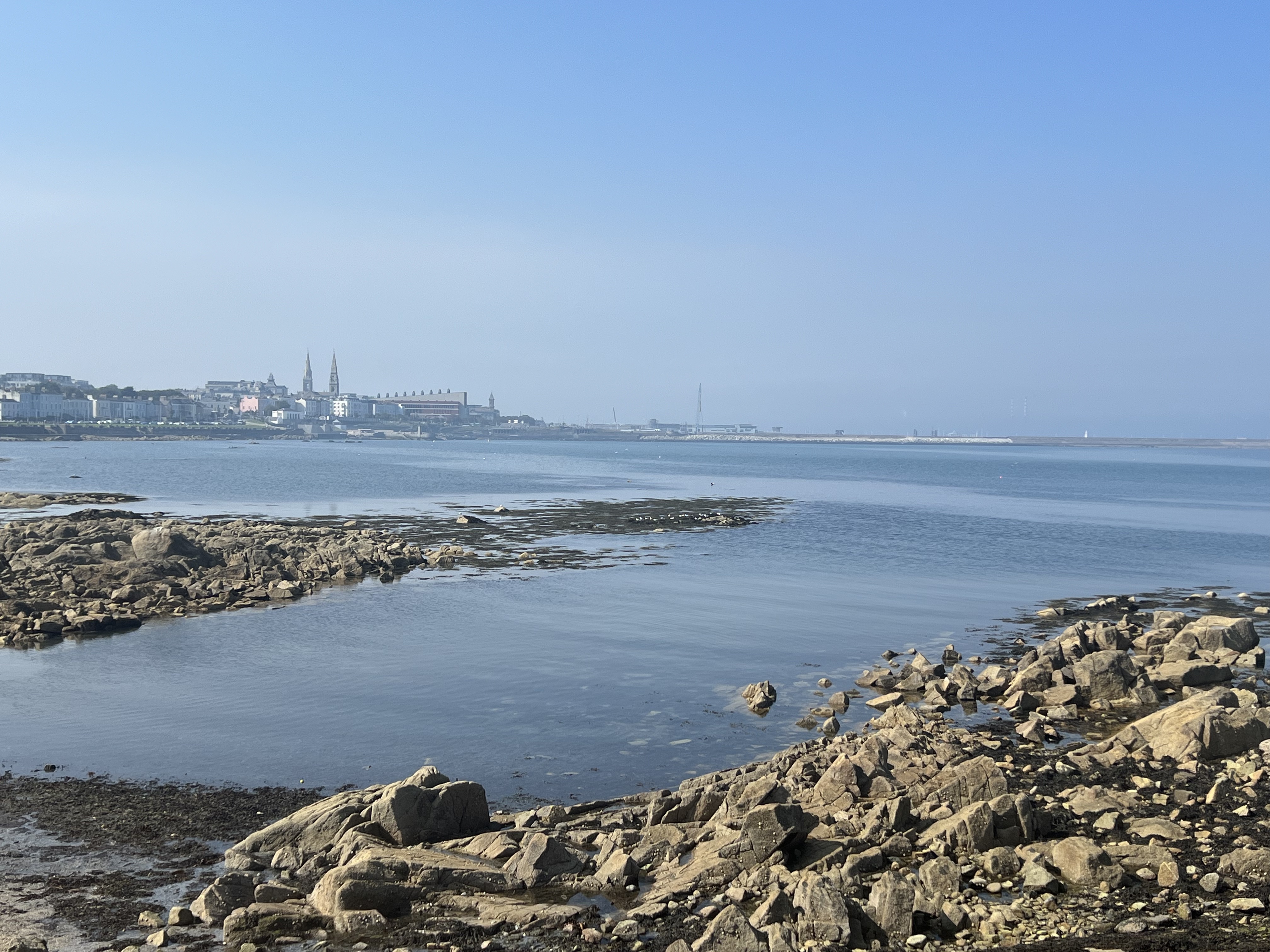
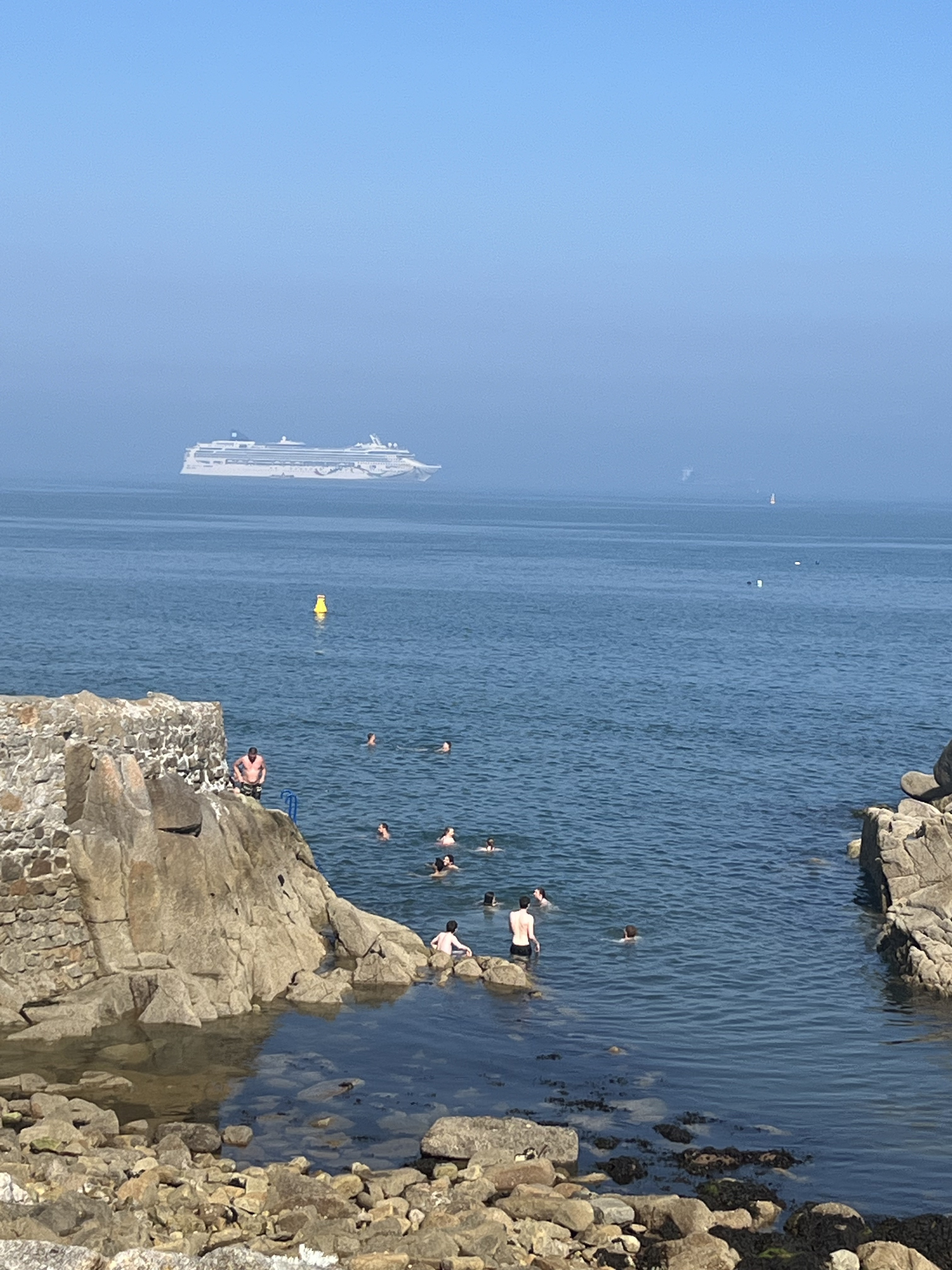
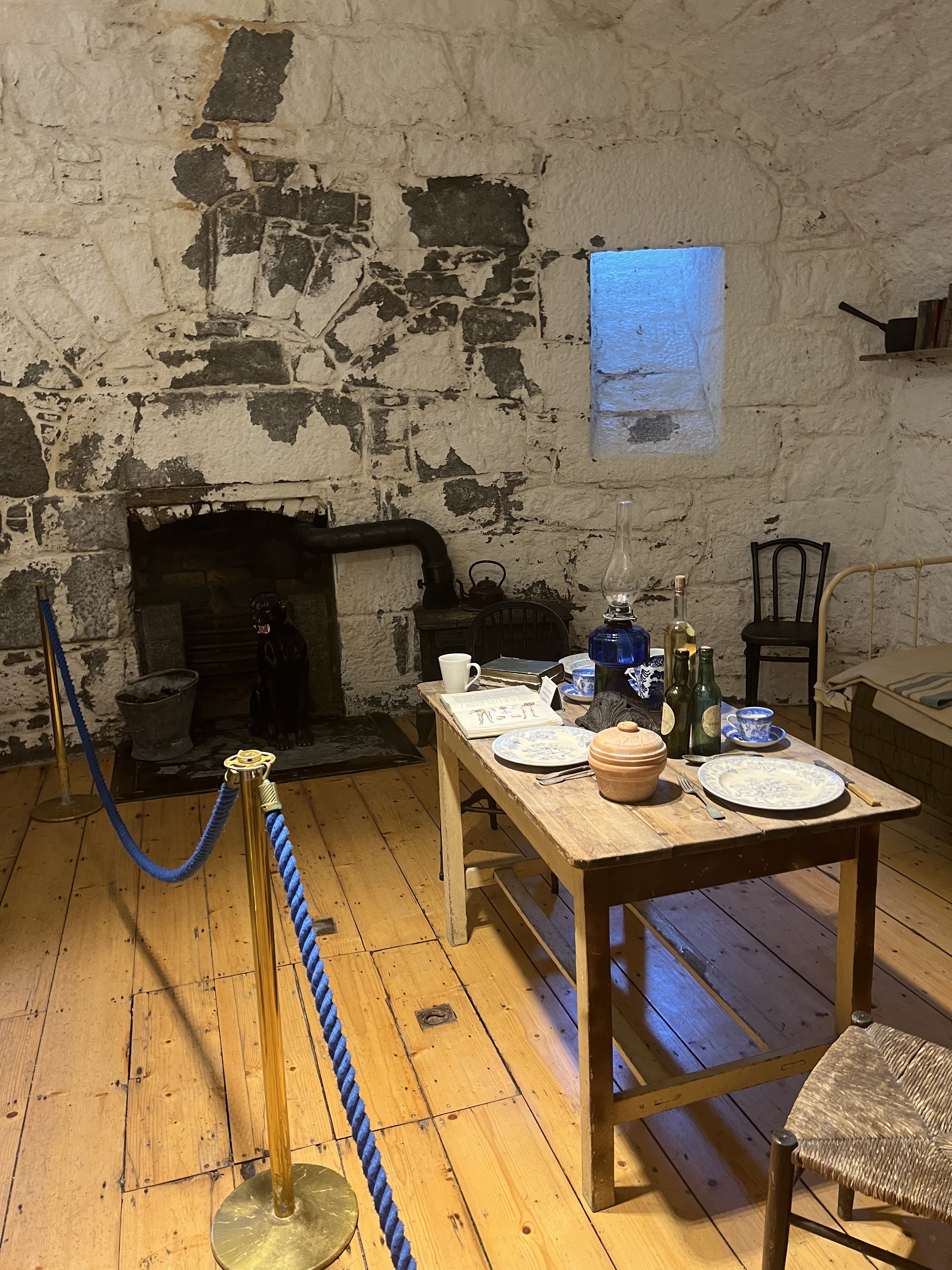
The guys were interested in exploring the transit system in Dublin and thus took the commuter train out to Dun Laoghaire. This is an historic suburban coastal town – home to the first suburban railway, the first purpose-built yacht club, and the world’s largest asylum harbour. Since it was such a lovely day, people were swimming and enjoying the fine summer weather. There are two piers. The East Pier takes you past the historical sundial, the bandstand, the battery and the lighthouse at the end. The walk is about 2.5 km return. The lighthouse features a small museum in honor of James Joyce, who spent some time in the area. The West Pier is unpaved and slightly longer but provides for a better view of the harbour and the boats in the Marina.

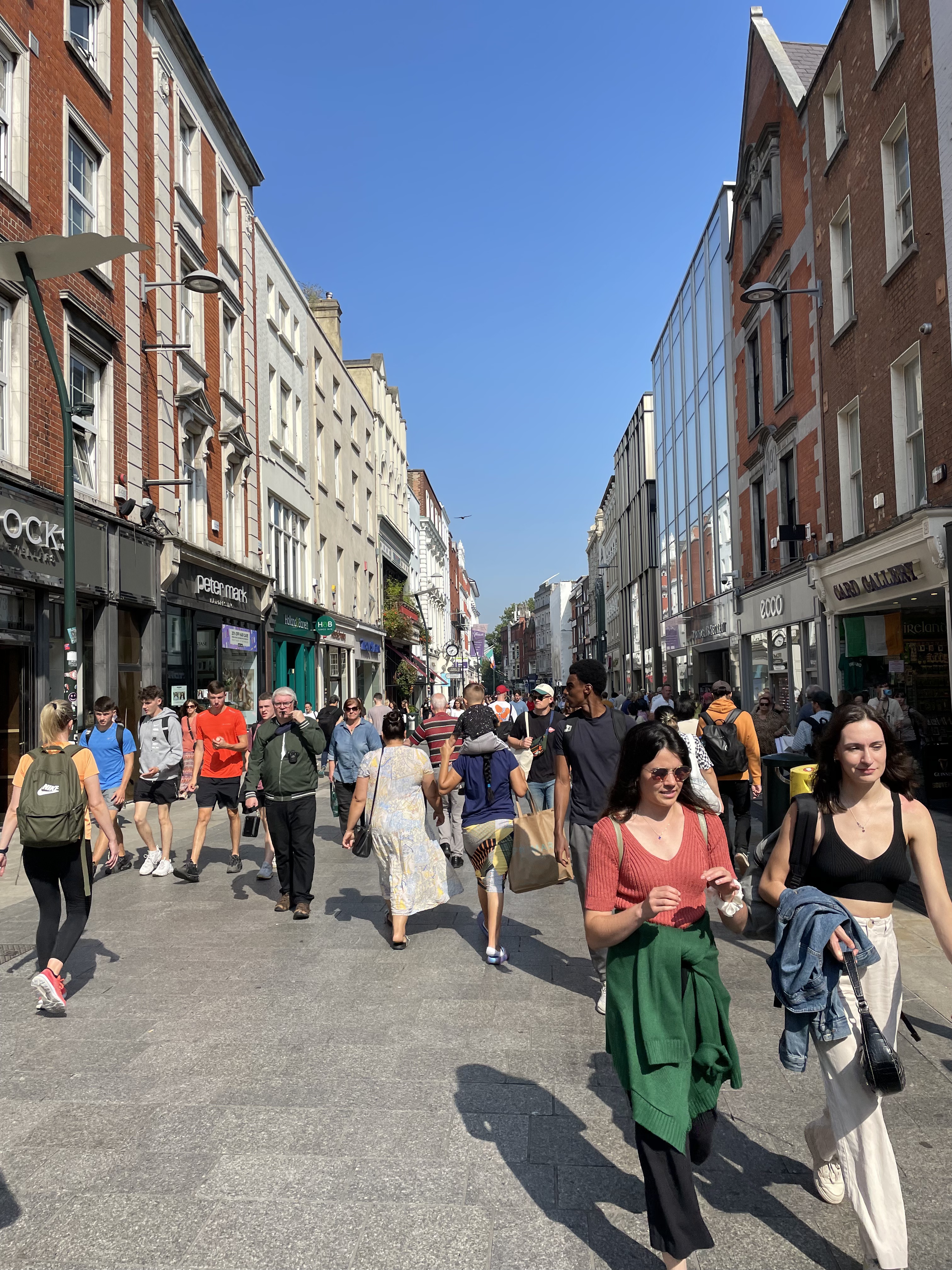
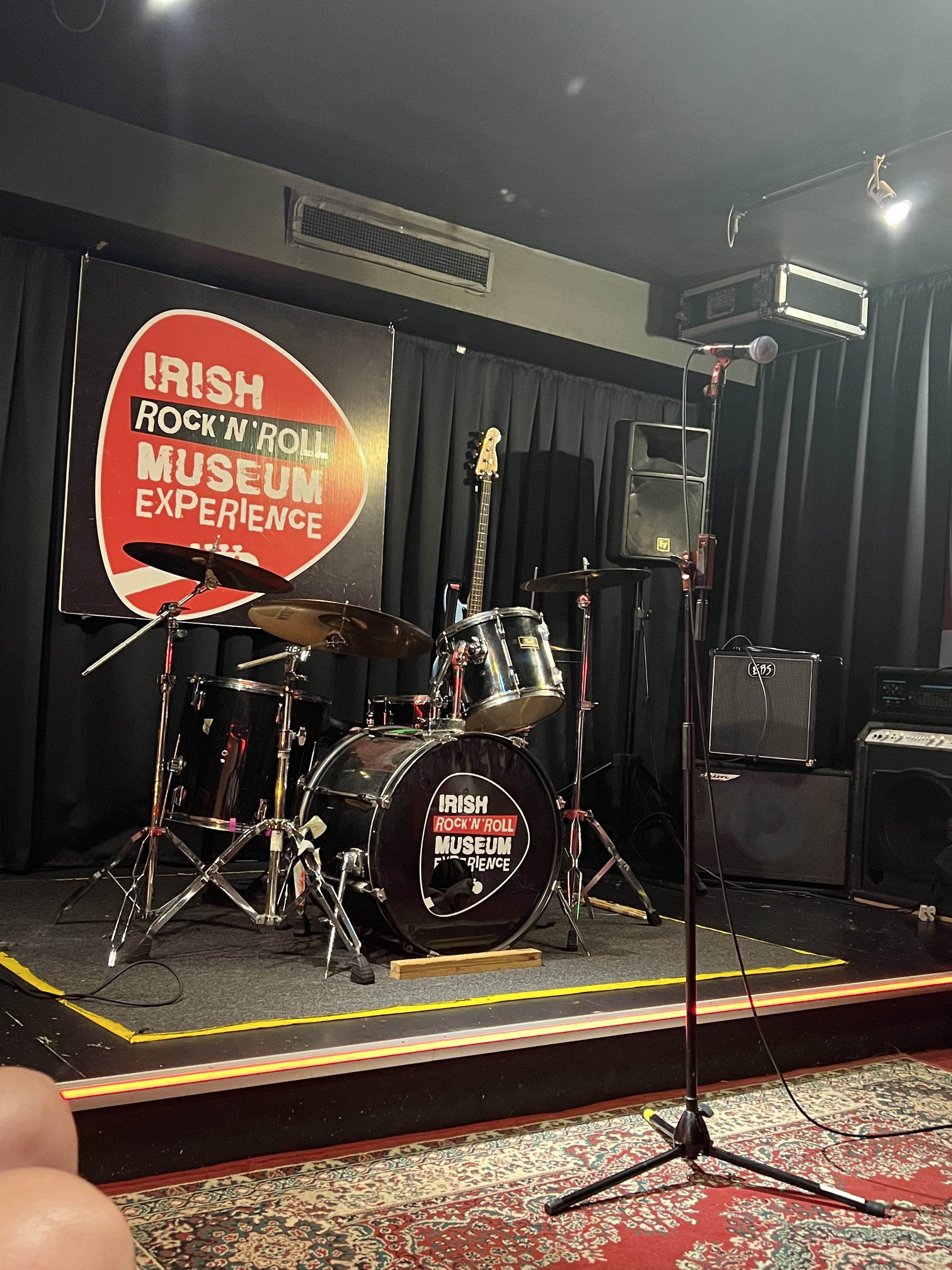
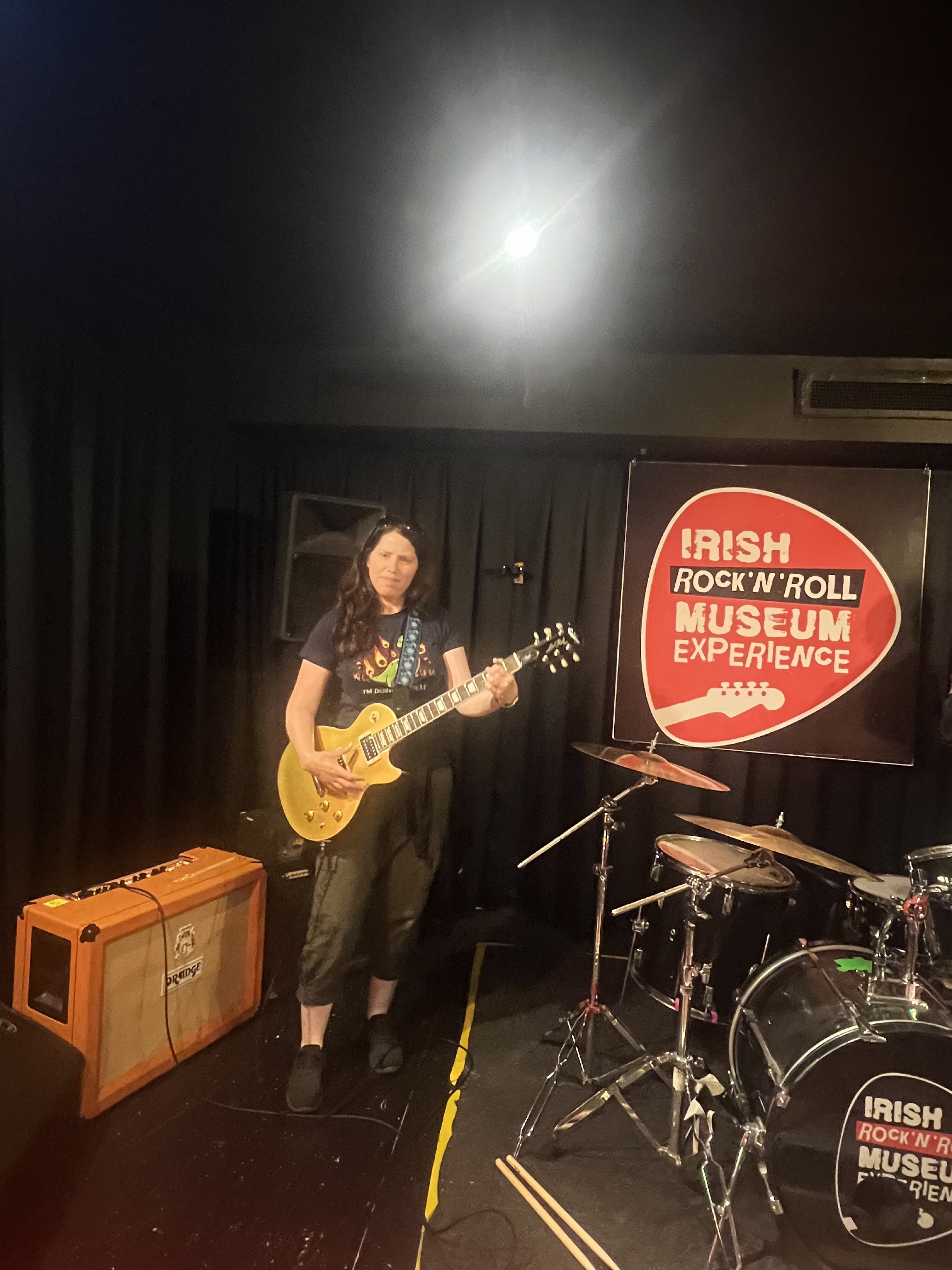
The gals went to Grafton Street to check out the shops and do a little shopping. I returned to the hotel early on the bus while Jenn continued with a music tour of Dublin. She had a great time ending up at a recording studio where she tried out her performance skills.

Dinner that evening was at Flanagans and then we all went to check out the Barbie movie. Both kids had seen it before but were quite keen to see it as a family. What fun!

Our last day in Dublin was “explore your own interests.” Mom and George Jr went to the EPIC museum while Dad and Jenn explored the Archaeology Museum. EPIC is a museum located in an historic building on Custom House Quay where it was used to store tobacco, tea and spirits. It overlooks the River Liffey, which was the departure point for so many people who fled the country during The Famine. It’s a very fitting location for Ireland’s emigration museum. Beautifully designed and entirely interactive, the displays tell the story of over 300 people who became scientists, politicians, poets, artists and even outlaws all over the world. The local joke is that the English discovered the world, while the Irish populated it! It was a fascinating, informative morning.

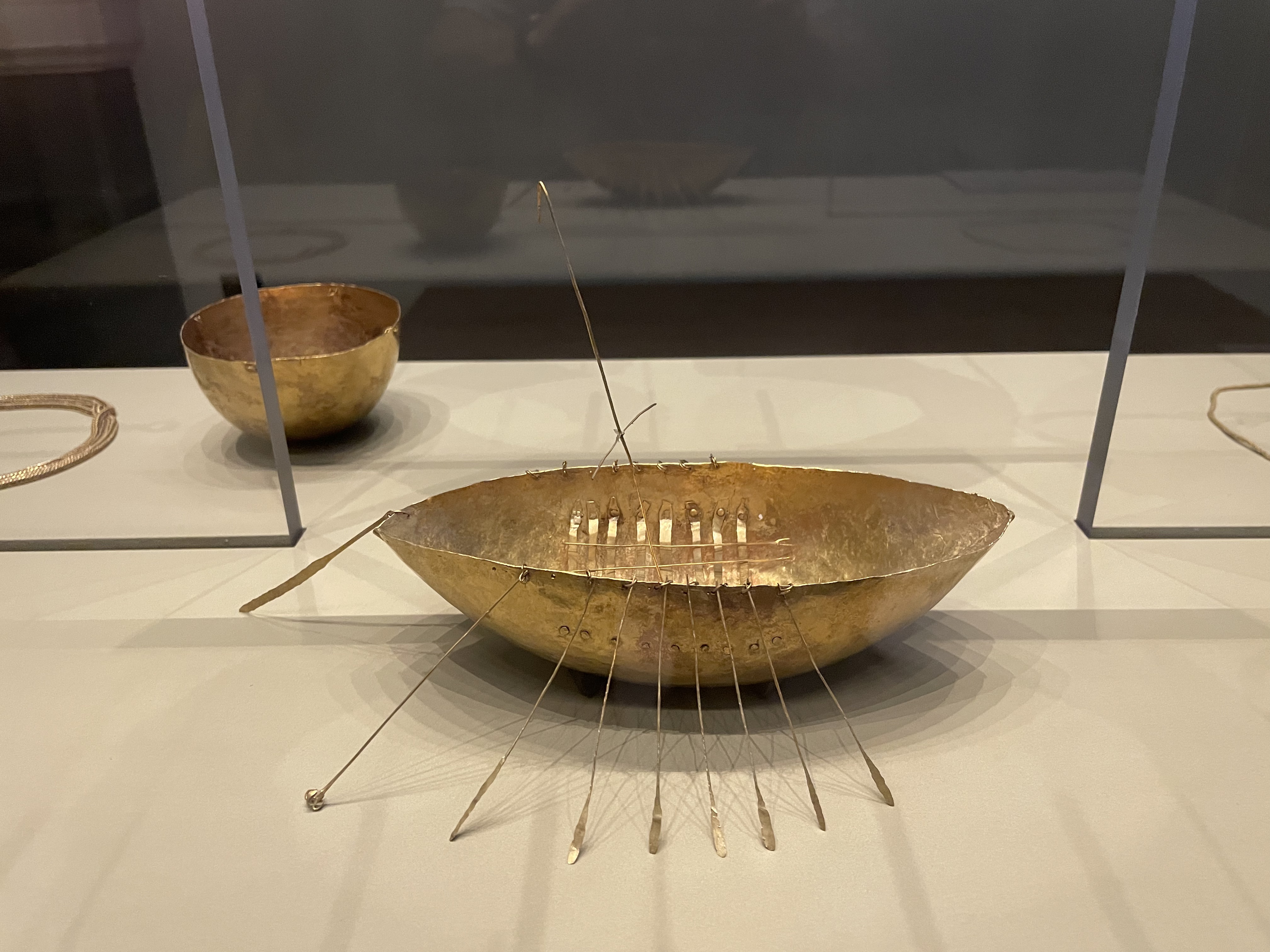
Jenn and Dad lucked in when they arrived at the Archaeology Museum as a tour was to begin shortly. The docent was a young man who was very knowledgeable and provided a very interesting tour. At the end of the tour, they realized that he was going to lead another in about an hour. They separated and explored different parts of the museum and then met again for the second tour. It was fascinating to go to a museum and see some of the artifacts from sites that we had visited. Also of interest was a diorama of a village that explained what life was like in Viking Ireland, a precursor to next year’s trip.

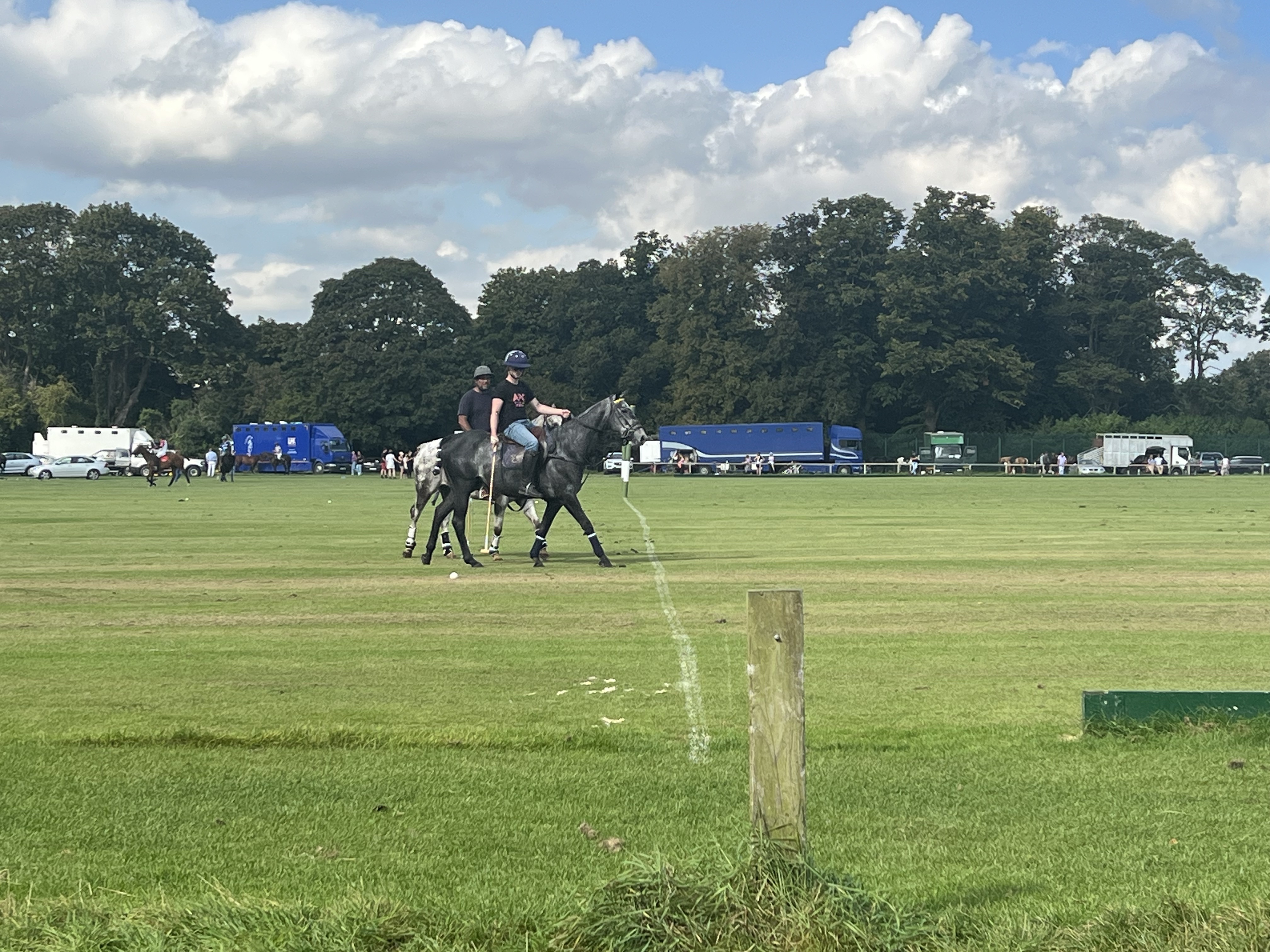
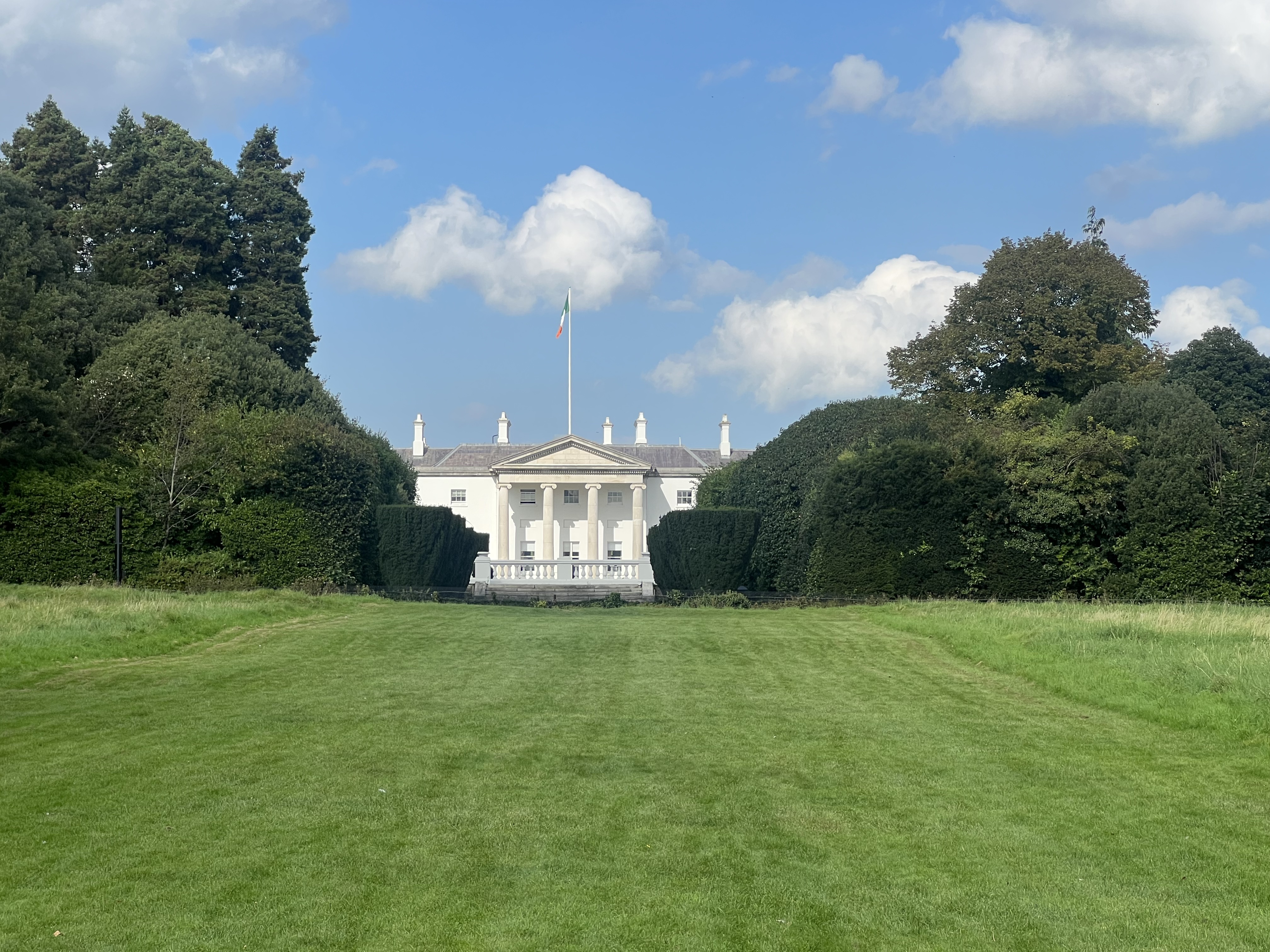
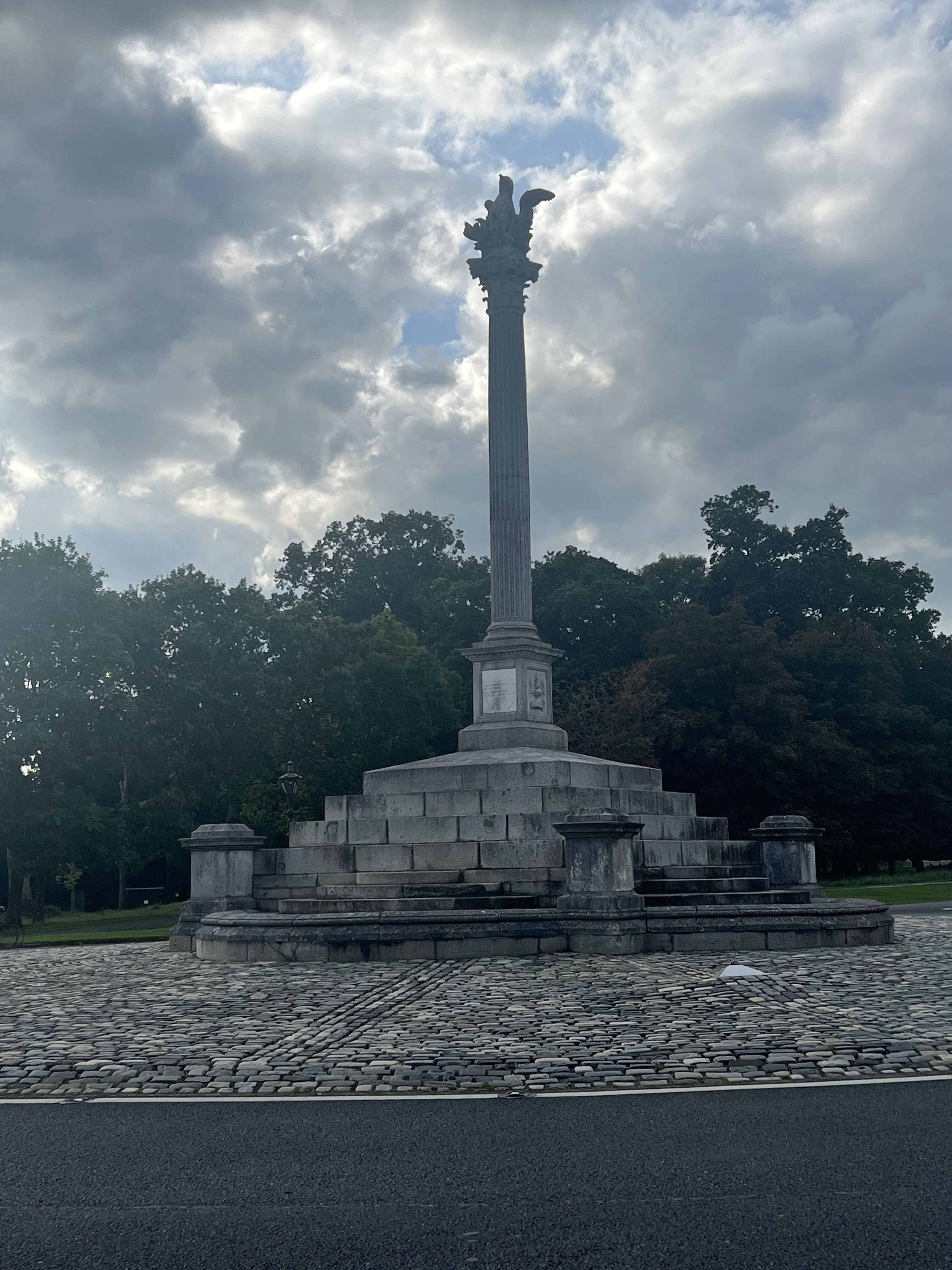
We agreed that we would reconnect at Phoenix Park after lunch. This is one of the largest enclosed public parks in any capital city in Europe and has a long history dating back to the eighteenth century. Included in the park are zoological gardens, flower gardens, a biodiversity information centre, a cafe and tea rooms, walking and cycling trails, as well as many sporting venues. Jenn went off to check out the polo grounds, while George and mom perused the flower gardens and checked out one of the concession stands for a cold drink. Dad sat on a park bench and chatted with other visitors to the park. It was a warm day and we were all beginning to flag towards the end.

Dinner for our last night was at Teddy’s Bar & Brasserie, directly across from the hotel. The food was good and the service was excellent. Then it was back to the hotel for final packing and an early morning bus to the airport. Fortunately, the bus stop was just a short walk from the hotel but 6:20 am was early!

After picking up our stored luggage and checking in, we had a wee breakfast before bidding adieu to George Jr who was catching a later flight to the continent. Dad, Jenn and I flew home without incident until it came time to meet our chauffeur, my sister Barbara, at the airport. Because we had forgotten to take our golf clubs out of the trunk of our car, there was no way we could get all our luggage and George’s bike in the car. Dad ended up taking a separate cab with the bike.

We also brought a little something extra home with us! Jenn and I both came down with COVID the next day. Despite having sat between us on the plane, Dad did not seem to get it … but then maybe he and George had a mild case of it in Ireland? We will never know.

Vermont Fall Colours

We’ve heard so much from friends about the fall colours in Vermont, that we decided to plan a trip in 2021. That didn’t happen because of COVID, but we managed to make it happen in 2022. We invited my sister and her husband to join us and booked four days at the Holiday Inn Vacation Club at Mount Ascutney.

We left Toronto on Sunday and travelled as far as Montreal, staying at St. Jean Sur Richelieu overnight. Monday was the beginning of exploring the highways and byways of Vermont. Our first stop was Burlington, a city on the eastern shore of Lake Champlain, where we stopped for a coffee down by the river and then took a quick drive through town. Our second stop was Stowe, Vermont. It is, of course, famous for its trails and ski slopes but for us non-sporty types, it was just a lovely spot to stop for lunch. We visited Piecemeal Pies on the main street for lunch. Savory pies, made in the English style, are served with soups, salads and other accompaniments. It is a relatively new restaurant in town with a bigger operation in White River Junction. It was certainly popular.

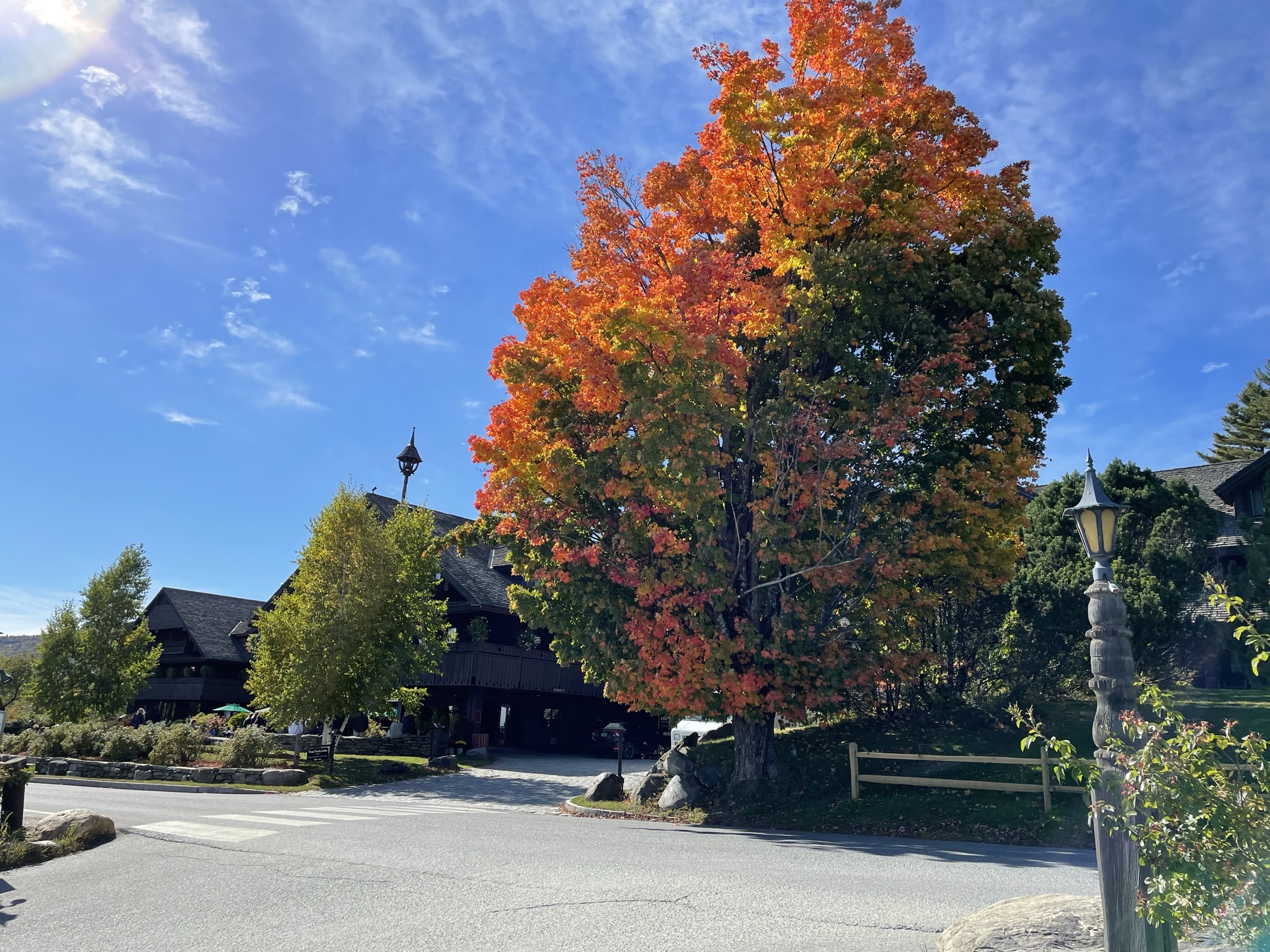
On the way out of town, we detoured to see the Trapp Family Lodge – home to the Von Trapp Family of Sound of Music fame. It’s a beautiful building, rebuilt in the early 1980s after a fire destroyed the original lodge from the 1940s. The property includes some 2,500 acres offering indoor and outdoor resort amenities. A little further along we discovered the Cold Hollow Cider Mill, home of the legendary cider donuts. The donuts are everything the brochure says they are, and an apple pie for dinner that night wasn’t too shabby either.

Trapp Family Lodge
Maple tree just starting to colour
View from Lodge

We stopped for a short time in Montpelier to pick up groceries and then on to Mount Ascutney to check in at the Holiday Inn Resort. After a BBQ chicken dinner and cheering on the Blue Jays, we retired for the night looking forward to our first day trip tomorrow.

This area of Vermont is ideal for short day trips. I had found a number of routes on line, and the first one we chose started in Chester and travelled along small back roads through Grafton to Townshend (Route 35). Grafton is home to the Grafton Village Store, Grafton Village Cheese and the Grafton Inn. There are many photo stops along the way.

Other days we explored routes in the other direction. The road to Woodstock (Route 44 and 44A) became quite familiar to us as we found we needed two days to explore the towns of Woodstock, Quechee and Taftsville. On a nice sunny, warm day we stopped for ice cream and a wander through the quaint town of Woodstock. Another day we visited the Quechee Gorge and Simon Pierce Glass facility. Unfortunately, the restaurant there is so busy that it requires reservations a month in advance.

People had recommended that a visit to Sugarbush Farm was a must so we fit that in on one of our last days. It’s a bit of a hike – especially if you take a wrong turn – but well worth a visit and even more so if you have kids. We came away with a number of different kinds of cheese that are packaged such that refrigeration is not needed. They also have maple products but as Canadians, that’s like taking “coals to Newcastle” as the saying goes.

Since we were staying in Mount Ascutney, a trip to the top was a must. It’s in the State Park so a $5 per person entrance fee is required. The entrance is just a short 10-minute ride from the resort. Once you get to the top parking lot, there is a hiking trail that takes you a further distance to the very top.

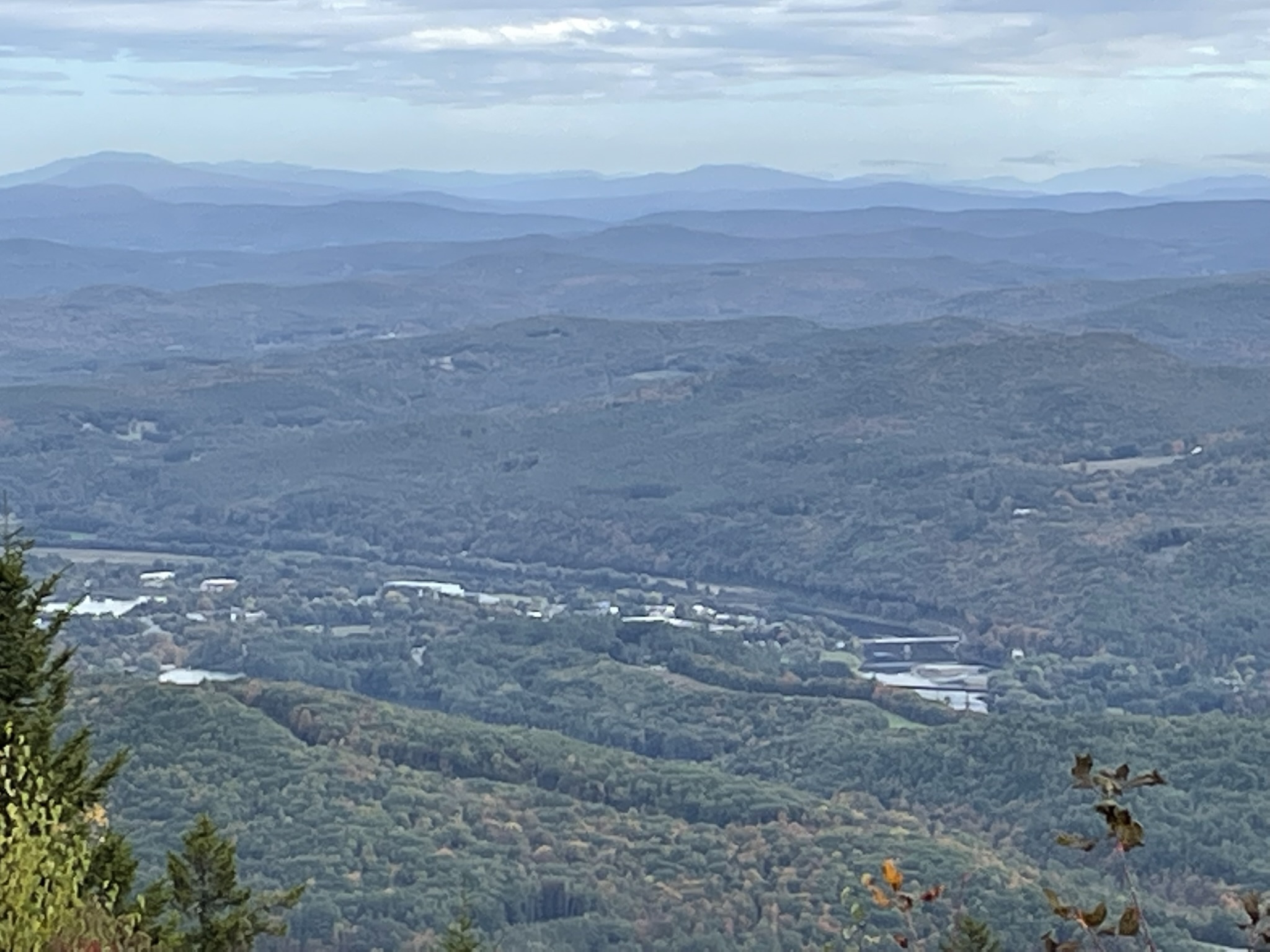
View from Mount Ascutney on a cloudy day

We enjoyed a number of meals at local restaurants although there isn’t anything that is really close to the resort. The Holiday Inn does have a restaurant on-site, called the Maple Kitchen, which is open Tuesday – Sunday. The food and presentation is quite good, but the noise is significant because of a very low ceiling. A trip to White River Junction to Elixir was our favourite. Made more enjoyable by a server who was passionate about seeing that we were well looked after, the food was wonderful and the ambience was classy rustic. Reservations are required as it has become one of the town’s most popular restaurants in just the short time it has been open. Another evening we enjoyed a visit to The Common Man in Concord, NH. A very large restaurant with a lovely outdoor patio beside a waterfall, the food served is typical New England fare and very plentiful. Gas is cheaper in New Hampshire so a planned fill-up was a bonus.

We spent just three full days in the Mount Ascutney area but realized there is so much more to see. A return visit will be planned for the future.

Rhine River Cruise and Oberammergau

This trip was many years in the making. In 1990, Nancy’s parents travelled to Oberammergau with friends from their church in Florida. It was such a highlight for them that we added it to our travel bucket list. In 2010, we were three weeks away from leaving when George had a major heart attack. We had rationalized that we should go when we were in our 60s, not knowing what our health might be like in our 70s. Well, that didn’t happen! Our second attempt was in 2020, but obviously COVID intervened. We were very happy for Craig Travel to hold our deposit in the hopes that things would go forward in 2022 … and they did.

The tour included a seven-day Rhine River cruise on AMAWaterways followed by a four-day bus tour through the Bavarian Alps. Our tour group consisted of 28 people mostly from the GTA. The tour leaders were Joan and Roger Rix from Innisfil.

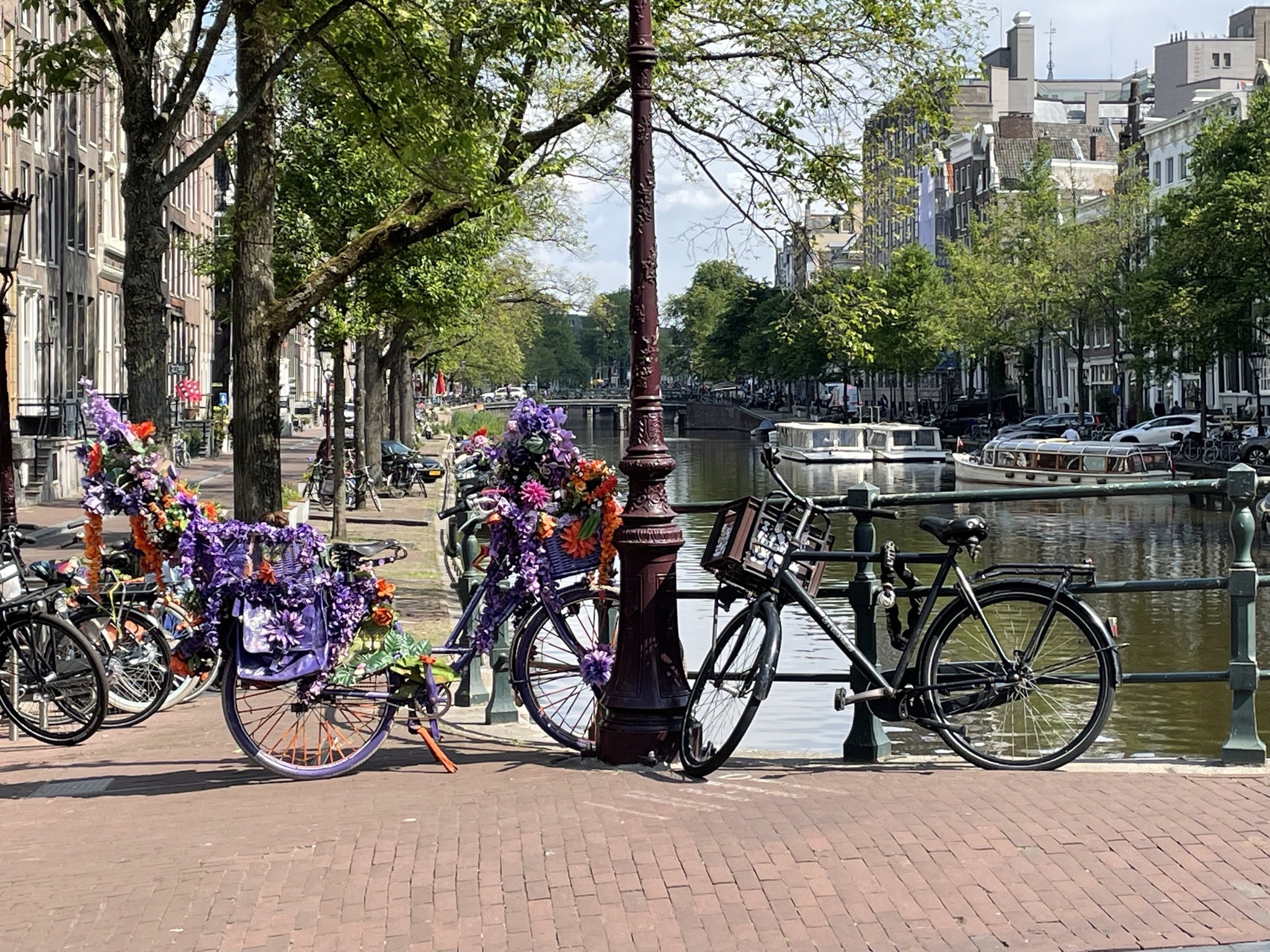
We left three days early (May 29th) so as to get acclimatized before the tour started. Returning to Amsterdam gave us an opportunity to stay at our favourite B&B and visit with the owner, Corina Koon. We also arranged to have lunch with Anne Catrien, whom we had met on a Norwegian cruise in 2010, and her new “significant other.” On two previous trips to Amsterdam, we had not been able to visit the world-renowned Rijksmuseum due to it being closed for renovations. We were very happy to spend most of one of our full days there.

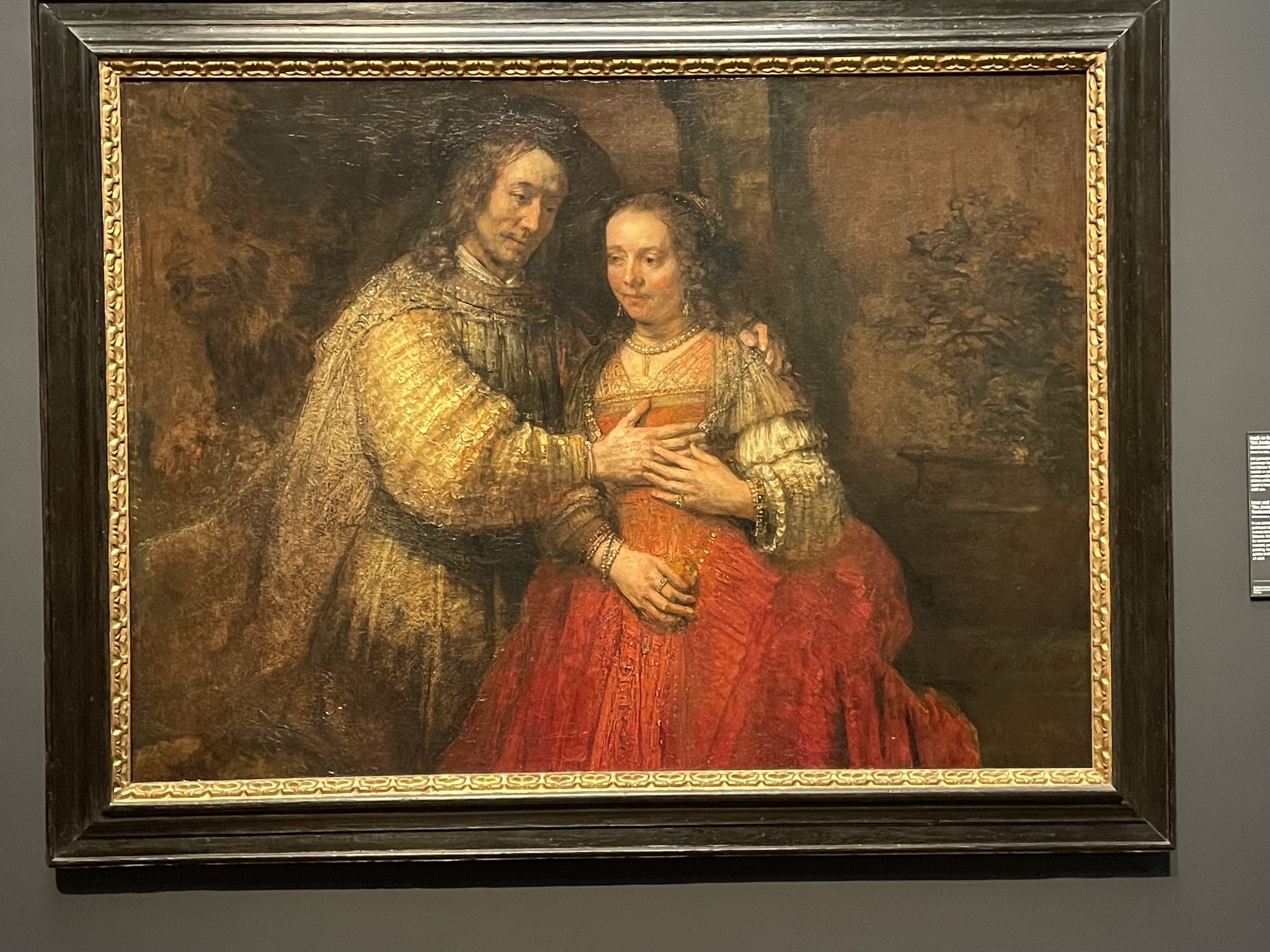
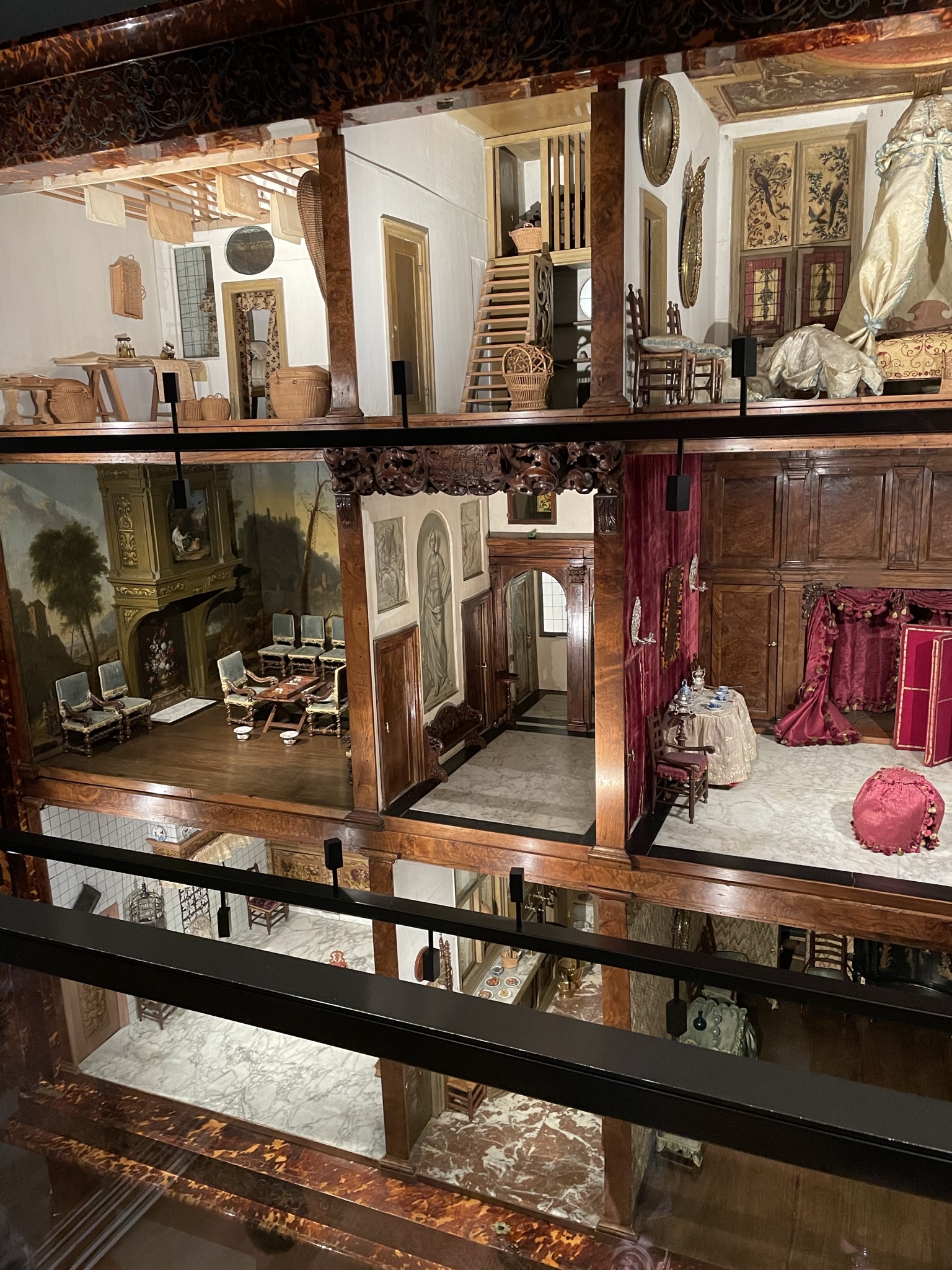
Aside from all the famous Rembrandt paintings, we were taken by the three Doll’s Houses on display. The most famous one once belonged to Petronella Oortman. It provides a detailed view of how affluent houses in Amsterdam were built and furnished. All the pieces are made to scale and replicate their real counterparts. She custom-ordered china, cabinets, fabrics, etc. An extremely expensive hobby, her doll’s house cost as much as a house on the canal!

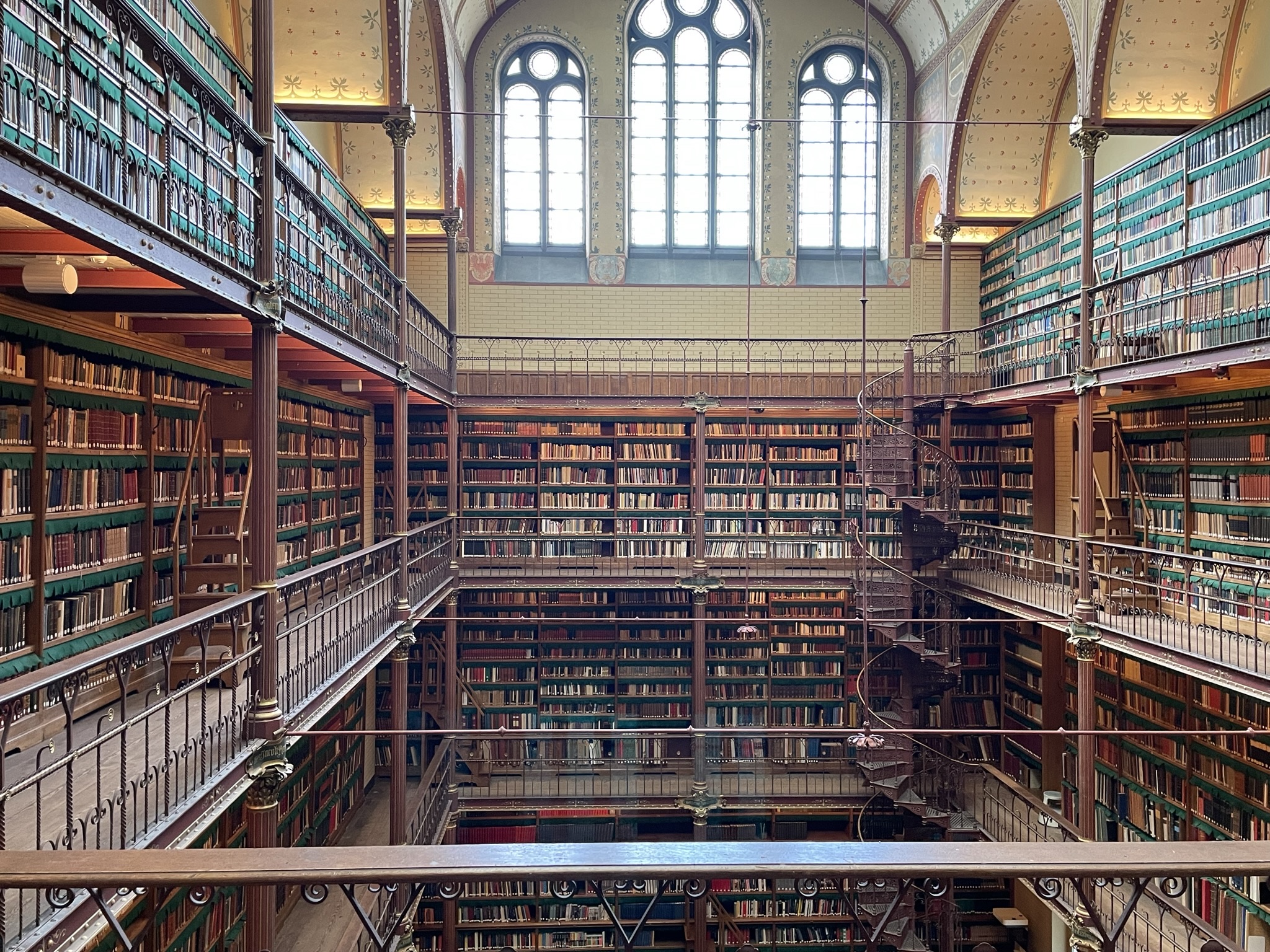
The museum’s current building was designed by Philip Cuypers and first opened in 1885. It houses a beautiful library which serves as the largest and oldest art historical library in the Netherlands. Researchers were very busy the morning we visited.

There are so many wonderful restaurants in Amsterdam that it is always difficult to choose. This time we opted for Nine Spices (an Indian restaurant close to the B&B), Balthazar’s Kitchen (which features a very limited menu and an intimate setting with an open kitchen) and Sama Sebo (a well-known Indonesian restaurant).

Day 1 – Amsterdam

Our ship the AmaLucia was waiting for us on Thursday morning when we arrived at the port. Since we were early, we just sat and read, went out for lunch and came back in time to find our cabin and unpack before dinner. The cabin we were assigned was not what we had expected (our fault) and so after arranging an upgrade we made a quick move to provide a bit more room and some in-cabin seating. At dinner that evening we caught up with the remainder of our tour group. COVID policy required that our group of 28 sit at four tables of six and one foursome. It meant that we could circulate amongst the tables but for COVID-purposes we were one bubble. Imagine our surprise when our dinner companions the first night turned out to be cousins of a lady at our church and best friends with one of our friends! Ross and Betty Verner are members at Edmison Heights Baptist Church and we found we had many connection points aside from the two mentioned above. If dinner the first night was any indication, we will be well fed on this trip!

Day 2 – Amsterdam

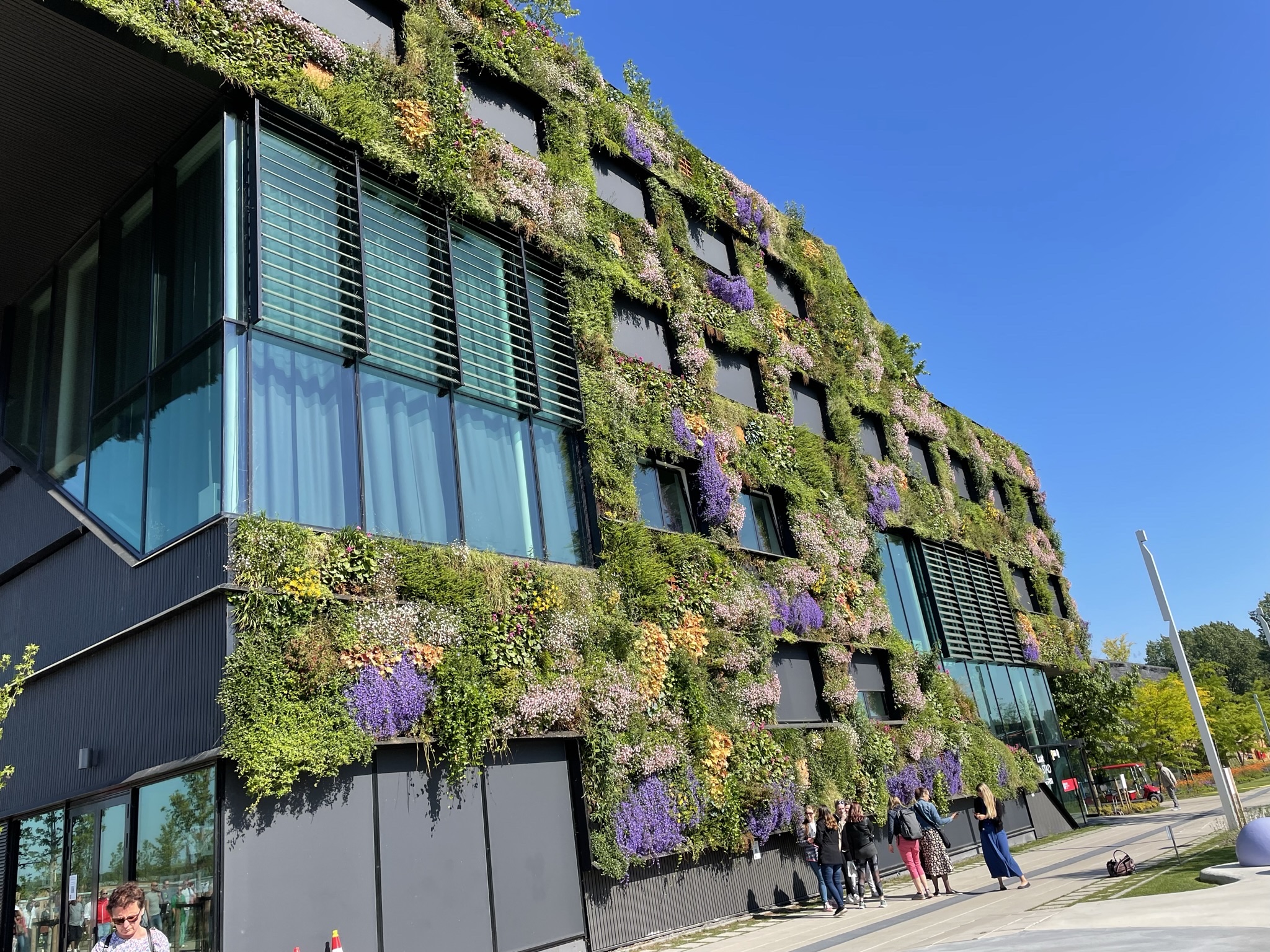
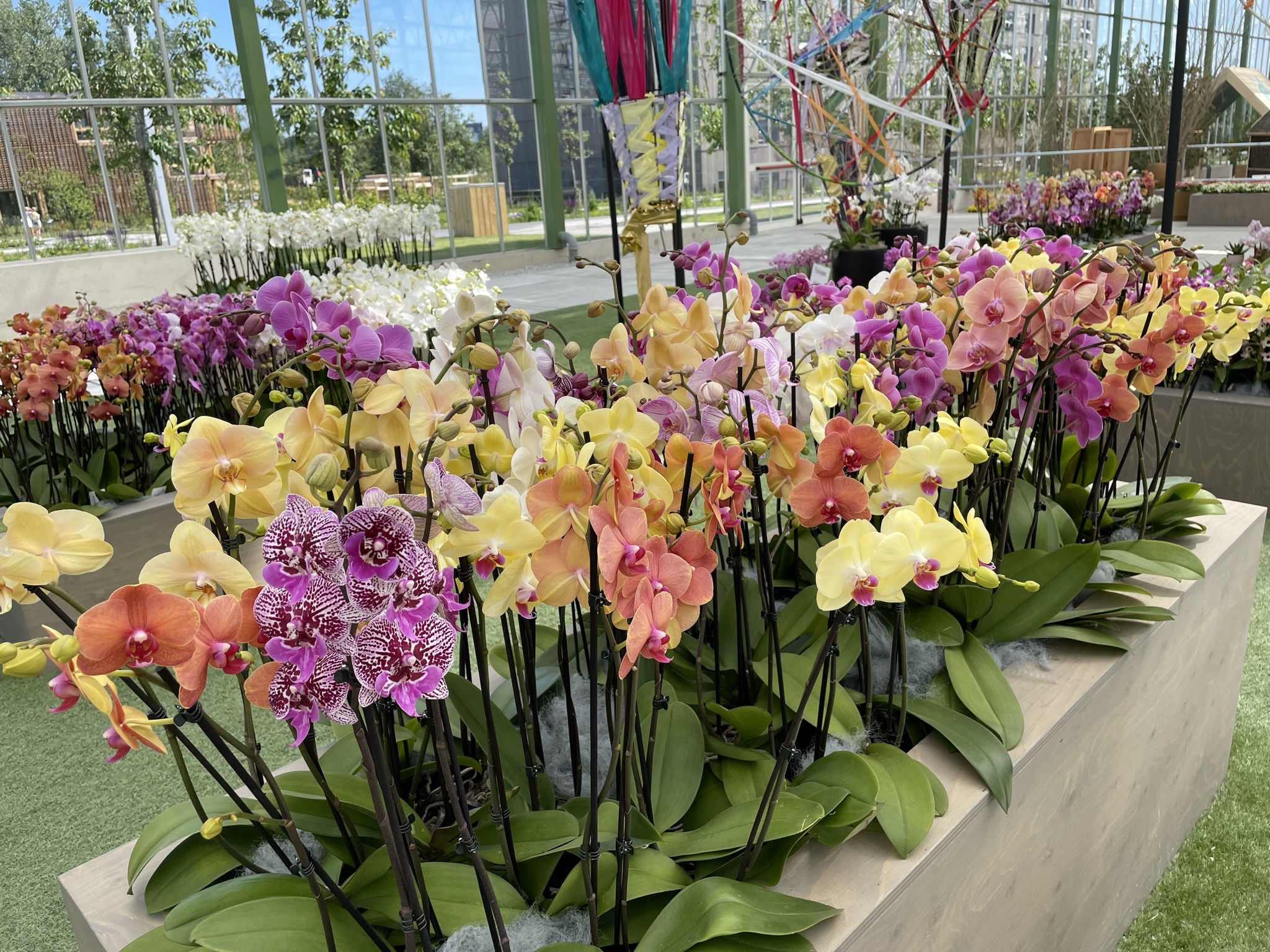
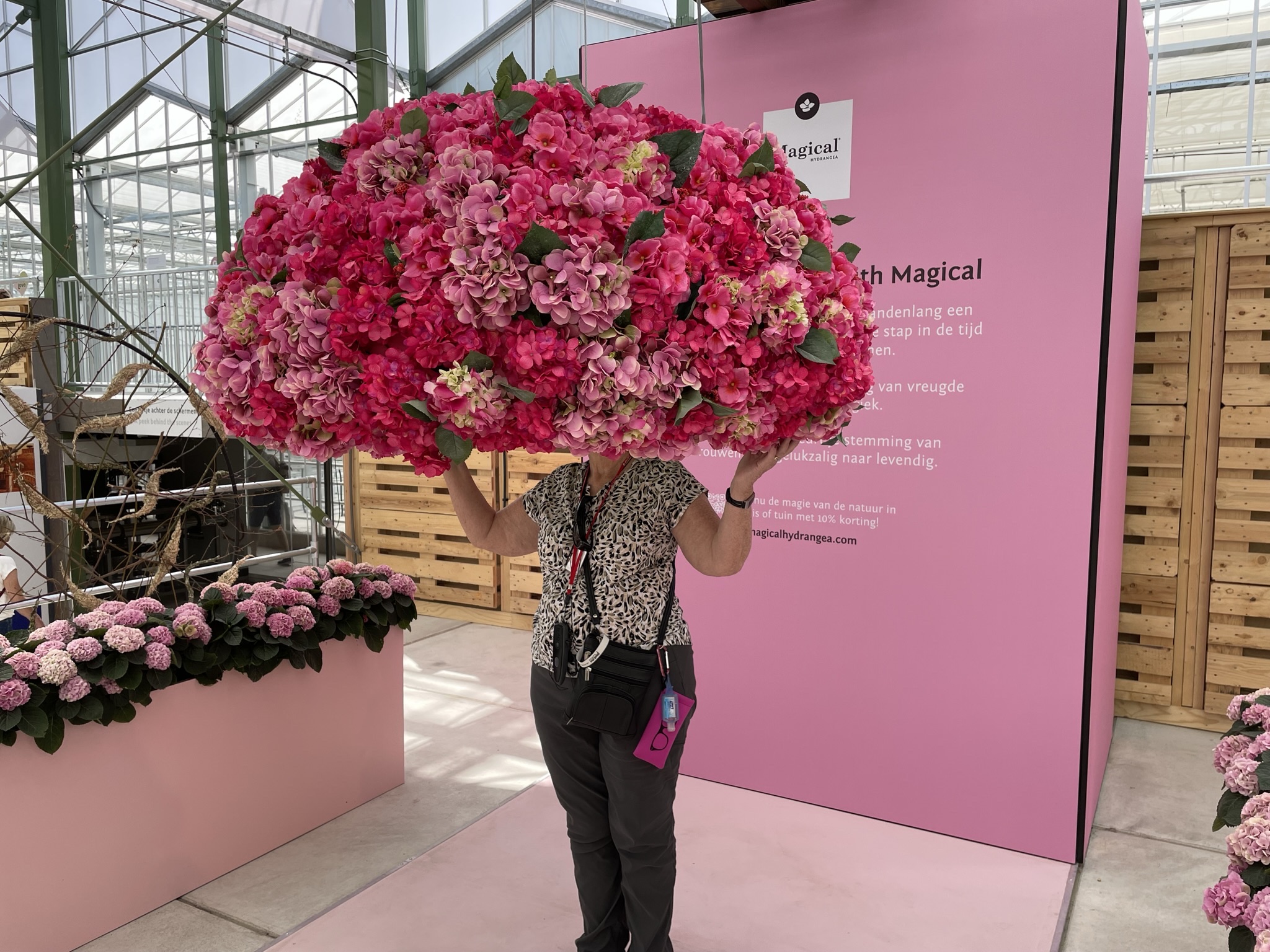
There were a number of choices for tours this morning including the usual canal tour, a self-guided walking tour and a bus trip out to Floriade. We opted for the latter. Floriade is a once-every-ten-year International Horticultural Expo held at different sites throughout the Netherlands. We spent a day at Floriade in 2012 and enjoyed it so much that we were pleased it was on again and close-by this visit. This year’s theme focused on making our cities more fun, more beautiful and more sustainable. Because we only had about four hours before the bus returned to the port, we just got an overview of the expo and sampled some really excellent tomatoes.

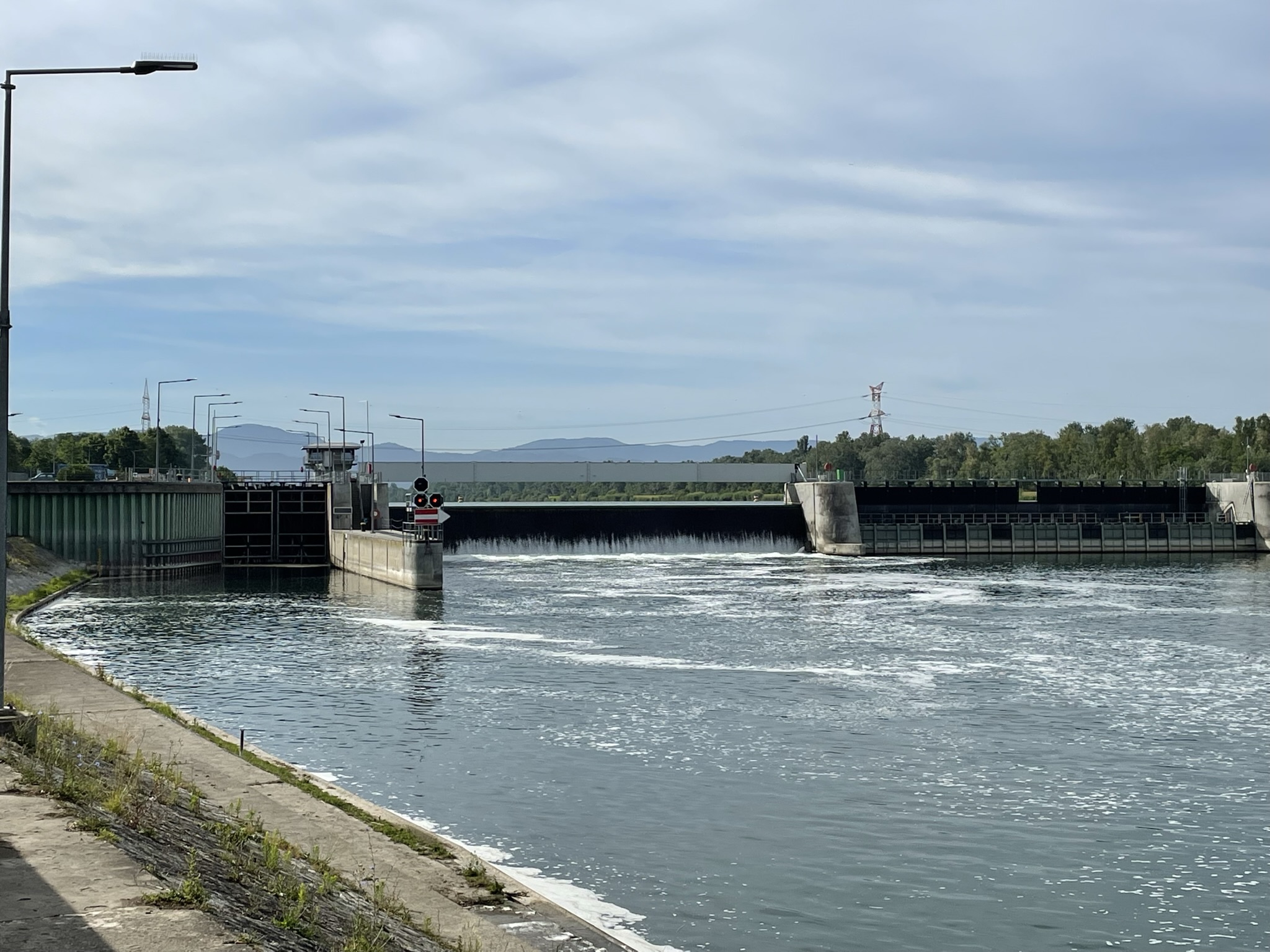
We returned to the ship in time to sail away mid-afternoon. Shortly thereafter we passed through our first of many locks on this voyage. We had been warned that there is not much room in the locks and to keep our hands and heads in the boat. For sure, there was only about 6-8″ between our French balcony and the wall of the lock!

Dinner tonight was in the Chef’s Table, a specialty restaurant. It was a seven-course tasting menu and included appetizers, soup, fish, a sorbet to cleanse the palate, Irish Short Ribs and a caramel chocolate tart. Since it was just the Craig Travel group we had the fun of celebrating the Verners’ 66th Wedding Anniversary with a cake and card. After dinner we each took the opportunity to briefly introduce ourselves to the rest of the group. This precipitated more “do you know someone I know” kinds of conversations in the days to come.

Other people we met amongst our group with connections were Carol and Sandra from the Uxbridge area. Carol was a teacher and is a friend of Ron and Heather, George’s cousins, and Sandra knows one of their sons at her church in Leaskdale. Annie and Greg from Alberta are members at Trinity Baptist and know someone with whom Nancy worked at CBOQ. Ted lives here in Lorne Park and knows many of our acquaintances at Christ First Church. It really is a small world!

Day 3 – Cologne, Germany

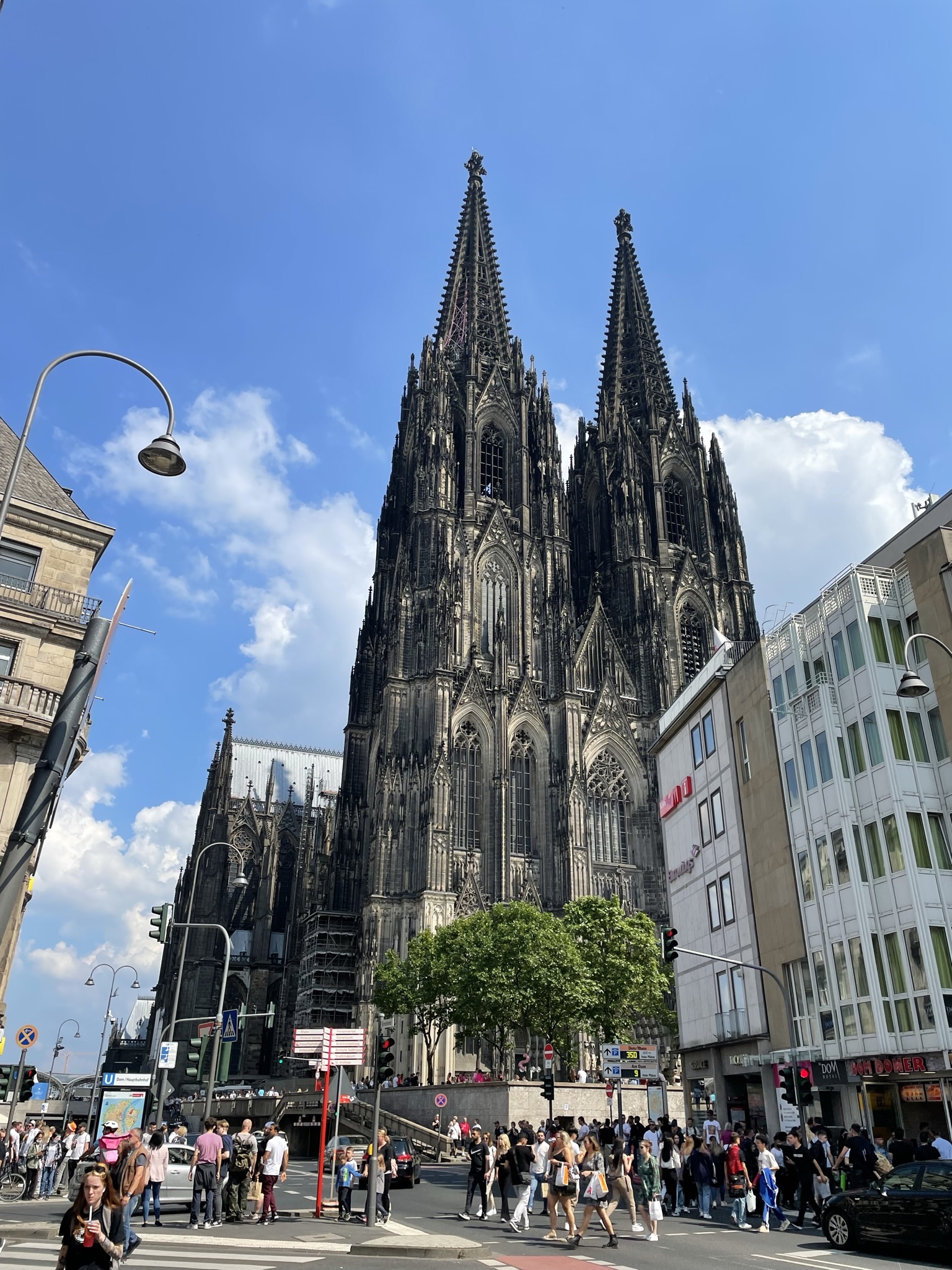
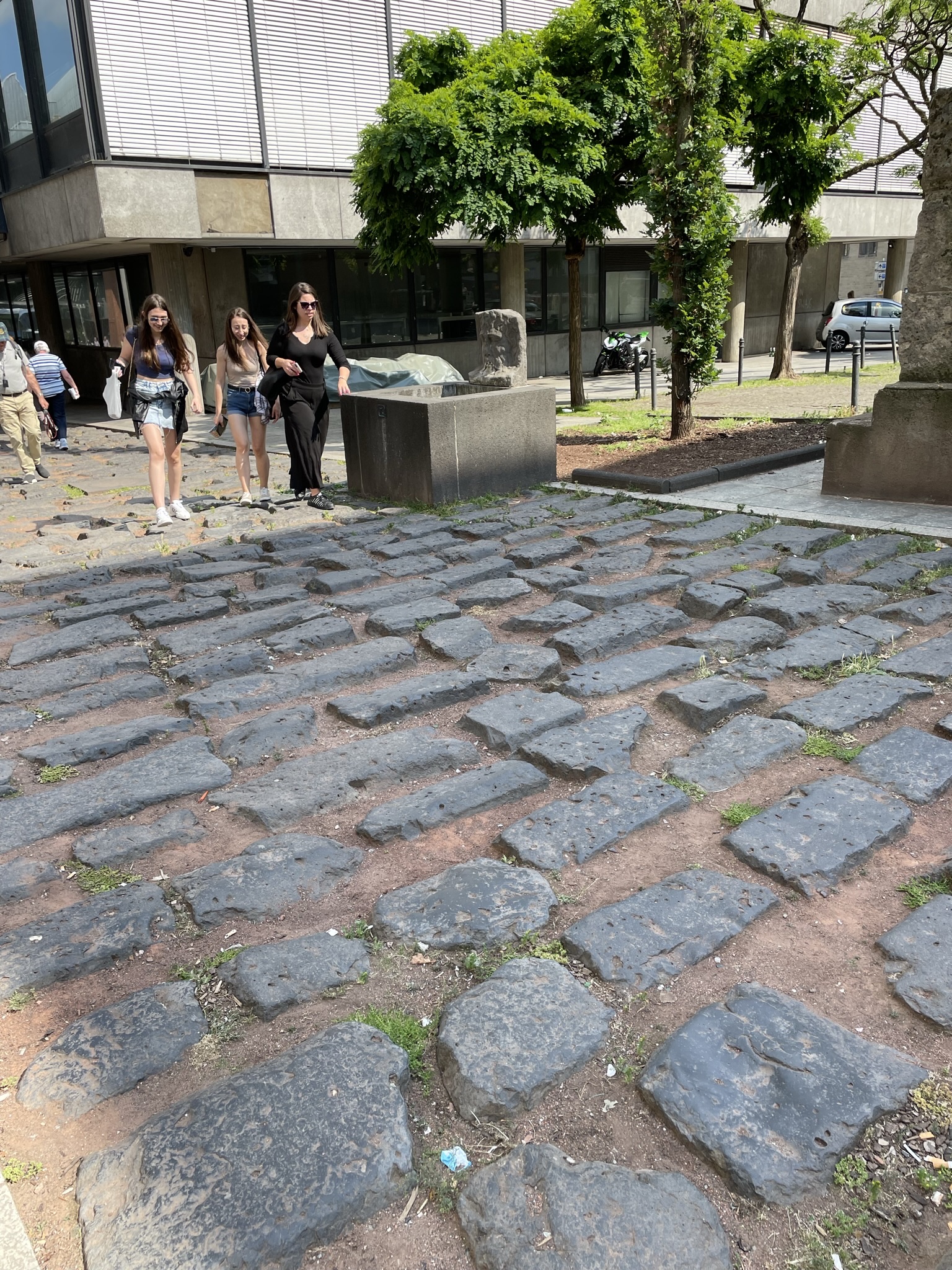
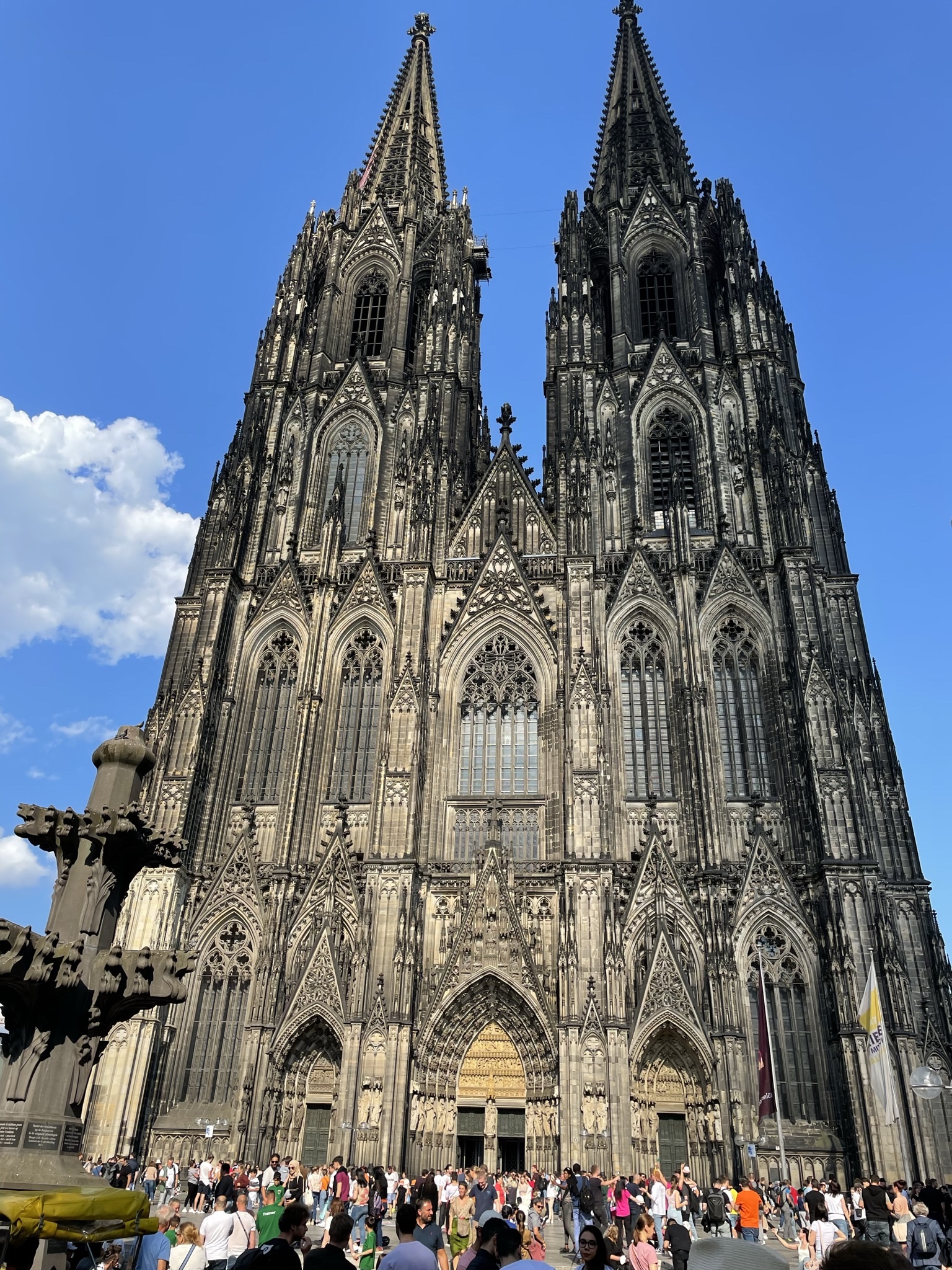
We arrived in Cologne mid-morning and after lunch dispersed to our various tours. Choices were a walking tour of the old town, Kolsch Beer tasting, or a bike tour. We opted for the walking tour. Cologne is the fourth most populous city in Germany and the largest city on the Rhine River. The medieval Cologne Catholic Cathedral is, of course, its focal point. It ranks as the tallest cathedral in the world and was built to house the Shrine of the Three Kings. The city was one of the largest European cities in medieval and renaissance times. Cologne was one of the most heavily bombed cities in Germany during World War II resulting in 95% of the millennia-old city centre being completely destroyed. The post-war rebuilding effort has provided for a mixed cityscape with modern buildings interspersed with a few restored major historic landmarks such as city gates and churches, including about 31 in the Romanesque style. Unfortunately, because the Mass was being held, we were unable to view it from the inside.

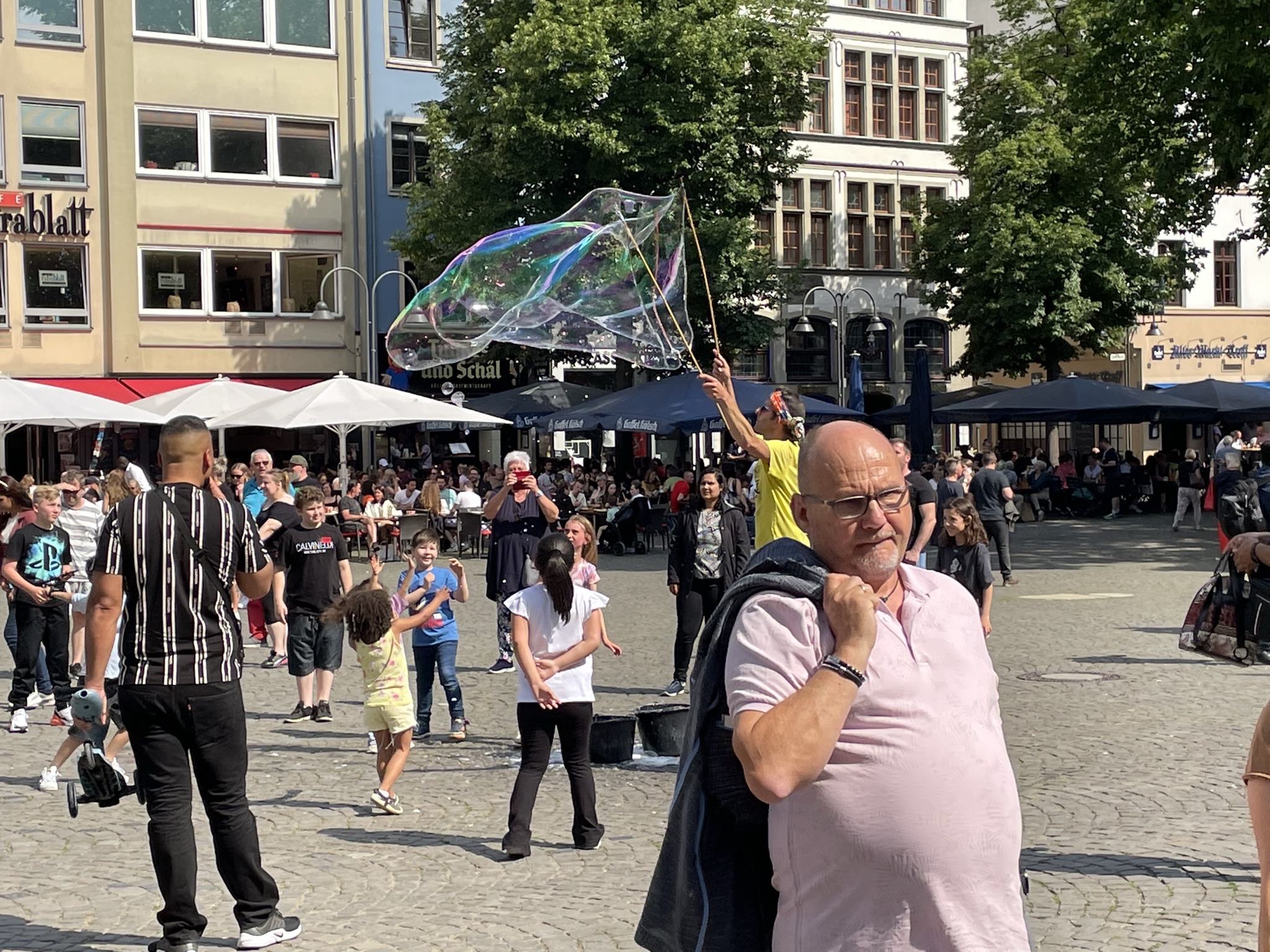
One of the large annual celebrations in Cologne is Carnival, celebrated in its current form for over 190 years. It’s now known as Germany’s craziest party, extending from the kick-off on November 11th and culminating in five days of craziness ending on Ash Wednesday. Carnival Clubs put on special events throughout the city and parades and costume balls abound. Millions of people pour into the city at the end. The Ostermann Fountain sits in the centre of Ostermannplatz Square in old town. The figures depicted on the fountain are references to the songs of Willi Ostermann, a musician and lyricist whose music is still popular during Carnival.

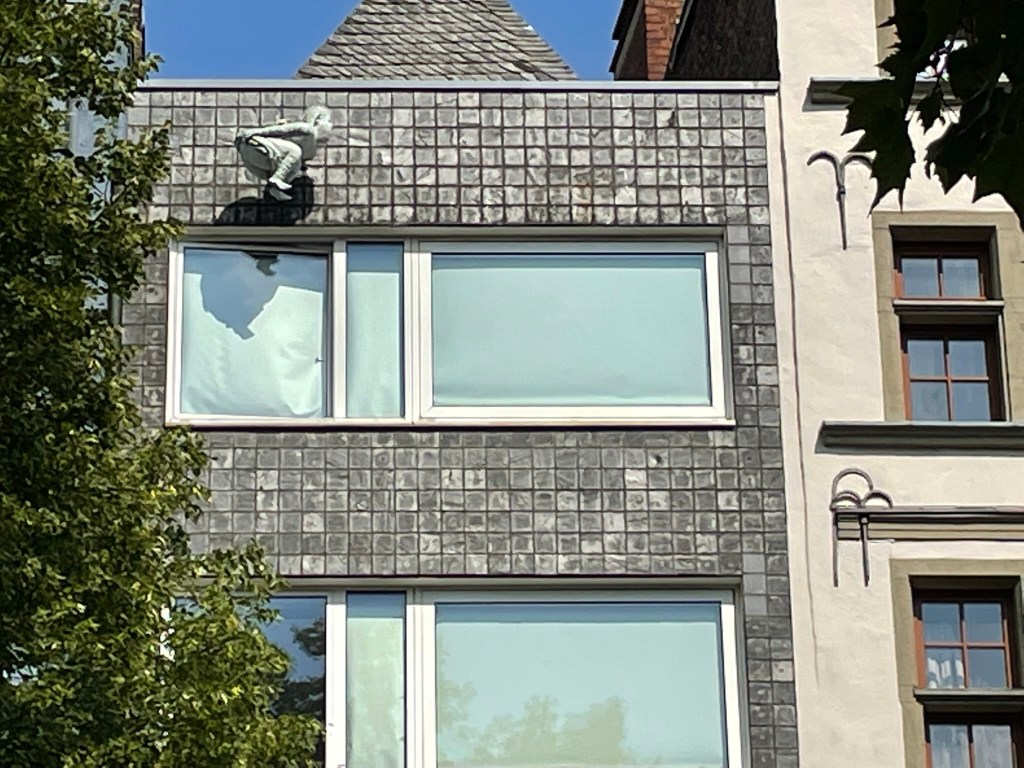
It’s common throughout Europe to find figures on building facades that have a special meaning. This builder/resident was giving a subtle message to the government.

Day 4 – Rhine Gorge to Rὒdesheim, Germany

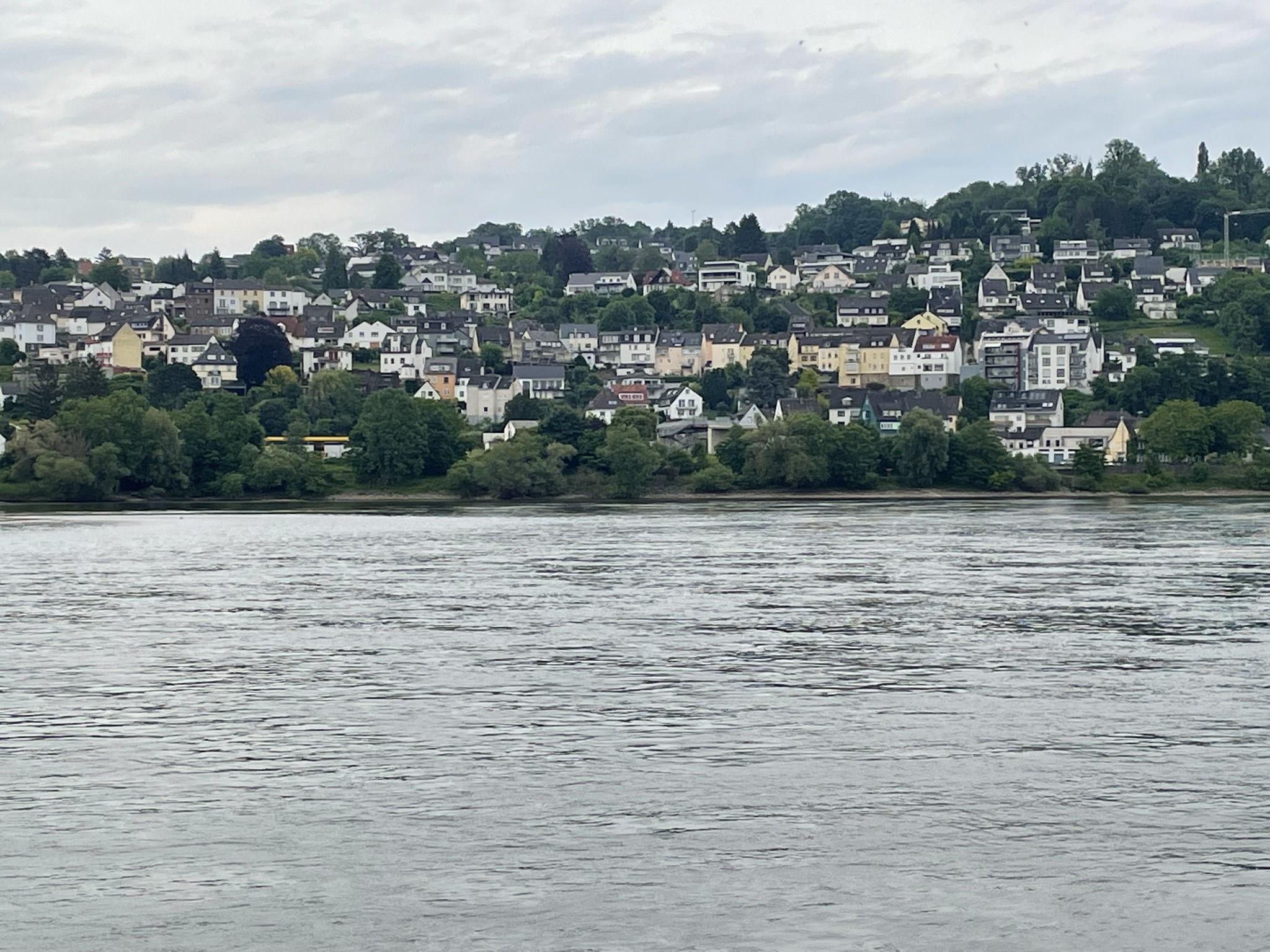
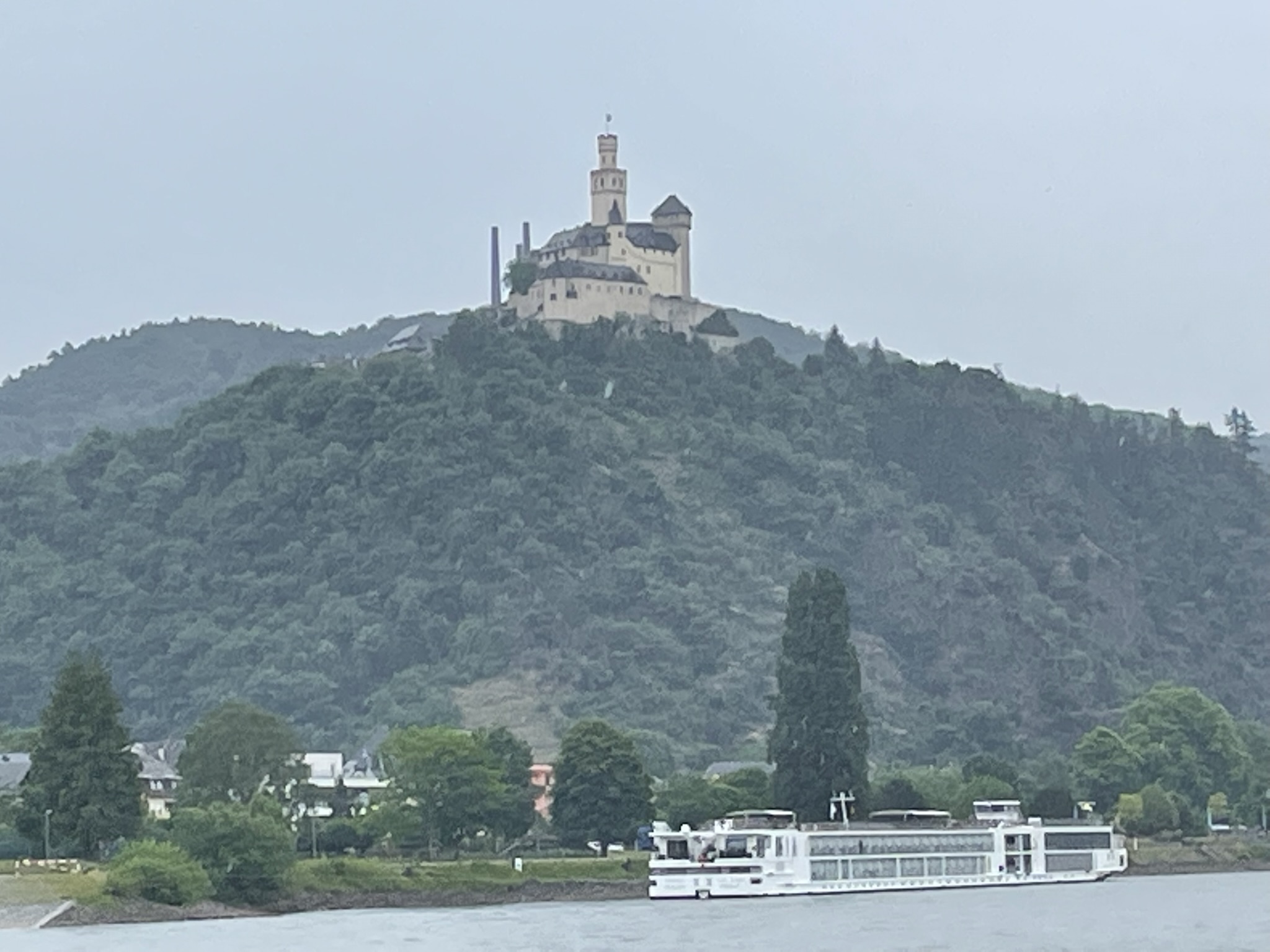
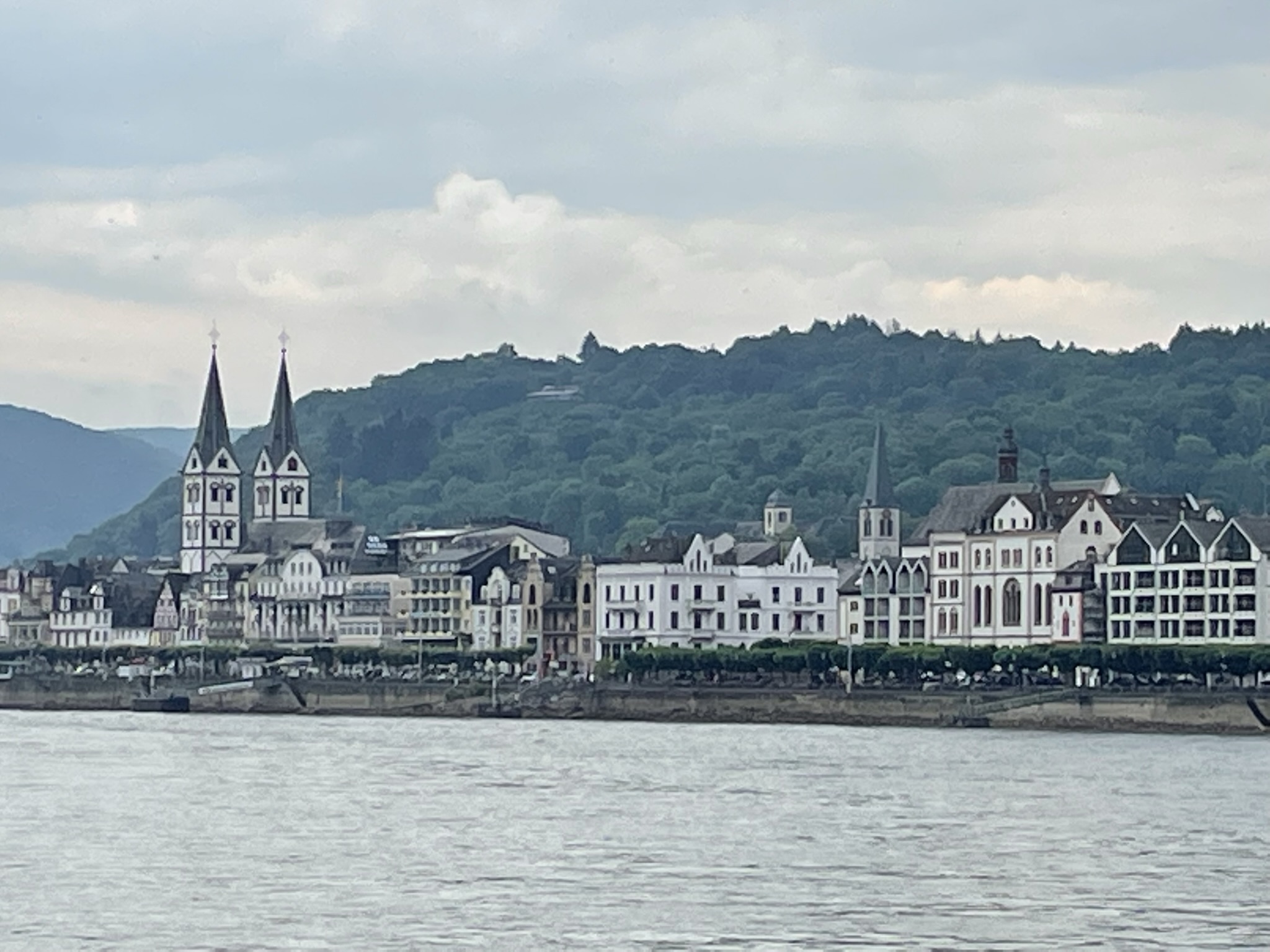
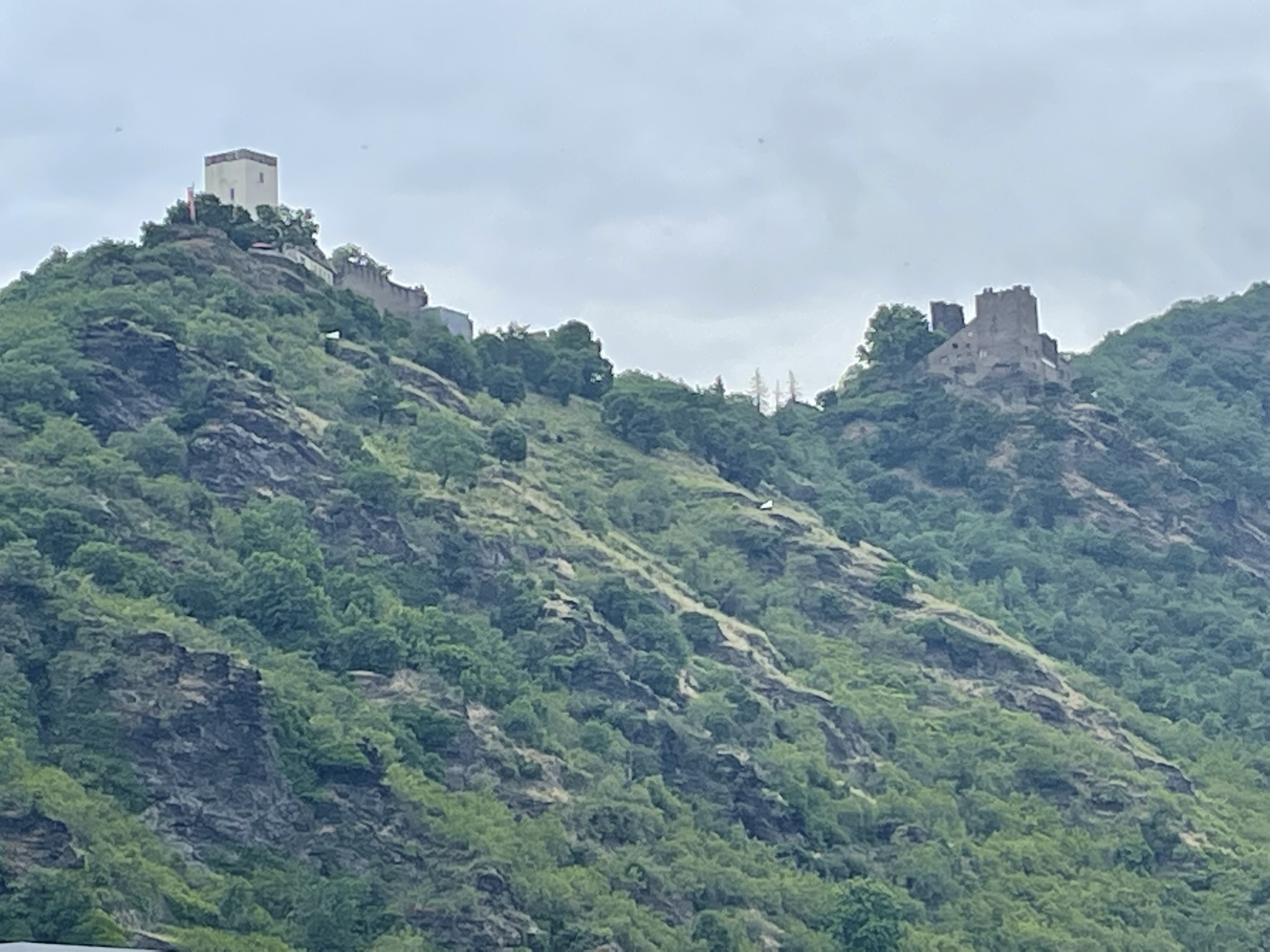
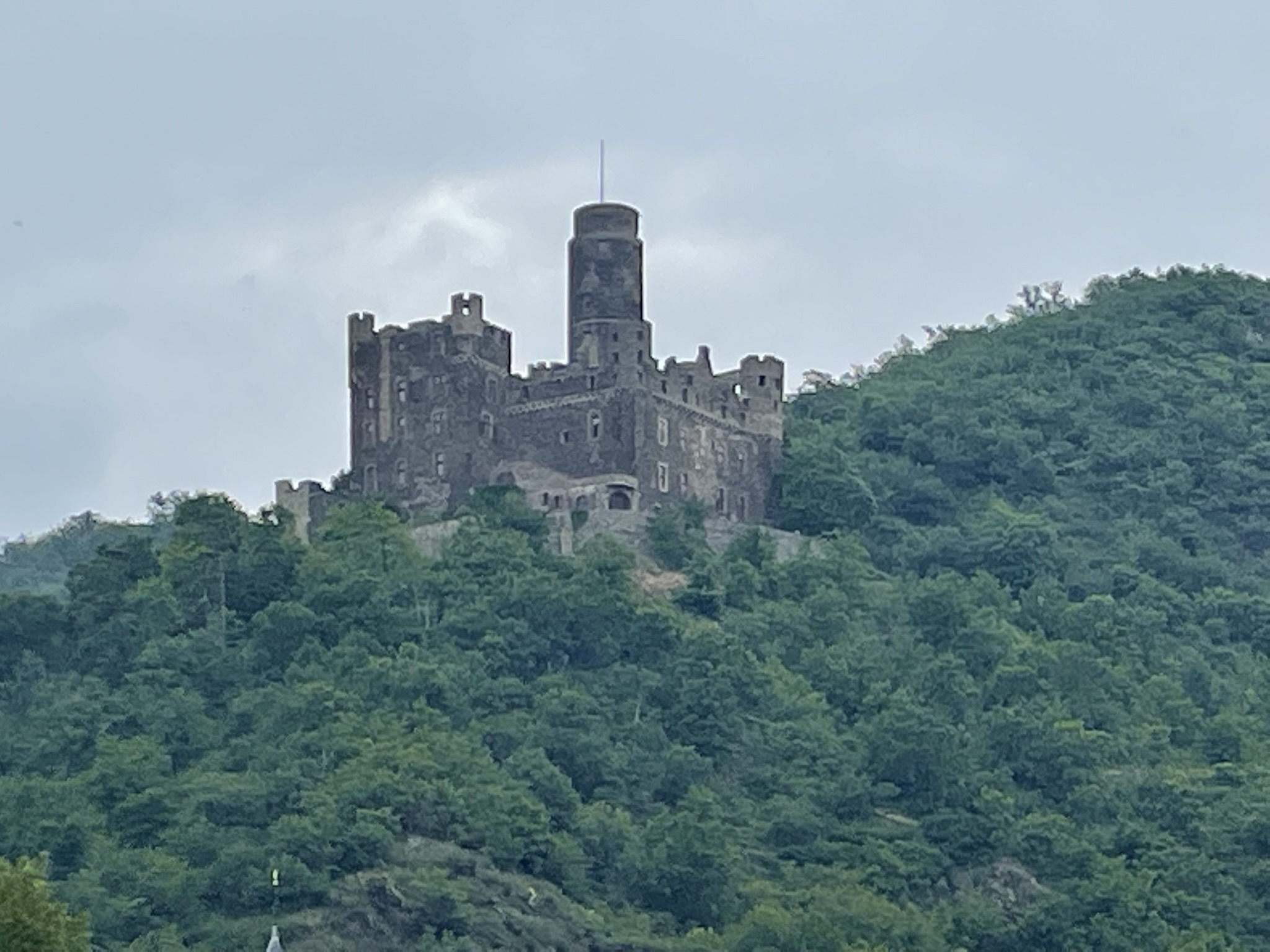
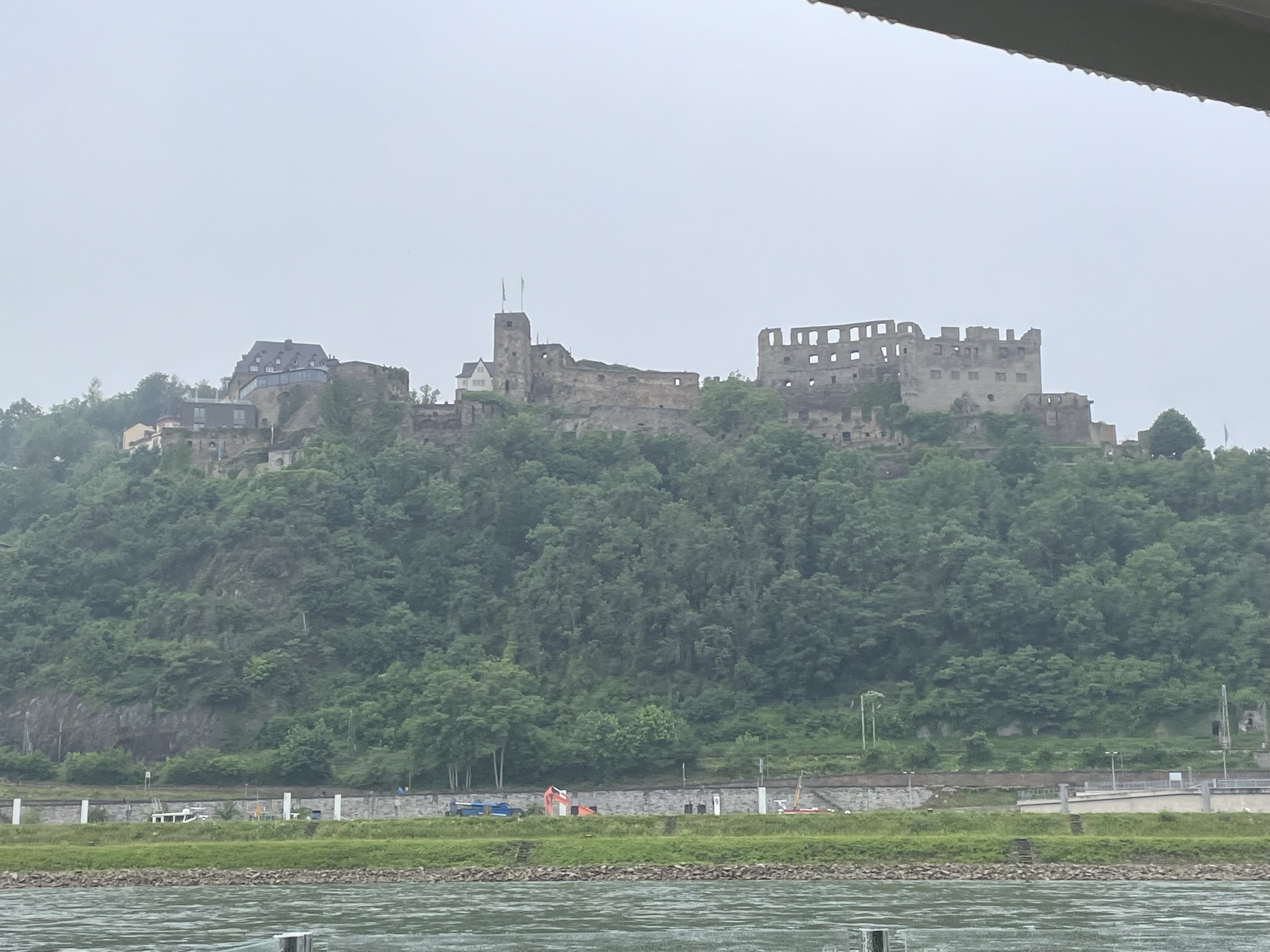
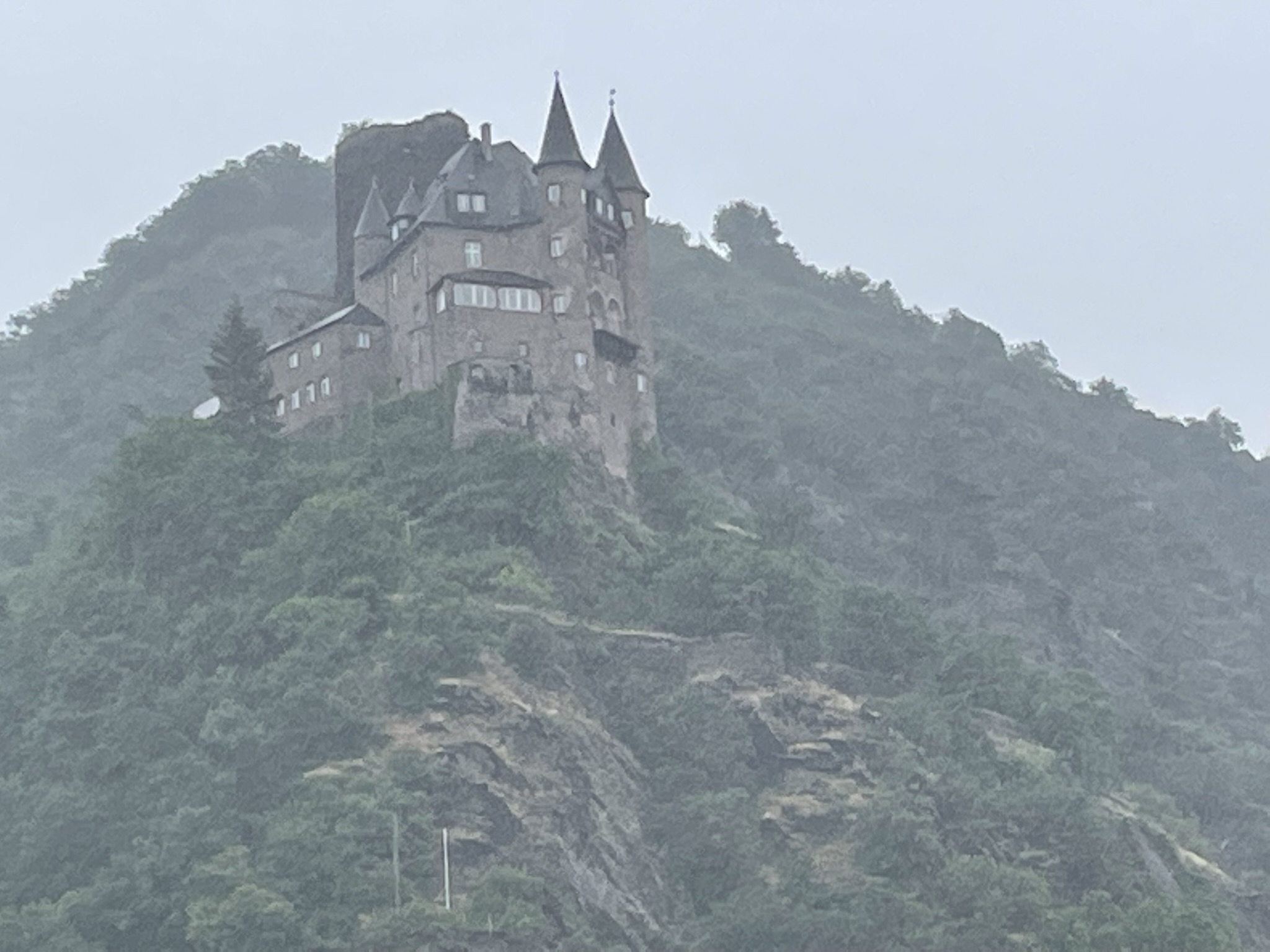
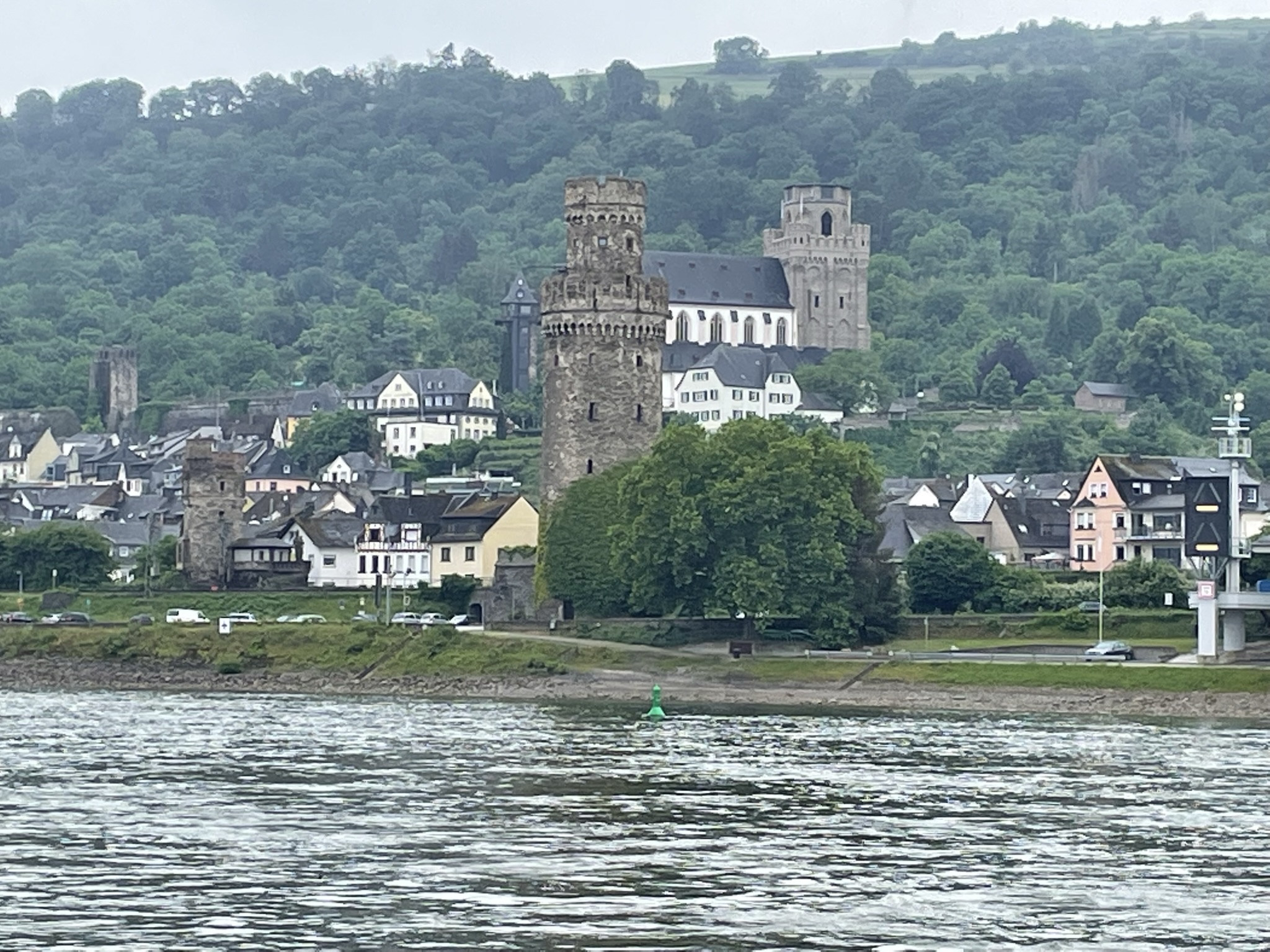
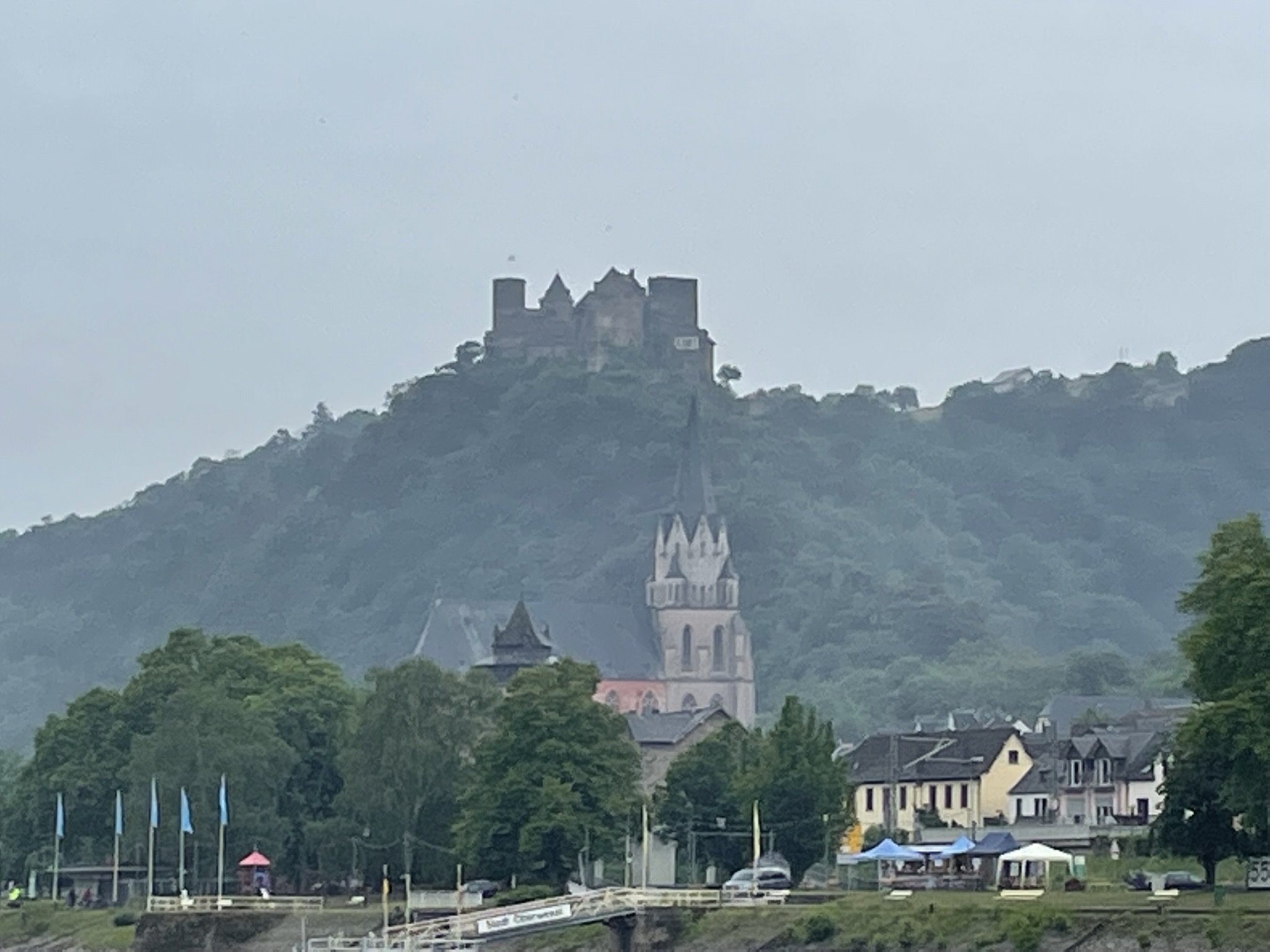
This morning’s cruise took us through the Rhine River Gorge – the popular name for the Upper Middle Rhine Valley, a 65 km section of the river between Bingen and Koblenz in Germany. In 2002, it was added to the UNESCO World Heritage Sites list for the unique combination of historical, cultural, industrial and geographical reasons. Unfortunately, it was a rainy, overcast day which meant it did not appear at its best. It was still a beautiful trip. The river has been an important trade route in Europe since prehistoric times and continues to be busy with both commercial and tourist traffic. Small settlements have grown up along the shoreline but are constrained in size, thus retaining their historic feel. With wealth came many castles and the valley became the core region of the Holy Roman Empire. Many were left in ruins after the Thirty Years War and have become the attraction for the cruising industry. The commentary on the boat was difficult to hear but we had taken Rick Steves’ guide book with us and were able to follow along with that.

Many of the castles still lie in ruins but some have been salvaged and serve as popular B&Bs, restaurants and museums. At some point we’d love to go back and explore this stretch of the river by auto.

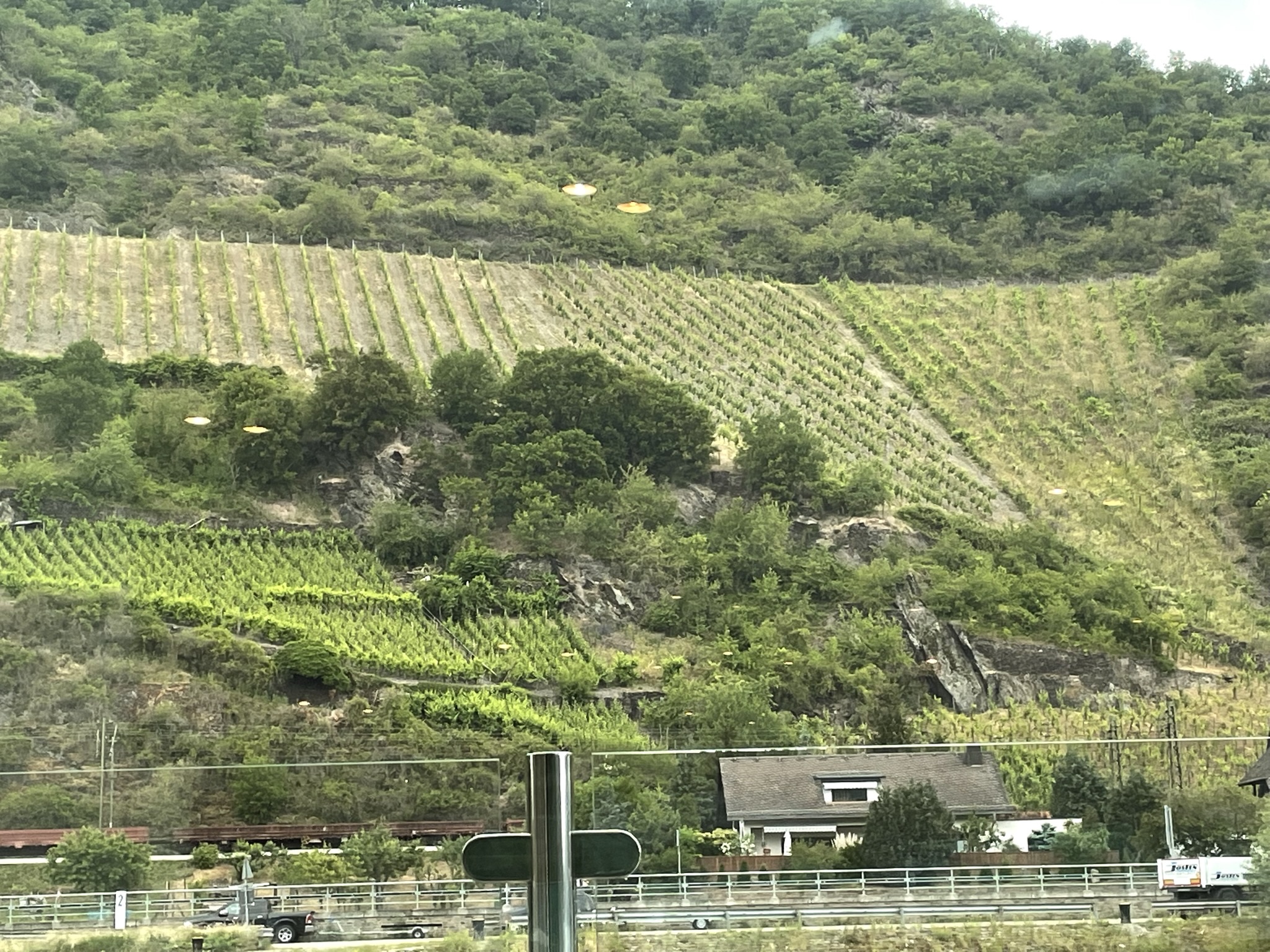
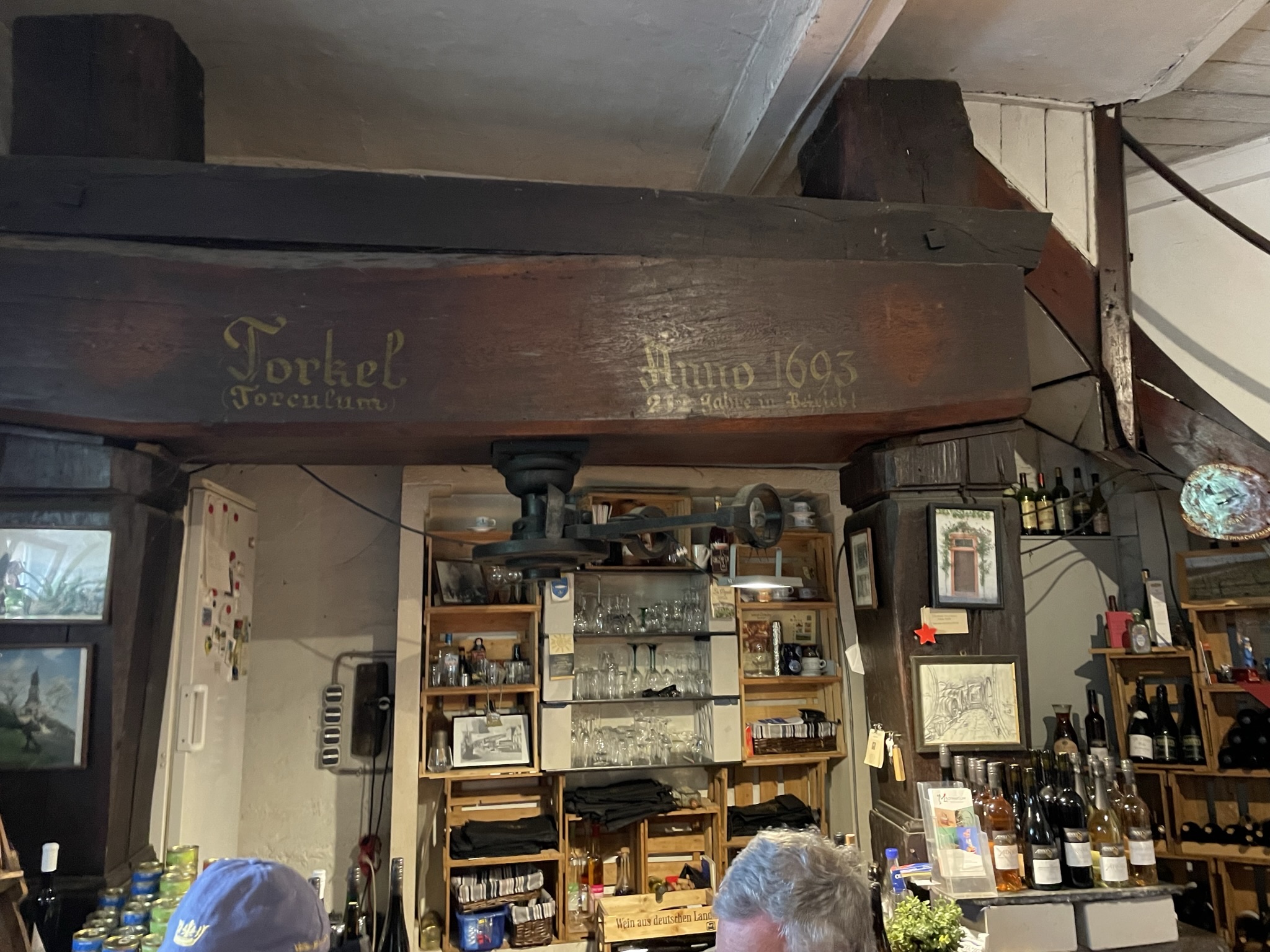
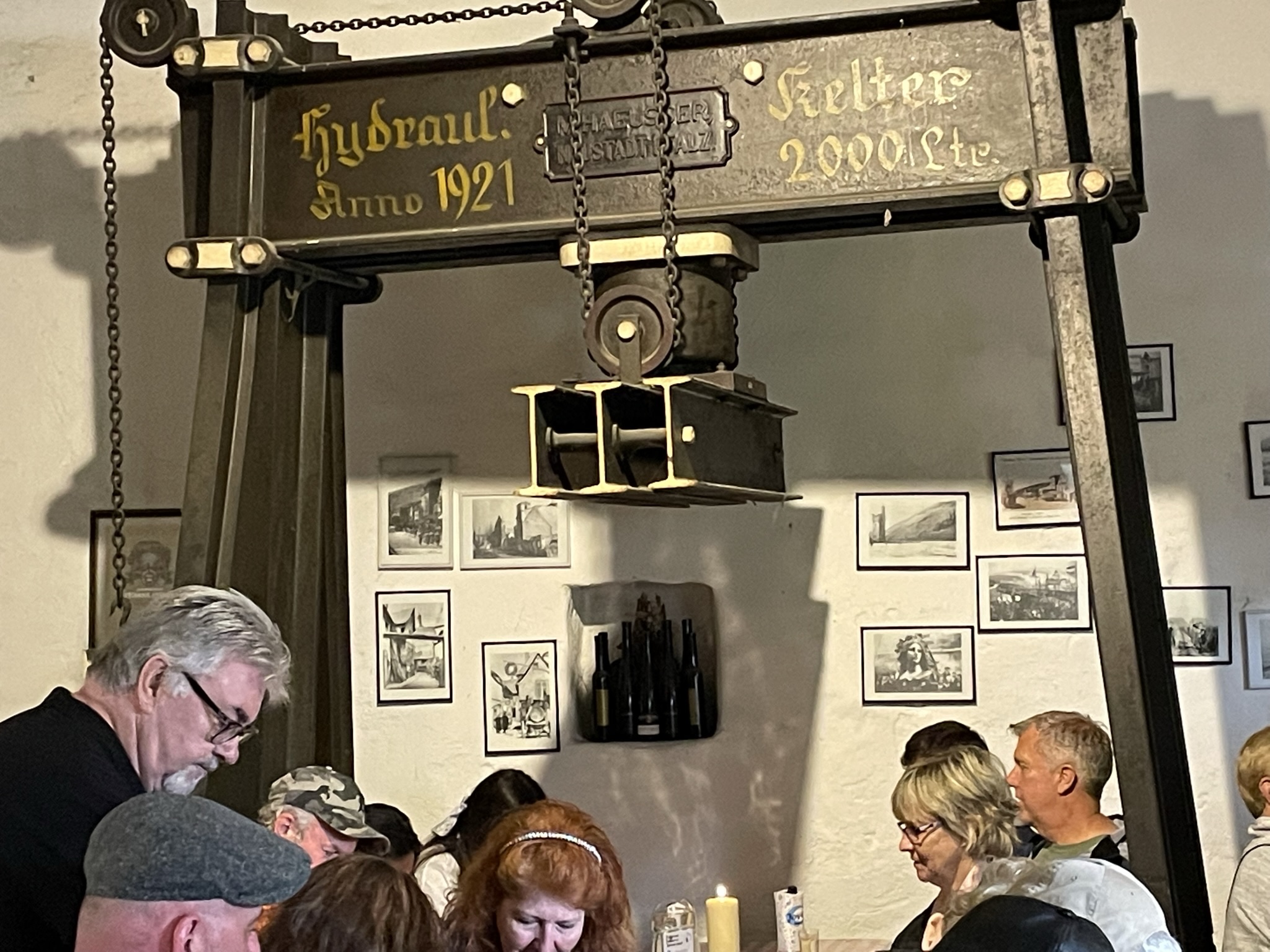
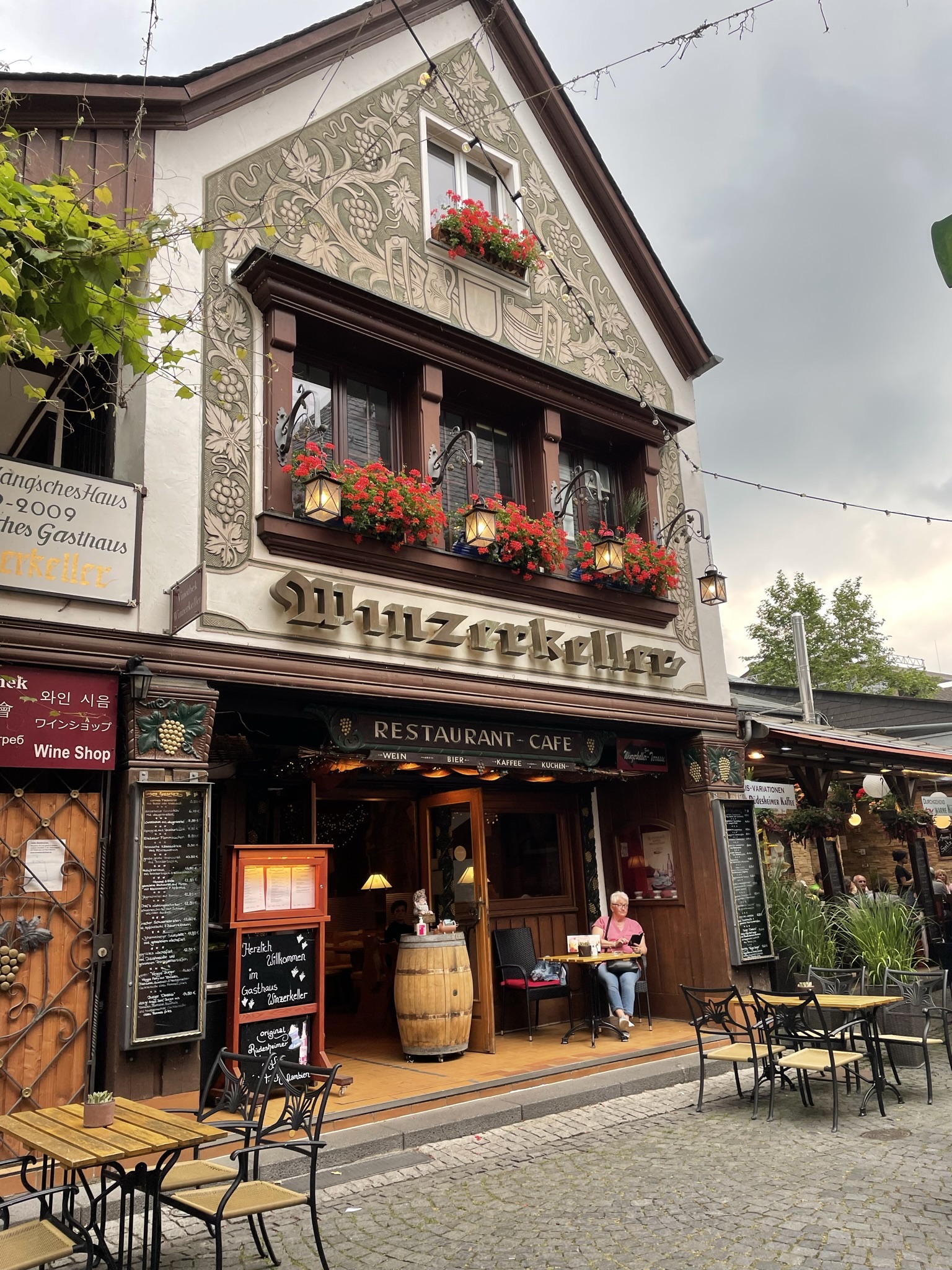
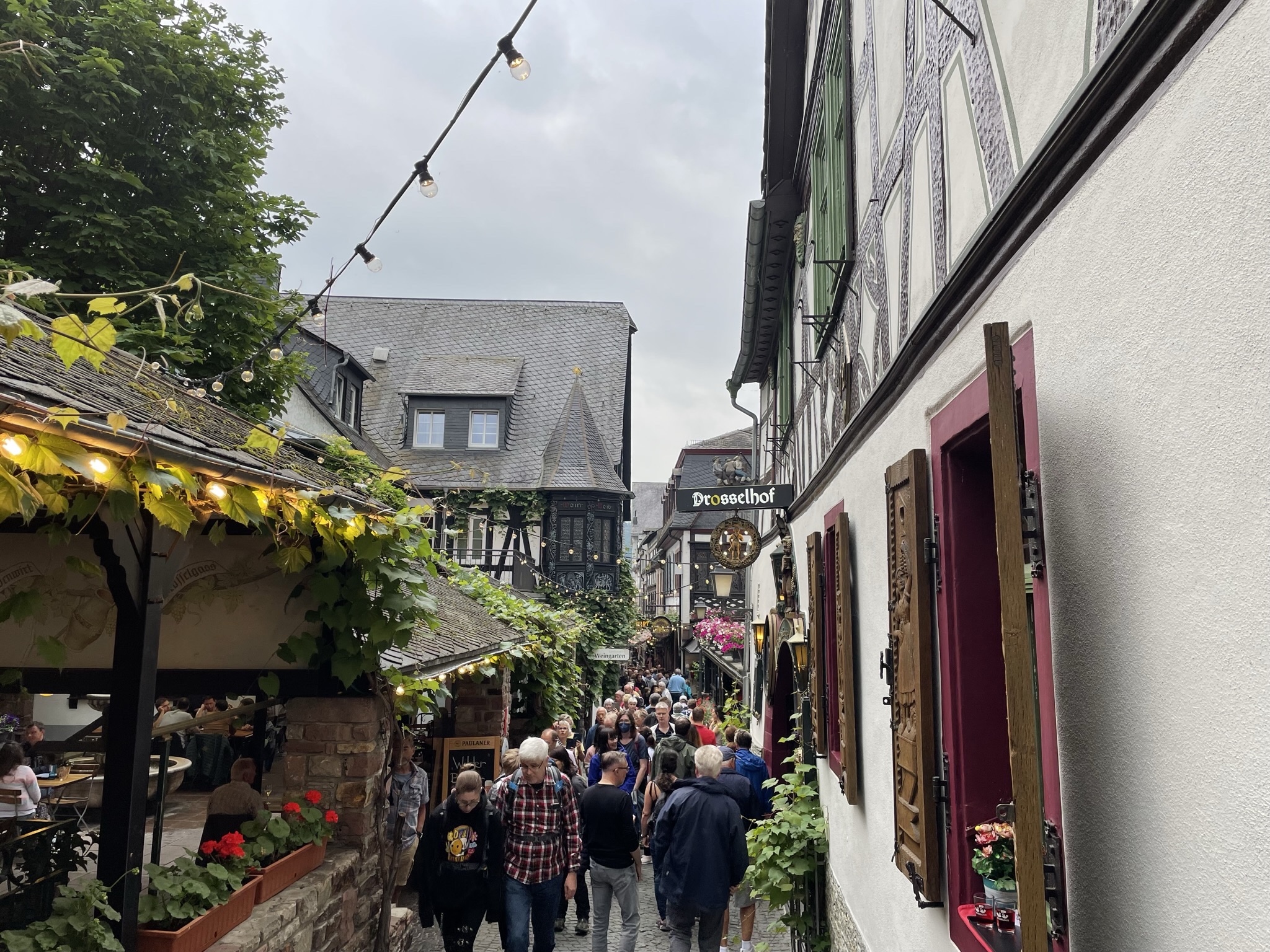
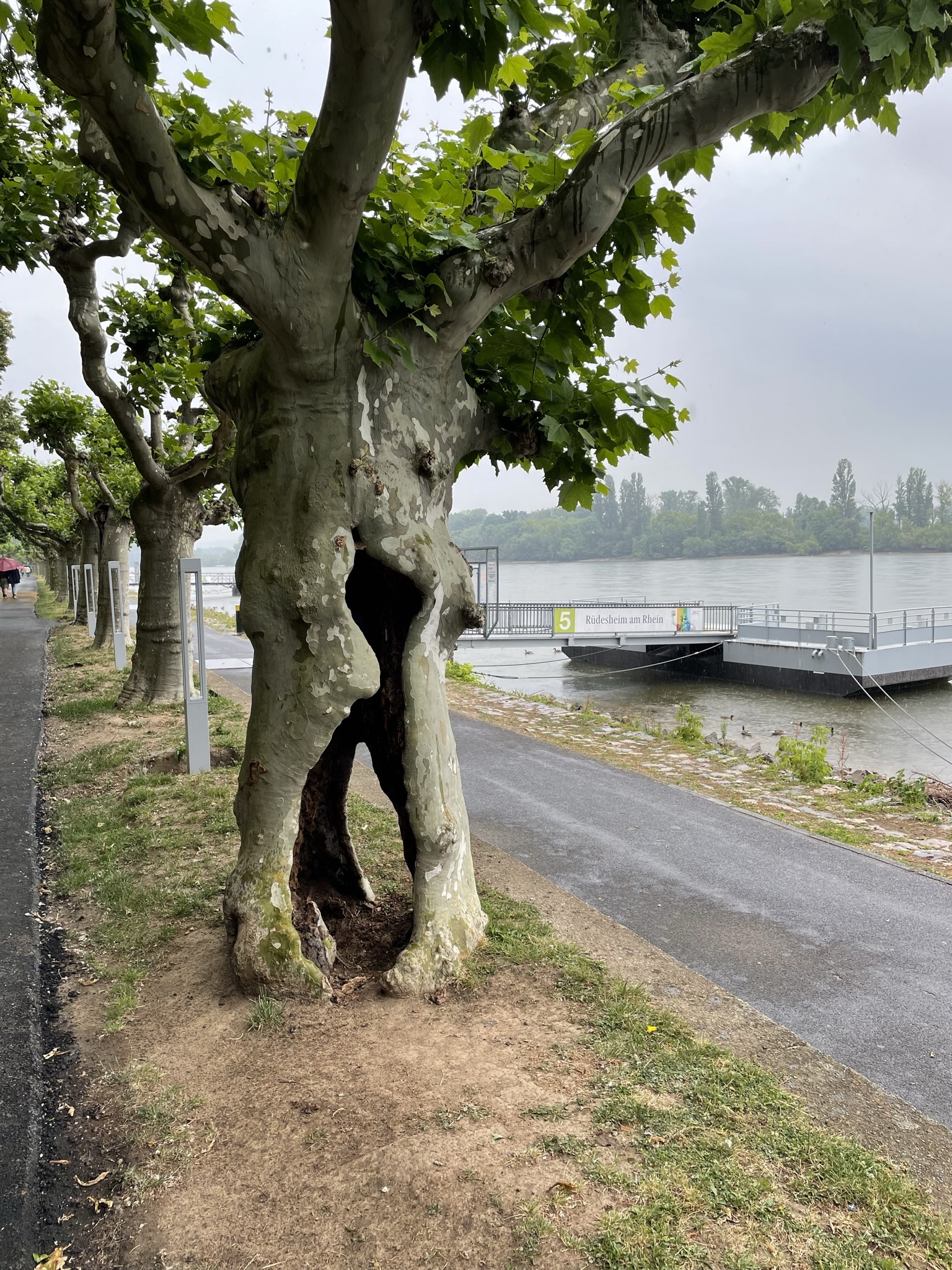
After lunch we arrived in Rὒdesheim am Rhein and had a choice of three different tours – a wine tasting, a vineyard hike, and a guided bike tour. We opted for the wine tasting. Rὒdesheim is another ancient city known best for its winemaking. Our visit was to the Adolf Storzel winery, in business since as early as 1647. It’s a family-owned and operated business and produces mostly Riesling and Pinot Noir wines. While the wine tastings take place in town, the winery is located on the outskirts of town and includes a new building with a restaurant overlooking the vineyards.

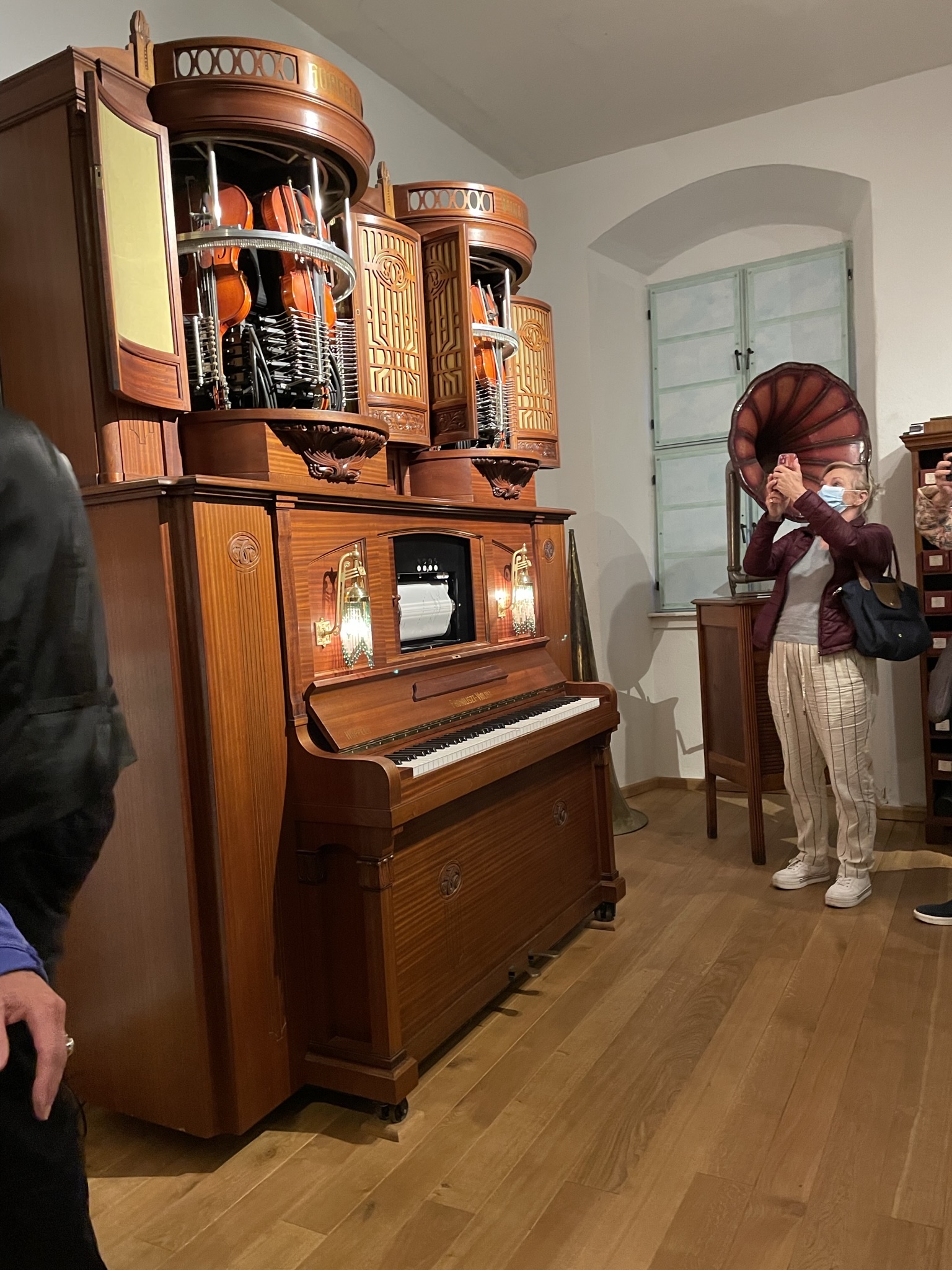
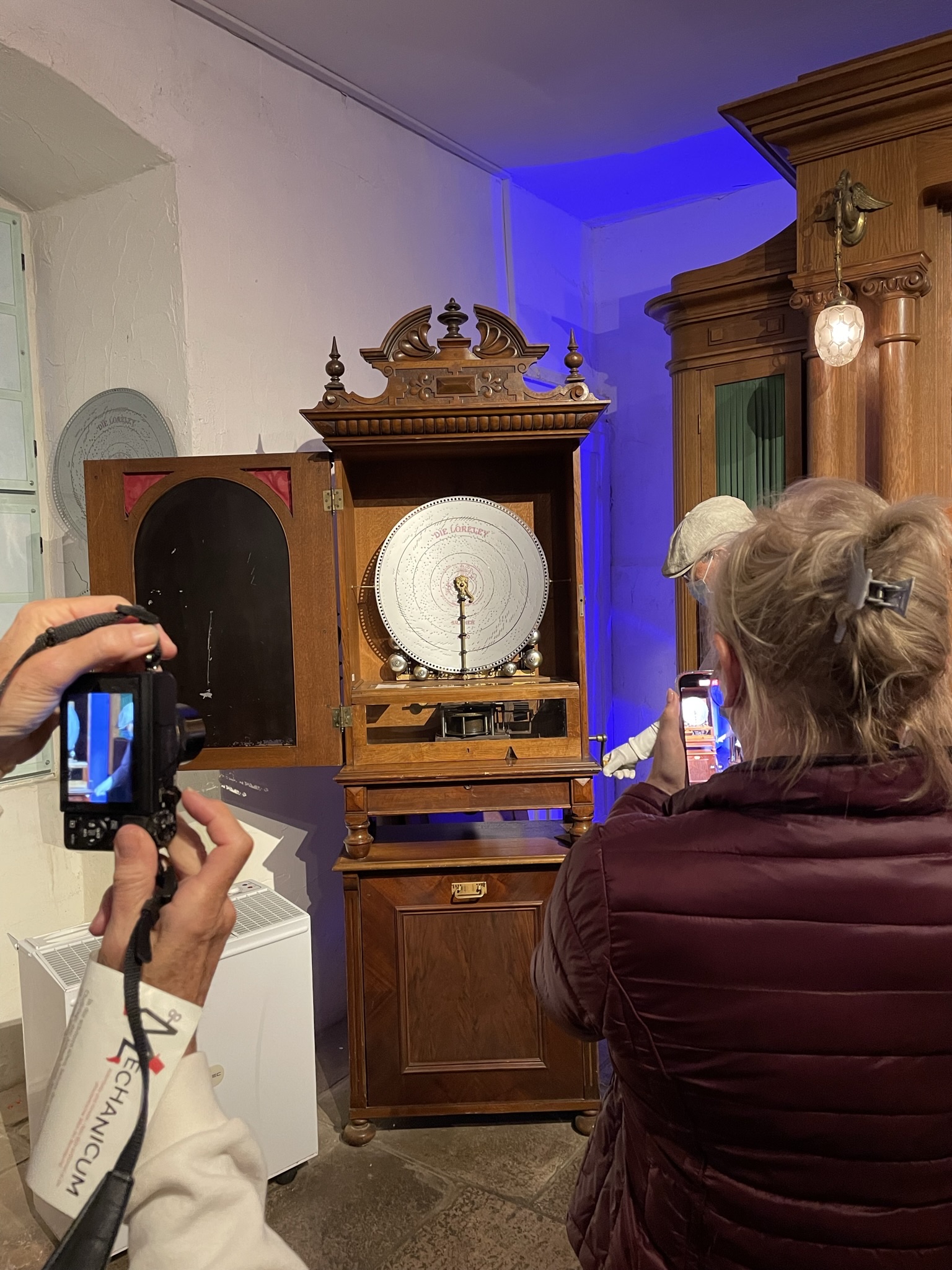
After dinner we had an opportunity to go back into town to visit the Siegfried’s Mechanical Musical Instrument Museum. What a unique place! There is a museum like this in Utrecht, which we had visited in 2012, but the difference is that most of the mechanical instruments here are all still in working order. And the tour guide (owner) was a delight!

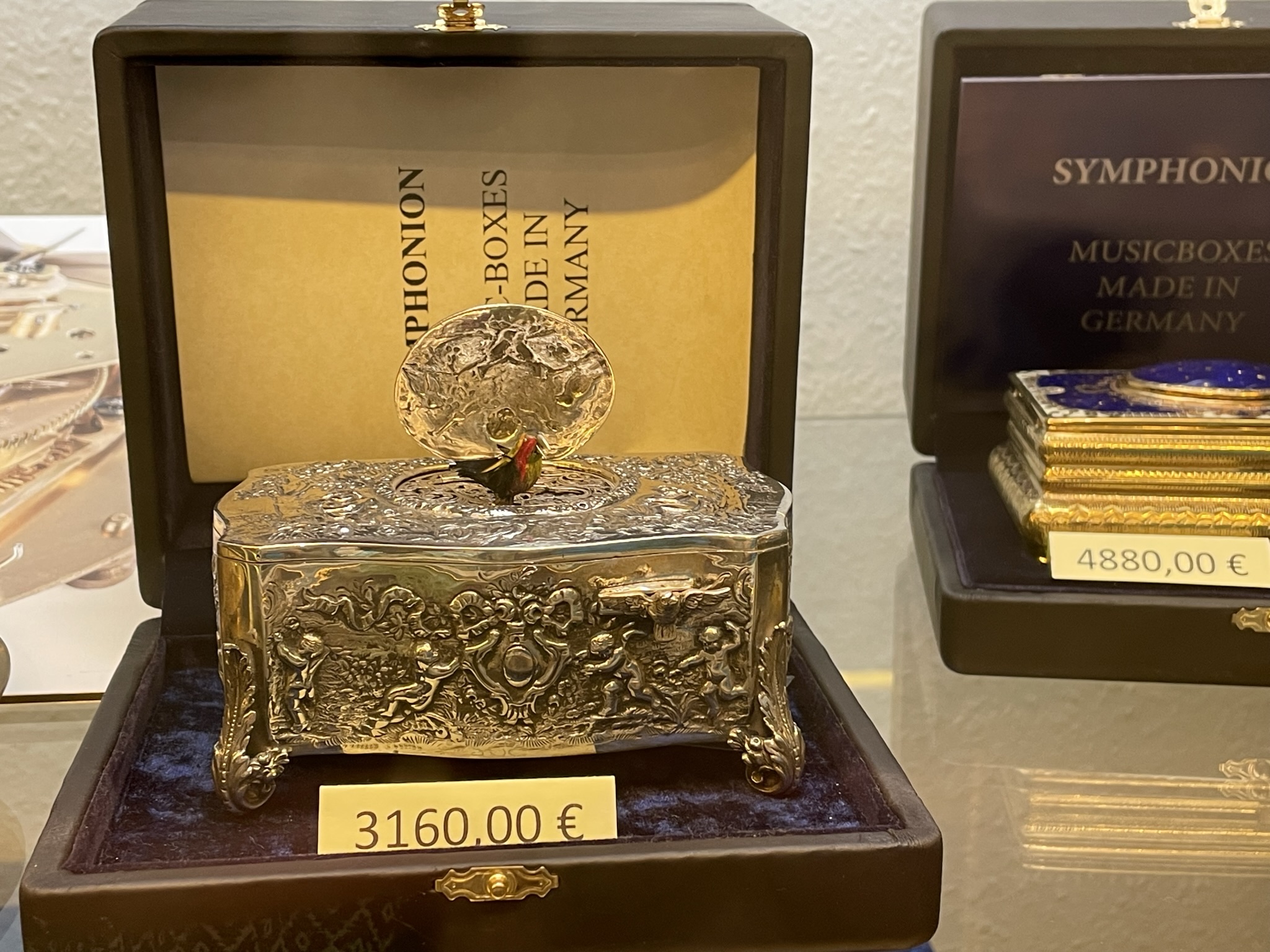
For someone who collects music boxes, this one was a bit out of our price range.

Day 5 – Ludwigshafen, Germany

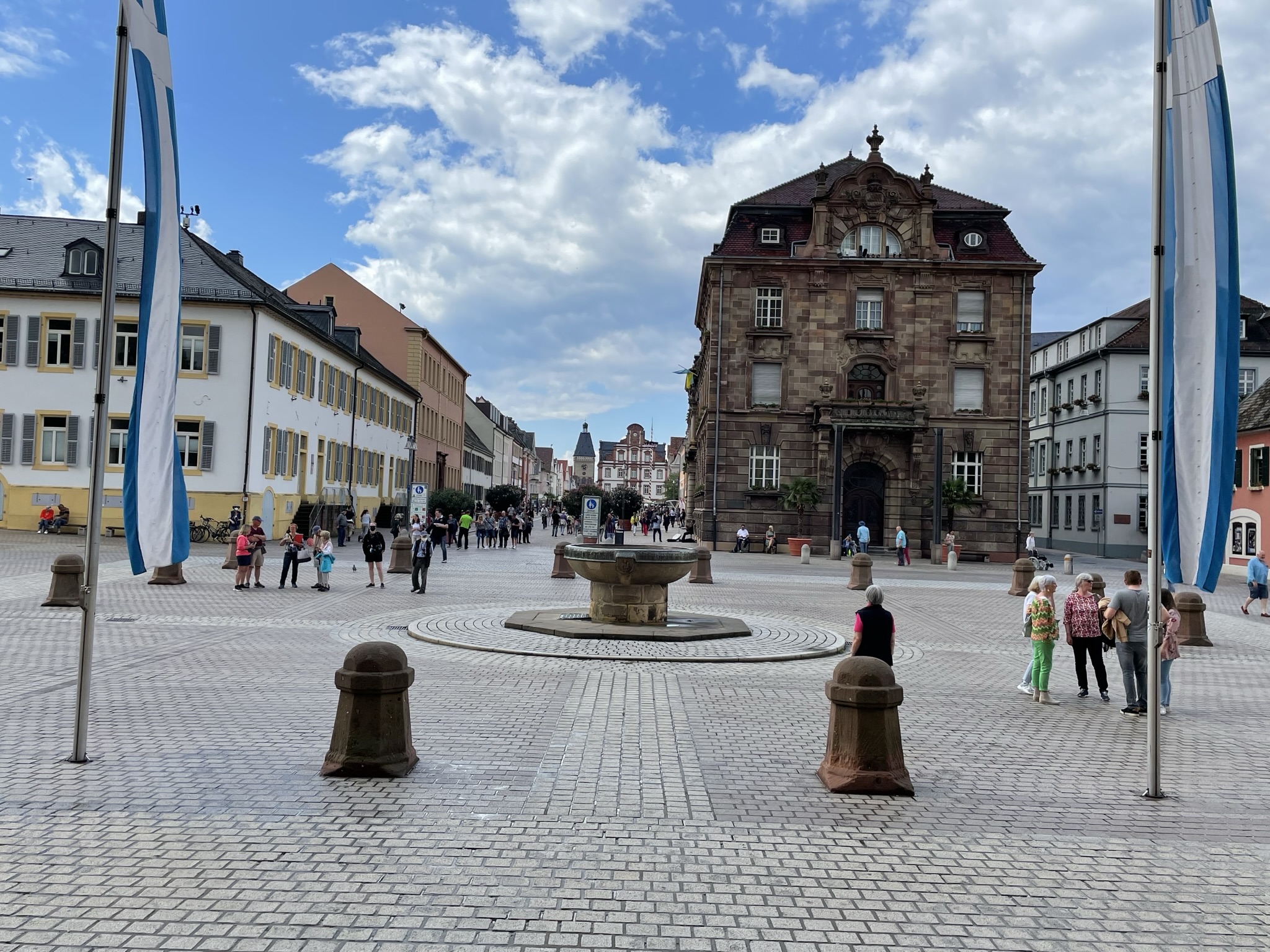
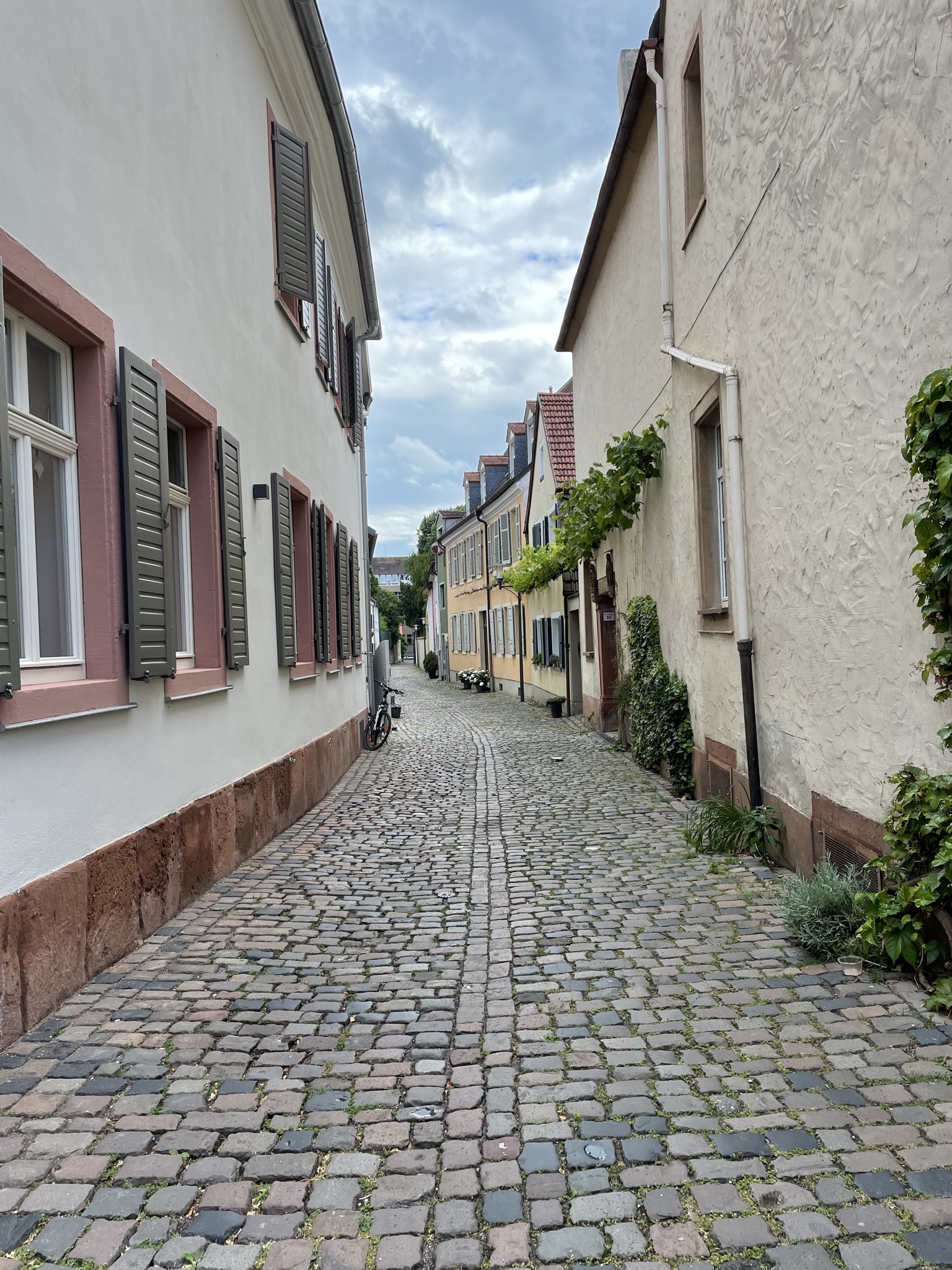
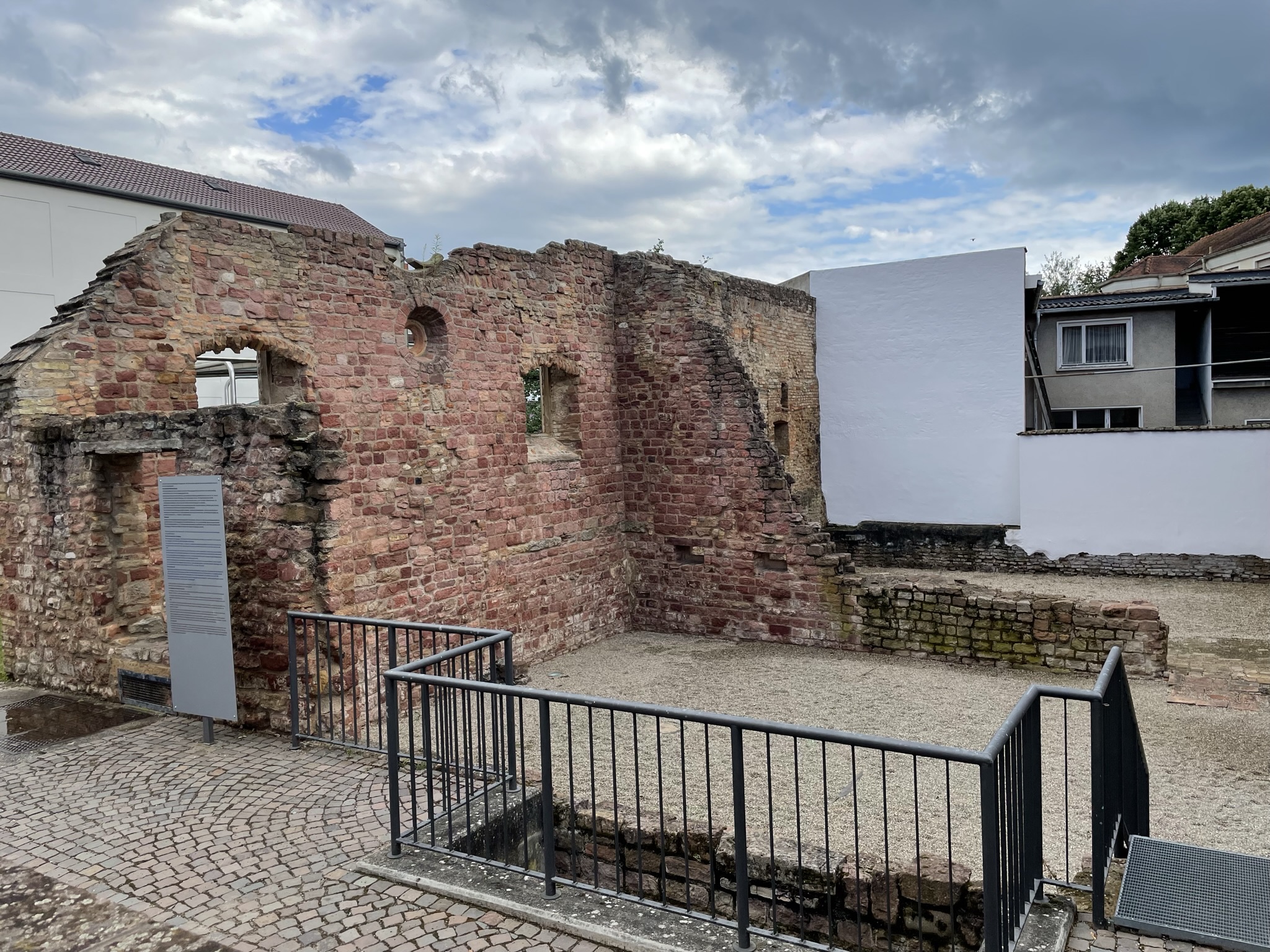
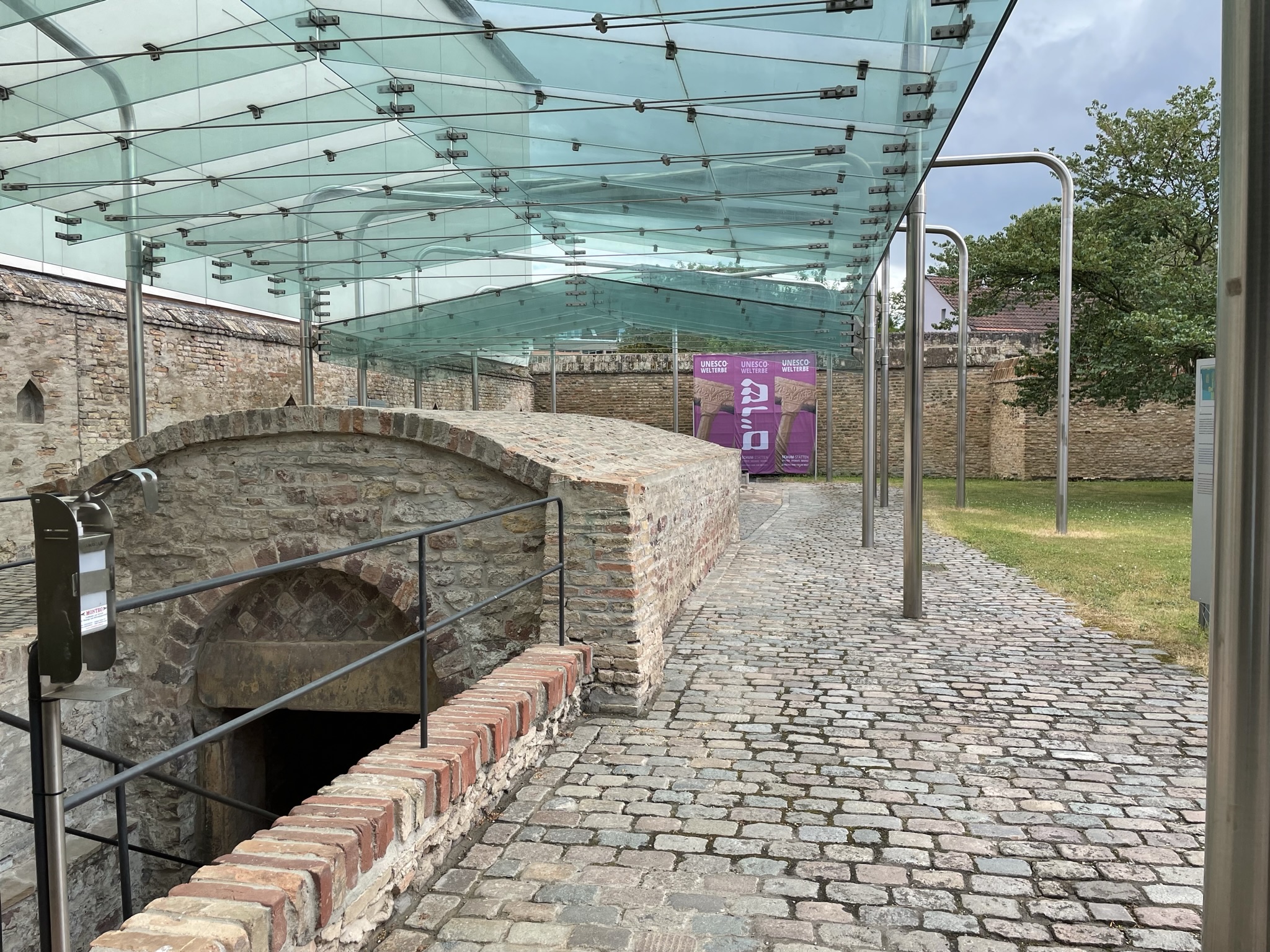
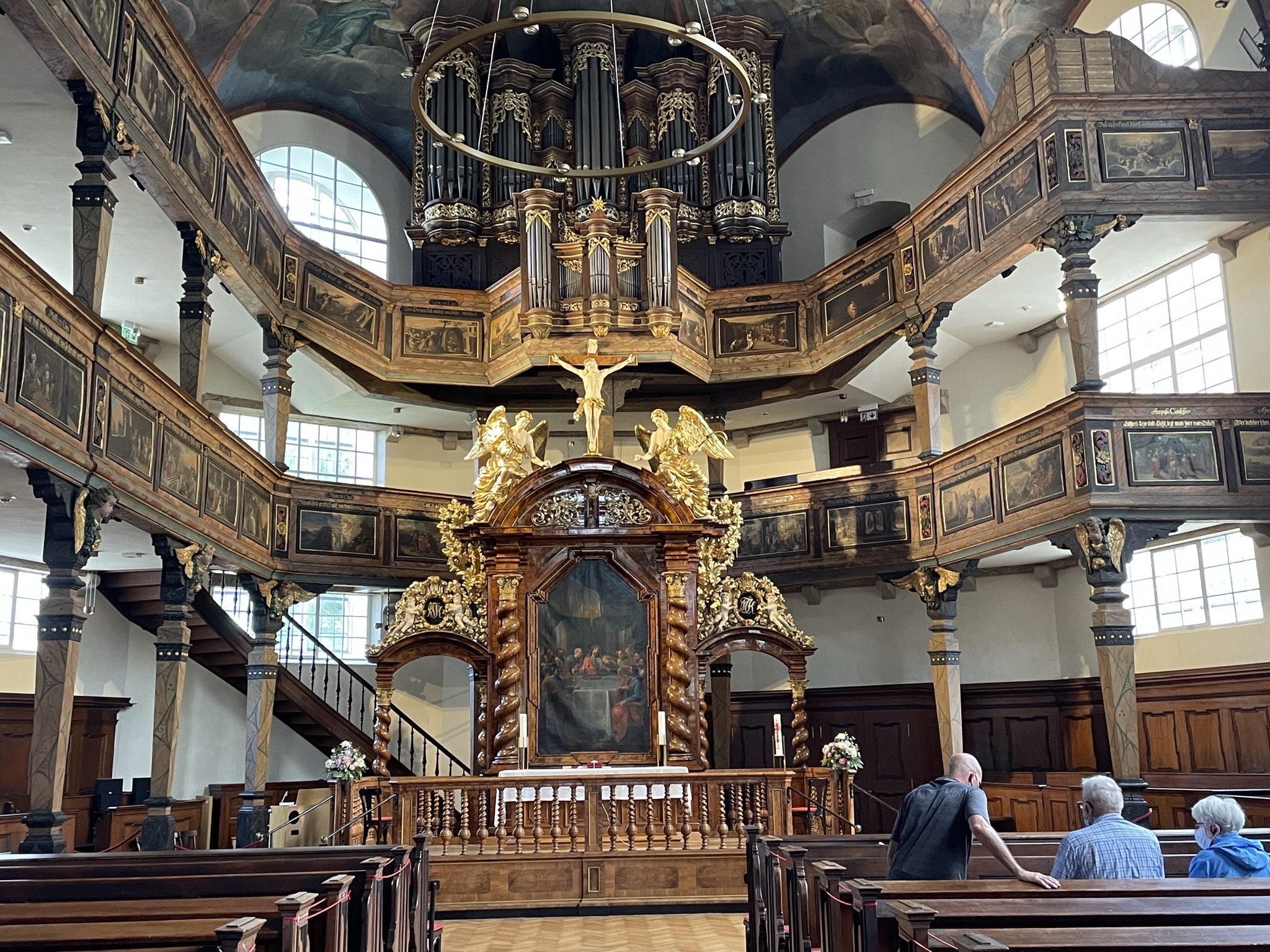
While our boat docked here, we didn’t really see the town as the port is in an industrial area. It is home to BASF, the world’s largest chemical producer and was the birth/death place of Chancellor Helmut Kohl. Directly across the river is the town of Mannheim.. Our choice of excursions today was a trip to Romantic Heidelberg, a walking tour of Speyer, a hike or a bike tour. We opted for the trip to Speyer, one of Germany’s oldest cities. Speyer Cathedral dominates the landscape and beneath the high altar are the tombs of eight Holy Roman Emperors and German Kings. The city is famous for the 1529 Protestation at Speyer which played a part in the unhindered spread of the evangelical faith and allowed for the spread of Martin Luther’s works and teachings. During the Middle Ages Speyer was the hometown of one of the most important Jewish communities in Northern Europe. The Jewish Courtyard with remnants of a medieval synagogue and intact mikveh are also a UNESCO World Heritage Site. Our local guide here was excellent.

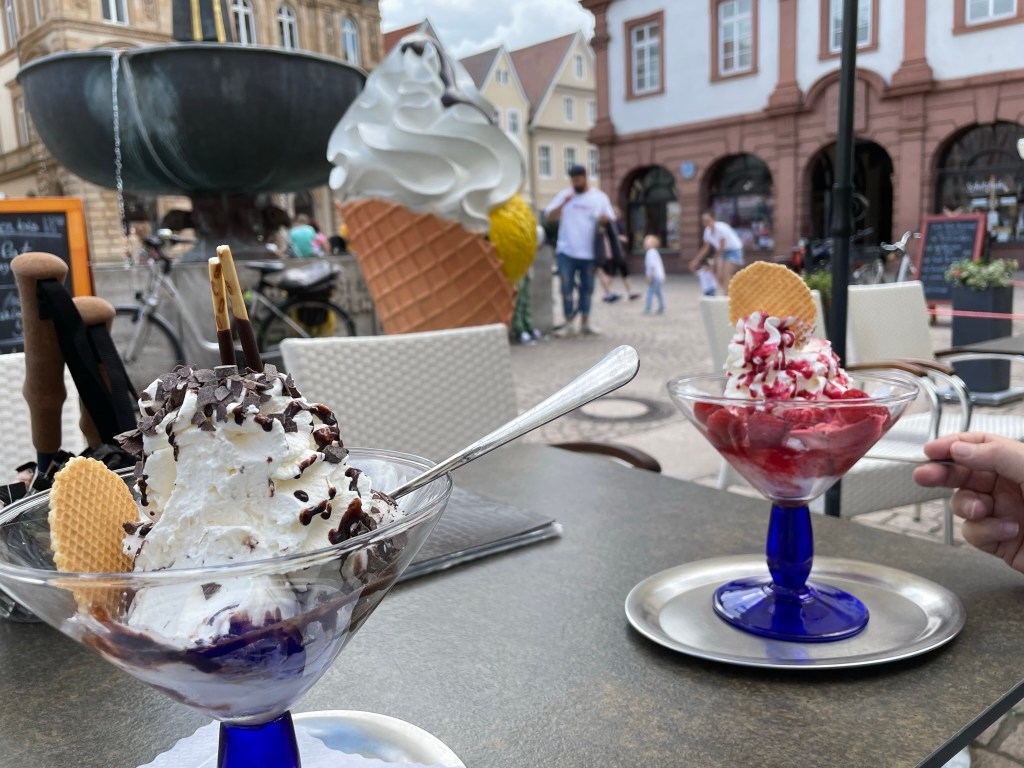
It was a very hot day when we visited Speyer and so we just had to stop for an ice cream treat.

Day 6 – Strasbourg, France

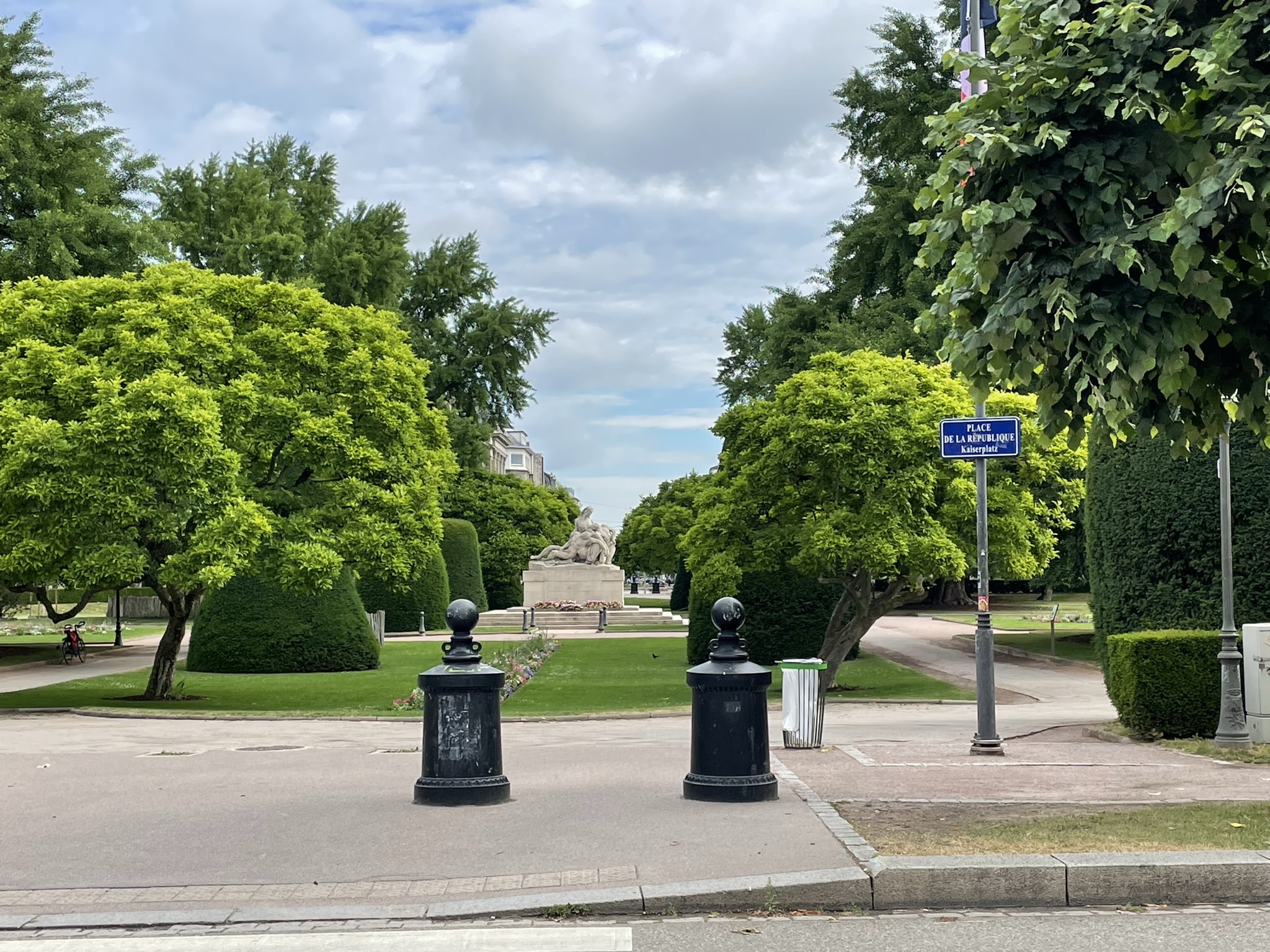
A quaint combination of French and German cultures makes this city a wonderful place to visit. It is the official seat of the European Parliament, and affiliated organizations, as well as many other European organizations separate from the EU.

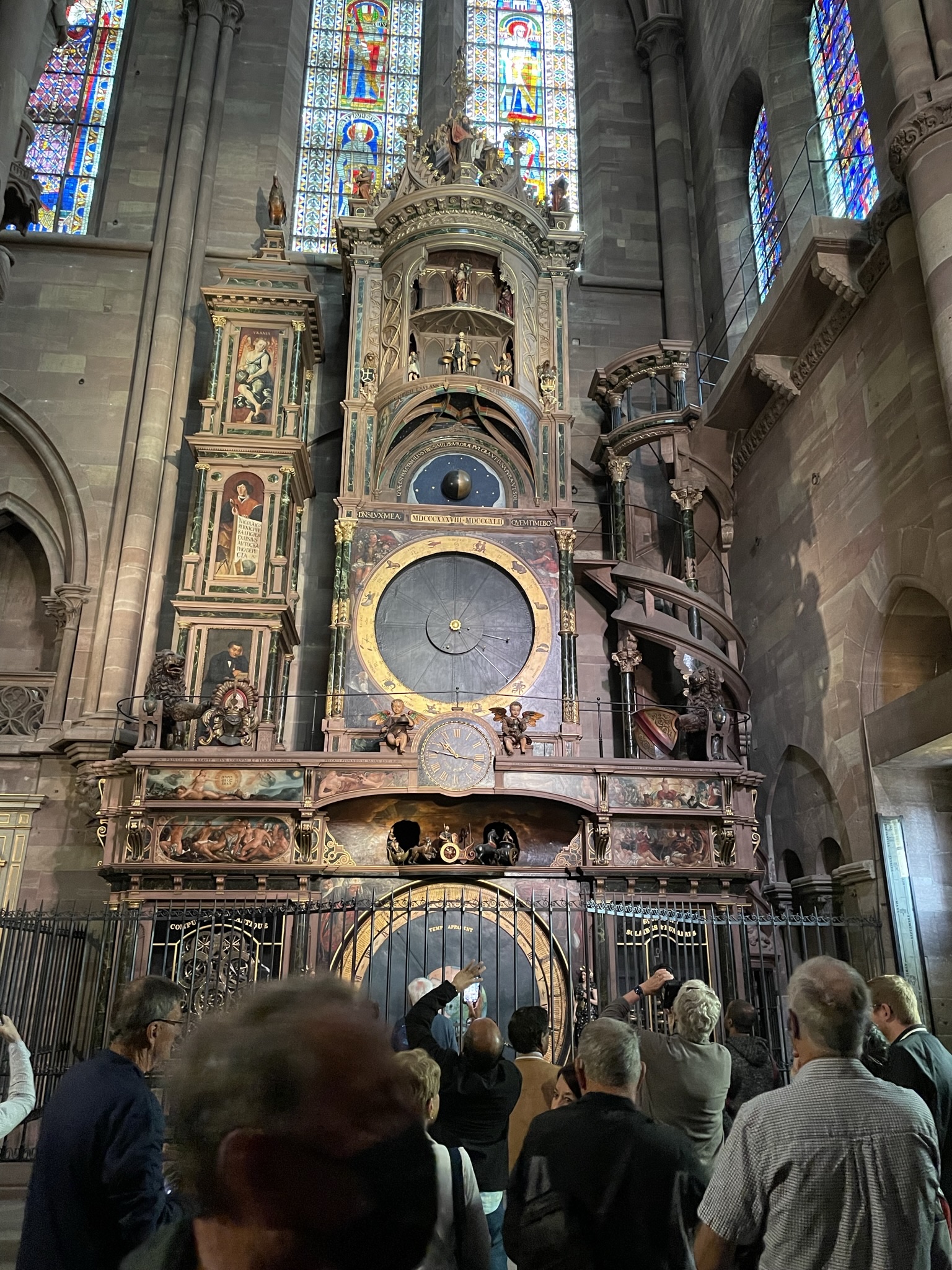
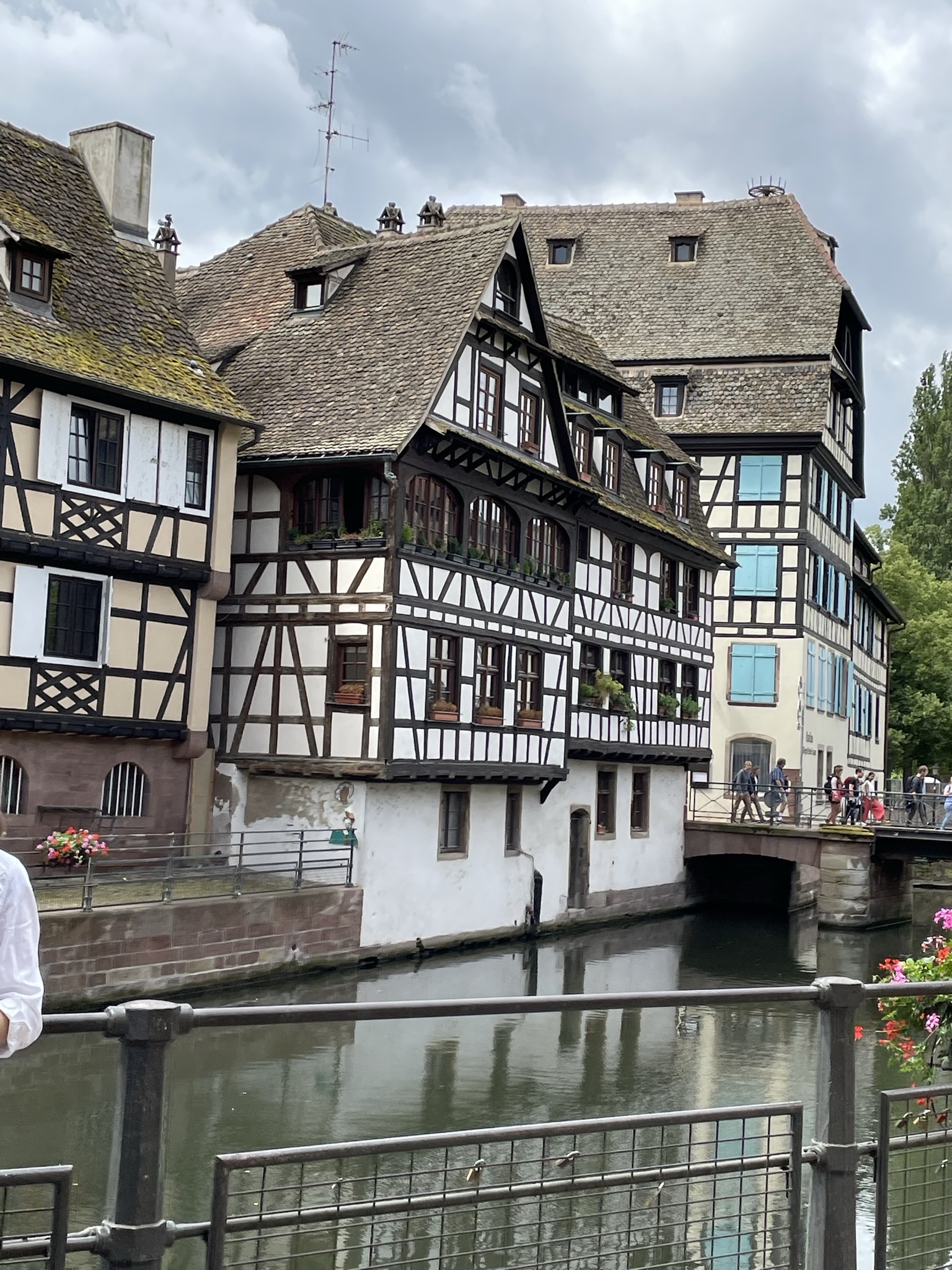
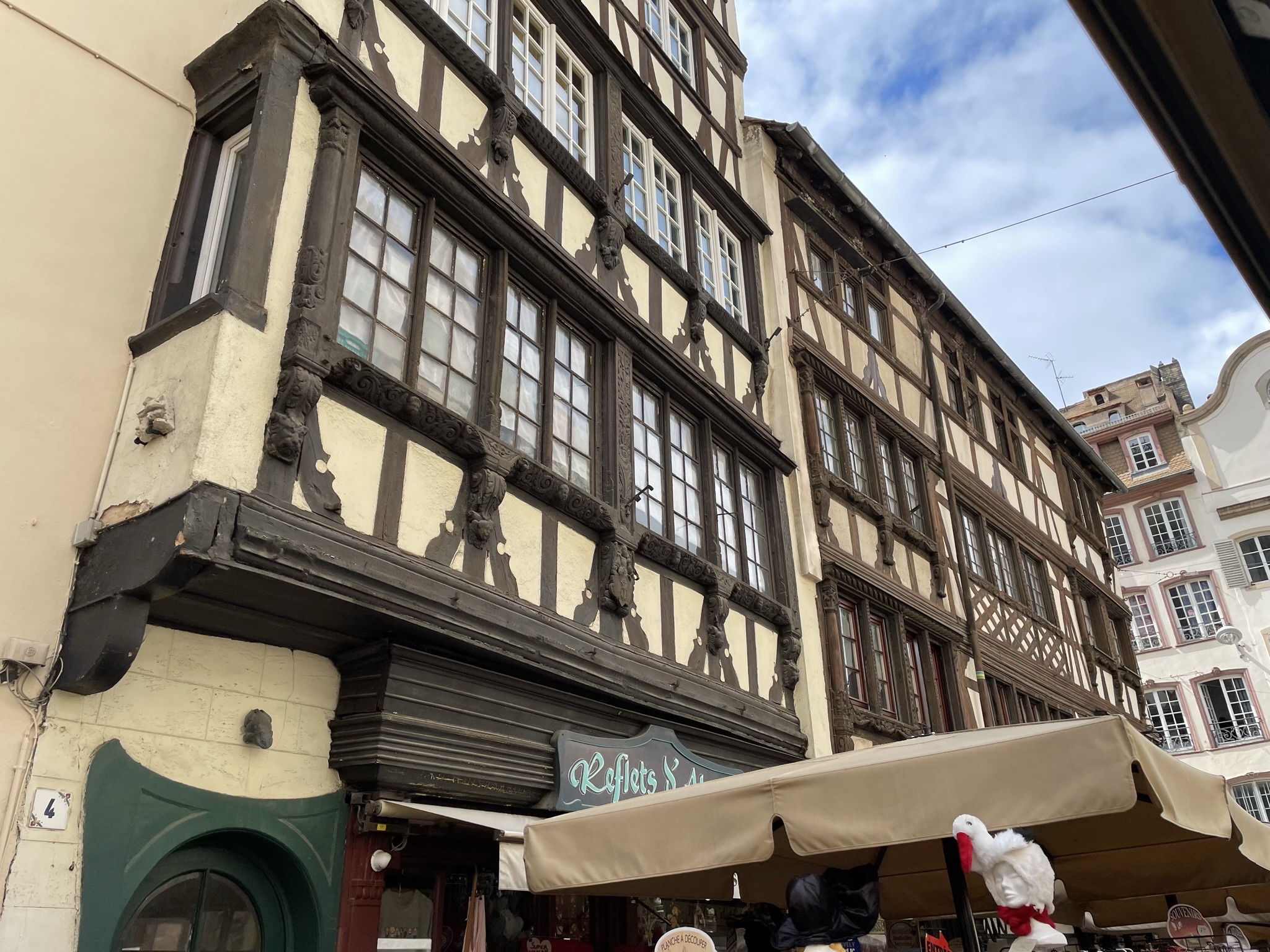
The city is chiefly known for its beautiful sandstone Gothic Cathedral with its famous astronomical clock and for its medieval timber framed buildings especially in an area called Petite France. Our tour included a walking tour of the cathedral district followed by free time to explore on our own. We arrived at the cathedral in time to see the clock.
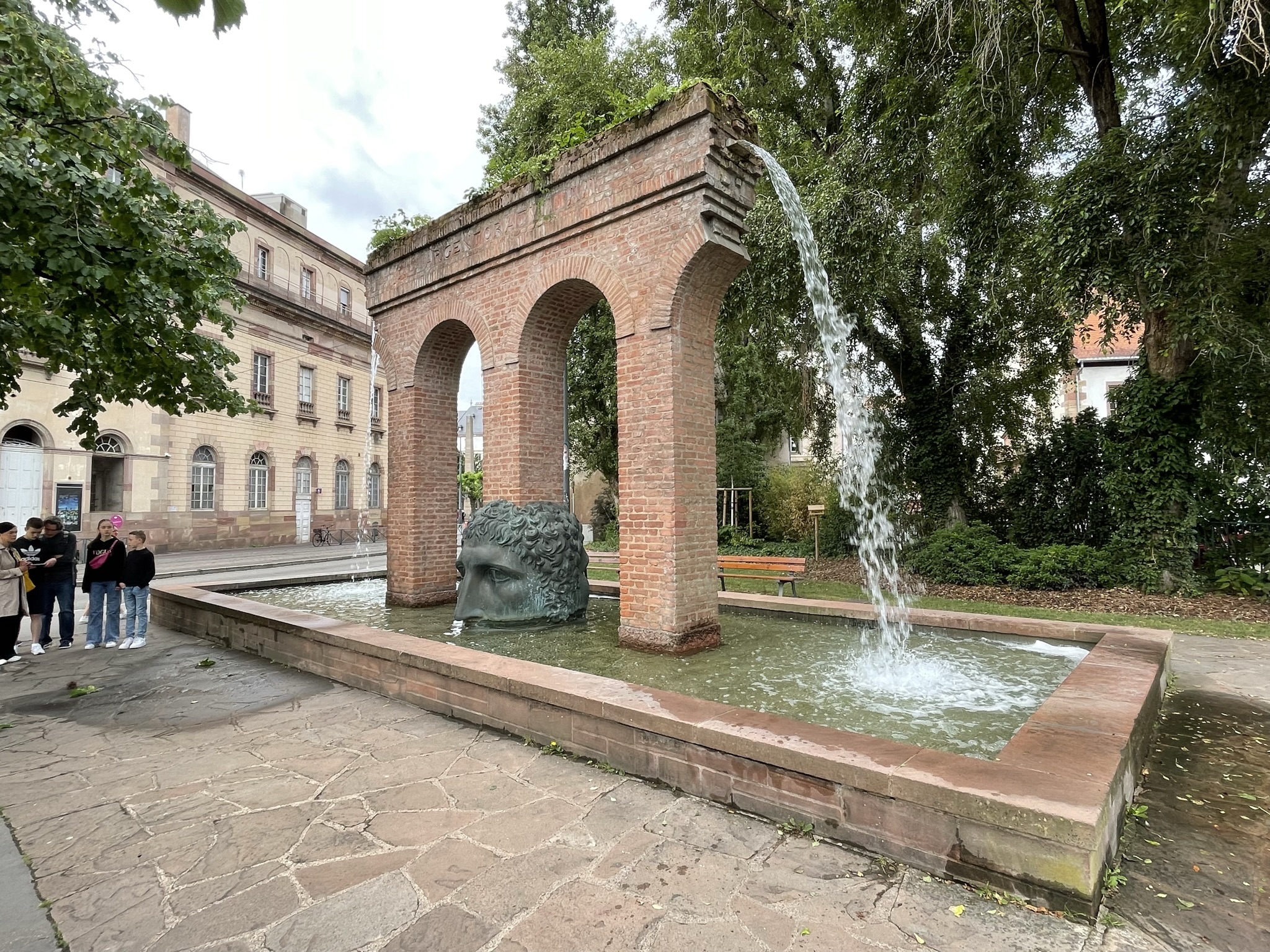
There were a couple of things that struck us about the city. It is very green with lots of big parks and is well treed throughout. Special attention is given to both the French and German cultures and people seem to live compatibly together, despite a long history of discord. Even though the old town suffered significant damage during World War II, most of that has been rebuilt in the original style. Public transit seems to be very well developed especially within the town centre.

Strasbourg played an important part in the Protestant Reformation with personalities such as John Calvin. It was also one of the first centres of the printing industry thanks to pioneers such as Johannes Gutenberg. Representatives from Strasbourg took part in the Protestation at Speyer mentioned earlier.

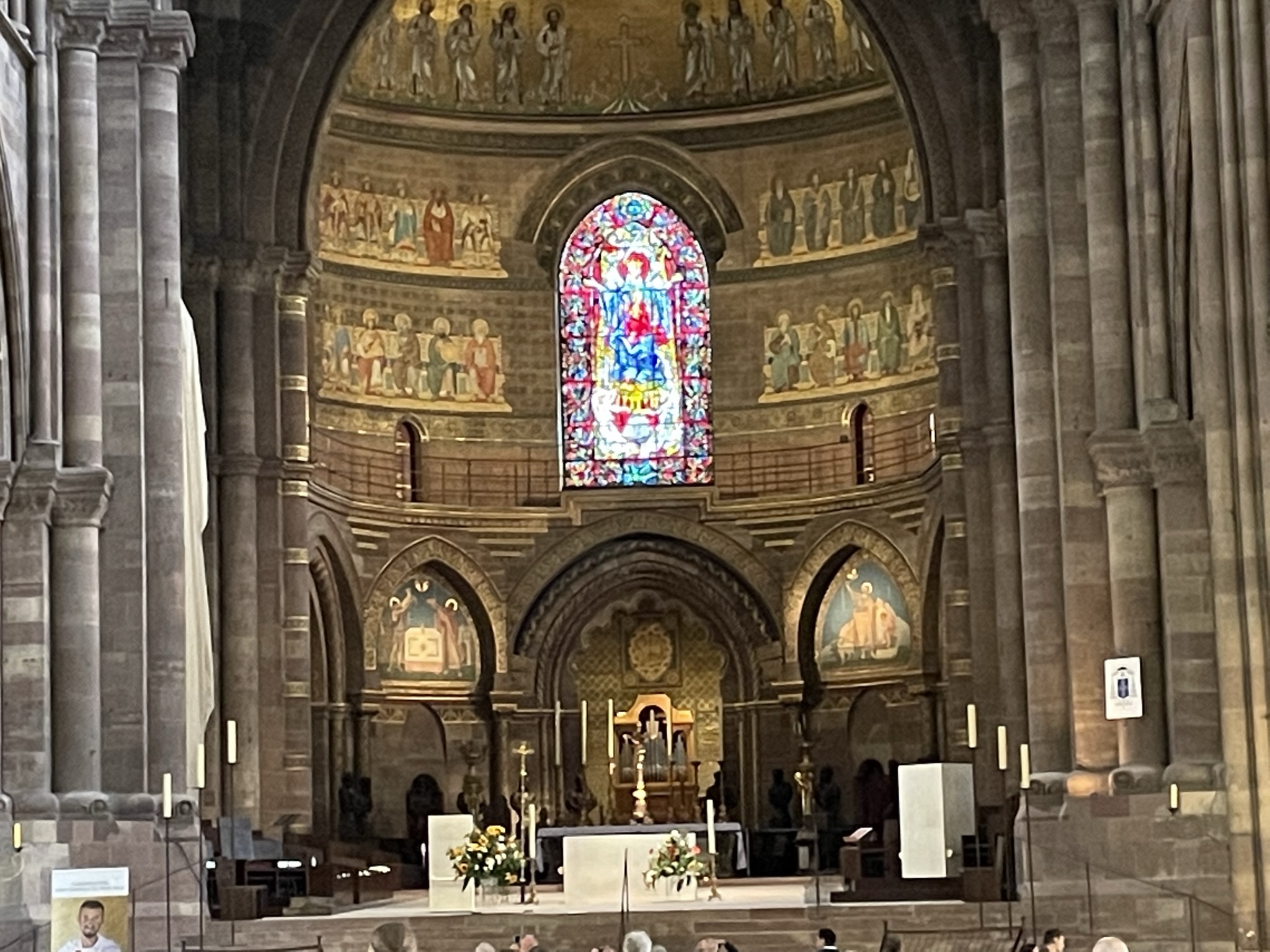
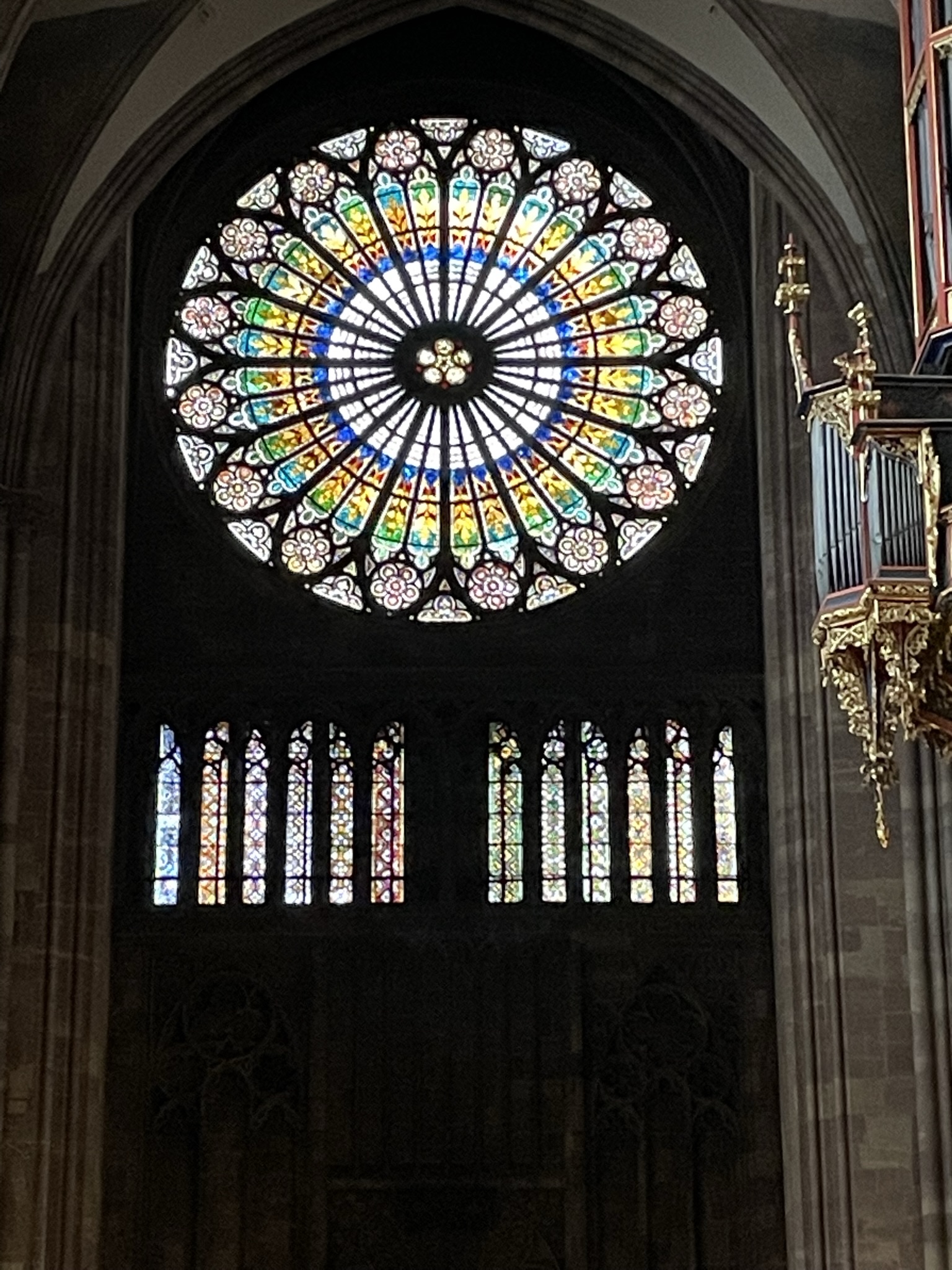
The cathedral construction began in 1190 and was completed in 1439. It was the world’s tallest building through until 1874 when it was surpassed by a Lutheran church in Hamburg, destroyed during World War II. Today, it remains the highest existing structure built in the Middle Ages. While some of its architecture is Romanesque, it is considered to be one of the finest examples of Rayonnant Gothic architecture. Of particular note were many beautiful stained glass windows, the grand Silbermann organ consisting of 2,242 pipes and 47 different effects, and of course the astronomical clock.

This is the third clock on this spot and dates back to 1843. The main attraction is the progression of 18″- high figures of Christ and the Apostles which occurs every day at solar noon, while the life-size cock crows three times. There is a video on YouTube for those who are interested.

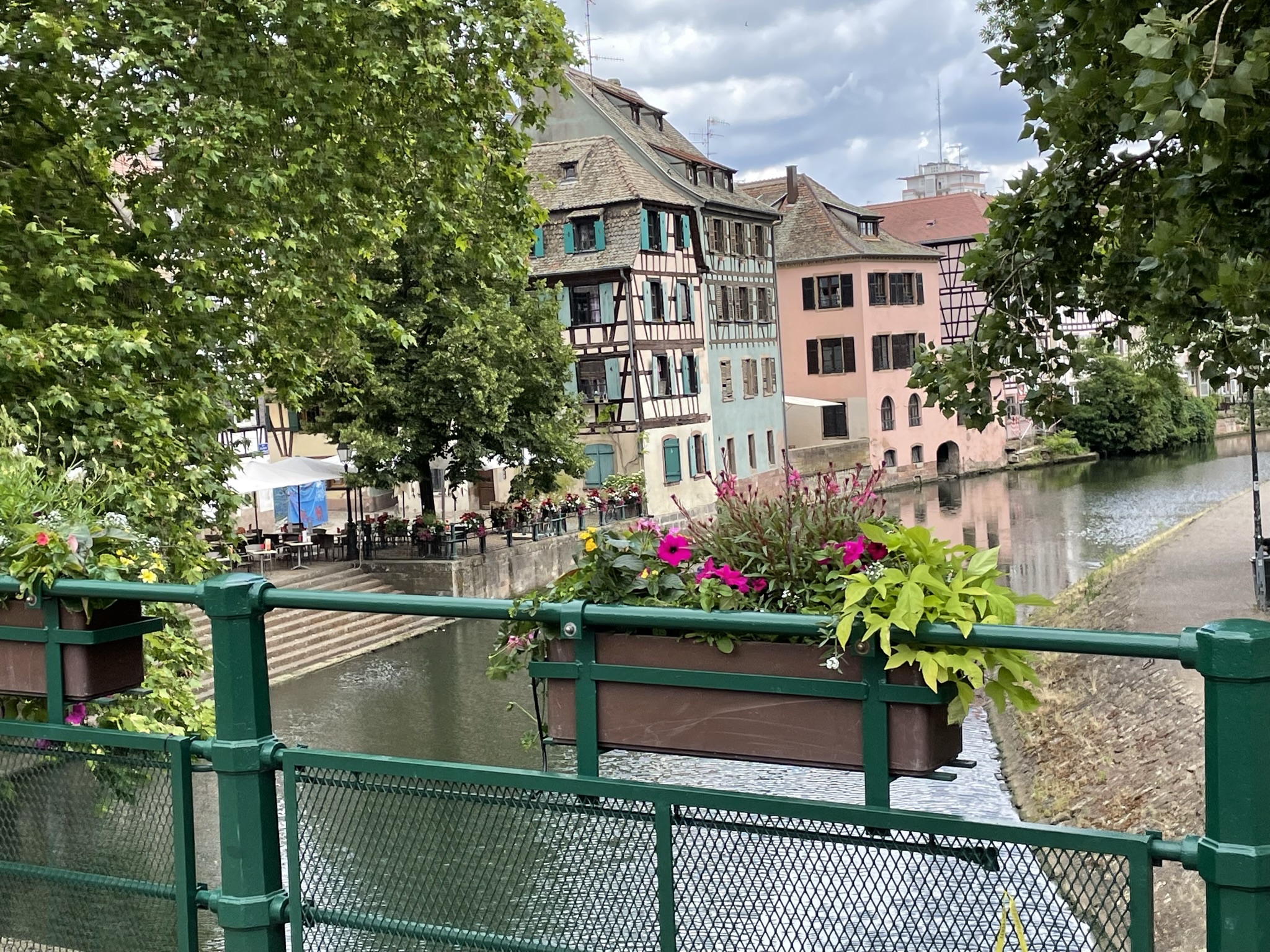
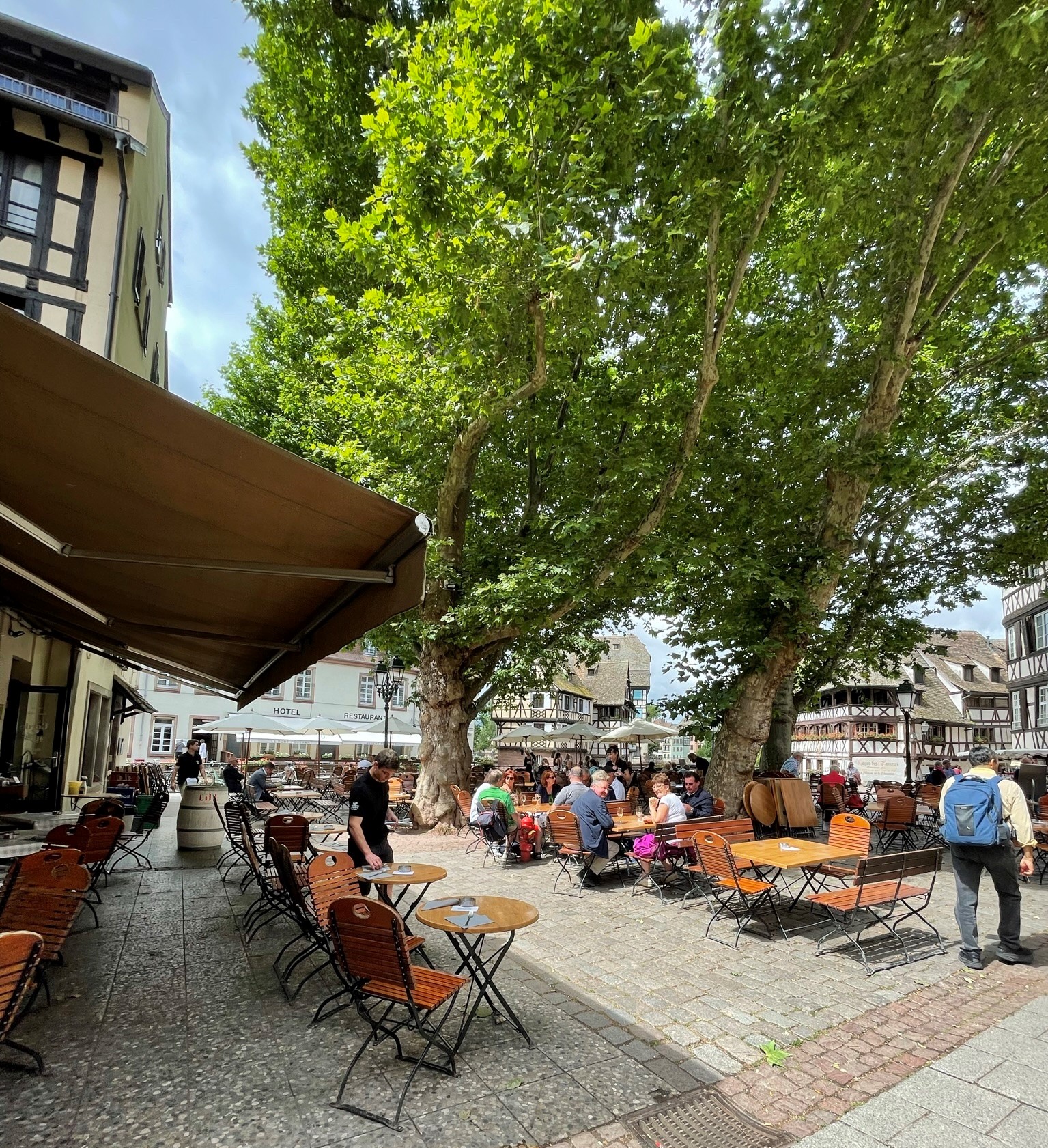
After our walking tour we chose to take a narrated tram tour of La Petite France, an historic quarter in the city. In this area the River Ill splits up into a number of channels that cascade through an area that in the Middle Ages was home to the city’s tanners, millers and fishermen. It is a delightful area with its weirs, lock and half-timbered buildings.

Day 7 – Breisach, Germany

Breisach is a small town on a hill founded by a Celtic prince. Its name is Celtic and means breakwater. The boat dock is in front of a bridge that leads over the Rhine to Neuf-Brisach, Alsace. Our tour choices this morning were a walking tour of the medieval town of Riquewihr, an excursion to Frelburg, a Black Forest hike or a Breisach Wine Country Bike Tour. We chose the tour of Riquewihr.

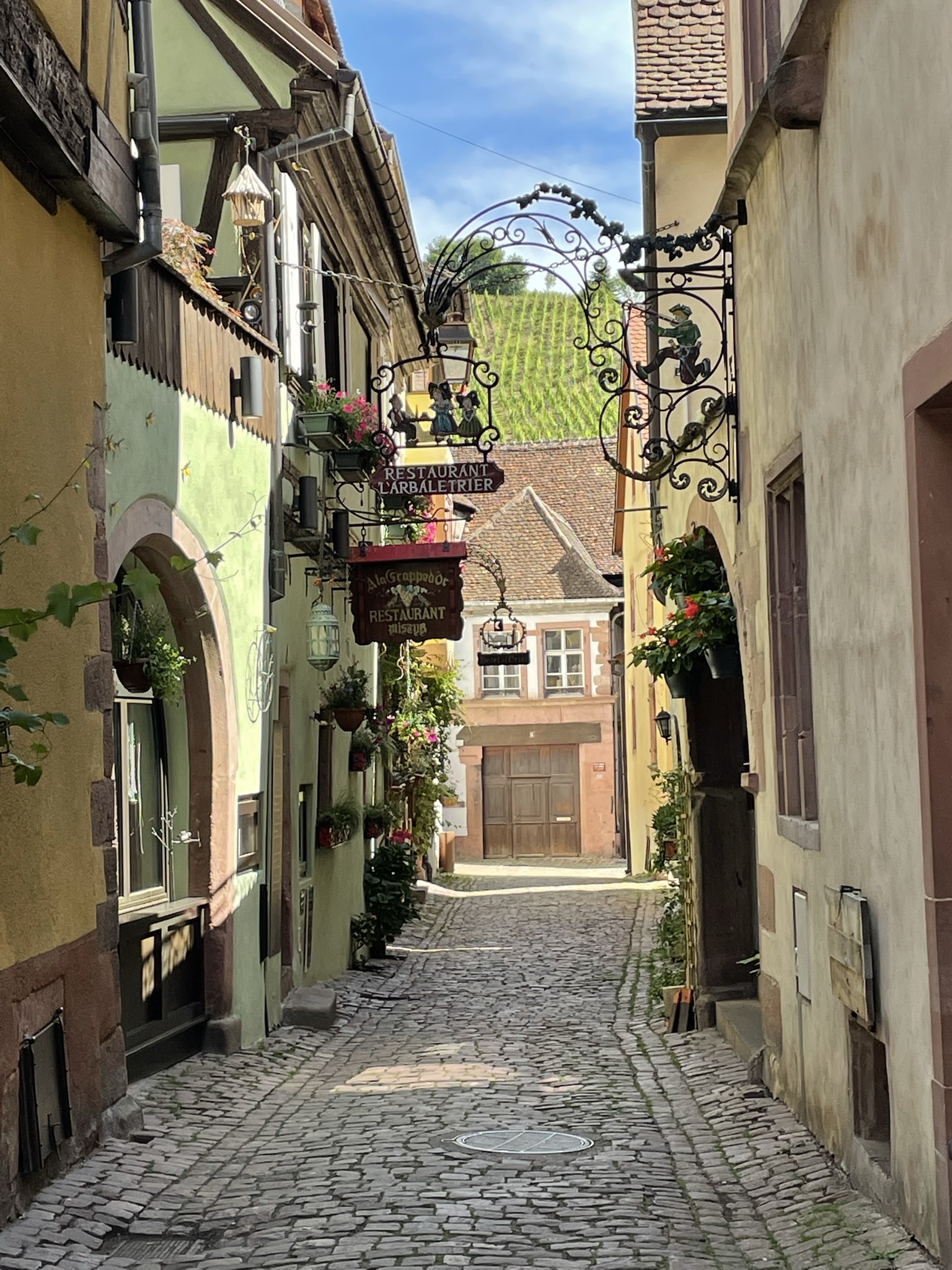
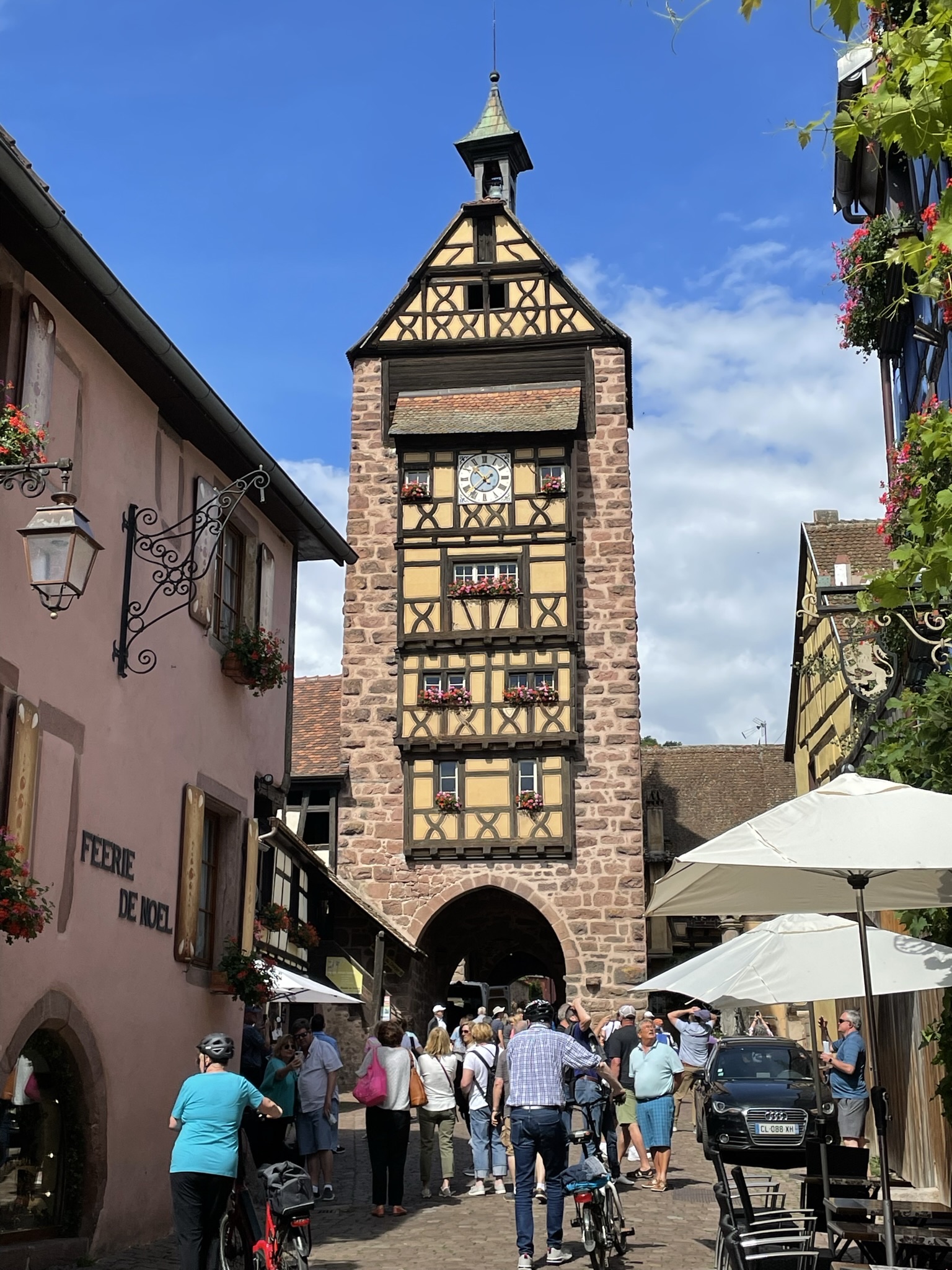
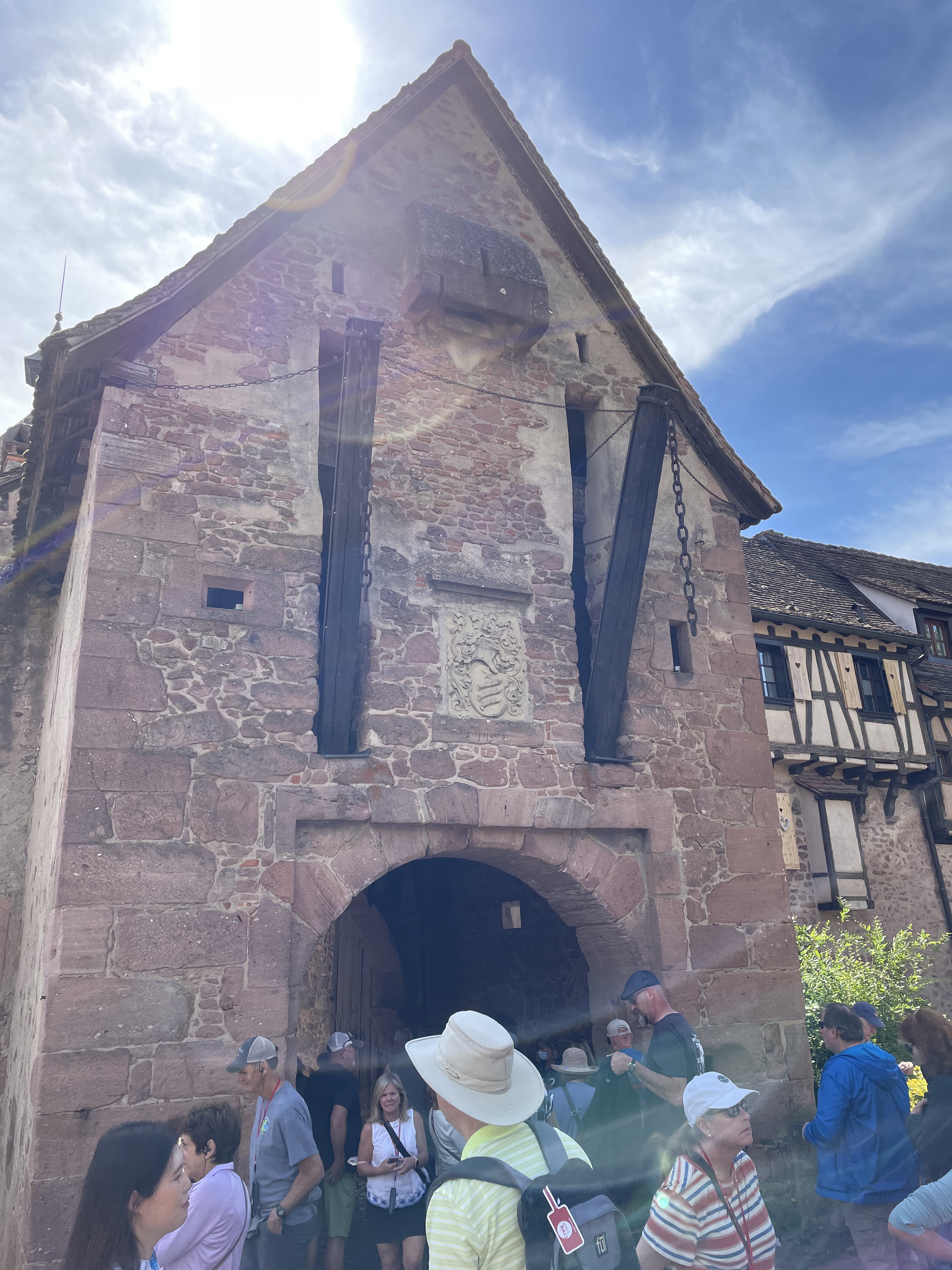
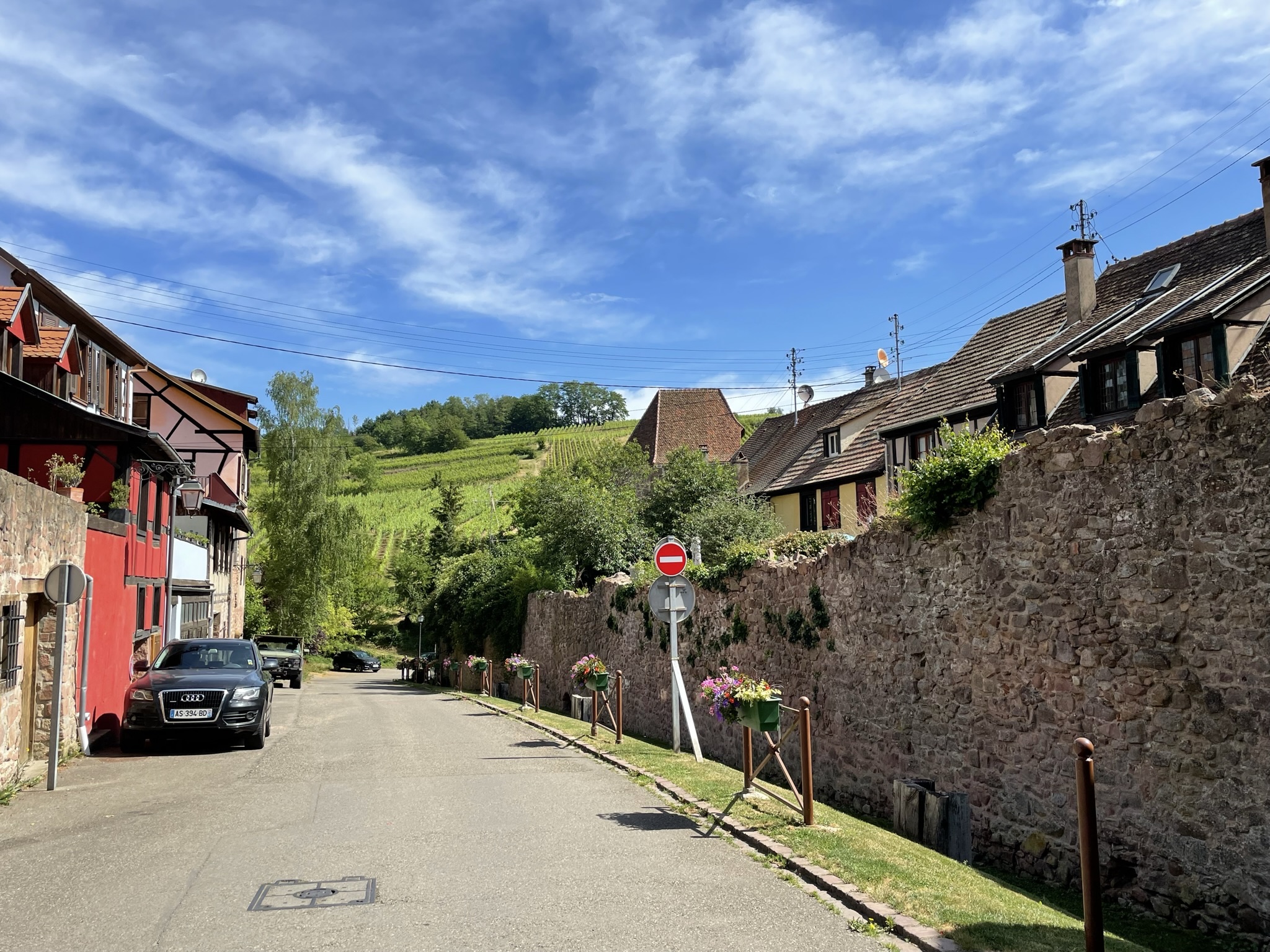
Known for its Riesling and other fine wines produced in the village and its historical architecture, Riquewihr is a popular tourist attraction. There were six tour buses in the small car park. One of the few towns not badly damaged during World War II, the city is still surrounded by its medieval fortifications and is overlooked by a castle from the same period that serves as a museum. The town consists of one main street with a few alleyways. Shops sell products and crafts all made locally and some even hand out samples – macarons, jams and jellies, and hand-rolled pretzels.

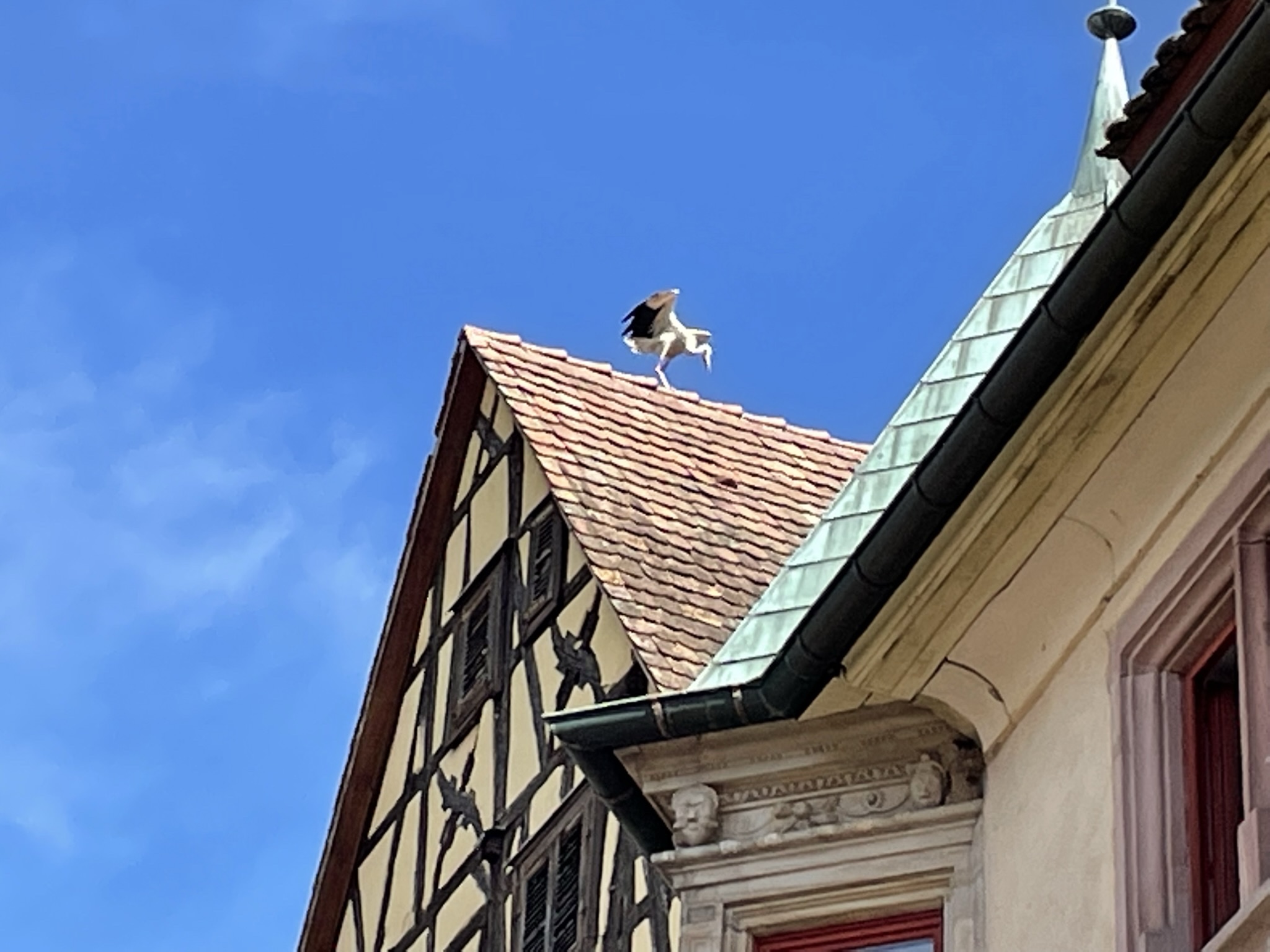
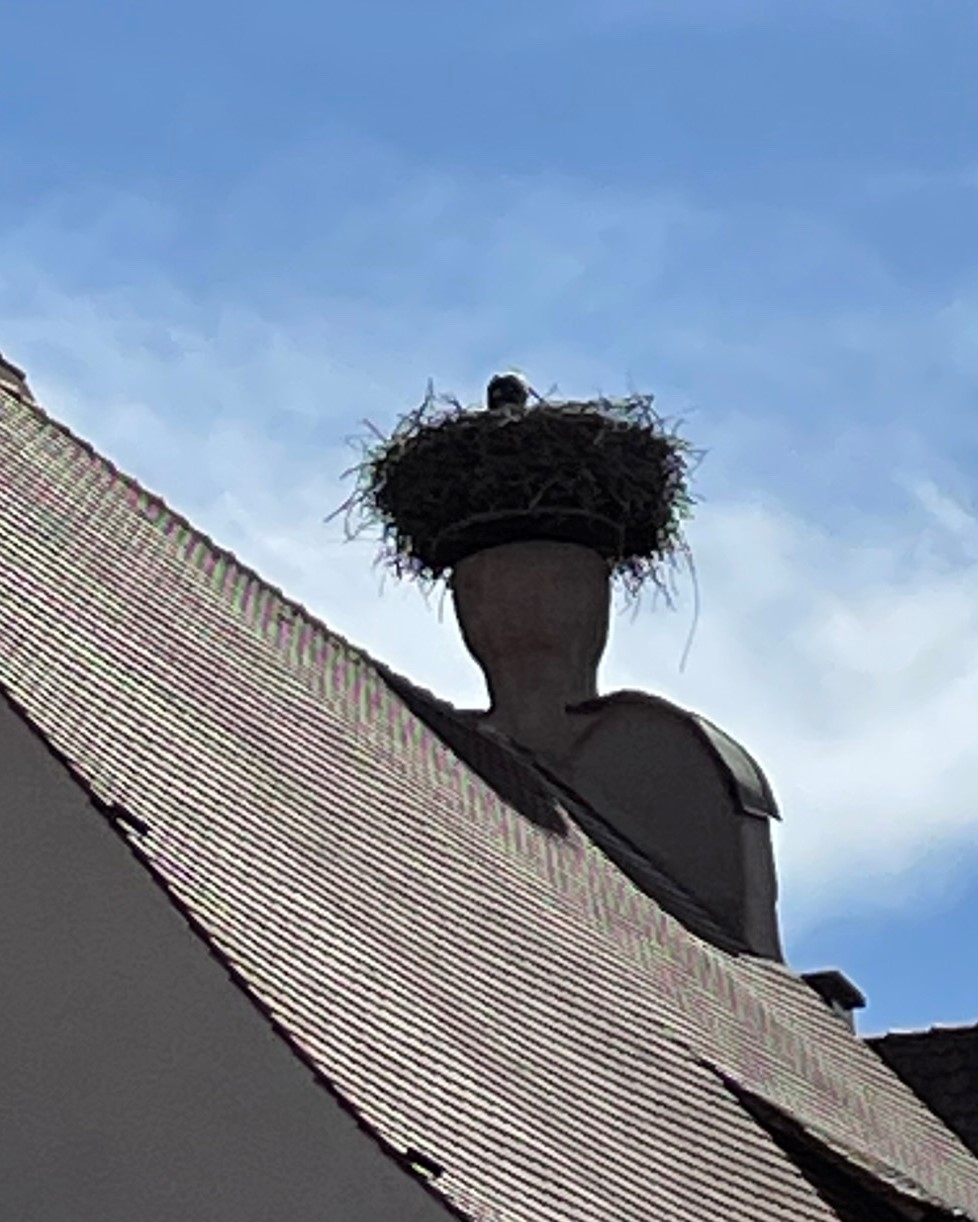
The highlight for many was the up-close sighting of a stork and its nest.

Back on board the boat we celebrated with the Captain’s farewell party. Tonight we travel through a number of locks arriving in Basel by morning.

Day 8 – Basel and on to a bus

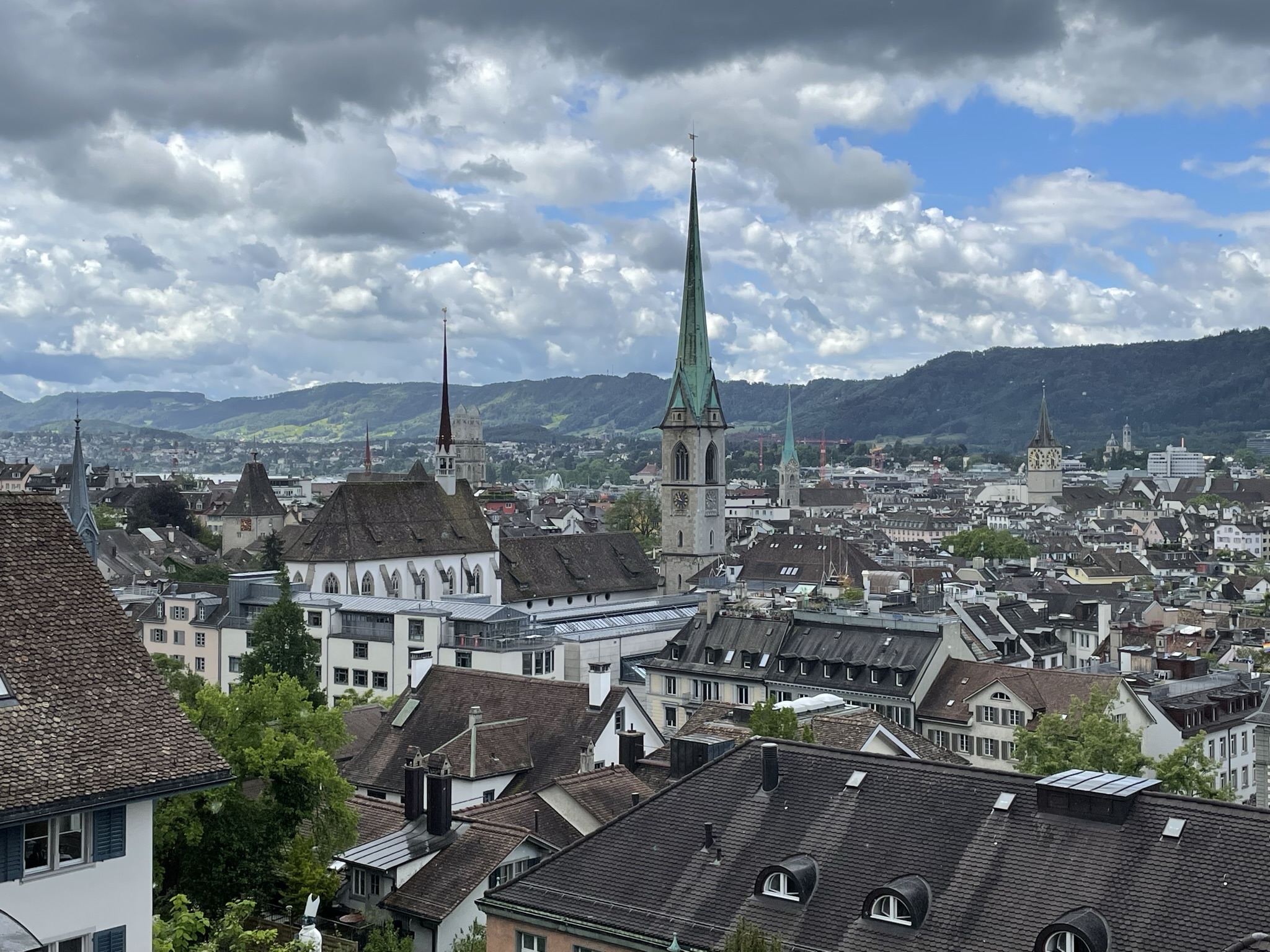
We were up early this morning to finish packing and prepare to disembark. Today we leave the other 104 AMA guests and continue on with just our small Craig Travel group. Our first stop was Zurich for a quick tour, lunch and a view of the city from above.

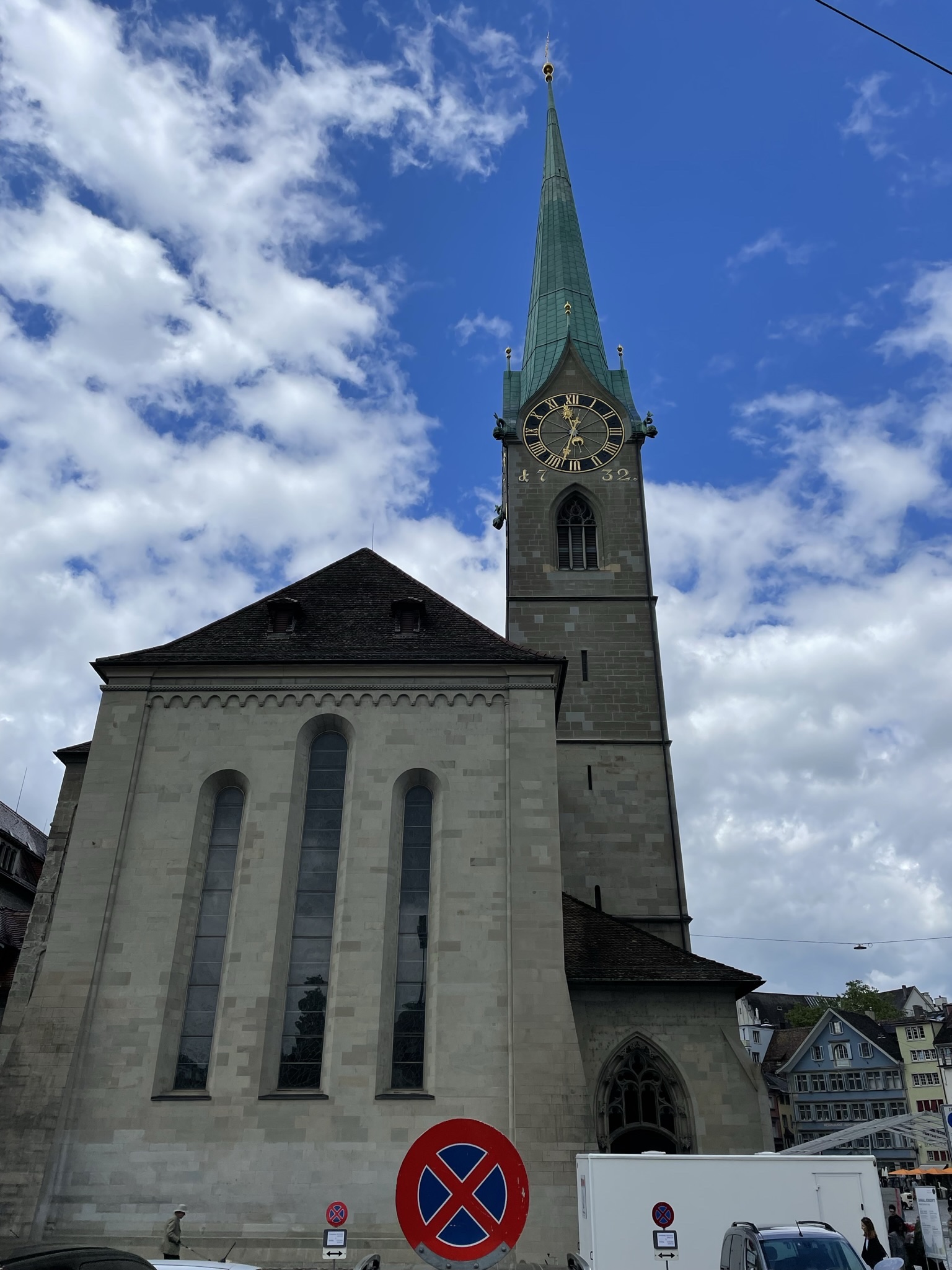
Zurich is the largest city in Switzerland and is among the world’s largest financial centres despite a relatively small population. In 1529 it became the primary centre for the Protestant Reformation. Our tour introduced us to a number of churches, one of which, Fraumuster (translates as Women’s Minister) had a very interesting history. The site was a former abbey for aristocratic women founded in 853. The abbess was very powerful and politically active and was granted the rights of mayor. The church continues today as a part of the Evangelical Reformed church and carries on the traditions of the convent.

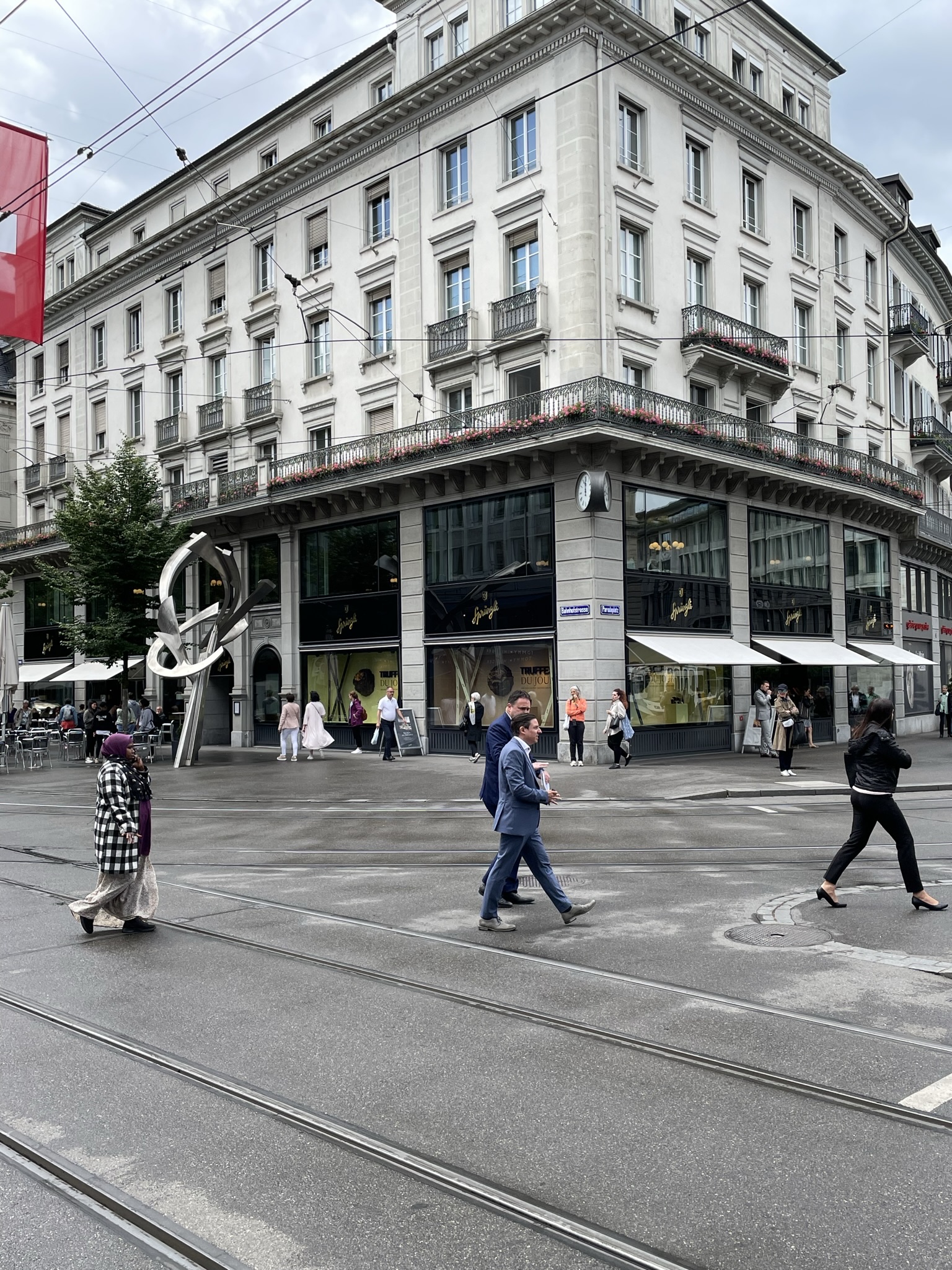
During our walk around town, it was pretty obvious that Zurich is a city of wealth. The main street is full of high-end shops with security guards at the door and people were well dressed in formal business attire. We found a nice outdoor cafe for lunch that served quiche and salad (for two) for just under $70! Of course Switzerland is well known for chocolate, and many shops abound along the main street.

After lunch we re-boarded our bus to continue on to Lake Constance and Hotel Halm. One thing we have had fun with along the way is the European penchant for duvets. On the boat we finally had to ask for a sheet and blanket, finding the duvet just too heavy. At Hotel Halm, we removed the duvet and used the cover as a sheet. The air conditioner worked in the living room but didn’t do much in the bedroom although we were able to open the window to cool the room off at night.

Today was the first day that we recognized that more and more of our group were succumbing to a “summer cold.” We continued to mask on the bus and in the hotel, but it was hard to avoid potential transmission at meal times.

Day 9 – Lake Constance, Germany

The town of Konstanz (or Constance in English) is a holiday town at the west end of Lake Constance. It is also a large university town. Our hotel was conveniently located in the old town very close to the ferry docks. George participated in the walking tour of the port area while Nancy caught up on some much needed rest. The remainder of the morning was free time with lunch on our own.
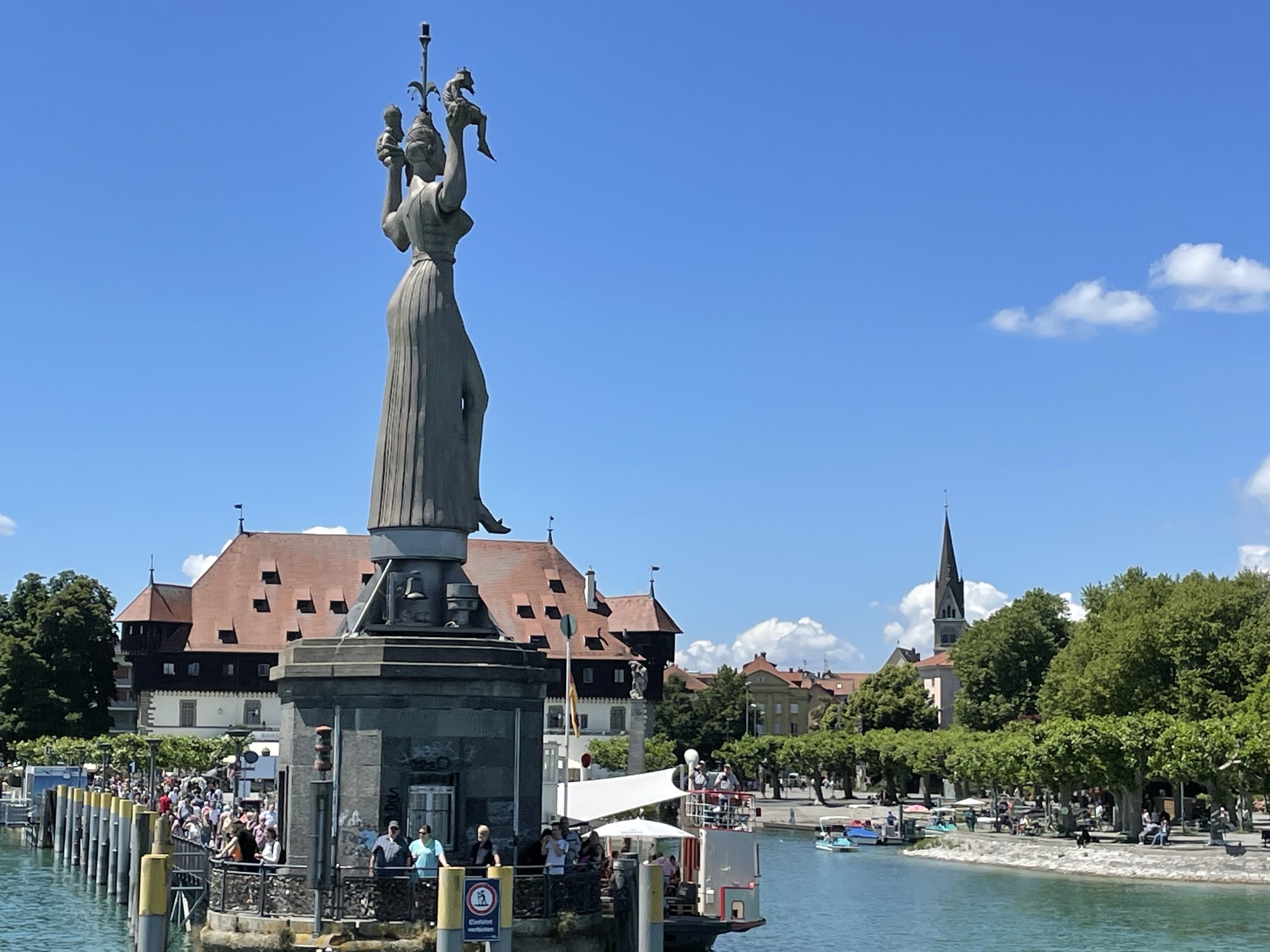
Imperia is a statue at the entrance to the harbour commemorating the Council of Constance that took place between 1414 and 1418. Thirty feet high it stands on a pedestal that rotates around its axis every three minutes. The woman holds two men in her hands – one wearing the papal tiara and one wearing an imperial crown – the artist suggests, rather than the real participants in the Council, they represent fools who have acquired the insignia of secular and spiritual power. The statue refers to a short story by Balzac, La Belle Imperia.

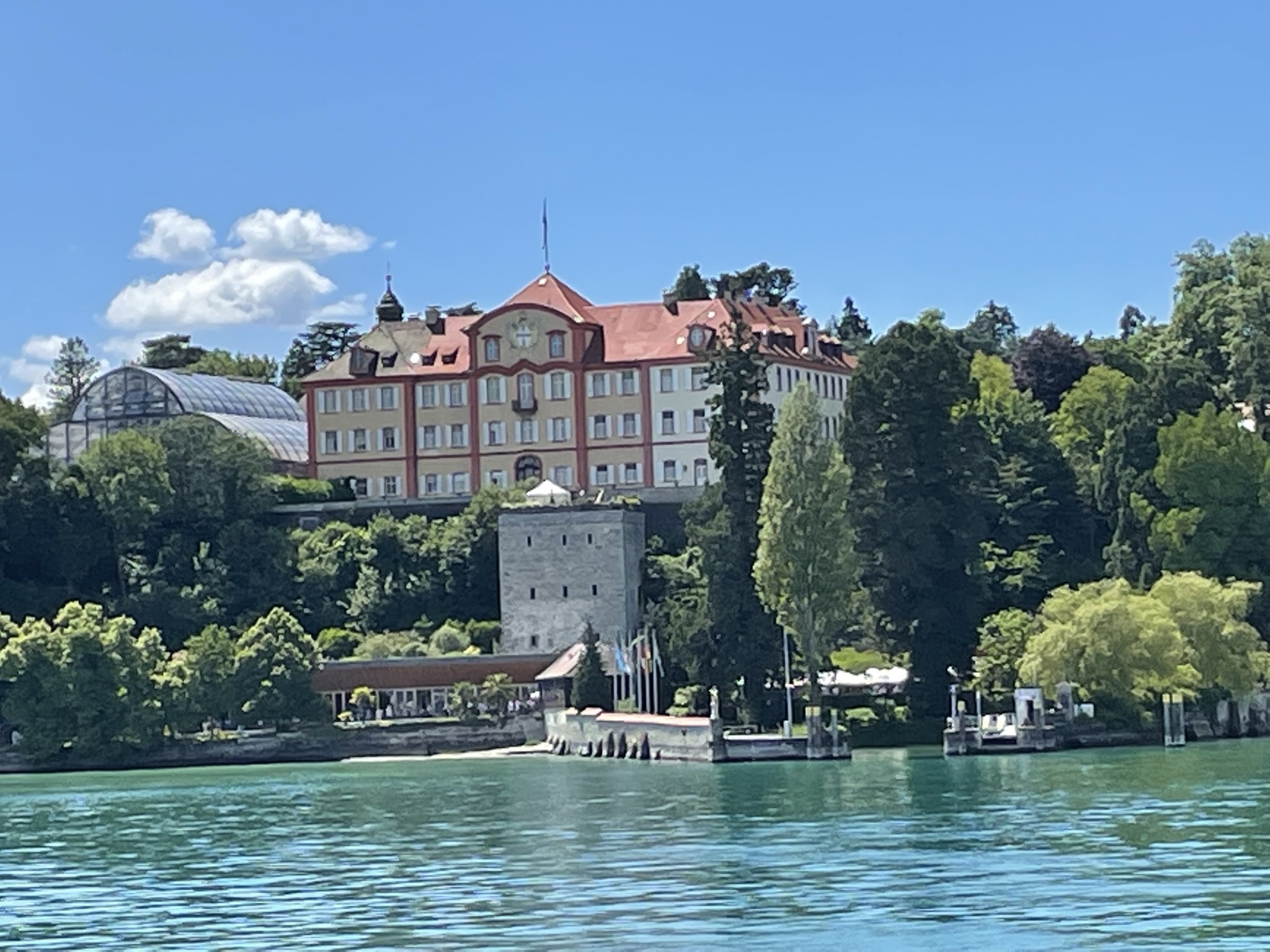
In the afternoon we took a ferry across to Mainau Island, known as the flower island of Lake Constance. Operated since 1853 by a private corporation run by various members of the Bernadotte family, at various times it was a garden and park open to the public, accommodation and recovery for French prisoners liberated from Dachau, a quasi-YMCA operation for war-damaged young people to have opportunity to heal and have international meetings with young people from other countries. In the almost 20 years of that program’s existence, some 20,000 participants from 40 countries participated in events at Mainau Castle. From 1950 on, work began in earnest to develop the gardens and park for the public. Buildings were renovated and new ones built along with much-needed infrastructure. Today some 1.2 million visitors visit the 25-hectare garden annually. Today, Countess Bettina Bernadotte, born in 1974, oversees the corporation as Managing Director. If you’re in the area, you should plan a visit!
We finished off the day with schnitzel dinner down by the river and a beautiful sunset with our friend Ann.

Day 10 – Liechtenstein and Innsbruck

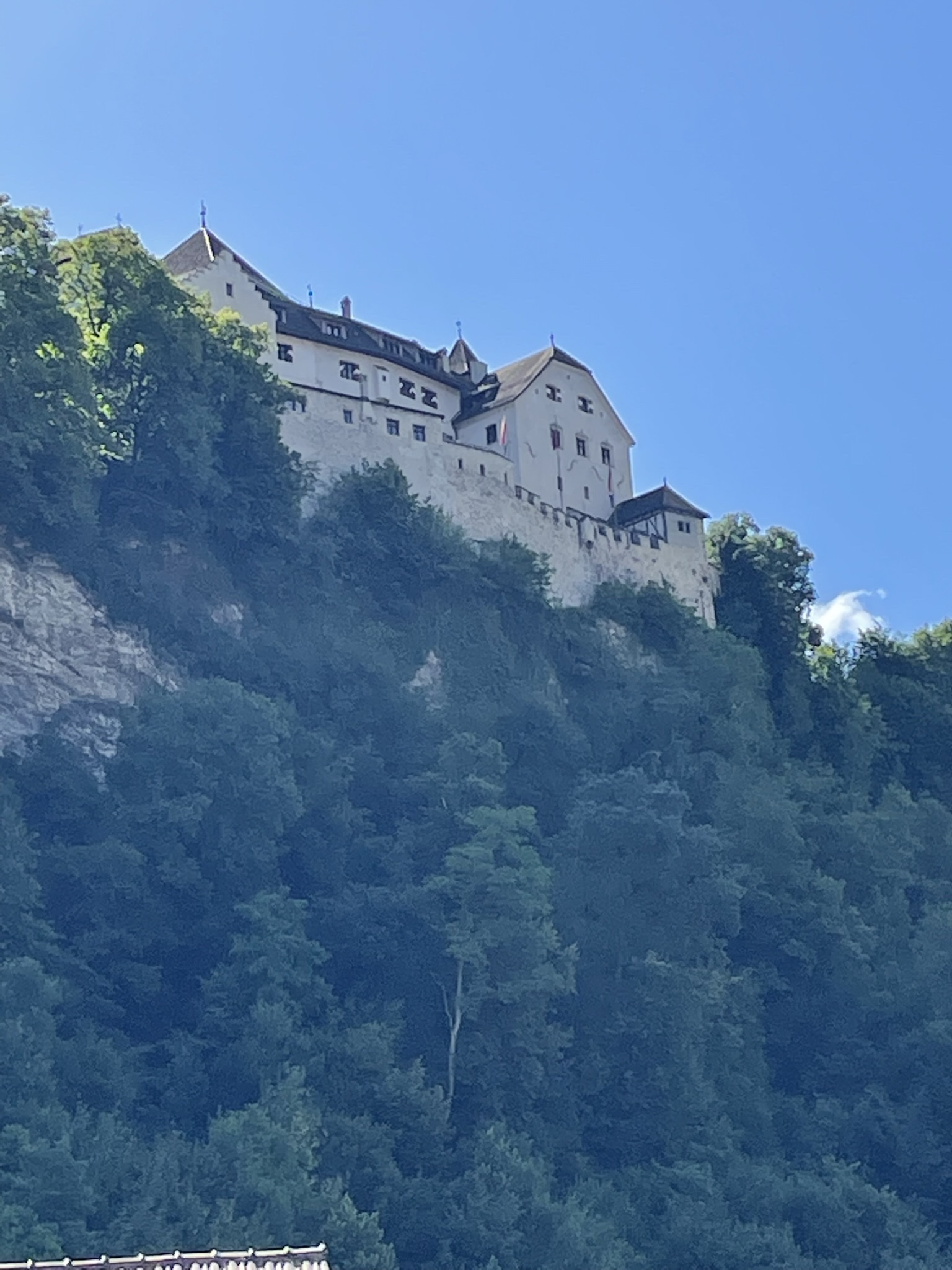
Leaving Lake Constance, we travelled through four different countries on our way to the little town of Oberammergau in the Bavarian Alps. Because Constance is a border town, we travelled through Switzerland and then on to Vaduz, Lichtenstein, a small principality wedged between Switzerland and Austria, where we made a morning stop for coffee. The fourth smallest country in Europe, it is also one of the wealthiest in the world, having attracted many companies because of its low tax rate. Dominating the town is the Vaduz Castle, perched atop a hill overlooking the city. The prince and his family still live in the castle when they are in the area.

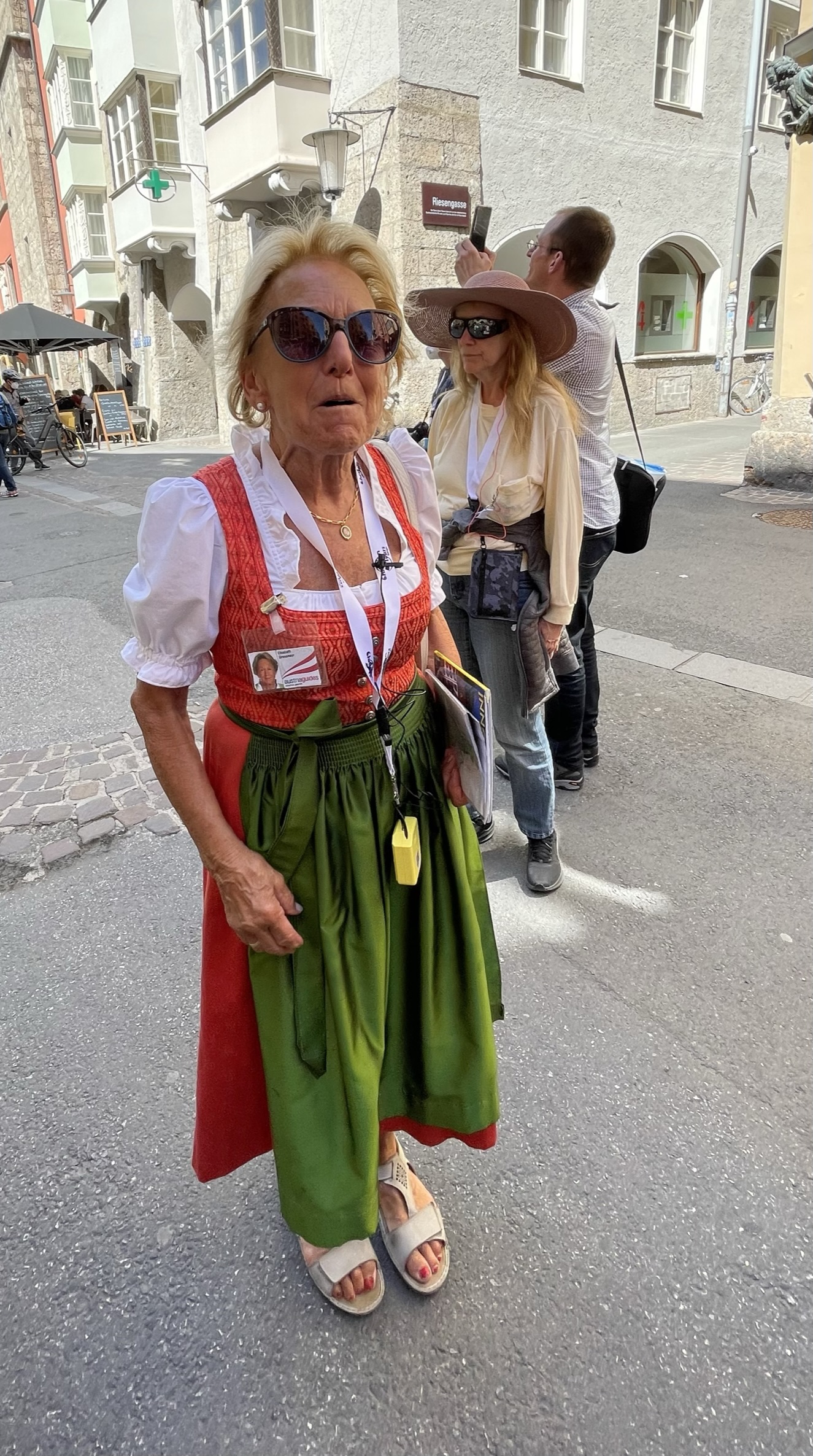
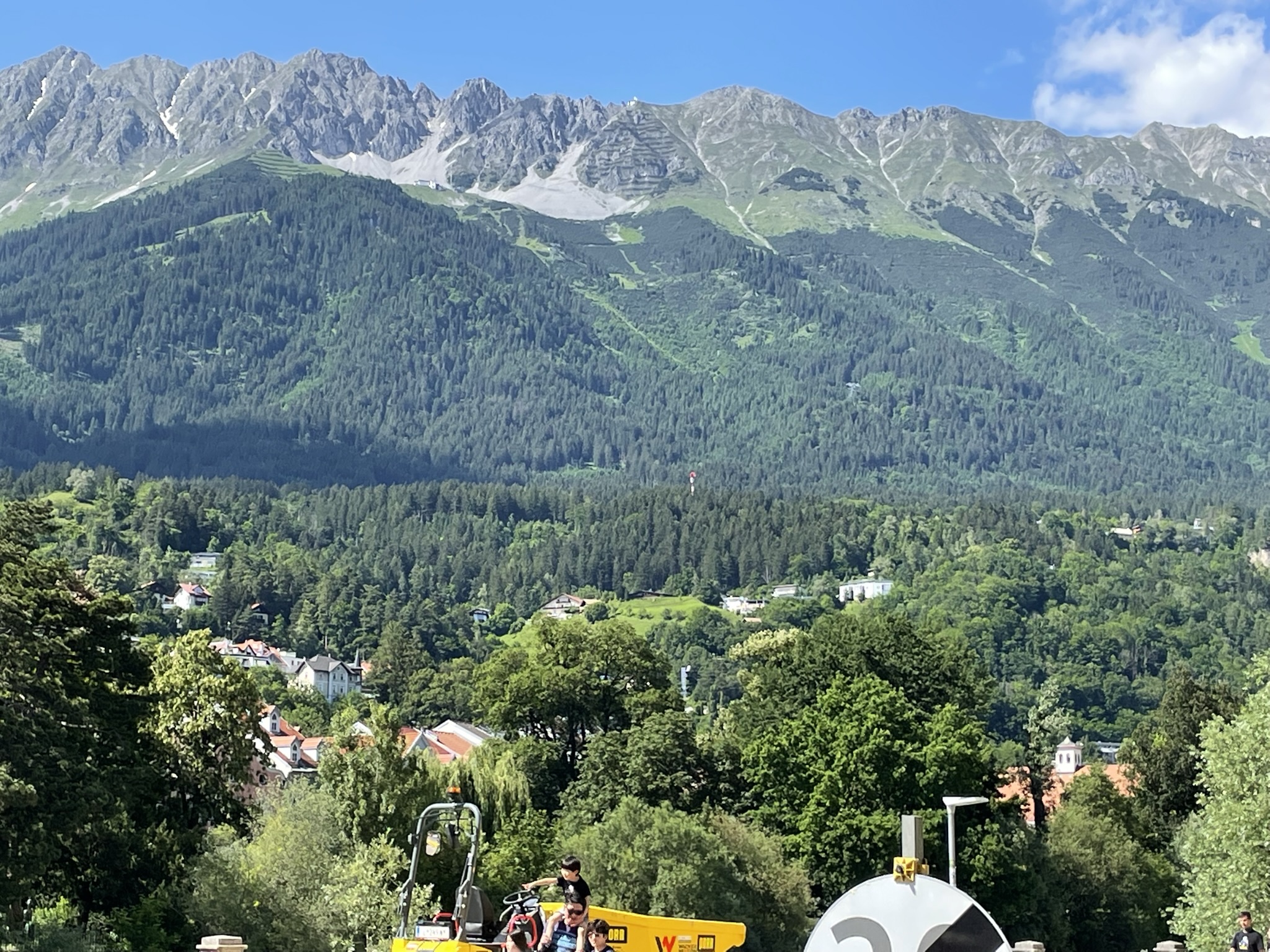
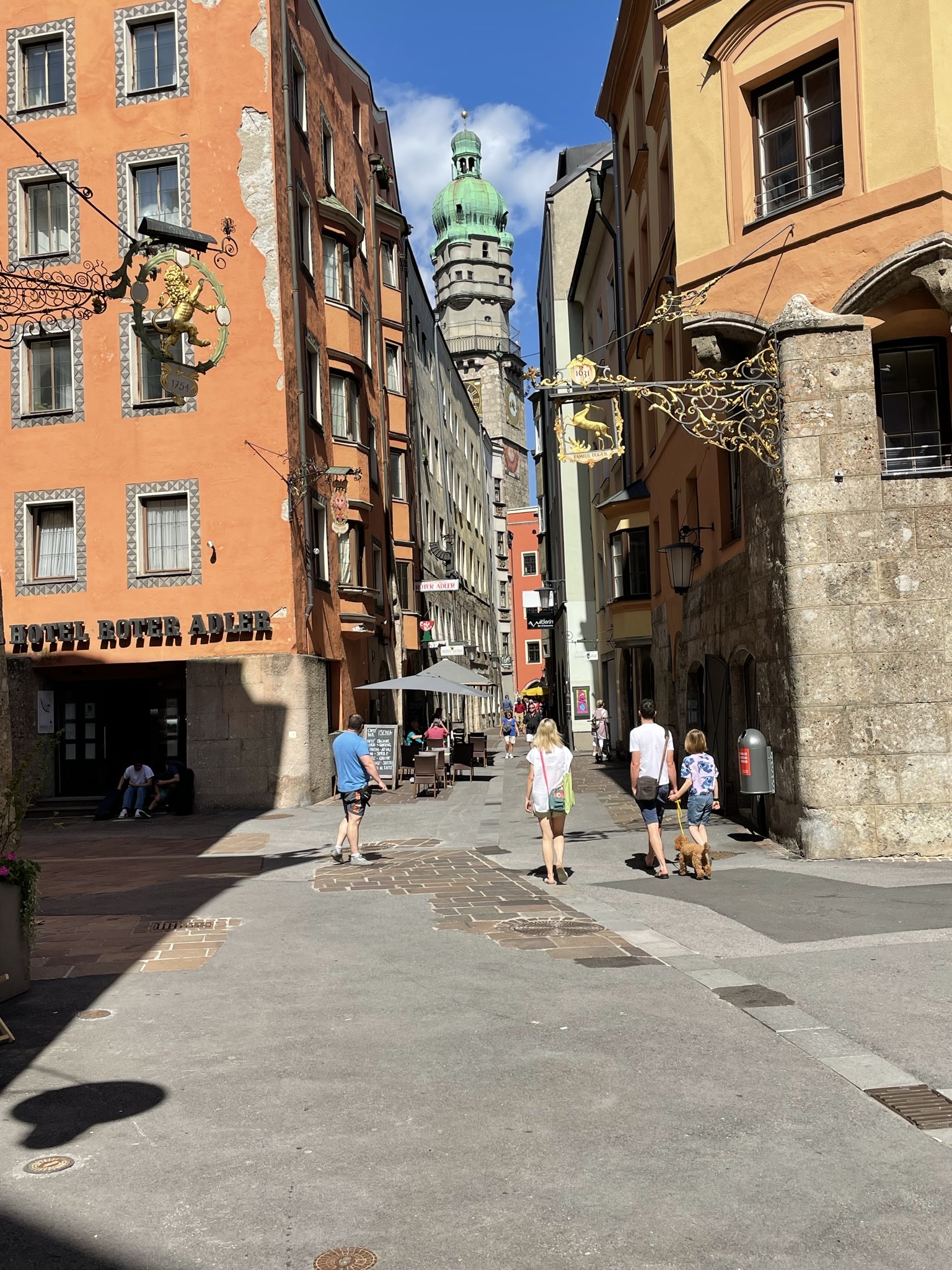
Our next stop was Innsbruck, Austria where we enjoyed lunch on a patio and did a walking tour of parts of the old town. Coming into town we passed the site of the 1964 and 1976 Winter Olympics. Our guide was an 88-year old woman, quite well known for her passion for the city and her unlimited energy. She lives part way up the mountain visible from the town and rides her bicycle to and from work everyday. She still skis five or six times a week in the winter. It seemed like everyone who lived in town knew her.

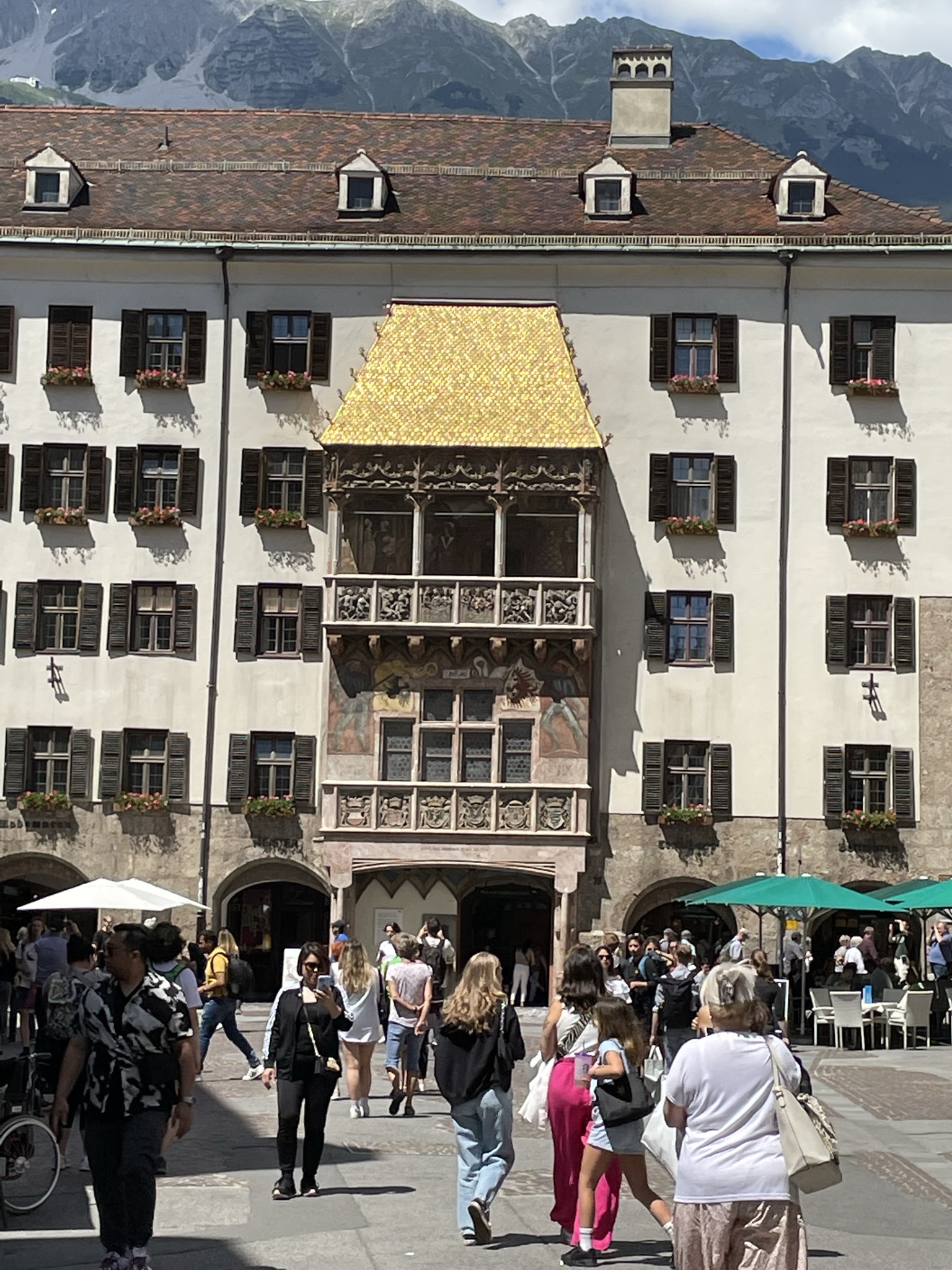
The meeting place in Innsbruck is the famous building with a golden roof. Completed in 1500, the roof was decorated with 2,657 fire-gilded copper tiles for Emperor Maximilian I to mark his wedding to Bianca Maria Storza. Typical of buildings during that period it is richly decorated with reliefs, frescoes, and coats of arms.

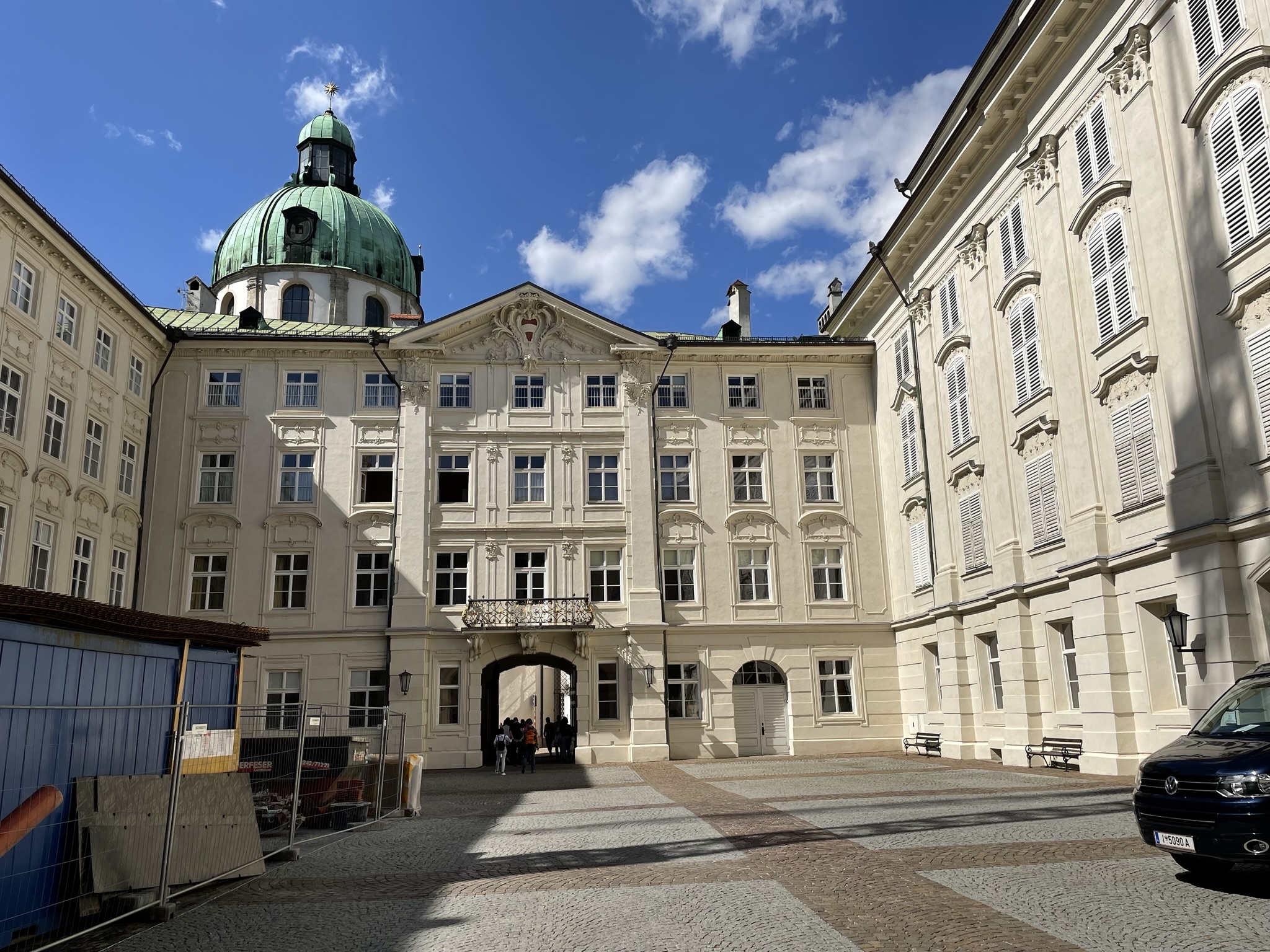
The Imperial Palace is a large residential complex once used by the Habsburgs and is considered one of three significant cultural buildings in the country (along with the Hofburg and Schonbrunn Palaces in Vienna). It currently serves as a museum with five themed areas illustrating various aspects of the political and cultural history of the former imperial palace.
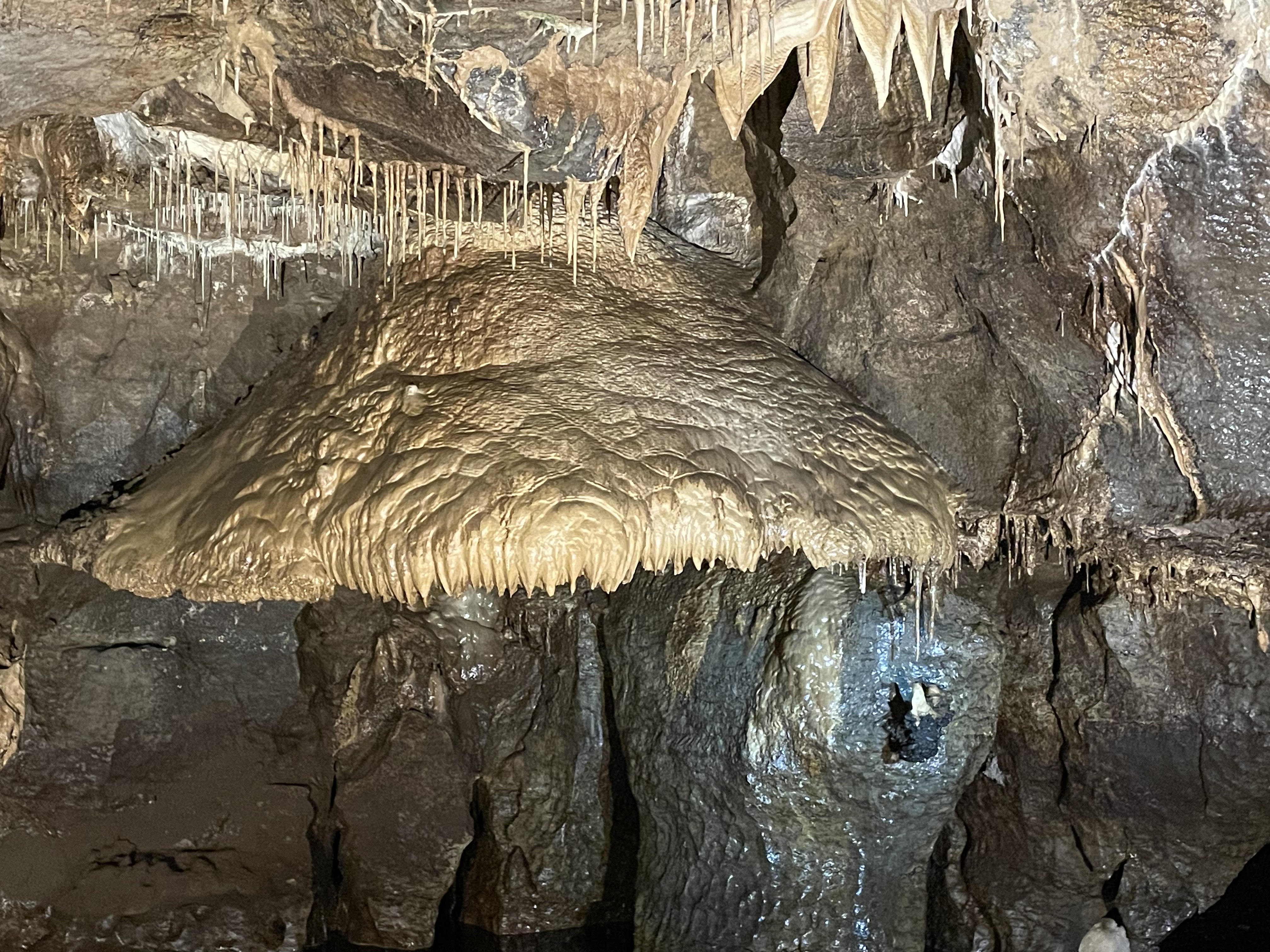
The Court Church was built in 1553 in the Gothic style and is a memorial to the grandfather of Emperor Maximilian 1, whose ornate cenotaph fills the centre nave of the church. The cenotaph is surrounded by 28 large bronze statues of ancestors, relatives and heroes.

Then it was off to Oberammergau and a beautiful afternoon drive through the Bavarian Alps. Our hotel for the next two nights is the Hotel Alte Post. George seems to have caught “the cold” and we retired early, after plying him with Tylenol, hoping that it was nothing more serious.

Day 11 – Oberammergau

After breakfast, it was obvious that George had succumbed to something more serious than a cold and a COVID positive test was not really what we wanted to see. Our doctor had suggested that two positive tests 24 hours apart was more reliable and so we decided not to share this news until another test tomorrow morning. Our ethical dilemma was whether or not he should attend the Passion Play. We rationalized that since we would be sitting in our Craig Travel bubble with others who had “the cold” and since this was our third and final try to see the play, we were going, masked and distanced as much as possible. How ironic that this Passion Play presentation began because of a plague, and here we were experiencing our own version of a plague in 2022.
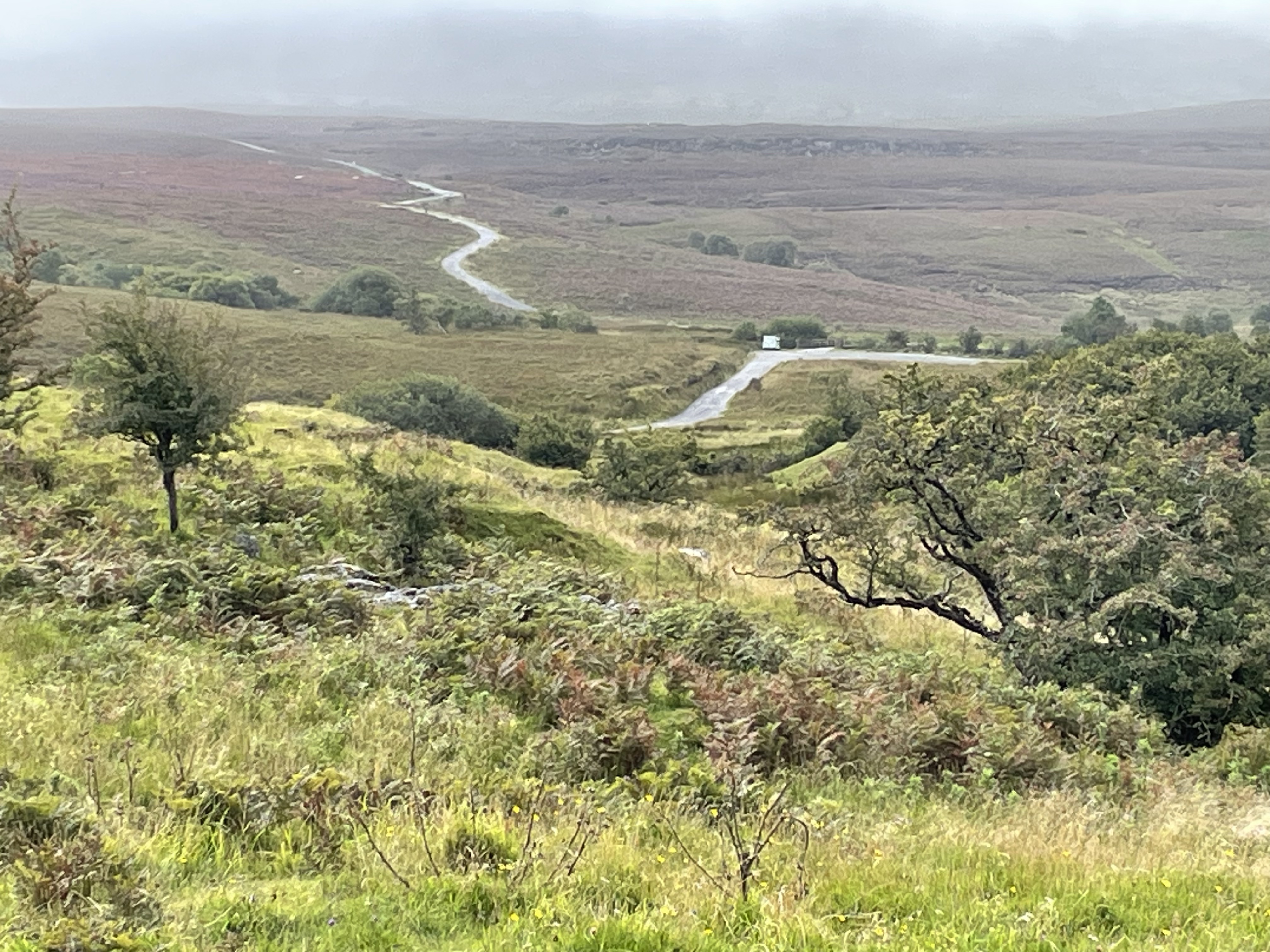
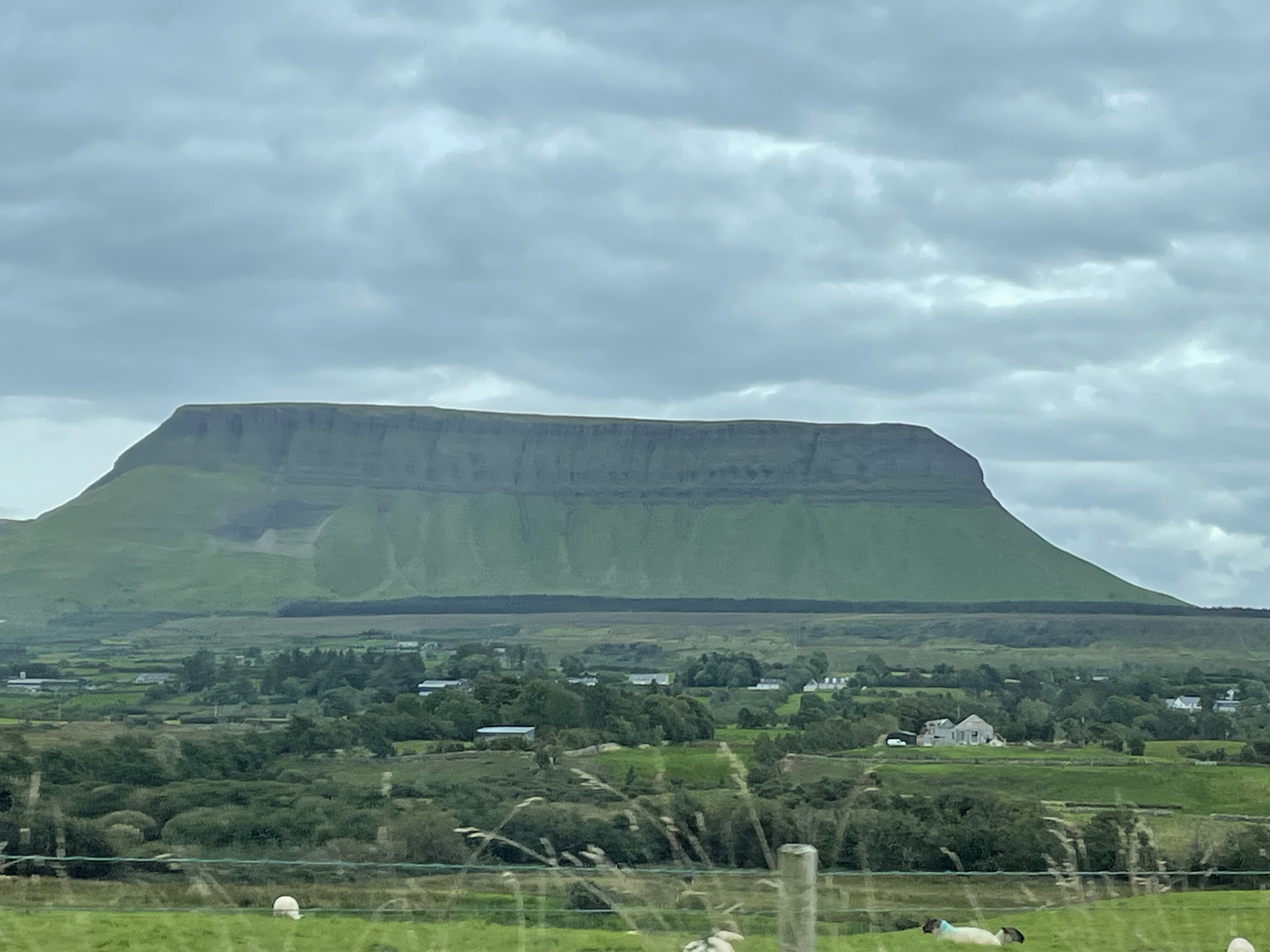
The small town of Oberammergau is known for its woodcarvers and woodcarvings, its NATO school and around the world for its 380-year tradition of mounting the Passion Play every 10 years. First performed in 1634, the play is performed, according to legend, because of a vow made by the inhabitants of the village that if God spared them from the effects of the bubonic plague then sweeping the region, they would perform a passion play. Originally performed every year between 1634 and 1680, it then moved to every ten years. Normally performed in years ending with zero, the play was also performed in 1934 and 1984 to celebrate the 300th and 350th anniversaries. The 1920 presentation was delayed by two years because of the post-war economic conditions and the 1940 presentation was cancelled due to the onset of World War II. Of course, the 2020 presentation was also postponed to 2022 due to COVID.

The presentation involves over 2,000 actors, singers, instrumentalists and technicians, all of whom are unpaid. Participation is a labour of love! Performances are held five days a week from May to October and the number of visitors range from 420,000 to 530,000. Most tickets are sold as part of a package with one or two nights’ accommodation and meals.

The text of the play is a composite of four distinct manuscripts dating from the 15th and 16th centuries, and covers the short final period of Jesus’ life from his entrance into Jerusalem leading to his crucifixion and resurrection. In German, the play has also frequently been criticized for being antisemitic and a multi-decade effort to reduce such content has led to substantial revisions of the play. Some of these changes involve inclusion of Hebrew phrases and prayers (e.g. – at the Last Supper). The play is divided into 12 Acts, six of which are performed in the afternoon and six in the evening. Total playing time is about five hours.

Each section begins with a tableau from the Old Testament accompanied by spoken word and choral accompaniment. The tableau fades and the New Testament story is told in dramatic, real-life fashion with children, crowds, animals coming and going and much to keep one’s mind and eyes engaged. Each audience member is provided with a book containing the text of the play in their preferred language, which is helpful to keep one on track with the various scenes, but in reality you can’t both watch the play and read the text at the same time.

The current theatre opened in 1900 and was modernized following the 1990 production to include more comfortable seating, heated floors, accessibility seating and modernized stage mechanics. In 2010 a retractable glass roof was installed over the stage, which before had been open to precipitation. Today the theatre can seat 4,700 patrons.

In between the afternoon and evening performances we returned to our hotel for dinner. We were surprised when the young man serving our beverages indicated that he plays the part of the Apostle John. His father, the General Manager at the hotel, plays the part of Pilate but was not scheduled that day. It is common to see people around town looking very much like the characters they play. Only those who were born and raised in Oberammergau or have lived in the village for at least 20 years can become part of the Passion Play. Rehearsals for this year’s play began in January 2022 but a Hair and Beard Decree was in force since February 2021. All performers must allow their hair to grow out, which for men also means growing their beards. Music rehearsals began in November 2021 requiring participants to perform nearly an hour and a half of choral music by heart, and with confidence. Young people are encouraged to participate as choristers. Besides all the sets that are re-used, set changes have to be well-rehearsed because of technical complexities for set-up and dismantling quickly. Some 1,500 costumes were hand-crafted and fitted for each participant.

Unfortunately photography is not allowed in the theatre but there are a number of good pictures on line at http://www.passionsspiele-oberammergau.de

The town of Oberammergau has just over 5,000 inhabitants. We didn’t get an opportunity to explore given our potential COVID status but it seemed to be a well-tended town with lots of community flavour. Obviously the Passion Play injects a lot of money into the town and the local expression “the Passion Play will pay for it” is used to explain improvements such as a new community centre and swimming pool and other civic improvements. Certainly the downtown core is filled with beautifully decorated buildings. Many of the stores have windows full of beautiful woodcarvings.

The NATO school is NATO’s premier facility for training and education at the operational level. It conducts hundreds of multinational programmes annually in direct support of NATO’s operations. Since its founding, it has graduated over 200,000 students and hosts 10,000 students and many conferences annually. The facility is a modern, state-of-the-art training and conference facility set in the Bavarian Alps just outside of town.

Day 12 – Munich

Monday morning arrived, and again the COVID test was positive. We reported this to the tour leader and accepted her recommendation that we continue on with plans for the day so as not to cause a disturbance. We respectfully indicated that once we arrived in Munich, and after the one-hour bus tour, we would find our own way to our hotel and leave the group to isolate in our room.
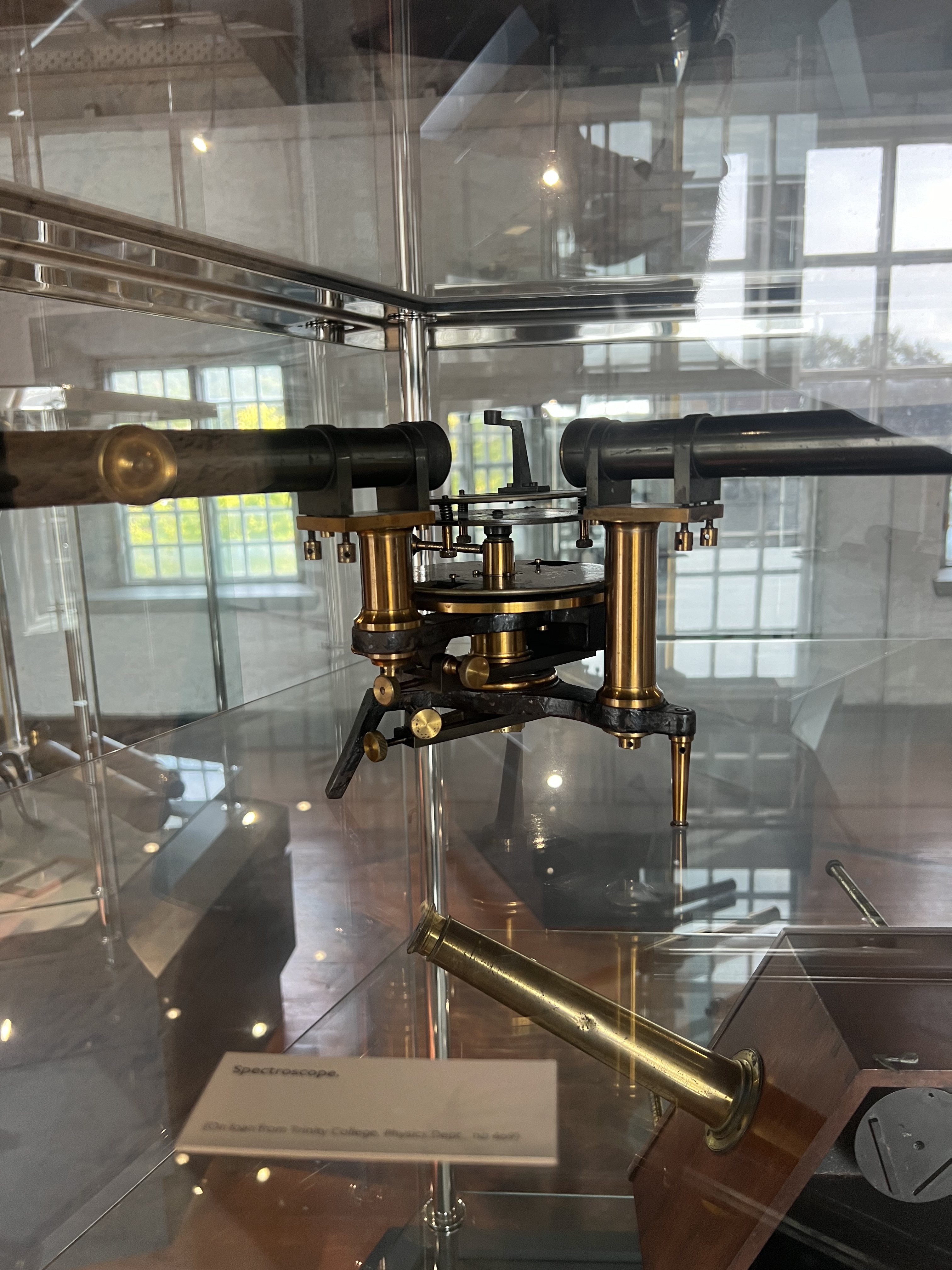
Our bus tour took us by the site of the 1972 Summer Olympics, the BMW Headquarters and many statues in recognition of Munich’s long history. Four grand royal avenues of the 19th century connect Munich’s inner city with its suburbs. With a population of over 1.5M, it is the third largest city in Germany. A global centre of art, science, technology, finance, business and tourism, etc., Munich today enjoys a very high standard of living and is often ranked as one of the world’s most livable cities.

After the bus tour, we shared lunch with Ann on a patio and then hailed a cab to take us to the Holiday Inn Leuchtenbergring. The staff there were most accommodating and helped us settle in to our room and understand the Munich Public Health isolation guidelines. Five days in our room begin today!

Days 13 – 17 – Munich

Each day was pretty much the same. Our breakfast arrived between 8:15 and 8:30 and contained enough goodies to provide us with both breakfast and lunch. There was a coffee maker in the room that kept Nancy happy and staff were available to deliver any other supplies we needed during the day. Fortunately, Greg and Annie, two fellow travellers, were staying through until Friday and were more than helpful in making trips to the pharmacy and grocery store as needed. Nancy began showing symptoms on Tuesday morning and went to the local pharmacy to get a medically supervised COVID test, required for insurance purposes. There were phone calls and lots of emails with Craig Travel and our Trip Interruption insurer, re-booking flights, understanding what they would require for reimbursement, and trying to get a grip on Ontario’s requirements for travellers returning having had COVID abroad. Fortunately, with our VPN subscription, we were able to watch the CBC News, baseball games and other TV shows from home. Dinners were chosen and delivered through an app called Lieferando, similar to SkipTheDishes. We actually ate quite well under the circumstances.

George’s isolation was finished on Saturday and he took a short walk to pick up some cough candies. On Sunday we both went for a walk in the local cemetery, figuring no one there was concerned about our COVID germs if we were still contagious. We stopped at a patio for lunch but wore our masks and kept our distance. It was very warm and humid so we weren’t out for long.
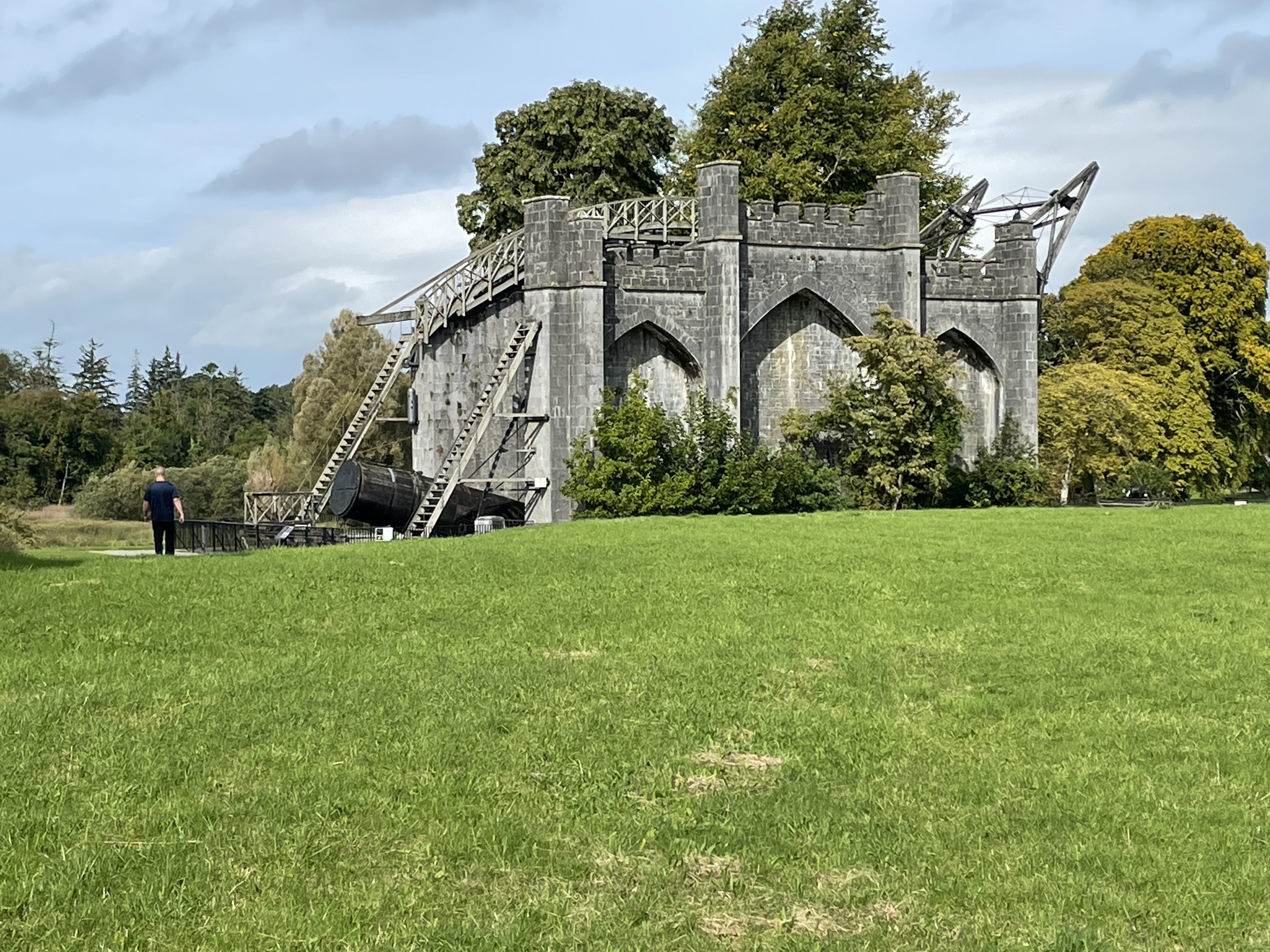
Days 18 & 19 – Munich

We had planned two days in Munich at the end of our trip to see the city but this was shortened to just one full day in the end. We opted to do a portion of Rick Steves’ self-directed walking tour of the Old Town, available through an app. It was excellent but stamina (or lack thereof because of the heat) dictated a shortened route.

The tour began in the Marienplatz where we were on time to see the Rathaus-Glockenspiel, a tourist attraction at the Town Hall. Built in 1908, the clock chimes and enacts two different stories and 11 am at 12 pm, and again at 5 pm in the summer. A video is available on YouTube.

The top half of the Glockenspiel tells the story of the marriage of Duke Wilhelm V to Renata of Lorraine. There is a joust with life-sized knights on horseback representing Bavaria and Lothringen. The Bavarian knight wins every time, of course.

The bottom half then tells the story of the cooper’s dance. According to myth, the coopers danced through the streets of Munich, which was experiencing a plague in 1517, to “bring fresh vitality to fearful dispositions.” By tradition, the dance continues to be performed in Munich every seven years.
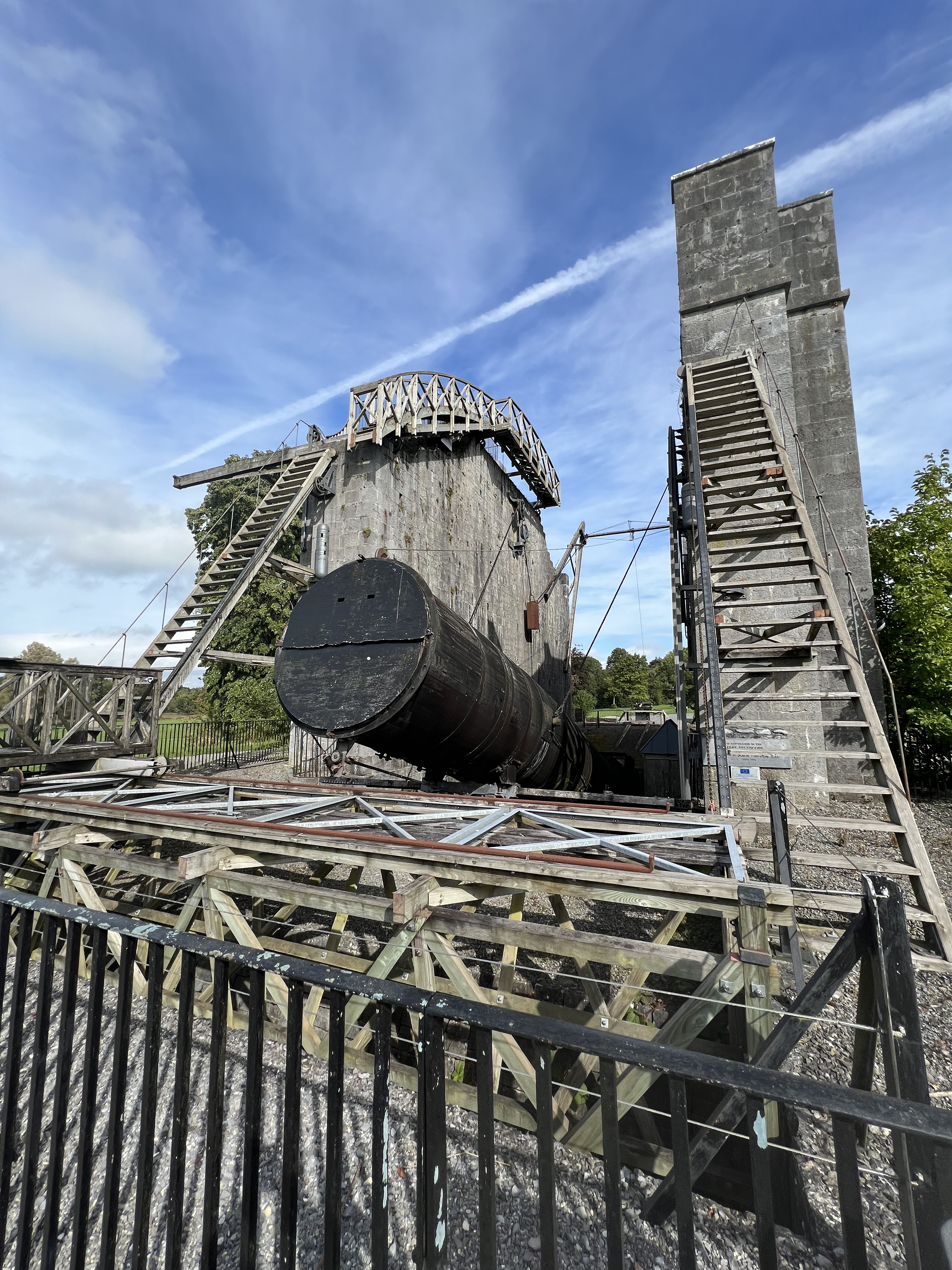
At the end of the show, which lasts 12 to 15 minutes depending on which tune it plays, a small golden rooster at the top of the Glockenspiel chirps quietly three times.

From there we explored St. Peter’s Church, the oldest recorded parish church in Munich. Its tower is visible throughout the old town. Heavily damaged during World War II, the altar is dominated by a statue of Saint Peter. The ceiling fresco, a number of large paintings and several altars all add to the interior beauty of the church.

The Ohel Jakob Synagogue (Jacob’s Tent) was built between 2004 and 2006 as the new main synagogue for the Jewish community in Munich. There is also a museum and community centre included in the compound. In a tunnel between the synagogue and the community centre is a memorial to the more than 4,000 Jews of Munich who were killed during the Holocaust.

The Asam Church was built from 1733 to 1746 by a pair of brothers as their private church, which allowed them to build in line with their own ideas as independent contractors. It is considered to be one of the most important buildings of the southern German Late Baroque. Evidently, the brothers also used it as a display for their building skills to gain other contracts.
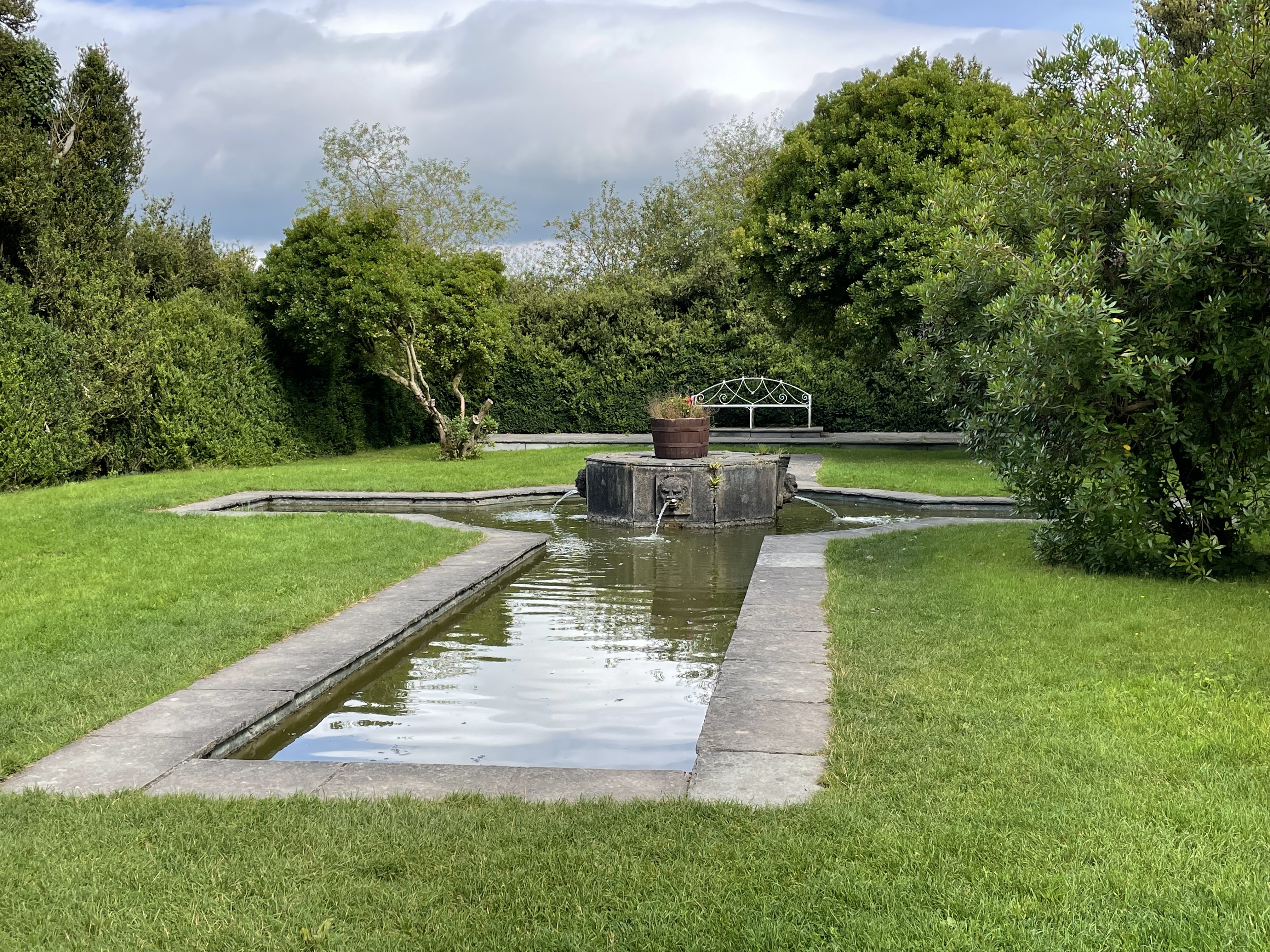
The Viktualienmarkt in the heart of the old town is an outdoor market with over 100 stalls that attracts epicures, foodies and tourists. Everything from Bavarian delicacies to exotic produce is available. Of course, there is also a large beer garden. The market area also includes a series of water fountains featuring statues of folk singers and comedians. A traditional Malbaum (Maypole) takes centre place in the Viktualienmarkt and serves as a great meeting spot for those who might get lost while sampling the wares.

We stopped for lunch at Noah’s patio, a modern Italian cafe not for from the market and then decided to head home. The disappointment of the day was that the ice cream shop mentioned in Rick’s guide had moved and we had to settle for a Starbucks frappe.

We went to bed happy tonight knowing that only one more day of travel would bring us home and we’d be in our own bed tomorrow night.

Day 20 – Travel home

June 16th – There had been a lot of press lately about hours-long waits at airports, lost luggage and frayed tempers. We must have been two of the fortunate few for our lines in Munich airport were nothing more than normal, there was no line through security and we had time for a leisurely lunch before boarding the plane. When we arrived in Toronto, disembarking was done 75 people at a time and the line through Customs moved fairly quickly. Our luggage was waiting (off-loaded from the carousel) when we arrived in the luggage hall. Our car was delivered to the Arrivals pick-up lane by a kind family member. We drove ourselves home and were sitting in the TV room just a little longer than 2 hours after our plane landed. We were glad to be home!

Desert 2022

This post is just a blog to remind us of what we did during three months in Palm Desert in the winter of 2022. The beginning of our time was very much affected by the presence of COVID as noted in the previous post. We were very glad to have a lovely two-bedroom villa with a sheltered patio adjacent to the sixth hole of the Shadow Mountain Golf and Country Club. Days were mostly spent reading, watching TV, golfing, playing tennis, and walking and collecting rogue golf balls on adjacent streets. It was late January before we ventured out to a restaurant patio and began to do our own grocery shopping.

Our one day-trip was a drive up to Idyllwild, a small town in the San Jacinto mountains. All the shops and restaurants are locally owned and it is a peaceful, quiet respite from busy city life. We highly recommend the Red Kettle for a quick bite.

Giant chain saw carving by local artist David Roy. Took four years to complete.

In mid-February, our son George came to visit for two weeks. While he was actually working most days, we enjoyed the odd trip out to a patio, celebrating Dad’s birthday at Spencer’s in Palm Springs, two golf games, and trying to find him and his bike in Indio using the Find my Friend app. A visit to the Living Desert was an enjoyable day out, although mom pooped out part way around. Our attempt at making Middle Eastern Beef Kabobs was a failure. We’ll try again at home when we have a hotter bbq and leaner meat.

George stayed long enough to pick Barb and Merlyn up at the airport before heading off to the west coast. Things were more open by the end of February and we enjoyed many nice meals out as we toured around. We took them to Idyllwild, Joshua Tree, Premium Outlets, and spent a day in Palm Springs – the ladies shopping and the men doing the Windmill Tour. Our trip to The Living Desert was made possible because they rent scooters allowing both Merlyn and me to travel in relative comfort. We only golfed once since we were busy most other days. The highlight of their visit was seeing the Jersey Boys in concert at the McCallum Theatre (their Christmas present) and a Night Out at the Chi Chi Club (part of Modernism Week). The latter was a wonderful evening of music and fine dining modeled after the old supper clubs of the 1950s.

After they left, we had a few more weeks to ourselves before heading north. We had enjoyed getting to know our neighbour, Mary Anne, and had her for lunch one day. We also had dinner at Woodhaven and brunch at the Pink Cabana. We celebrated our last night in Palm Desert at Sullivan’s Steakhouse.

On our way home, we stopped at our timeshare in Las Vegas for a few days, enjoying an evening watching the Canadian men (Brad Gushue’s rink) playing in the World Men’s Curling Championship. George also got to swim in a heated pool, something that isn’t possible in Palm Desert since most pools are only solar heated.

Our trip north took us through Gallup, Amarillo, Joplin, Terre Haute, Washington-Meadowlands, near Pittsburgh, and on to Mississauga. The weather was good all the way through except for a snow shower near Erie, PA.

Off to the Desert

Despite COVID-19 being still a big factor in our lives, we made the decision to proceed to Palm Desert for the winter as planned. We had purchased cancellation/trip interruption insurance when we paid our final deposit in November but had not given too much thought, based on scientific data, that there would be yet another wave. While our insurance would have covered us had we or other members of our family fallen ill with anything other than COVID, the insurance was not valid for any COVID-related reasons. The other factor in our decision was that our private health plan confirmed we would be covered should we contract COVID while away. And so … we decided that isolating in Palm Desert was much more appealing than isolating in the deep cold of another Ontario winter.

We left Mississauga on Christmas Day after lunch and gift exchange with the family. We were somewhat anxious to cross the border for fear it might be closed again. After a night in Sarnia, we arrived at the border about 8:30 a.m. on a Sunday morning. There was no one there and we breezed through in less than a minute.

The weather was overcast but above freezing all the way through to Indianapolis, our first stop. Traffic was light since it was a Sunday, and we were able to make good time. We are always interested in all the trucks and vans on the road, especially what they are pulling. One funny sight was a rather large van pulling a pick-up truck with a golf cart and bicycles in the cargo space.

Our plan to avoid restaurants and going into gas stations as much as possible worked well. We used a drive-through for lunch and mostly used the rest stops which were scarcely populated. We were prepared, with plates and cutlery, to eat dinner in our hotel room. Our stop for the night was the Holiday Inn in Plainfield on the south side of Indianapolis. It’s in a large complex of hotels close to the airport with a number of restaurants within walking distance (unfortunately closed because of the holiday). On our way to pick up dinner at Applebee’s, we were directed out along the country roads and were a bit surprised to see a deer at a watering hole.

Since we were the only ones at breakfast the next morning, we decided we could eat in the dining room. We had brought our colourful picnic plates downstairs with us to use as a try to take breakfast back up to the room. The staff person at the front desk was doubling as the breakfast attendant that morning – a young girl in her late 20s. When she saw our plates she remarked “So cute. Something my parents would do!”

Travel through to Memphis was uneventful and we were happy to see the sun for long periods and watch the temperature rising as we got further south. It was 18C by the time we got to West Memphis. Since dinner last evening was quite large, we were able to save enough for lunch today, which we ate outside at the Rend Lake Rest Stop. It was a bit cool, but we ate quickly and were on the road again.

Once again we stayed at the Holiday Inn – West Memphis, but this time requested a room on the backside of the hotel away from the noisy traffic. We are beginning to see more people without masks, although many travellers our age are wearing them at most stops. For dinner we picked up Mexican food at Las Magaritas.

Since there were too many people in the breakfast room, we took our food back to our room and ate there. We hadn’t seen any Canadians (at least in cars) as yet but later in the morning we found one. His trailer was a dead giveaway. It said “Life is great, eh!”

We made a stop in Little Rock at the AAA to pick up a map that we hadn’t gotten from the CAA before leaving Ontario. There is one person in my car who still likes to look at paper maps. It was too far to drive to the next Rest Stop for lunch so we decided to stop in Hope – the birthplace of William Jefferson Clinton – and just eat in the car. As we drove into the Wendy’s drive-through, I realized we had been here before. The Baskin Robbins was a dead giveaway sandwiched between Wendy’s and the Service Centre store. We both ordered salads, but I ended up having to go into the store to collect the chili and tortilla chips for my Taco Salad. After our lunch stop, we drove through to the Rest Stop at Hopkins on I40, which is new and has a small interpretive centre and nice walking paths. It was well used and was a welcome stopping spot.

By the time we arrived in Plano, TX, the weather had warmed to a lovely 26C. The Holiday Inn is brand new, but what we didn’t know was that it is located along the George Bush Turnpike which is a toll road. I guess they will catch up with us eventually. Its one redeeming feature is that it is very close to an Olive Garden – one of our favourites.

Again we ate breakfast in the room and prepared for a wet drive as the rain had arrived. It continued to rain until about 10:30 and then cleared up. We stopped in Abilene to pick up a Subway for lunch and then continued on to the Rest Stop at post 256. Perched on a hill (the only one to be seen) in very windy, somewhat cold temperatures, it wasn’t very inviting and so we ate in the car.

The terrain is generally quite flat, big sky country, and we could see dust clouds off in the distance. Signs along the highway warn of sand storms. This part of the journey through to El Paso passes through scrub brush, ranching (cattle and horses, although we didn’t see many) and then oil works. Hwy 40 is a divided highway with two lanes in each direction. Exits are far apart. Late in the afternoon we came upon an accident in the eastbound lanes. A truck hauling an equipment trailer had jackknifed and a fire ensued. The backup must have easily been about 5 miles long and while they were diverting traffic onto a one lane service road, it too was completely clogged. I don’t know how long people would have sat in the tie-up but it is a reminder to always carry the necessary supplies. We were also surprised at the number of transports coming east when there were very few travelling in our direction.

Our stop for the night was the Holiday Inn in Monaghans. It is an older hotel and was not as well serviced as most HIs are. We understand that it is an out-of-the-way place and would only be used stopping for the night between Dallas and El Paso. There was a restaurant close by which advertised the best ribs in Texas. I placed an online order, but when I went to pick it up no order could be found. After studying my confirmation email, the bartender said, “But that’s for our restaurant in North Dakota!” We don’t know how that happened, but they very kindly said they’d prepare my order anyway (I hadn’t paid for the other one) and I agreed to wait in the car. Alas word came back from the kitchen that they’d run out of ribs, so we had salmon instead.

The buffet next morning was somewhat spotty and the attendant wasn’t very accommodating. We were able to get out usual breakfast, but many were upset that there was no bacon and eggs. The drive through to El Paso was uneventful, and we picked up a salad in town and then drove to the rest stop just west of town on Hwy 10. It is a very nice rest stop with individual picnic tables in adobe-style shelters. While there we met a couple from Manitoba who have been visiting various relatives throughout the US since November. They were pulling a camper van and while they liked the idea of stay anywhere and not having to unpack, he did say it was a bit of a nuisance having to take it everywhere you go. We both remarked on how little we have interacted with anyone on this trip. I think these were the only people we had chatted with for anything more than a cursory greeting.

As we got into the mountains the temperature dropped fairly quickly and it began to rain. By the time we had settled into the Holiday Inn in Wilcox it was raining quite heavily. Wilcox is really just a truck stop on the highway. The hotel was quite dated and the poorest of all the ones we stayed in – old, damaged furniture, grungy rooms and poor lighting. Since it’s just a crossroads, the choices for dinner were slim – fast food or Country Pride at the truck stop. We thought that the Country Pride specialty, pork chops, would make for a good dinner since we’d missed the ribs the night before. Not to be! It became chicken teriyaki stir fry instead. It actually wasn’t too bad, and we shared the last bowl of their corn chowder.

Breakfast was again in the room but when I stopped in after checking out, I missed being able to get some fruit for lunch. The hotel was very full with families travelling home after holidays with relatives, business people, local workers, and people travelling like us. The choices are few along this stretch.

Our travel plans changed as we were originally planning to drive through to Palm Desert and spend New Year’s Eve in a hotel there before gaining entry to our Villa on Saturday. The price of hotel rooms in Palm Desert on New Year’s Eve dissuaded us, and we decided to decamp in Buckeye, AZ for the night. This left us with a short four hour drive today, so at the suggestion of our son we made a detour to Tombstone, AZ.

Tombstone advertises itself as the little town that “refuses to die.” Founded in 1877 by a prospector, it became one of the last boomtowns of the American frontier. It grew significantly until the mid-1880s because of the silver mining in the area. It’s best known as the site of the Gunfight at the O. K. Corral. It derives its current popularity from tourism and the highest-rated brewery in Arizona. Many of the buildings are originals and everyday there is a gunfight at the O. K. Corral. It’s hard to tell as one walks around town who are the actors and who are the folks who actually live there.

We chose not to attend the gunfight since we had done this elsewhere, but we did stop to talk to some of the actors. There was a group of four guys dressed in old-fashioned suits at one end of town and about half-way down there was another group of three guys dressed as cowboys. I stopped to ask the cowboys if they were “the good guys or the bad guys.” One of them immediately asked me if I was a Canadian: he must have recognized the accent. It turned out he was born and raised in Kitchener-Waterloo and had been in Arizona for 30 years.

We stopped at a small store to buy pistachios, which are for sale everywhere down here, and treated ourselves to two pieces of pecan pie to have at dinner tonight.

Three cowboys

The section of Hwy 10 from El Paso to Buckeye is very scenic. With mountains on both sides in the distance, big boulders sit atop other boulders, seemingly thrown there by some giant in the past. It is very similar to what you see in the Joshua Tree National Park. It was a cloudy morning, and we drove in and out of showers along the way.

Buckeye is the last town before you enter the desert drive across to the Coachella Valley. We were pleasantly surprised by a new Holiday Inn built at one end of a large shopping complex which also included a local hospital. Dinner tonight was roast beef from the Cracker Barrel, right across the road and of course our pecan pie for dessert. In preparation of potential closed gas stations and lunch spots on New Years Day, we bought gas and lunch salads before turning in for the night.

We celebrated the New Year by sending messages back home at 9 p.m. and again at midnight local time. Hopefully 2022 will bring a resolution to the pandemic, and travel will become easier.

We arrived in Palm Desert about 1 p.m. on New Years Day to find our Villa in good order. After a quick lunch, we set off to Ralph’s to pick up our grocery order, placed online the previous day. How nice that they were open on what at home is a statutory holiday!

Our villa sits on the 6th tee box of the Shadow Mountain Golf Club in the El Paseo district of Palm Desert. It’s a two-bedroom unit and looks like it will meet our needs quite well. We intend to stay close to home, while COVID rages here, although tennis and golf are possibilities with the right social distancing measures.

Road Trip to Texas

This post has been about two years plus in draft form. I intended to finish it when we got home but my dad took sick and I obviously forgot all about it. As I was preparing to draft a new post today, I found this draft awaiting and finished it so it could be published.

Oct 31st – Nov 17, 2019 – There are two or three purposes for this little road trip: to have some time away after a very different summer and fall season, to check out two Holiday Inn Club Resorts, and to see what three days on the road is like in preparation for a future trip to Palm Desert by car, when we will do five days on the road.

Our route took us through Detroit to Indianapolis, then on to Memphis, Dallas and finally to Canyon Lake in the hill country of Texas. Each of the first three days was a seven or eight hour drive with extra time for gas and food.

In Memphis, we spent a few hours on famous Beale Street and had dinner at BBKing’s Blues Club. A live band was playing all the old favourites and although it was loud, it was quite fun. It was quite hectic outside as ESPN was setting up for broadcasting the college football championship the next day.


Canyon Lake Resort is in the hill country of Texas and appeared to us upon arrival to be quite isolated. As we roamed around over the next few days we realized that there are some very quaint towns and wonderful vistas along these rural roads. The resort itself is older, having been purchased by HICV from another timeshare company. It will take a number of years to bring it up to HICV standards. People are quite friendly in these parts and we have struck up conversations with locals in restaurants, which often leads to tips on things to do.

Our first day here, since the weather forecast was excellent, we drove to San Antonio (about 1 hour) and toured the city using the Hop On Hop Off bus. We opted to do the audio tour of the Alamo which was excellent and then had lunch at Landry’s on the Riverwalk.

We had an interesting time on our second day here since we only had a half day to fill in. We decided to play tennis but the courts at the resort were being used for a hay-bale maze. We were told that arrangements had been made to allow us to play at the high school, but no one there knew anything about those arrangements. The receptionist very kindly googled and phoned to find public courts in New Breunfel. By that time it was too late to play and return for our meeting with the HICV staff. That meeting also didn’t quite go as planned. Our rep was someone who had only been working for them for three months and I think he may have been intimidated by our firm commitment to not buying more points despite the fact that he felt we could save money in the long term by having those points which renew every year. Never tell the customer they’re wrong! After we left him, we carried on to New Breunfel and played tennis and then had dinner before returning to the resort.

The next day was a planned golf day, which I had booked earlier in the week. Imagine our surprise when we went to get the directions and found I’d booked a tee time for Canyon Lake G&CC in California! A quick email to cancel that tee time and a new booking at the right club and we were good to go. It was an interesting round of golf given that the grass is currently dormant. Most fairways were a mixture of clover and large bare spots, but most of the greens were fairly good. There was no one in front of us and we were able to play the whole 18 holes in just over three hours – George H. W. Bush would be proud since 2 1/2 hours was his limit for 18 holes. We were back in time to do laundry and enjoy the pool before going to the local steakhouse for dinner.

Our last full day here was cloudy with scattered showers and got progressively colder throughout the day. We decided to do a scenic drive through hill country and used one of the online guides as our model. Our route took us to Fredericksburg, an old town settled in 1846 by 120 German immigrants. It boasts a 3 1/2 mile long wide main street with century old limestone buildings and new structures standing side by side, depicting a true blending of the traditional and the contemporary. Of note is the Veriens Kirche, an eight-sided building, in the middle of town. It is a replica of the first public building in the settlement which served as the town hall, the schoolhouse, a fort and a church for all faiths. We had a lovely chat with a representative of the historical society about their display on the history of trains in Fredericksburg.

A little further along, we stopped at Grape Creek Winery for lunch. Neither of us were aware that grapes could be grown in Texas and that there is, in fact, a fairly sizeable wine industry resident here. In fact, George read that after Napa Valley, this is the second largest viticulture area in America. There are currently over 50 wineries in operation with more being built every year.


Our last stop was at Devil’s Backbone overlook. History has it that much of the area we travelled today is haunted. A section of highway with many small curves has been nicknamed the Devil’s Backbone. A small park looks out over the valley and would be quite scenic on a sunny day. A chain fence has been constructed at the edge of the park, presumably to stop people from hiking down the steep cliff. The fence has become a repository for people to leave a talisman and includes crosses of all descriptions, flowers, stuffed animals, etc. It took us a while to figure out what this was all about but Google helped us put two and two together.

The next stop on our road trip was Austin, the state capital. Known for its beautiful capitol building, we used the Hop On Hop Off bus to shuttle us around town before taking the capitol building tour. The city seems quite small for a state capital with the downtown core taking up maybe a dozen streets in either direction. There is a large university and hospital complex within those blocks as well. On the southern side of the freeway that dissects the downtown is a unique artsy area with lots of shops and restaurants. Probably the biggest surprise for us was to find out that the legislature only sits for five months during a two year period meaning that all of the elected representatives and senators have full-time careers elsewhere.

After we left Austin, en route to our next HICV Resort in Galveston, we made a detour to visit the President George H.W. Bush Library at College Station on the grounds of Texas A&M University. It was easy to find and we spent most of a day there. The library is well laid out and tells the story of President Bush’s life’s work very well.


South American Cruise 2019

Feb 19th – Today we begin our three week adventure travelling from Buenos Aires, Argentina to Santiago, Chile on the Zaandam (Holland America). In order to get acclimatized before boarding the ship, we booked two days in Buenos Aires on our own. The flight from Toronto was uneventful although we did notice the more cramped space on smaller planes that make the long haul flights now. It was difficult to walk the aisle without bumping someone and, while the legroom was fine, the reclining mechanism didn’t move more than three inches. The seats were very uncomfortable for a ten hour overnight flight!

We booked a private transfer from the airport to our hotel which is something we have found to be very helpful…no negotiating a fee…no chance of getting ripped off…and they are always waiting for you as you exit immigration. Our hotel is The Intercontinental downtown on Moreno Street. Since our room wasn’t ready, and we refused to pay for a upgrade that would provide free breakfast and afternoon snacks, we left our luggage with the concierge and went off for a walk and early lunch. With a temperature in the mid-30s and humidity that rivals Toronto in the summer, we weren’t out long before we were both happy to be returning to the air conditioned comfort of our hotel room.

After a nap and a change to summer clothes, we ventured out again for an early dinner. As per the European custom, dinner here is usually about 7 or 8 pm. We knew we wouldn’t last that long but the concierge was helpful in directing us to restaurant El Querandi that was able to serve an early dinner. We had the place to ourselves and enjoyed attentive service, excellent food, and the friendly staff.

Feb 20th – After a continental breakfast in the dining room (much cheaper than the up-selling yesterday) we waited on our tour guide to pick us up for a city tour. Buenos Aires has a population of 3M people with another 1M arriving from the suburbs everyday for work. Driving here requires patience and expandable travel times depending on traffic. Imagine a road through the centre of town that has nine lanes in each direction and four bus lanes in the centre. That’s 9 de Julio…one of the main thoroughfares. They also have an extensive subway with seven different lines…something we might explore if we had more time.

The tour took us past a number of important cultural and government buildings, some lovely parks, and through a number of different neighbourhoods, each with unique architecture and histories. We had personal time at two spots – Plaza de Mayo to see the Cathedral and the Pink House, mansion and office of the President; and Caminito, a vibrant, unique area inhabited by artists and cafes. We ended the tour at the Obelisk built in 1936 to commemorate the quadricentennial of the founding of the city. It serves as a beacon and a favourite meeting spot. After a stop for lunch we returned to the hotel for a rest and preparation for an evening of entertainment Argentinian style.

We were picked up about 8pm and taken to Cafe de Angelita for dinner and a tango show. The dinner was quite nice and included a typical Argentinian appetizer, a choice of four different entrees (we had steak), and a choice of dessert. Wine and unlimited bottles of water were included. The hall is quite beautiful and seats about 150 people. Dinner was served with precision – I think they’ve done this before. The show began about 10:30 and went until midnight. It’s advertised as a show that tells the story of the tango over the past hundred years. Certainly you could tell that from the costumes and the changes in the style of music. I would have liked a bit of commentary in between numbers but perhaps language is a problem. We were quite tired by the time we returned to the hotel and crawled into bed shortly after 1 am. Good job we don’t have to get up tomorrow!

Feb 21st – Today was purposely planned as a quiet day so we could arrive at the pier without having to rush. We had a leisurely breakfast and read until it was time to pack up and meet our taxi. Boarding was quite well organized and we were settled in to our stateroom on the Zaandam by 1:15. We went off and had lunch before returning to unpack and settle in. I have a feeling we’re going to spend a fair bit of time comparing Holland America to Oceania. So far, the storage is better on the Zaandam but the bathroom on the Marina was much nicer. After a rest, we explored the ship, stopped for a drink in the library, attended the draw in the spa (we didn’t win) and then had a light dinner in the Lido Market. During dinner we enjoyed watching the container yards at the pier as truck after truck arrived with more containers to be stacked, awaiting shipment. We decided that it must all be computerized since no one appeared to be controlling the loading arm and the trucks stopped at different points in the rows, presumably depending on their contents and final disposition. Hopefully tomorrow before we leave we’ll get to see some being loaded onto a ship.

We had a problem with our air conditioning unit, but the staff responded quickly and fixed the problem right away. Tomorrow’s another warm day and we’ve scheduled a culinary walking tour…it’s another early night, I think.

Feb 22nd – Our last day in Buenos Aires was a real highlight of our few days here. We signed up to do a culinary walking tour, which actually began with a bus tour through some of the same areas we had travelled on Wednesday. While the sights were the same, the commentary was different and we learned much more about the city and its neighbourhoods. As mentioned previously, the population of the city is 3M but the metropolitan population is close to 13M. Inflation is running at about 48%, making it difficult for everyone to think positively about the future. Our guide told us that mortgages and loans are non existent at reasonable rates so purchases of homes and new cars are not realistic given a good wage is about $1000 US per month.

We began our culinary tour at La Canita for some street food called choripan – basically a chorizo sausage on crusty bread. It is served with two different sauces, one that’s like salsa and the other made with olive oil, vinegar and spices. The building was over 100 years old and used to be a dairy.

Our second stop was at La Guitarrita, a cafe that specializes in food and wines from the Salta region in the northwest of the country. We tried beef empanadas, which are very much like a meat pie. They were quite tasty and this one had a stewed beef filling instead of ground beef like last night. The wine was from the Cafayate winery in an area of the country that is becoming very well known.

Our third stop was at Las Cholas, a traditional Argentinian steakhouse. Here we dined on flank steak, sirloin steak, rice, fries, and grilled vegetables. They also served grilled provolone cheese on crusty bread, paying homage to the Italian influence felt in Buenos Aires. In other parts of the country one would experience French and German influences. The wine served was a Malbec for which Argentina is one of the biggest producers.

Our last stop was for ice cream, which is really gelato only a bit creamier. Our guide told us that’s because the cows here eat more grass than in Italy!

On the way back our guide entertained us by talking about some of the idioms specific to Argentina. The first was “rich enough to have a cow tied up”. This dates back to the 19th century when wealthy people moved their families back to France for the winter season. On the boat, they took all their household staff, food for the journey including chickens in cages, for eggs, and a cow tied up so there would be fresh milk. The second idiom was “throw butter to the ceiling” which relates to wasting money. It was a custom to celebrate a child’s first birthday by hosting a gala event during which people would throw butter to the ceiling…even though the child was too young to understand.

The entertainment tonight was presented by Pampas Devils Gauchos, a group of three dancers/drummers who were quite amazing. They began with the usual tango dances and a short video about the history of the tango and then moved into a rhythmic presentation of drumming skills and then a combination of drums and boleadoras (acrylic balls on the ends of ropes that hit the floor to make rhythmic sounds). It was quite mesmerizing. Google them to see some video of their presentation.

Feb 23rd – Our first stop en route to Cape Horn was Montevideo, Uruguay. It is at the mouth of the estuary, across from Buenos Aires, but closer to the ocean. The capital of Uruguay, it is a mixture of old and new…old colonial style buildings and modern skyscrapers. Uruguay has a population of only 3.5M people but is only 1/10 the land size of Argentina. It is listed as the richest country in South America, most likely because there are no really wealthy people as in Brazil and Argentina. Everyone would be considered “working class.” Agriculture is the main industry, especially potatoes and beef. Despite growing ten times the amount of food required by its population, food costs remain high and are a major source of complaint.

Our excursion for the day was a bus trip to Colonia del Sacramento, a UNESCO Heritage Site. Founded in 1680 by Portuguese Captain Manuel Lobo, governor of Rio de Janiero, it sits on a peninsula surrounded on three sides by water. A wall across the fourth side ensured it was protected from invasion. In 1777, the city was successfully captured by the Spanish hence leaving behind a delightful mix of both Portuguese and Spanish architecture. Uruguay achieved independence in 1858(?). Many buildings have been rebuilt or refurbished as museums that explain the original plan of the city and its changes over time. People continue to live within the city walls although accommodation is quite expensive. Our guide, Betty, did an excellent walking tour providing us with the history and unique features of many buildings. The Basilica of the Holy Sacrament has been rebuilt many times during its life…noticeably once during Spanish rule. They thought it wise to keep their ammunition in the sacristy, in case of invasion. It worked well until the church was hit by lightning!

After the walking tour we enjoyed lunch at a restaurant, close to the church, complete with a singer for our dining pleasure. Lunch was a choice of beef or fish.

On the outskirts of Colonia was an old hotel and casino, now converted to a school, and an old bull ring, slated for refurbishment. I’ll add more about this when I have access to the internet.

There is a unique feature about the Uruguayan people that we saw at play during out tour of Colonia. They like tea…and so you will see many of them cradling a thermos of hot water and a gourde-like bowl with a metal straw. The tea leaves float on top and the straw provides a way to sip the tea as you walk. It’s called a ???.

We ate in the dining room tonight where service is four-star. What fun watching people new to cruising react to delivery of their twice-baked potato soup – delivered as a empty bowl with a few pieces of cheese, potato and bacon in the bottom. We noticed that if you don’t react, the soup is brought in a jug relatively quickly and poured into the bowl. If you do react, you may have to wait for the rest of the table to be served their appetizers before your soup arrives, or the waiter may try to convince you that what you see is the soup. Lots of laughs!

Feb 24th – Feb 28th – As can happen in this area of the world, things have not gone as planned. There was an ominous sign as we left Montevideo watching a thunder storm form over the city. Later in the night the rolling of the ship began as we hit winds of 15 to 25 knots. The captain explained, in the morning, that their only option was to slow our speed to reduce the roll and potential damage to the ship. The slower speed meant that we arrived in Port Madryn one day later than planned.

Port Madryn was settled by a group of 150,000 Welsh folk and is a very small town. Although there is a town further inland that has retained its Welsh heritage, there was little evidence in town other than a monument. We hadn’t planned any tours, so we joined forces with a Hymn Society friend, Nancy Hardy, and explored the town on our own.

We’ve enjoyed the Trivia Team challenges each evening and have joined forces with Nancy Hardy, Malcolm and Elspeth Sinclair and another couple to form Team Mensa.

The entertainment has been somewhat sporadic so far, given the bad weather. We’ve enjoyed two shows – one by the entertainment team and one by Shirley Dominguez, who plays an electric harp with a Latin beat.

Since we’ve had three full sea days, there has been lots of opportunities for port, history, scientific and cultural lectures. We’ve particularly enjoyed Tommie Sue Montgomery, a history professor who lives in Oshawa. Her lectures are both informative and interesting.

Unfortunately, the delays and bad weather have meant that we will not be stopping at Port Stanley in the Falkland Islands. Evidently only about 1/3 of the ships who travel this route make it there. Disembarkation is by tender and any bad weather involving high winds makes it very dangerous to use the tenders. So, on we go to Puntas Arenas!

Mar 1st – We woke up this morning in Puntas Arenas, Chile, a small city of 160,000 people famous for being one of the windiest places on earth. It is said that at some times of the year the wind is so strong they put ropes across the road for people to hang on to while crossing. When you look at the trees, the direction of the prevailing wind is obvious – they all lean in the same direction.

The region of Patagonia in the south, where Puntas Arenas is located, makes up about 10% of Chile and its inhabitants are fiercely independent. Mountains cover about 89% of Chile. The population is about 2M people and 7.5M sheep.

Our tour today was called the Tycoons of Patagonia and featured some of the original families to the area. The first stop was the Cemetery where Sara Braun is buried. She was one of the wealthiest women in PA and contributed significantly to the building of the city at the turn of the century. The Cemetery is ranked sixth most beautiful in the world. Who knew there was a ranking system for cemeteries!

The second stop was the Braun Menendez Museum, her brother’s house that has been left with its original period furniture. There was also a small museum of artifacts from the founding of the city and other interesting items.

We then had an opportunity to wander through the central square and visit some of the artisan’s stalls along the way. The statue in the centre of the square reminded us of the statue of Timothy Eaton, at home – one foot was well polished as people rubbed the toes to ensure a return visit to PA.

The final stop was probably the most interesting. The Dick family came to PA from Scotland over 100 years ago to farm the land. They specialized in beef and sheep. Their great grandchildren carry on the family farm, which has been moved further out of town due to expansion of housing within the city. The old homestead, however, has been turned into a tourist attraction to show people the history of the area and farming techniques at the turn of the century. They were most welcoming and served a snack prior to a visit to the sheep and llama pens and a demonstration of sheep shearing. We quite enjoyed this stop.

After returning to the ship we hopped on the shuttle bus and went back into town for lunch at a cafe that had free wifi. Downloading 275 messages took a bit of time and most of them were quickly dispatched to the trash folder. George got two days of the Globe and Mail, which will keep him happy reading about the Canadian political crisis.

The entertainment tonight was called Frozen Planet in Concert: A Visual & Musical Journey. It was an amazing film made by the BBC and shown in partnership with Holland America, accompanied by the musicians on the ship. There were about ten different stories with film footage from the Arctic and Antarctic regions. Very enjoyable!

Tomorrow we cruise the Beagle Channel early morning with narration.

Mar 2nd – The Beagle Channel is a channel shared between Argentina and Chile, discovered by Fitzroy in 1830. He made another voyage in the area in 1833 accompanied by Charles Darwin. The channel was named after Fitzroy’s ship HMS Beagle. Our cruise through the channel included narration describing the history of the area and the six glaciers that one passes on the way down to Ushuaia, the southernmost city in South America. We were reminded yesterday in Chile that in fact Port William is further south, although it is only classed as a town – a bit of good-natured rivalry.

We docked in Ushuaia shortly after noon and embarked on a 4.5 hour nature tour. Our first stop was Tierra del Fuego National Park which covers 68.9 hectares of the southern tip of the Andes. Most of the Park is naturalized but does provide for some camping and hiking in restricted areas. The vegetation is mostly Southern Beech and Guindo, a type of evergreen. The Fuegan Red Fox is abundant in the lower regions while the Guanaco is more abundant in the upper regions. New species introduced for economic reasons such as the beaver, rabbits, and muskrats have not fared well and are causing problems to the ecosystem. After a brief stop at the most southern post office in Argentina, the bus took us along highway 3 to the terminus of the Pan-American highway – the most southerly point that one can drive.

The next part of the tour was by catamaran along the Beagle Channel. There we were able to see some of the wildlife including imperial cormorants, rock cormorants, skua and sea lions. Unfortunately, the weather closed in and we experienced rainy conditions until close to the end of the trip when the sun finally arrived.

We only had about 30 minutes left when we arrived back to our ship. Sine this was our last stop in Argentina and we still had 900 Pesos left, we walked to the end of the pier where we found a wine shop and were able to purchase two bottles of wine similar to the ones we had tried earlier in Buenos Aires. We had just enough to leave a little tip for the clerk.

While we didn’t get to see much of town, Ushuaia means “bay to the west.” It’s a city of about 80,000 and continues to grow. It was originally established as a penal colony, but the government in the 70s and 80s began to give tax-free status to encourage people to move there. As the population has grown, new professionals such as doctors, lawyers, and teachers have moved in as well creating a good community base. One would think this far south, the winters would be quite extreme but in fact the temperatures don’t change that much: 0* to 10* year round. The most depressing part would be the 200 days of rain…but our guide said you get used to it, especially if you like hiking and the outdoor life. Tourism accounts for 20% of their economy.

Mar 3rd – We were up early again this morning as we rounded Cape Horn just after 7 am. Cape Horn is where the Atlantic and Pacific oceans meet and is the most deadly passage in the world. Waves have been known to be over 30m or 100′. More than 1000 ships and 15,000 lives have been lost traversing this route. We were fortunate as the seas were very calm.

There are only three structures on the Cape – a lighthouse, a home for the keeper, and a memorial built to those who have lost their lives rounding the Cape. The property is maintained by Chile and the current keeper lives there with his wife and three children. They are resupplied once a month and otherwise live a very secluded life.

The memorial is in the shape of an Albatross and Sara Viel, a Chilean poet, wrote this poem to accompany the sculpture. [to be Added later].

Today was a full day at sea and was quite restful. The weather is very changeable with periods of sun followed by abrupt closing-in with heavy clouds and rain showers. We attended two lectures and Ask the Captain Anything. The latter was very well done as he, Chris Norman, explained the inner workings of the ship, how staffing works, a bit about how he came to his position as captain, and some of the finer points of cruising the Southern Hemisphere. In particular, we thought he did an excellent job of explaining the process of decision-making that went into the change of itinerary regarding the Falklands.

Dinner tonight was in the dining room and we were assigned a seat by the window at the back of the ship. The changeable weather rewarded us with a double rainbow just as we were finishing dessert.

Mar 4th – The windy, rainy weather system continues to haunt us providing for lots of rocking and rolling. Fortunately, neither of us suffer from seasickness. Around 1pm, we were finally able to enter the Nelson Passage which provided some protection from the wind and a lot less motion.

There were two more lectures this morning on Chile and our two remaining ports. This was followed by a lunch for Members of the Mariners Club, which we attended with Nancy Hardy. We certainly have enjoyed a number of relaxed meals chatting with people from around the world. The majority are from the US, Canada, and the UK but there are a good number from France, which allows us to practice our conversational French.

Just before dinner tonight, we entered one of the fjords to view Brujo Glacier. It’s one of 118 glaciers in the area and is a tidewater glacier, meaning that the ice comes right down to the water line. We don’t remember any of the glaciers in Norway being this large…but we’ll check that out when we return.

We had a lovely dinner in the Pinnacle Grill complements of our travel agent, Rozik, at CAA.

Mar 5th – Not too much to write about today as it was yet another day at sea. We attended two lectures – one by Tommie Sue on the history of Chile and the other on the habits and culture of whales by George. Tonight’s entertainment was an excellent presentation by Andrea Amat, a flutist from Spain.

The weather has been less than stellar. Today we had winds gusting up to 50 mph with heavy rain. We are passing the fjords but there’s not much to see. Fortunately even though the seas are rough, the Zaandam is doing a pretty good job of handling them. It was a bit rough over night but the rest of the day has been tolerable. At bedtime, we still don’t know if we’ll be able to get into Puerto Montt tomorrow. The forecast is for strong winds and rain, and it’s a tender-port. We’ll see!

Mar 6 & 7th – We were up early and ready to disembark by 9 am for a trip to Petrohue Falls and the Orsono Volcano. There we all sat in the theatre trying to be positive given the circumstances. It was obviously windy with heavy rain, and some of us truly hoped they would cancel, but they stretched out the decision to cancel the port call just about as long as they could. I suspect there was a fair bit of diplomacy going on in the background as the decision was taken out of the captain’s hands. The portmaster imposed a ban on small vessels which meant that the ship’s tenders couldn’t be used. After about an hour they finally cancelled the port. I doubt we would have seen much and a walk in the forest would have been somewhat miserable given the weather.

Over these two days, there were more lectures – this time on Football and why it is so popular in South America – a five-kilometre walk around the deck to raise funds for cancer, a lovely afternoon concert by Adagio, another presentation by the entertainment team, more games of trivia…and it’s time to pack.

Mar 8th – Our departure time this morning was quite civilized given that we made our own arrangements to travel from the port in San Antonio to our hotel in Santiago. Our driver was waiting for us just outside the terminal building. The trip takes about 90 minutes, most of it on tollways. At one point he stopped as we passed through the toll gate and waved a lady over to the car. He bought two packages of pastries and gave us one. I don’t know what they’re called, but they were small cakes filled with creme de leche and covered with icing sugar- messy but good.

Santiago has four tollways covering over 250 km. The speed limit is 120kph but we suspect we were travelling faster than that at times. The line ups to pays tolls at various entrances was unbelievable but we assume there’s a faster way for vehicles who travel them frequently.

Our hotel, Courtyard in Las Condes, is fairly new and quite modern. It’s located between the Andes mountain range and downtown Santiago and has its own selfie spot on the 18th floor. It’s also conveniently located to Mall Parque Arauco, the most popular in Santiago. Located around a central outdoor courtyard, the mall has most of the usual American stores and restaurants.

After getting settled and having a quick lunch, we headed off on the Hop On Hop Off bus tour. The route takes about two hours and winds its way through residential areas and the commercial district. We were particularly struck by the varying architecture throughout the city. From traditional Spanish areas, to the occasional English Tudor style, to large neo-classical structures such as the palace and the buildings around the Plaza des Armas, to the modern skyscrapers, there is eye candy everywhere you look.

Traffic is horrendous, as expected, and we were surprised by the number of people in the downtown area. Some streets have been converted to pedestrian only and most major streets have express bus lanes to improve commuter travel.

Santiago is a city of neighbourhoods and one that caught our fancy was Providencia because of its Canadian connection to the Sister of Divine Providence who arrived in Chile from Canada in 1853. The amusing part of the story is that their landing here was due to the fact that their original destination in Oregon was flooded. Not knowing how to make the return journey to Canada, they met a Chilean sea captain who brought them to this remote corner of the world. Their ministry flourished and the area eventually became known as Providencia. Today it is an upscale area well suited to the many hotels, restaurants and embassies located there.

The tour guide made a point of telling us that Santiago is a relatively safe city and many of the neighbourhoods have a very vibrant nightlife. The presence of many police stationed on street corners throughout busiest areas of the city was also reassuring.

After a little rest, we ventured out to the Mall for pizza dinner and a treat at the bakery restaurant. A swim in the hotel pool finished off a lovely day.

Our family trip to the ballgame

July 31st to Aug 12th – For a retirement gift, our kids gave us two tickets to each of the Major League Ball Parks, to be used over the course of many years – one ball park each year. At a family Thanksgiving gathering last year George Jr suggested that a family trip to Seattle to see the Blue Jays could be a fun adventure. He broadened the invitation to include any of the aunts, uncles and cousins who wanted to come along. Aunt Maureen, Josh and KayaKayla signed on, as did Marilyn (as long as her service dog Mozart could join us). The date was set for the holiday weekend in August 2018 and tickets were purchased.

In March, Josh let us know that he was unable to get the necessary vacation time. Then the week before we were to leave Maureen had to back out because of illness. Our group shrunk from eight to five plus one dog.

Jennifer, George and I flew direct from Toronto to Seattle on July 31st so that we could get familiar with the city before the others arrived. We found our hotel and met a friend, Jim Jagow, who lives in Seattle. He was a great tour guide for the day (four adults in a small Kia makes for interesting travel) and we enjoyed the sights of the city through the eyes of one who lives there. The next day we moved into a lovely home in the Green Lake district of the city and awaited the arrival of the others.

George had flown to Calgary a week early and biked/hiked with a friend through Alberta and the northern states to Vancouver. He met Marilyn at the Vancouver airport and the two drove through to Seattle arriving just in time for dinner. Dinner was at the California Pizza Kitchen, a restaurant chain that George and I frequent in Palm Dessert. There is something for everyone on their menu. We spent a quiet evening getting everyone settled into the appropriate bedroom and preparing for the day ahead.

On Friday, we decided to part ways and meet up at the ball game later in the day. This allowed for everyone to sight-see as they wished. George, Marilyn and I took the car to the Seattle Centre and then took the Hop On Hop Off bus through the first half of its run. Slowed down by a long train, it meant that we had limited time at the waterfront since we also wanted to spend some time at Pike Place Market. It was quite warm and traffic in the city was very slow. By the time we arrived at the Market we were all in need of nourishment and liquid refreshment.

Seattle Pier

After the Market we walked up to the Light Rail station and headed out to Safeco Field. Safeco Field is also very easy to access on the Light Rail from the monorail link at the Seattle Centre. The first order of business was to sell the three extra tickets, which we weren’t able to give to friends or family in the area. I finally settled for 1/2 the price paid initially. The game was fun given that it was almost like a home game for the Jays. When they play in Seattle, all the western Canadian baseball fans flock across the border. We guessed that at least 80% of the attendees were Jay fans. They won which made it even better! The ball park is quite homey-feeling and there were lots of food choices. Where else can you get a grilled cheese at the ball park?

George and Jenn spent the day at the Pop Culture Museum and the Bill Gates Foundation Museum before joining us at the ball game. They chose to ride bicycles, which appear everywhere in Seattle. Unlike the Bixi Bikes in Toronto that have to be returned to a fixed stand, the bikes in Seattle can be left anywhere. One sees them everywhere throughout the city and it became a bit of a game to make up a story about why someone had left their bike “there”. We’re told they even have electric bikes.

On Saturday, the kids went off to continue sightseeing with their Seattle Visitor’s Card – touring the Space Needle and taking a harbour tour. With nothing planned for the evening, they decided to go back for another ball game. George, Marilyn and I returned to the Hop On Hop Off tour and enjoyed a lovely lunch at Ivar’s down at the port. The line up at the Great Wheel was still too long, given the heat and humidity. We’ll have to leave that for another visit.  We finished the tour and then headed home for a quiet afternoon.

In the evening Marilyn and I headed off to the outlet mall for some shopping therapy while George had a quiet evening of reading at home.

We had heard through friends that one of the best tours in Seattle is at the Boeing plant. That was our gathering spot on Sunday afternoon. After arrival, you have time to visit a small museum before attending a video presentation describing the Boeing company and introducing the rules for the tour. They take you by bus out to the plant – which is hard to describe. The size of the facility is enormous and the planes are huge when looking at them up close. It was an excellent tour: well worth the cost.

Kayaking on Green Lake

After dinner at a Mexican restaurant, the kids went off to the city again to explore a number of Tech specific sites such as Amazon’s new grocery store without cashiers and Microsoft’s offices in Redmond. The rest of us spent Sunset up at Kerry Park – a panoramic view of the city with lovely reflections of the sun as it sets.

Sunset at Kerry Park

On Monday morning we were up early and departed for Vancouver via White Rock, BC. This is George’s favorite place on the west coast and I think he would happily live there if we were to move west. Our home in Vancouver was near the Capilano Suspension Bridge and wasn’t nearly as big or nice as the one at Green Lake. We made do.

George and Jenn spent one day with Auntie Maer exploring all her old haunts – her apartment, the Bridge and other sites. George and I met the Yurkoviches, friends of my friend Margaret Gray for breakfast and also spent an afternoon with Barbara Matiru, a friend from Africa days. We all enjoyed the harbour tour and dinner and a stroll through Gastown. The kids decided to go to Whistler for a few hours, while George, Maer and I  took a driving tour of West Vancouver to see all the big homes up in the hills. Maer enjoyed a special steak dinner at the Keg topped off with an ice cream cone later that night at Dairy Queen – well maybe it was Mozart who enjoyed the cone the most.

After just two very short days, it was time to pack up and move on again. Maer and George Jr left to drive to Calgary, stopping along the way at Revelstoke (to ride the Pipe Mountain Coaster),  Lake Louise (to eat Mac n Cheese at the Fairmont Hotel) and Banff. Jenn, George and I headed back towards Seattle, but took the ferry from Coupeville to Port Townsend – destination Sequim. We had a beautiful home there and spent two days exploring the Olympic Pennisula. The first day we drove to Forks, sight of the Twilight series, which included a lovely drive along Crescent Lake.

Crescent Lake

Quileute Indian Reserve near Forks WA

Later we planned to go up to Hurricane Ridge, but were thwarted by dad not having filled the gas tank as expected, while Jenn and I were in Safeway gathering dinner supplies. As the distance to empty rapidly descended from 50 miles to 32 miles, after only a partial ascent, we decided to return to town and get gas and attempt the trip the next day. Unfortunately, it was wet and foggy the next morning, so although we made it to the top, the view was non-existent. Dad is still living this one down!

View from part way up Hurricane Ridge

We returned to Seattle via Tacoma and met Jim Jagow again at the oldest pub in Seattle for one last meal together. After a brief stop to see the Seattle Troll, we bade goodbye and headed to our hotel ready to fly out the next morning.

Seattle Troll

I think everyone would agree it was a great trip – lots of laughs, great tours, good food and the Blue Jays won. What more could we ask for!!


Baltic and Scandinavian Treasures – Day 12

July 1st – Our last day began with a sunny arrival just before 8 a.m. in Tallinn, Estonia – the last of the three Baltic States. While it was sunny and warm, it was very windy.

Our tour today was a very special one. Because of the number of Estonians we know, we decided to hire a driver and guide and do a private tour. Arvo and Greta-Catrina met us on the pier and after brief introductions we headed off for what was a delightful four hours. Our first stop, after the bank, was the President’s Palace home to the current President and Catherine’s Palace, built by Peter the Great for his wife. It is now a museum.

#140 - Presidential Palace

We then moved on to check out the botanical gardens, although time didn’t allow a visit. We stopped at the communications tower which has importance from a coup d’etat attempt in Moscow in 1991. The Estonian SSR made a resolution to restore the national independence of Estonia. The Soviet army troops attacked the tower trying to take control, but four individuals locked themselves into the 22nd floor to maintain a connection to the outside. The coup eventually failed and the tower was built in 2005 as a monument to the memory of the protection of the tower.

#147 - TV Tower

Every five years a large choral festival is held in Tallinn and we are aware of a number of individuals who have either attended to perform or just to listen. The large amphitheater site was closed but we were able to get an idea of what it might be like.

#145 - Song Festival Site

A stop at St. Bridget’s Monastery showed ruins dating back to 1436 juxtaposed against the modern day church and convent next door that reportedly only houses six or seven nuns.

We then headed back into town touring the upper town with modern offices and condos as well as a small enclave of wooden houses dating back to the early 1900s, which has become a very trendy area.

The remainder of the trip was a walking tour though old town…a network of winding lanes within the old stone walls. A folk music demonstration in the main square gave us a taste of the traditional Estonian costume and music.

#158 - Tallinn Pano

A stop at Canada House on July 1st didn’t result in anyone home…but a number of us joined in the singing of Oh Canada just the same.

#156 - Canada House

We enjoyed our time with Greta so much that she joined us for lunch at a medieval restaurant. Lunch included elk soup (drunk directly from the bowl), wild game meat pies and cider. Greta speaks Estonian, Russian, Italian and English and often acts as an interpreter for the Italian Embassy. In fact she will be translating for the Italian Prime Minister and his family when they visit Estonia next week. The Pope is scheduled to visit in September but she isn’t sure if her services will be required or not.

Dinner tonight was in the Grand Dining Room with three other couples from the U of T alumni group. The entertainment included a few selections from Mama Mia, in honour of our arrival tomorrow in Sweden. Then it was back to the room to finish packing and put our suitcases out for pickup. We have to be out of our room by 8 a.m. in the morning making for an early wake up again, although we do gain an hour tonight.